

How Refurbished IT Impacts Business Cash Flow: A 2026 Strategic Guide
Your next fleet of enterprise laptops could be a drain on your balance sheet or a catalyst for growth. In 2026, the traditional cycle of buying brand-new hardware is no longer just an IT decision; it’s a financial risk that traps vital capital in rapidly depreciating assets. Understanding how refurbished IT impacts business cash flow is now essential for UK enterprises aiming to maintain a healthy cash reserve whilst equipping staff with high-performance Dell or HP hardware. You likely feel the pressure of high upfront costs and the frustration of supply chain delays that stall critical projects. We agree that your capital is better spent on scaling your operations than on the steep “new-box” premium that vanishes the moment a device is unboxed.
This strategic guide explores how a shift to refurbished hardware releases trapped liquidity and strengthens your working capital. We’ll examine the real-world impact of hardware depreciation, the benefits of direct procurement, and how to secure premium technology without compromising your financial agility. By the end of this guide, you’ll have a clear roadmap for capital-efficient scaling in a competitive market.
Key Takeaways
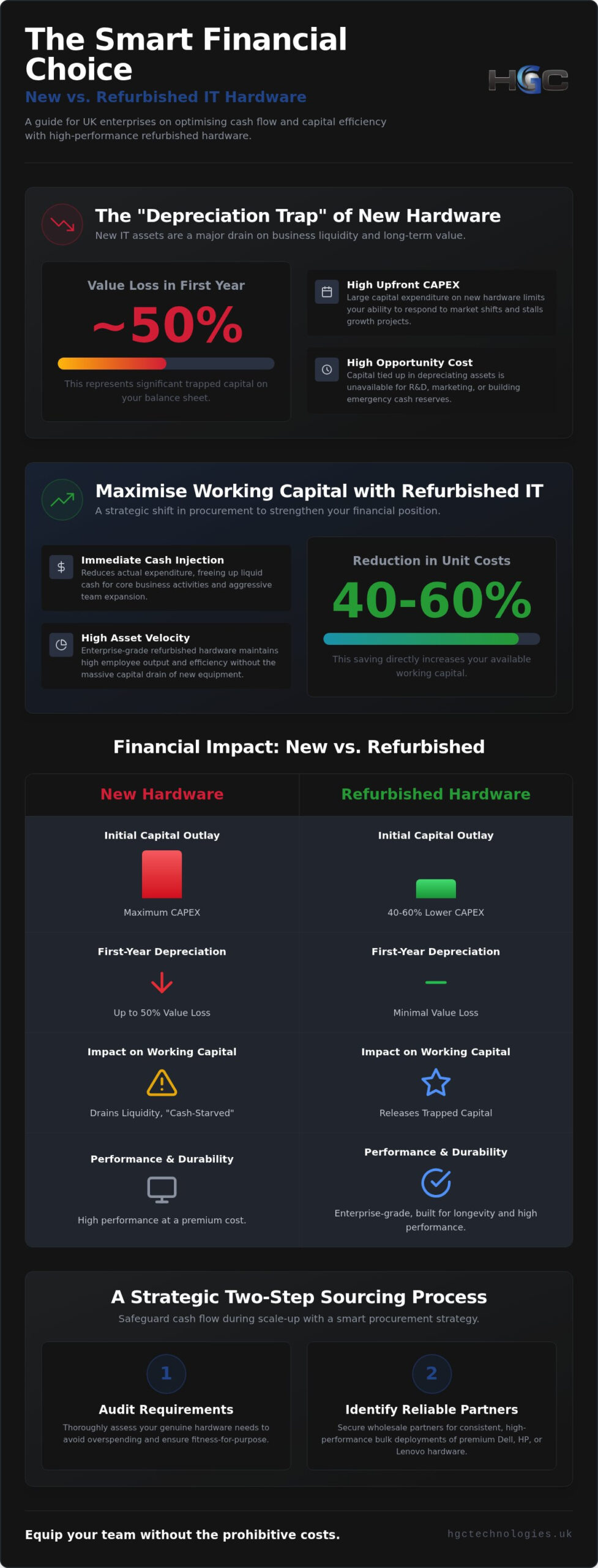
- Avoid the “Depreciation Trap” by understanding how new hardware loses up to 50% of its value in the first year, which protects your long-term balance sheet.
- Discover how refurbished IT impacts business cash flow by reducing unit costs by 40-60%, immediately increasing your available working capital for operational growth.
- Compare the financial efficiency of direct-purchase assets against traditional procurement models to identify the most advantageous tax implications for your enterprise.
- Learn a strategic two-step process for auditing your hardware requirements and identifying reliable wholesale partners for consistent, high-performance bulk deployments.
- Maximise your scaling potential by equipping your team with premium Dell, Lenovo, or HP hardware without the prohibitive costs associated with brand-new equipment.
The Hidden Cost of New IT Hardware on Business Cash Flow
Purchasing brand-new enterprise laptops often feels like a safe bet. However, the financial reality is far less comforting. Most new professional devices suffer from a “Depreciation Trap” where they lose up to 50% of their initial value within the first twelve months. This rapid decline represents a significant amount of trapped capital that could have been utilised elsewhere. When you commit to high Capital Expenditure (CAPEX) for new hardware, you limit your organisation’s ability to respond to sudden market shifts. Large upfront outlays frequently lead to “cash-starved” growth phases. This is a state where a company has the talent and the orders to scale but lacks the liquid cash to execute because that wealth is sitting in depreciating silicon.
Forward-thinking UK enterprises are now viewing Refurbished electronics as a strategic financial alternative rather than just a cost-saving measure. By opting for second-user IT, you drastically reduce the initial capital hit. This fundamental shift in procurement directly influences how refurbished IT impacts business cash flow, allowing for a more agile financial posture.
Understanding the CAPEX vs. Liquidity Balance
Heavy IT investment can quickly skew a company’s debt-to-equity ratio. When you tie up liquid cash in assets that lose value the moment they leave the box, you incur a high opportunity cost. That capital isn’t available for marketing, R&D, or emergency reserves. In 2026, procurement teams are prioritising financial flexibility over the prestige of “brand new” labels. They recognise that liquidity is the lifeblood of resilience. Reducing the initial cash outflow for hardware ensures that your balance sheet remains lean and ready for investment in core business activities.
The Reality of Enterprise Hardware Lifecycles
There is a vast difference between consumer-grade equipment and enterprise-grade hardware from manufacturers like Dell and HP. Corporate machines are built for longevity and intense daily use. Because of this superior build quality, a three-year-old corporate laptop often outperforms a brand-new budget consumer model in both speed and reliability. This durability is why how refurbished IT impacts business cash flow is so positive; you’re getting high-performance tools without the premium price tag. Asset Velocity is the measured speed at which an organisation transforms its capital investment in hardware into tangible revenue through employee output and operational efficiency. High-performance refurbished gear maintains this velocity without the massive upfront capital drain.
How Refurbished IT Procurement Maximises Working Capital
Liquidity defines the operational ceiling of any enterprise. When procurement leaders understand how refurbished IT impacts business cash flow, they unlock a 40-60% reduction in unit costs compared to brand-new hardware. This isn’t merely a saving; it’s an immediate injection into your “Cash at Hand” metric. Unlike debt-based strategies that rely on credit facilities to manage supplier payments, direct procurement of refurbished assets reduces your actual expenditure. This allows for aggressive team expansion without the need to extend bank lines or increase interest-bearing liabilities. Maintaining healthy supplier payment ratios becomes significantly simpler when your core infrastructure costs are halved from the outset.
Releasing Trapped Capital for Growth
Consider a scenario where a UK firm equips a 50-person department. Choosing high-performance refurbished Dell units over new models can save tens of thousands of pounds in a single transaction. This released capital represents more than just a lower invoice; it’s a dedicated budget for a new senior hire, a critical R&D project, or a quarterly marketing campaign. Investors and stakeholders value this level of capital efficiency. It demonstrates a commitment to the circular economy whilst proving that the management team prioritises high ROI over superficial brand-new labels. A stronger balance sheet, unburdened by unnecessary asset costs, builds long-term confidence amongst shareholders and lenders alike.
Avoiding the Interest Trap of Financing
Direct purchase of refurbished gear consistently outperforms the total cost of ownership (TCO) of financed new equipment. Whilst financing might seem to preserve cash in the short term, the long-term interest and contractual liabilities often erode the perceived benefits. Owning your assets outright from day one eliminates monthly overheads and keeps your balance sheet clean. HGC Technologies facilitates this by providing reliable, high-volume wholesale refurbished laptops that meet enterprise standards without the interest trap. This model ensures you have the hardware required for scale without the long-term debt burden often associated with new technology rollouts. By removing monthly liabilities, you gain the financial agility to pivot your strategy as market conditions evolve.
Comparing CAPEX vs. OPEX: The Financial Case for Second-User Hardware
Choosing between brand-new procurement, leasing, and refurbished acquisition requires a deep dive into how each model affects your liquidity. New purchases demand significant Capital Expenditure (CAPEX), locking away funds that could otherwise drive innovation. Leasing models are often categorised as Operational Expenditure (OPEX), yet they frequently carry hidden interest rates and restrictive contracts that inflate the total cost of ownership. Direct procurement of refurbished hardware offers a middle ground; it provides the tax advantages of asset ownership with a much lower initial capital requirement. This approach represents a strategic business opportunity for firms looking to optimise their balance sheets without sacrificing quality.
In the UK, the tax implications of IT asset depreciation allow businesses to claim capital allowances on their hardware. When you purchase refurbished equipment, you’re claiming these allowances against a lower purchase price, which often results in a faster path to a positive Return on Investment (ROI). Grade A refurbished units are particularly effective here. They offer the aesthetic and functional performance of new machines but at a fraction of the cost, ensuring your staff remain productive whilst your cash remains liquid. Understanding how refurbished IT impacts business cash flow means recognising that the “residual value” of these assets stays higher relative to their purchase price compared to new gear.
The Depreciation Curve of Enterprise IT
Consider the value of a high-end Dell Latitude over 48 months. A brand-new unit loses nearly half its value the moment it’s deployed. By the fourth year, its market value is negligible. Buying “post-peak depreciation” is the smartest move a CFO can make. You’re essentially letting the first owner pay for the steepest part of the value drop. Refurbished enterprise laptops typically retain roughly 65% to 70% of their second-hand purchase price over a twenty-four-month period, whilst brand-new units frequently retain less than 25% of their initial retail cost after forty-eight months. This stability makes your IT estate a more predictable financial asset.
Standardisation and Maintenance Costs
Operational cash flow is often drained by “hidden” support costs. Sourcing bulk batches of the same model, such as the Dell 7420, allows your internal IT team to maintain a single software image and a uniform set of spare parts. This standardisation drastically reduces support overheads and increases team efficiency. When your IT staff don’t have to troubleshoot twenty different hardware configurations, they can focus on projects that generate revenue. Lower maintenance costs translate directly into a more positive operational cash flow, as you aren’t constantly bleeding funds into reactive repairs or complex driver management across a fragmented fleet.
Strategic Sourcing: Safeguarding Cash Flow During Scale-Up
Scaling an enterprise requires more than just increased sales; it demands a meticulous approach to capital preservation. Controlling the “outgoings” side of the cash flow equation is often overlooked, yet it’s where significant liquidity can be reclaimed. Understanding how refurbished IT impacts business cash flow during a scale-up involves moving away from reactive purchasing toward a structured, five-step sourcing strategy.
First, audit your hardware requirements. Distinguish between “mission-critical” roles, such as high-end developers, and “standard” administrative positions. You don’t need brand-new workstations for every desk. Second, identify wholesale partners capable of providing consistent bulk batches. This ensures uniformity across your fleet. Third, evaluate grading. Use “Grade A” units for client-facing staff to maintain a premium corporate image, whilst utilising “Grade B” for back-office roles where cosmetic perfection is less critical. Fourth, implement a rolling refresh cycle. Replacing 20% of your fleet annually prevents the massive, one-off cash outlays that often cripple growth-phase budgets. Finally, integrate refurbished servers to scale your backend infrastructure without resorting to high-interest debt.
Selecting a Wholesale Partner in the UK
Choosing the right Wholesale Laptop Distributor UK is a pivotal decision for long-term stability. Look for partners with significant inventory depth and rigorous testing protocols to ensure every unit meets enterprise standards. Reliability is paramount. UK-based support and national delivery capabilities are essential for maintaining project timelines. When you work with a specialist who understands the nuances of the domestic market, you reduce the risk of procurement delays that can stall your operational momentum. This stability allows you to forecast your IT spend with greater accuracy.
Scaling Infrastructure: Servers and Workstations
Your backend must keep pace with your headcount. Utilising enterprise server hardware UK allows you to scale your data capabilities without the infrastructure bottlenecks typical of budget-constrained setups. For specialised roles, bespoke PC builds offer the exact performance required without the bloatware or unnecessary features of off-the-shelf units. Managing the “hidden” costs of software licensing is also simpler when you standardise on refurbished enterprise gear, as these machines often come with digital licences tied to the hardware. This holistic view of how refurbished IT impacts business cash flow ensures that your scale-up remains financially sustainable.
Ready to optimise your procurement? Explore our range of bulk refurbished enterprise hardware to secure your growth.
Optimising Your Procurement Strategy with HGC Technologies
HGC Technologies stands as the UK’s premier source for high-performance refurbished hardware, specialising in the bulk supply of Dell, Lenovo, and HP systems. We provide a direct sales model that prioritises capital efficiency, offering a superior alternative to interest-bearing agreements. For businesses with healthy cash reserves, this model delivers a significant advantage by securing a high ROI without the long-term debt or hidden financing costs that often erode corporate profitability. Our extensive range, which includes bulk Dell refurbished laptops and original smartphones, undergoes rigorous testing protocols to ensure Grade A quality. This commitment to excellence protects your business reputation whilst delivering the uncompromising performance your team requires to remain productive.
High-Volume Availability for UK Resellers and Corporates
Large-scale deployments require a partner with substantial inventory depth and logistical precision. Sourcing bulk Lenovo refurbished laptops from HGC ensures that your project timelines are met without the supply chain delays that frequently plague the new-hardware market. We maintain comprehensive national coverage, facilitating rapid deployment for UK enterprises and resellers alike. Integrating original smartphones wholesale UK into your wider procurement strategy further streamlines your mobile workforce costs. By consolidating your hardware requirements with a single wholesale specialist, you gain better control over your asset lifecycle and procurement rhythm, ensuring that your technology estate remains modern and efficient.
Custom Solutions for Enterprise Needs
Whilst standardisation is vital for operational efficiency, certain specialised roles demand unique configurations. We tailor server and custom PC builds to meet your specific budgetary and technical constraints, ensuring you don’t pay for unnecessary features. This bespoke approach further optimises how refurbished IT impacts business cash flow by aligning your expenditure exactly with your technical requirements. Our team possesses a deep understanding of the unique UK procurement landscape, from capital allowance implications to logistical standards. This expertise transforms hardware acquisition from a simple technical necessity into a powerful strategic financial advantage. Consult with HGC Technologies today to audit your hardware cash flow impact and discover how our direct sales model can strengthen your balance sheet for 2026 and beyond.
Future-Proofing Your Enterprise Financial Strategy
Transitioning to a circular IT model is a sophisticated move that prioritises long-term liquidity over the high-depreciation trap of brand-new hardware. By understanding how refurbished IT impacts business cash flow, your leadership team can reclaim vital capital that’s often trapped in rapidly devaluing assets. This strategic shift allows for aggressive scaling whilst protecting your working capital. It ensures your staff remain equipped with high-performance Dell, HP, or Lenovo systems. You’ve seen that the choice between hardware tiers isn’t just about the initial price tag; it’s about the overall health of your balance sheet.
Securing high-quality, Grade A hardware doesn’t mean compromising on performance. As a specialist wholesaler, HGC Technologies provides the robust infrastructure needed for this transition. Our direct sales model is designed to deliver maximum ROI without the burden of interest-bearing liabilities. With national UK delivery on all bulk orders, we ensure your project timelines remain on track. Maximise your business cash flow with Grade A refurbished IT from HGC Technologies and position your organisation for capital-efficient growth.
Frequently Asked Questions
How much can a business typically save by switching to refurbished IT?
Businesses typically save between 30% and 50% when switching to refurbished hardware. In some cases involving high-spec DDR5 memory, savings can reach as high as 70% compared to brand-new retail prices in 2026. These figures demonstrate exactly how refurbished IT impacts business cash flow by immediately reducing the capital required for procurement. This allows you to divert funds towards revenue-generating activities instead of losing them to the initial retail premium.
Does refurbished hardware have a higher failure rate than new equipment?
Certified refurbished enterprise hardware doesn’t have a higher failure rate than new equipment. Unlike new units that are often batch-tested, every piece of refurbished gear from a reputable wholesaler undergoes individual manual testing and diagnostics. Because enterprise models like the Dell Latitude or HP EliteBook are built for durability, they often outlast new consumer-grade laptops. This reliability ensures that your operational uptime remains high whilst your maintenance costs stay low.
Can I buy refurbished laptops in bulk for my entire UK workforce?
You can certainly procure refurbished laptops in bulk for an entire national workforce. HGC Technologies specialises in high-volume supply, providing consistent batches of the same model to ensure fleet standardisation. This approach simplifies your IT support and internal imaging processes. Whether you need 50 or 500 units, sourcing bulk Dell or Lenovo laptops ensures that every employee has access to premium performance without the prohibitive cost of a brand-new fleet.
What are the tax benefits of buying second-user IT equipment for a UK company?
UK companies can claim capital allowances on second-user IT equipment just as they would on new hardware. Purchasing these assets allows you to offset the cost against your taxable profits, which provides a clear fiscal advantage. Because the initial purchase price is significantly lower, the path to a positive return on investment is much shorter. It’s a capital-efficient way to manage your technology lifecycle whilst making full use of available tax incentives for business investment.
How does refurbished IT impact a business’s ESG (Environmental, Social, and Governance) rating?
Opting for refurbished hardware significantly improves your ESG rating by reducing your carbon footprint by an estimated 60% to 80% compared to buying new. Manufacturing a single new laptop generates roughly 350 kg of CO2e, whilst a refurbished equivalent is responsible for only about 70 kg. This choice demonstrates a commitment to the circular economy and helps your business comply with the EU Corporate Sustainability Reporting Directive and other emerging environmental regulations.
Is it possible to get custom-built PCs from a refurbished IT wholesaler?
Yes, it’s possible to obtain custom-built PCs that meet specific technical requirements. HGC Technologies provides bespoke server and PC configurations tailored to your organisation’s unique needs. This flexibility means you aren’t forced into “one size fits all” solutions that might include unnecessary, expensive components. By only paying for the performance you actually need, you further optimise your expenditure and ensure your hardware supports your specific operational goals effectively.
What is the difference between Grade A and Grade B refurbished laptops for business use?
Grade A refurbished laptops are in near-perfect cosmetic condition and are ideal for client-facing staff or senior management. Grade B units may show minor cosmetic marks or light signs of previous use but are functionally identical to Grade A machines. Many organisations use Grade B hardware for back-office roles or internal server rooms where aesthetic perfection isn’t a priority. Both grades provide the same enterprise-level reliability whilst offering different price points to suit your budget.
Why should I choose a direct purchase model over a lease-to-own IT contract?
Choosing a direct purchase model over a lease-to-own contract avoids long-term debt and interest-bearing liabilities. Whilst leasing might seem to preserve cash, the total cost of ownership is almost always higher due to interest and contractual fees. Direct ownership from day one means you have full control over the asset. This is a critical factor in how refurbished IT impacts business cash flow, as it keeps your balance sheet clean and removes monthly financial burdens.

Managing IT Hardware Refresh Cycles: The 2026 UK Strategic Guide
With RAM prices rising fourfold and SSD costs climbing from £40 to over £150 in early 2026, the tr

Post-Purchase Support for Wholesale Laptops: A 2026 Strategic Guide for UK Resellers
In the competitive UK IT hardware market, a low unit price is often a Trojan horse for hidden operat

Refurbished Laptop Supplier with Fast UK Delivery: The 2026 Procurement Guide
Retaining Windows 10 hardware in 2026 now costs businesses $61 per device in mandatory security upda