

Refurbished Laptop Warranty Standards UK: The 2026 Strategic Reference
What if the security of your entire corporate IT infrastructure rested on a warranty document that lacks the technical rigour required by 2026 benchmarks? For many procurement professionals, the transition to circular technology is often stalled by a legitimate fear of inconsistent grading or the risk of high failure rates in bulk hardware batches. You’ve likely found that the line between statutory consumer protections and complex commercial contracts is increasingly blurred, leaving your organisation vulnerable to unexpected downtime whilst navigating conflicting supplier claims.
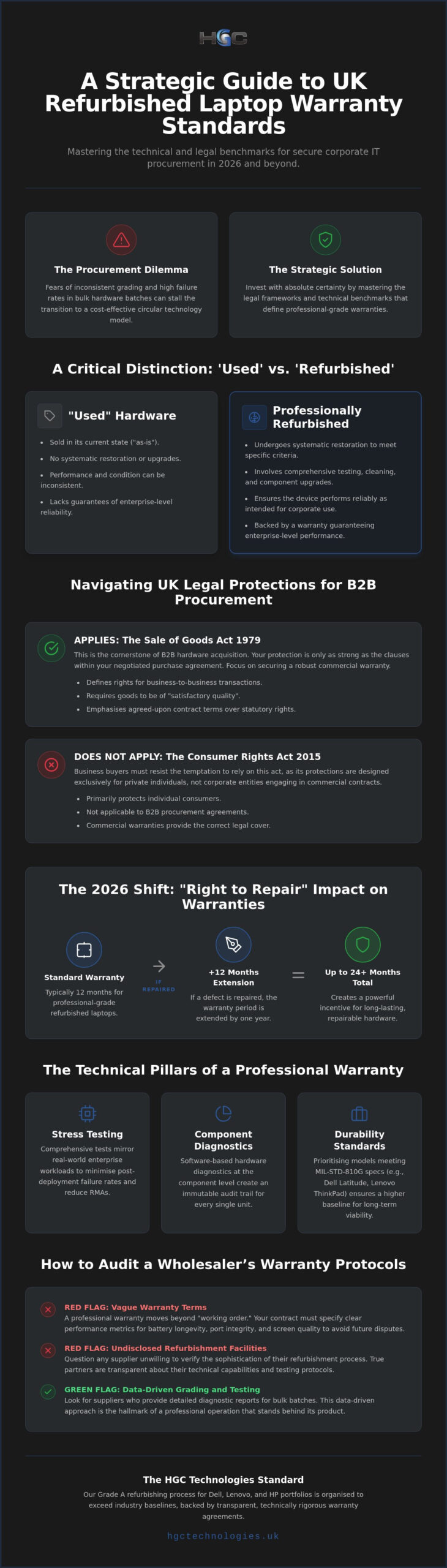
This strategic reference empowers you to master the technical and legal benchmarks that define professional refurbished laptop warranty standards UK to secure your corporate IT procurement. By understanding these frameworks, you can move beyond simple price comparisons and invest with absolute certainty in your hardware lifecycle. We’ll explore the critical impact of the 2026 Right to Repair directive, clarify the legal protections surrounding B2B tech purchases, and establish a clear framework for evaluating supplier warranties when sourcing Dell, HP, and Lenovo assets at scale.
Key Takeaways
- Understand how the 2026 Right to Repair directive and the Sale of Goods Act impact your B2B procurement strategies, ensuring you don’t compromise on essential commercial legal protections.
- Identify the technical testing cycles and durability benchmarks that minimise failure rates in bulk hardware deployments.
- Master the complexities of refurbished laptop warranty standards UK to distinguish between basic consumer rights and the robust commercial agreements required for corporate scale.
- Learn to audit wholesaler protocols by spotting critical red flags in warranty terms and verifying the sophistication of their specialised refurbishment facilities.
- Discover how HGC Technologies organises its Grade A refurbishing process to exceed industry baselines across Dell, Lenovo, and HP portfolios.
Understanding the Legal Landscape: UK Warranty Standards for Refurbished IT
Professionalism in the secondary hardware market begins with a rigorous legal definition. Whilst a “used” device is simply sold in its current state, a refurbished unit undergoes a systematic process of restoration to meet specific functional criteria. This distinction is critical for corporate buyers because Refurbishment (electronics) involves testing, cleaning, and often upgrading components to ensure the device performs as intended. In the context of refurbished laptop warranty standards UK, the baseline is no longer just “working order” but a guarantee of enterprise-level reliability that justifies its place in a corporate fleet.
For B2B procurement, the Sale of Goods Act 1979 remains the cornerstone of hardware acquisition. Unlike individual consumers, business entities operate under contract law where terms are negotiated and agreed upon at the point of sale. This means your protection is only as strong as the clauses within your purchase agreement. It’s essential to recognise that whilst the law requires goods to be of satisfactory quality, the specific interpretation of “satisfactory” for a three-year-old Dell Latitude or Lenovo ThinkPad differs significantly from a brand-new machine. Professional refurbishers bridge this gap by providing voluntary warranty extensions that align with corporate refresh cycles.
The Consumer Rights Act vs. Commercial Contracts
Business buyers must resist the temptation to rely on the Consumer Rights Act 2015, as its protections are primarily designed for private individuals. When engaging with a wholesale laptop distributor UK, your focus should shift to the specific commercial warranties provided in the service level agreement. Enterprise-grade hardware from Dell and Lenovo is defined as “Fit for Purpose” when it can maintain the rigorous demands of a modern office environment, including battery longevity and port integrity. Ensure your contract specifies these performance metrics clearly to avoid disputes over hardware degradation during the deployment phase.
Statutory Minimums for Refurbished Electronics
The 2026 regulatory shift has introduced new complexities for the wholesale market. Under the latest Right to Repair rules effective as of July 2026, if a defective product is repaired rather than replaced, the warranty period is extended by 12 months. This effectively pushes the standard two-year coverage to three years in specific repair scenarios for many electronic goods. Additionally, new UK e-waste regulations now mandate that large retailers and distributors provide clear pathways for repair and recycling, reinforcing the expectation that refurbished tech must be built to last. The standard warranty period for professional-grade refurbished laptops in the UK during 2026 is typically twelve months, though this is frequently extended by an additional year if a repair is undertaken during the initial coverage period under new Right to Repair mandates.
The Technical Pillars of a Professional Warranty Standard
A warranty is only as robust as the technical rigour that precedes its issuance. Whilst legal frameworks provide a safety net, the actual security of your corporate IT estate depends on the data-driven testing protocols performed at the component level. In the 2026 market, refurbished laptop warranty standards UK have evolved beyond simple functional checks to include comprehensive stress testing that mirrors real-world enterprise workloads. By ensuring a device can handle peak processing demands before it leaves the facility, refurbishers significantly reduce the likelihood of RMAs and protect the thin margins essential for reseller success.
Durability standards play a vital role in this technical foundation. Laptops designed to meet MIL-STD-810G specifications, such as the Dell Latitude or Lenovo ThinkPad series, offer a higher baseline for long-term warranty viability. These machines were built to withstand environmental stressors, meaning their internal chassis and hinges are less likely to suffer mechanical failure during a secondary lifecycle. When these hardware strengths are combined with software-based hardware diagnostics, the result is an immutable audit trail that validates the warranty. If you’re looking to upgrade your fleet with verified hardware, you can explore our professional-grade inventory to see these technical standards in practice.
Grading Standards: Grade A vs. Grade B Warranty Implications
Cosmetic grading is often misinterpreted as purely aesthetic, but it has profound functional implications. Wholesalers of wholesale refurbished computers UK often prioritise Grade A stock for corporate clients because the lack of external wear usually suggests a device has been used in a controlled office environment rather than a high-impact setting. In contrast, Grade C warranties typically exclude cosmetic wear and tear, and may even omit coverage for minor screen blemishes or battery degradation. Understanding these distinctions is essential under the Consumer Rights Act 2015, which requires goods to be “as described” at the point of sale.
Testing Protocols: Beyond the Power-On Self-Test (POST)
Reliability in 2026 requires moving far beyond the basic Power-On Self-Test (POST). Professional refurbishing facilities now implement full-load stress testing for CPUs and RAM to identify thermal throttling or stability issues that only appear under pressure. Battery health is another critical metric; industry-accepted standards now mandate a minimum of 80% original capacity for business-grade deployments. Finally, any valid warranty must be supported by verified data-sanitisation protocols, such as ADISA standards, to ensure that the hardware is not only functional but also compliant with modern data security regulations.
Commercial vs. Consumer Rights: Navigating B2B Warranty Agreements
High-volume IT procurement requires a departure from standard retail thinking. Whilst individual buyers often rely on statutory consumer rights on warranties and guarantees, corporate entities must operate within the framework of negotiated B2B contracts. In the wholesale sector, the “Return to Base” (RTB) model is the prevailing standard. This requires the buyer to ship faulty units back to the refurbisher for repair or replacement, a process that demands a highly organised logistics strategy when managing hundreds of assets across multiple sites.
Establishing refurbished laptop warranty standards UK at scale involves defining acceptable failure rates. For bulk batches of Dell or HP hardware, an RMA (Return Merchandise Authorisation) percentage of 3% to 5% is generally considered the industry ceiling for professional-grade stock. If failure rates exceed this, it often points to a systemic breakdown in the supplier’s initial testing protocols. To manage this effectively, professional warranty management relies heavily on serial-number tracking. This ensures every unit in a bulk shipment is accounted for, allowing for precise tracking of repair histories and preventing disputes over dead-on-arrival (DOA) stock.
Service Level Agreements (SLAs) for Corporate Procurement
Modern enterprise procurement has moved beyond simple “fix or replace” promises toward structured Service Level Agreements. These SLAs define specific Turnaround Time (TAT) expectations, which in 2026 are increasingly set at three to five working days for critical business hardware. For organisations sourcing bulk Dell refurbished laptops, HGC’s direct sales model organises support to ensure minimal disruption. This structured approach is particularly vital for enterprise server hardware, where uptime is a non-negotiable requirement for business continuity.
Reseller Protections and Batch Warranties
Resellers often face the unique challenge of managing warranties for their own end-customers. One effective strategy is negotiating “Buffer Stock” as a warranty alternative. Instead of waiting for a repair cycle, the wholesaler provides an additional 2% to 3% of units upfront to cover immediate replacements. It’s also vital to clarify if warranties are transferable; some wholesalers allow end-customers to claim directly, whilst others restrict claims to the original purchaser. Finally, always scrutinise liability limits in wholesale contracts to ensure they reflect the true cost of potential hardware failures across a large deployment.
How to Audit a Wholesaler’s Warranty and Testing Protocols
Precise auditing is the only method to ensure a supplier’s written guarantees carry technical weight. In the current market, certain phrases act as immediate red flags for any B2B buyer. Terms such as “Sold as Seen” or “No Returns” have no place in professional business technology procurement. These clauses often signal that a wholesaler is bypassing the refurbished laptop warranty standards UK that high-level corporate organisations require for fleet stability. A transparent Return Merchandise Authorisation (RMA) process must be clearly documented, allowing you to track an asset’s journey from the moment a fault is reported until a replacement or repair is finalised.
Consistency is guaranteed through international certifications. Adherence to ISO 9001 ensures that a refurbisher has implemented a rigorous quality management system, whilst ISO 14001 validates their commitment to environmental responsibility and sustainable hardware lifecycles. These standards provide a framework for repeatable results, ensuring that the fiftieth unit in a batch meets the exact same criteria as the first. If you require a partner that adheres to these stringent protocols, you can view our certified procurement options to secure your next hardware deployment.
The Wholesaler Audit Checklist
When vetting a potential partner, demand evidence of their internal processes. You should verify that all ex-corporate machines come with data-wiping certificates from recognised bodies like ADISA. This protects your organisation from the legal and reputational risks of data breaches. Additionally, review the technical qualifications of the build team, especially when sourcing complex server solutions or custom configurations. Finally, assess the supplier’s financial stability; a three-year warranty is worthless if the company lacks the longevity to back it up when claims eventually arise.
Enterprise Server and Custom PC Specifics
Procuring enterprise server hardware UK involves a different set of risks compared to mobile workstations. Whilst a laptop might fail due to physical impact, server-grade hardware is subjected to constant thermal stress and high-intensity workloads. Server-grade refurbishing requires distinct standards from consumer laptops because the hardware must maintain 24/7 operational uptime under extreme thermal loads rather than surviving occasional mobile use. For custom PC builds, ensure the wholesaler balances individual component manufacturer warranties with a comprehensive system-builder’s guarantee to avoid gaps in coverage.
Strategic Procurement: Implementing High Warranty Standards with HGC Technologies
HGC Technologies UK Ltd. acts as a knowledgeable guide for businesses navigating the complexities of secondary hardware markets. We don’t just follow refurbished laptop warranty standards UK; we actively shape them by implementing rigorous internal protocols that exceed statutory requirements. Our commitment to Grade A quality across Dell, Lenovo, and HP portfolios ensures that every unit delivered to our partners meets a premium functional baseline. By maintaining a direct sales model, we eliminate the ambiguity often found in third-party distributions, providing our clients with a single point of accountability and significantly faster RMA processing times.
This structured approach is particularly beneficial for corporate procurement teams and technology resellers who require high-volume stability. We understand that downtime represents a significant financial risk, which is why our tailored warranty solutions are designed to mirror the reliability of brand-new equipment. Whether you’re sourcing a single server solution or a fleet of five hundred workstations, our framework provides the technical and legal security necessary for long-term IT investment. We prioritise transparency in every contract, ensuring that your organisation is never left vulnerable to inconsistent grading or vague return policies.
Our Professional Refurbishing Lifecycle
Every asset in our inventory begins its journey with ex-corporate acquisition, ensuring a high-calibre pedigree from the outset. We subject each machine to rigorous multi-point hardware diagnostics that test everything from thermal efficiency to port integrity. For clients requiring specialised server configurations or custom-built business PCs, our build team applies the same methodical precision to ensure every component integrates seamlessly. This dedication to excellence extends to our original smartphone supply, where verified authentication protocols guarantee that every device is genuine, original, and fully functional for the end-user.
Partnering for Long-Term IT Stability
Supporting the UK market requires more than just hardware; it demands a commitment to reliable hardware lifecycles. HGC has become the favourite choice for businesses seeking high-performance, cost-effective infrastructure because we bridge the gap between affordability and enterprise-grade resilience. We provide the bulk quantities necessary for large-scale rollouts whilst maintaining the localised expertise required for bespoke technical support. Our role is to simplify your wholesale processes, acting as a visionary partner that values sustainability and long-term value. Contact us today to discuss your bulk procurement requirements and warranty needs, and let us help you build a more sustainable, secure IT estate.
Future-Proof Your IT Procurement Strategy
Mastering the nuances of refurbished laptop warranty standards UK is no longer an optional skill for procurement teams; it’s a strategic necessity for 2026. You’ve seen that true reliability is forged through rigorous technical auditing and ISO-aligned processes rather than just statutory minimums. By prioritising Grade A hardware and structured commercial SLAs, your organisation can effectively mitigate the risks of bulk deployment whilst contributing to a more sustainable circular economy.
At HGC Technologies, we act as your knowledgeable guide in this evolving landscape. We provide direct wholesale supply of Grade A Dell, HP, and Lenovo assets, backed by specialist enterprise server and custom PC expertise. Our methodical approach ensures that every unit in your fleet is an asset rather than a liability. Secure your business infrastructure with our professionally refurbished laptops and lead your organisation toward a more resilient digital future. We’re ready to help you achieve unmatched standards in your next hardware refresh.
Frequently Asked Questions
What is the difference between a manufacturer warranty and a refurbished warranty?
A manufacturer warranty is a guarantee from the original equipment manufacturer, whereas a refurbished warranty is issued by the specialist refurbisher who processed the device. Whilst the former is standard for new hardware, the latter is a bespoke commercial agreement that covers the specific restoration work performed. It’s essential to verify that your supplier has the technical infrastructure and financial stability to honour these claims directly over the long term.
Are refurbished laptop batteries covered under standard UK warranties?
Batteries are typically covered, but they often fall under a specific sub-clause due to their nature as consumable components. Professional refurbished laptop warranty standards UK usually guarantee a minimum health threshold, such as 80% original capacity, for a set period. You should clarify whether this coverage lasts for the full warranty duration or is limited to a shorter window, such as ninety days, to avoid unexpected replacement costs.
How long should a professional refurbished laptop warranty last in 2026?
In 2026, a professional refurbished warranty typically lasts for 12 months as a standard baseline. However, under the Right to Repair directive effective from July 2026, certain repairs can extend statutory coverage by an additional year in specific scenarios. For B2B procurement, most suppliers align their refurbished laptop warranty standards UK with corporate refresh cycles, frequently offering optional extensions that provide up to three years of total protection.
What does “Return to Base” (RTB) warranty actually mean for a business?
A “Return to Base” (RTB) warranty means the buyer is responsible for shipping the faulty hardware back to the supplier’s facility for repair. Unlike on-site support, which involves a technician visiting your office, RTB requires you to manage the logistics of transit. This is the most common model in the refurbished sector because it allows technicians to access specialised diagnostic equipment in a controlled, high-standard environment.
Can I extend the warranty on a bulk purchase of refurbished Dell or HP laptops?
Yes, extending coverage on bulk purchases of Dell or HP hardware is a standard practice amongst professional wholesalers. Many organisations choose to upgrade from a standard twelve-month agreement to a multi-year contract to match their internal lifecycle policies. You should discuss these requirements during the initial procurement phase to ensure the additional protection is reflected in your commercial service level agreement and batch tracking.
What are the most common exclusions in a refurbished IT warranty contract?
Common exclusions usually include accidental damage, liquid ingress, and issues caused by third-party software or unauthorised hardware modifications. Most contracts also exclude “fair wear and tear” and cosmetic degradation that doesn’t impact the device’s functionality. It’s vital to read the fine print regarding battery health, as some suppliers treat batteries as consumables that aren’t covered for the full duration of the main hardware term.
How do I claim a warranty repair if I bought my laptops through a wholesaler?
To claim a warranty repair, you must contact your wholesaler’s support team with the specific serial number of the affected unit. Professional suppliers use these numbers to track the unit’s entire history, from its initial acquisition to the diagnostics performed during refurbishment. Once the claim is authorised, you’ll receive instructions for returning the device to their technical centre for a thorough assessment and resolution by qualified engineers.
Is a 30-day return policy standard for B2B refurbished hardware in the UK?
No, a 30-day “right to reject” is a statutory consumer protection under the Consumer Rights Act 2015 and doesn’t automatically apply to B2B transactions. Business purchases are governed by the specific terms of your commercial contract. Whilst many wholesalers offer a short window for dead-on-arrival (DOA) stock, you shouldn’t assume that retail-style return policies apply to bulk hardware batches without explicit contractual agreement.
How to Choose Refurbished Laptops for Resale: The 2026 Professional Guide
Profitable hardware resale is built on the consistency of ex-corporate stock rather than the unpredi

Total Cost of Ownership: Refurbished vs New Laptops for UK Business in 2026
The most expensive way to equip your team in 2026 isn't just the price on the invoice; it's ignoring

Supplier Checklist for Refurbished IT: 2026 Guide
A refurbished IT supplier is best assessed through evidence about the batch, not a grade label. If r
Comments are closed.