

Tax Implications of Buying Refurbished IT in the UK: A 2026 Strategic Guide
Your next fleet of enterprise-grade laptops could effectively pay for itself through a combination of 50% lower upfront costs and immediate 100% tax relief. It’s a common misconception that HMRC treats pre-owned hardware differently, but the reality is that professionally refurbished assets are often the most strategic way to leverage your capital budget. Understanding the tax implications of buying refurbished IT UK is essential for any business looking to scale its infrastructure without draining its cash reserves.
You’re likely facing the constant pressure of balancing a tight IT budget with the need for high-spec Dell, Lenovo, or HP machines that can handle modern workloads. This guide will show you how to maximise your corporate tax efficiency whilst securing premium hardware that meets your technical requirements. We’ll explore the 2026 Annual Investment Allowance (AIA) limits, the impact of the 14% Writing Down Allowance, and the critical documentation you need to ensure your audit trail is bulletproof. By the end of this article, you’ll have a clear roadmap for tax-efficient procurement that supports both your bottom line and your digital transformation goals.
Key Takeaways
- Learn how to apply the £1 million Annual Investment Allowance (AIA) to achieve 100% tax relief on qualifying refurbished hardware in the year of purchase.
- Understand the strategic tax implications of buying refurbished IT UK, including how 2026 Corporation Tax rates and the 14% Writing Down Allowance impact your long-term ROI.
- Navigate the July 2026 VAT reforms that simplify accounting by removing computer equipment from the Capital Goods Scheme for UK businesses.
- Identify the essential documentation required for a compliant HMRC audit trail, including specific invoice details for bulk Dell, Lenovo, and HP assets.
- Discover how to scale your IT infrastructure with enterprise-grade hardware whilst maintaining a significantly lower total cost of ownership than buying new.
Understanding Capital Allowances and Refurbished IT Assets
Capital allowances represent a crucial mechanism for UK businesses to recover the cost of capital expenditure by deducting it from taxable profits. For enterprises scaling their digital infrastructure in 2026, understanding how these rules apply to non-new equipment is vital. Professionally refurbished hardware is classified as “plant and machinery” under HMRC guidelines, meaning it carries the same weight as brand-new kit when it comes to reducing your Corporation Tax bill. It’s a strategic move that allows you to secure enterprise-grade hardware whilst maintaining fiscal agility.
The strategic advantage of this classification is immense. It ensures that businesses don’t have to sacrifice fiscal efficiency to achieve high-spec performance. Understanding Capital Allowances is the first step toward a more resilient procurement strategy. Because HGC Technologies UK Ltd. operates on a direct sales model without complex financing or leasing, ownership is transferred immediately. This makes the invoice a straightforward, transparent document for your capital allowance claim, removing the ambiguity often associated with third-party lease agreements. Navigating the tax implications of buying refurbished IT UK starts with this clear distinction of ownership.
The Annual Investment Allowance (AIA) Explained
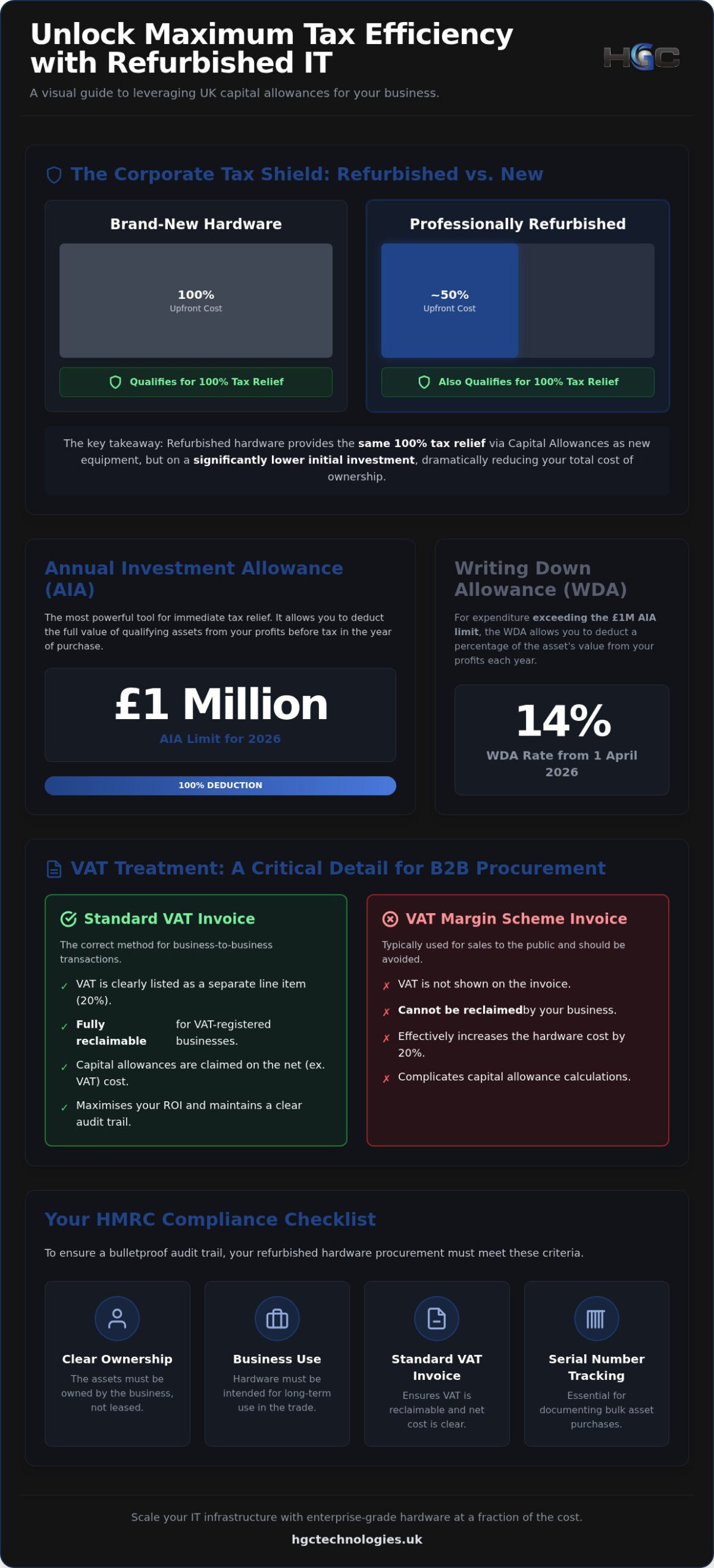
The AIA remains the most powerful tool in your tax planning arsenal. For the 2026 tax year, the AIA limit is set at £1 million, allowing businesses to deduct 100% of the cost of qualifying plant and machinery from their pre-tax profits in the year of purchase. This applies directly to bulk purchases of refurbished Dell or Lenovo laptops, effectively providing an immediate tax shield. If your expenditure exceeds this £1 million threshold, any remaining balance typically moves to the main pool, where the Writing Down Allowance (WDA) was reduced to 14% on 1 April 2026. By prioritising refurbished hardware within your AIA limit, you maximise the velocity of your tax relief and keep more cash within the business.
Qualifying Criteria for Refurbished Technology
To secure these benefits, you must ensure your hardware meets HMRC’s definition of a qualifying asset. There’s a significant distinction between “used” items bought from private sellers and “professionally refurbished” equipment sourced from a VAT-registered wholesaler. The assets must be used solely for business purposes and ownership must be clearly established. When you procure bulk HP or Dell units, ensuring they are documented as business-critical assets is essential for a successful claim.
- The hardware must be owned by the business, not leased or on a hire-purchase agreement.
- It must be functional and intended for long-term use in the trade.
- The purchase must be documented with serial numbers to provide a clear audit trail.
Choosing a reputable partner ensures your fleet qualifies for these incentives whilst delivering the reliability your team requires for daily operations.
VAT Treatment: Margin Scheme vs Standard VAT for B2B
VAT is often the most misunderstood element of technology procurement. When you source hardware from the secondary market, the invoice structure dictates whether you can reclaim 20% of your expenditure. Understanding the tax implications of buying refurbished IT UK requires a sharp focus on how your supplier handles Value Added Tax. Many smaller resellers operate under the VAT Margin Scheme, which is designed for sales to private individuals. Under this scheme, VAT is only calculated on the seller’s profit margin, and critically, it cannot be reclaimed by you, the business buyer. This effectively makes the hardware 20% more expensive for a VAT-registered enterprise.
Corporate procurement teams must insist on Standard VAT invoicing. This ensures the full 20% input tax is visible and reclaimable through your quarterly return. By choosing a wholesaler that operates on a standard accounting basis, you align your IT spend with your wider financial strategy. This transparency is also vital when calculating capital allowances for IT assets, as you’ll be claiming relief on the net cost of the equipment. If you don’t account for these differences, your expected ROI could vanish before the first machine is even deployed.
Standard VAT Invoicing for Corporate Clients
HGC Technologies provides standard VAT invoices for all bulk Dell, Lenovo, and HP orders. This is a deliberate choice to support B2B clients who need to maintain clear, reclaimable tax records. When you purchase 50 refurbished laptops, the ability to reclaim the VAT significantly lowers your net procurement budget. It’s the difference between a sunk cost and a manageable cash flow item. Avoiding Margin Scheme sellers is a priority for any fleet manager who wants to demonstrate fiscal responsibility to their board.
The Impact on Cash Flow
While the upfront cost of a bulk purchase includes VAT, the quarterly reclaim cycle means this capital is only tied up temporarily. You should time your large-scale upgrades toward the end of a VAT quarter to minimise the gap between payment and reclaim. Because we operate a direct sales model without complex financing, your internal accounting team can easily track the movement of funds. It’s a clean process that allows you to secure high-performance refurbished hardware without the hidden costs of inefficient tax structures. Budgeting for these upgrades requires a clear view of both the gross and net figures to ensure your cash reserves remain healthy whilst you scale. This methodical approach ensures your tax implications of buying refurbished IT UK are managed with precision.
Refurbished vs New: The Corporate Tax Shield Comparison
The UK’s fiscal landscape for technology investment has evolved significantly since the end of the 130% super-deduction era. In 2026, corporate decision-makers must weigh the benefits of “Full Expensing” for new equipment against the universal application of the Annual Investment Allowance (AIA) for refurbished assets. While Full Expensing offers 100% relief on new kit, the AIA provides an identical 100% deduction for professionally refurbished hardware. This creates a compelling “tax shield” that often favours the secondary market due to the significantly lower acquisition costs involved. Understanding the tax implications of buying refurbished IT UK reveals that the real winner is the business that maximises its hardware-to-capital ratio.
When you deploy a fleet of Dell Latitude 7420s or Lenovo ThinkPads, you aren’t just saving on the purchase price; you’re optimising your balance sheet. Refurbished assets typically experience slower depreciation relative to their purchase price compared to brand-new units, which lose a massive chunk of value the moment they leave the box. This stability makes your capital allowance claim more impactful over the asset’s lifecycle. It’s a strategic advantage that allows you to scale your infrastructure without the heavy “new gear” premium that often dilutes the value of tax incentives.
Analysing the Cost-to-Tax Relief Ratio
Financial efficiency is best measured by the “workforce power” your tax pounds generate. For a fixed spend of £50,000, a business can typically procure nearly double the volume of enterprise-grade refurbished laptops compared to high-end new models. Whilst a £50,000 spend on new hardware might equip 40 staff members, the same £50,000 invested in refurbished units could equip 80; both scenarios qualify for the same 100% AIA deduction. This means your tax relief is working twice as hard to support your operational capacity. You must verify that the VAT Margin Scheme for refurbished goods is not being used by your supplier, as this would prevent you from reclaiming input VAT and skew your ROI calculations.
ESG and the Circular Economy
Beyond the immediate financial returns, refurbished IT plays a pivotal role in modern ESG (Environmental, Social, and Governance) reporting. Participating in the circular economy is no longer just a “feel-good” initiative; it’s a core component of corporate responsibility that stakeholders and investors increasingly demand. As we move through 2026, businesses that can demonstrate a commitment to reducing e-waste may find themselves better positioned for emerging “Green” tax credits or preferential procurement terms. You can stay ahead of these shifts by monitoring Wholesale Refurbished IT Equipment UK trends. Choosing refurbished hardware allows your business to meet sustainability targets whilst simultaneously lowering the tax implications of buying refurbished IT UK through efficient capital allocation.
Documenting Purchases for HMRC Compliance
Securing tax relief is only half the battle; defending that claim during a routine HMRC check requires a robust and transparent audit trail. When you transition to a circular IT model, the quality of your documentation becomes the primary evidence of your fiscal compliance. HMRC inspectors look for a clear line of sight between the cash outflow and the physical asset in use within your business. Understanding the tax implications of buying refurbished IT UK involves recognising that a simple receipt is rarely enough for high-value capital allowance claims. You need detailed records that prove the equipment is a functional, high-value asset rather than a mere repair expense.
Your fixed asset register must be meticulous. Every bulk Dell or HP unit should be logged with its unique serial number and assigned a specific asset tag. This level of detail is particularly important for refurbished kit, as it distinguishes your enterprise-grade fleet from lower-quality “used” items that might not meet capital expenditure criteria. Proving the value of these assets is simplified when you hold “Grade A” certification documents. This grading confirms the hardware’s condition and longevity, providing a solid justification for categorising the purchase as a long-term capital investment rather than a short-term revenue cost.
The Perfect Audit Trail for Refurbished Assets
Implement a three-step verification process to ensure your procurement survives any level of scrutiny. First, you must obtain a full VAT invoice from a registered UK wholesaler. This document must clearly state the supplier’s VAT number and provide a breakdown of the standard VAT applied. Second, log every serial number immediately upon delivery. This prevents confusion during future audits and ensures each machine is uniquely identifiable. Finally, ensure your accountant categorises the assets correctly under the HMRC plant and machinery codes. Accurate classification is the cornerstone of a successful AIA claim.
Common Pitfalls to Avoid
One of the most frequent errors is sourcing hardware from non-UK or private sellers. These transactions often lack the comprehensive VAT invoicing required for corporate reclaims, leading to complications with the tax implications of buying refurbished IT UK. Another critical mistake is failing to distinguish between “repair” and “refurbishment.” While a repair is a revenue expense deducted from annual profits, a professional refurbishment is a capital investment that qualifies for allowances. You must also ensure that mobile hardware is used strictly for business purposes; mixing personal and corporate use can trigger benefit-in-kind complications that negate your initial tax savings.
To ensure your next fleet upgrade is fully compliant and tax-efficient, partner with a specialist wholesaler that provides the transparent documentation your finance team requires.
Scaling Your IT Infrastructure with HGC Technologies
HGC Technologies acts as the bridge between fiscal strategy and operational reality for UK organisations. Our national wholesale operation ensures that businesses can access high-spec hardware without the logistical hurdles of international shipping or fragmented supply chains. Because we operate a direct sales model, your internal finance team receives a clean, transparent invoice that is ready for immediate capital allowance processing. This clarity is essential when navigating the tax implications of buying refurbished IT UK, as it removes the complexities of third-party interest or deferred payment schemes.
Our commitment to excellence extends beyond the hardware itself. We provide a steady supply of enterprise-grade assets that allow for consistent fleet scaling. Whether you are replacing a handful of machines or refreshing an entire national department, our inventory of Dell, Lenovo, and HP hardware is curated to meet the demands of modern corporate environments. This stability allows you to plan your capital expenditure with confidence, knowing that the assets you procure today will qualify for full tax relief whilst delivering reliable performance for years to come.
Bulk Procurement Strategy
Standardising your fleet with specific models like the Dell Latitude or Lenovo ThinkPad series reduces internal support costs whilst simplifying your fixed asset register. A uniform fleet is easier to track, easier to value, and significantly easier to document for HMRC purposes. Integrating Bulk Dell Refurbished Laptops into your refresh cycle allows for a predictable tax-deduction schedule. Our direct sales model ensures that ownership is transferred at the point of sale, allowing your business to claim the full Annual Investment Allowance immediately without waiting for lease terms to expire.
- Direct ownership for immediate AIA and WDA claims
- Consistent supply of Grade A enterprise models
- Transparent VAT invoicing for standard B2B reclaims
- National reach to support organisations across the United Kingdom
Custom Enterprise Solutions
Higher-value infrastructure projects often require more than just laptops. For businesses looking to maximise their £1 million AIA limit, our custom-built PCs and server solutions represent a significant strategic opportunity. Tailoring your server hardware to specific project requirements ensures you aren’t overpaying for unnecessary features whilst still securing the “plant and machinery” status required for 100% tax relief. Our Enterprise Server Hardware UK roundup provides a detailed look at the specifications currently driving corporate growth and digital transformation.
Navigating the tax implications of buying refurbished IT UK requires a partner that understands both the technical and the fiscal requirements of a modern business. We invite you to contact our team today for a professional consultation to discuss your 2026 procurement goals and discover how our wholesale solutions can support your corporate tax efficiency.
Future-Proofing Your Digital Infrastructure and Tax Strategy
Scaling your enterprise fleet in 2026 requires more than just technical foresight; it demands a sophisticated understanding of how capital assets impact your bottom line. By leveraging the £1 million Annual Investment Allowance and insisting on standard VAT invoicing, you can significantly reduce your net expenditure whilst deploying premium Dell, Lenovo, or HP hardware. Navigating the tax implications of buying refurbished IT UK becomes a straightforward process when you maintain a meticulous audit trail and partner with a direct wholesaler that prioritises transparency.
As a specialist UK corporate procurement partner, HGC Technologies provides the high-performance custom PCs, enterprise servers, and bulk laptops needed to drive your growth. Our direct sales model ensures clear ownership and straightforward invoicing for immediate capital allowance claims. It’s time to transform your IT department from a cost centre into a strategic, tax-efficient asset that supports both your operational goals and your commitment to the circular economy.
View our wholesale inventory of refurbished Dell, Lenovo, and HP laptops to begin your next infrastructure upgrade with confidence.
Frequently Asked Questions
Do refurbished laptops qualify for the Annual Investment Allowance (AIA)?
Yes, professionally refurbished laptops qualify as “plant and machinery” under HMRC guidelines. This allows UK businesses to deduct 100% of the purchase cost from their pre-tax profits in the same year the equipment is bought. Provided your total annual investment stays within the £1 million AIA limit for 2026, you can achieve full tax relief on your refurbished fleet. This is a primary factor in the positive tax implications of buying refurbished IT UK for growing enterprises.
Can I reclaim VAT on bulk refurbished IT equipment?
You can reclaim the full 20% input VAT on bulk purchases provided your supplier issues a standard VAT invoice. Many smaller resellers use the VAT Margin Scheme, which prevents business buyers from reclaiming tax. However, sourcing from a specialist wholesaler that uses standard VAT accounting ensures the tax is transparent and recoverable. This reclaim significantly lowers your net procurement costs and improves cash flow for your organisation’s next major technology refresh.
Is there a difference in tax relief between buying new and refurbished hardware?
Both new and refurbished hardware are eligible for 100% tax relief through the Annual Investment Allowance. Whilst brand-new equipment may qualify for “Full Expensing” incentives, refurbished assets often provide a higher ROI because the initial acquisition cost is 30% to 50% lower. You receive the same 100% tax deduction on a smaller capital outlay, allowing your budget to stretch further. This makes refurbished Dell or Lenovo units an exceptionally agile choice for UK-wide corporate fleets.
How should I categorise refurbished servers on my business tax return?
Refurbished servers should be categorised as capital assets under the “plant and machinery” heading on your tax return. These high-value infrastructure components are essential for business operations and qualify for the same capital allowances as other computing hardware. If you have already utilised your full AIA limit, these servers typically enter the main pool for writing down allowances. Correct categorisation ensures your infrastructure investment is working as a tax shield whilst supporting your enterprise’s digital transformation goals.
What documentation does HMRC require for refurbished IT purchases?
HMRC requires a full VAT invoice that clearly lists the supplier’s details, your business name, and a breakdown of the hardware purchased. For refurbished assets, it’s vital to maintain a fixed asset register that includes serial numbers and asset tags for every unit. This documentation proves the equipment is a functional business asset rather than a simple repair. Keeping “Grade A” condition reports also helps justify the capital nature of the spend during any routine compliance check.
Does the VAT Margin Scheme apply to HGC Technologies UK Ltd. invoices?
No, HGC Technologies UK Ltd. does not use the VAT Margin Scheme for corporate wholesale orders. We provide standard VAT invoices for all bulk Dell, Lenovo, and HP laptops, ensuring our B2B clients can reclaim the full 20% VAT. This transparency is essential for businesses navigating the tax implications of buying refurbished IT UK. Our direct sales model is designed to simplify your accounting process and ensure your invoices are fully compliant for immediate capital allowance claims.
Are custom-built business PCs eligible for the same tax benefits as brand-name laptops?
Custom-built PCs are fully eligible for the same tax benefits and capital allowances as brand-name hardware. As long as the hardware is functional and used solely for business purposes, the entire cost of the build qualifies as plant and machinery. This allows organisations to procure high-performance, tailored workstations for specialised roles whilst still claiming 100% tax relief under the AIA. These builds are treated as qualifying capital expenditure, providing the same fiscal advantages as standard enterprise models.
Can I claim tax relief on refurbished smartphones for my employees?
You can claim tax relief on original smartphones purchased for business use, as these are considered qualifying business assets. When the company owns the handsets and provides them to staff for work purposes, the cost is a deductible capital expense. It’s important that the mobile contract is also in the business name to ensure compliance. Refurbished smartphones offer a cost-effective way to equip a mobile workforce whilst still benefiting from the same capital allowance rules as laptops and servers.

Refurbished Laptop Grading Standards UK: The 2026 Procurement Guide
A "Grade A" laptop from one wholesaler is frequently a "Grade B" disappointment from another, forcin

The Strategic Business Case for Refurbished Hardware in 2026
Sales of refurbished PCs in the UK almost doubled between the final quarter of 2024 and the end of 2

Refurbished Laptop Cosmetic Condition Guide: A 2026 Procurement Reference
In 2026, the difference between a high-performing IT fleet and a procurement disaster isn't found in