

Total Cost of Ownership: Refurbished vs New Laptops for UK Business in 2026
The most expensive way to equip your team in 2026 isn’t just the price on the invoice; it’s ignoring the “Acquisition Iceberg” that sits beneath the surface of every procurement decision. You’re likely balancing the need for high-performance hardware against tightening budgets and aggressive ESG targets, whilst worrying if refurbished kit can truly withstand the rigours of a critical business environment. It’s a valid concern, but the data suggests that sticking to brand-new hardware might actually be draining your capital unnecessarily.
This guide will show you how to accurately calculate the total cost of ownership refurbished vs new laptops to ensure your next bulk purchase delivers maximum value. We’ll explore why refurbished enterprise-grade units from Dell, HP, or Lenovo often provide 30-50% savings whilst still qualifying for the £1 million Annual Investment Allowance. You’ll gain a clear framework for justifying refurbished procurement, backed by a deep dive into hardware longevity and the specific UK tax implications that define the modern IT lifecycle.
Key Takeaways
- Shift your perspective from simple purchase price to a comprehensive lifecycle expenditure model that reveals the true financial impact of IT assets.
- Discover the specific variables required to accurately calculate the total cost of ownership refurbished vs new laptops, including tax deductibility and maintenance costs.
- Understand why business-grade refurbished units from brands like Dell, HP, and Lenovo often provide superior reliability compared to budget-focused new consumer hardware.
- Quantify how integrating refurbished technology into your procurement strategy directly supports UK corporate ESG targets by reducing carbon emissions and e-waste.
- Apply a practical framework for evaluating wholesale suppliers to ensure your bulk hardware investments remain resilient and high-performing over the long term.
Understanding Total Cost of Ownership (TCO) in IT Procurement
Strategic procurement is never a single event. It’s a continuous process of managing value from the moment an asset is requisitioned until it is securely decommissioned. For UK enterprises in 2026, the traditional focus on the lowest purchase price is no longer sufficient. To achieve true financial resilience, decision-makers must adopt the Total Cost of Ownership (TCO) model. This management accounting concept ensures that every pound spent is tracked across the entire hardware lifecycle, rather than just at the point of sale.
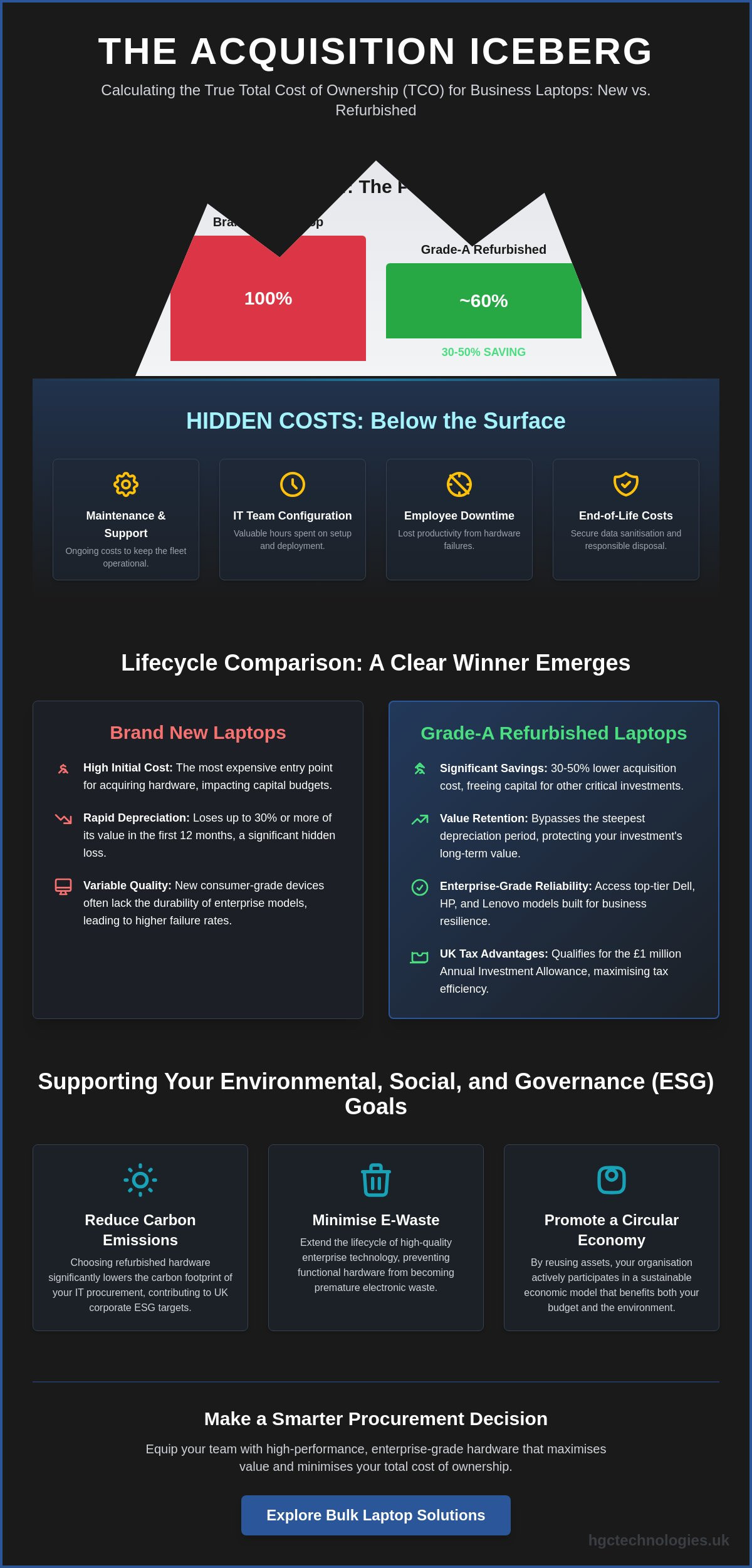
Calculating the total cost of ownership refurbished vs new laptops reveals what industry experts call the “Acquisition Iceberg.” The purchase price is merely the visible tip. Beneath the waterline lies a massive array of hidden expenses, including maintenance, support, and eventual disposal. In a 2026 economy defined by 25% corporation tax for high-profit firms and a continued focus on ESG targets, overlooking these hidden costs can lead to significant budget overruns. Refurbished hardware has emerged as a primary solution for businesses looking to bypass the heaviest financial burdens of the IT lifecycle.
The Components of Laptop TCO
A comprehensive TCO analysis breaks down into three distinct categories. Direct costs are the most obvious, encompassing the hardware purchase price, software licensing, and shipping fees. However, indirect costs often carry a heavier weight. These include the time your IT team spends on configuration, the cost of employee downtime during hardware failures, and the ongoing support required to keep a fleet operational. Finally, end-of-life costs involve secure data sanitisation and responsible disposal. Whilst these are often forgotten during procurement, they’re essential for regulatory compliance and environmental responsibility.
Why Initial Price is a Deceptive Metric
New hardware is a rapidly depreciating asset. Much like a new car, a laptop loses a significant portion of its market value the moment it is unboxed and deployed. During the first 12 months, depreciation is at its steepest, often wiping out 30% or more of the original investment. By opting for high-grade refurbished units from manufacturers like Dell, HP, or Lenovo, your business avoids this initial value crash. You’re essentially letting a previous owner pay for the most expensive year of the laptop’s life whilst you reap the rewards of a stable, business-grade machine. TCO serves as a strategic tool for IT budget optimisation, allowing decision-makers to justify investments based on total value rather than just the initial price tag.
The Acquisition Cost Gap: Refurbished vs New Laptops
The financial divergence between new and Grade A refurbished hardware represents the most visible component of the total cost of ownership refurbished vs new laptops. Data indicates that refurbished laptops typically cost between 20% and 60% less than their brand-new counterparts. For a UK business upgrading its fleet in 2026, choosing high-grade refurbished models from manufacturers like Dell, HP, or Lenovo often results in a minimum saving of 40% compared to new units with identical specifications. This gap is not merely a reflection of age; it is a strategic entry point for firms to acquire enterprise-grade build quality that would otherwise be price-prohibitive.
Whilst the upfront price is the primary driver, the broader sustainability of refurbished laptops adds an intangible but vital layer of value. Procurement teams are increasingly finding that the capital saved on hardware can be redirected into other critical areas of digital transformation. Businesses looking to scale their infrastructure quickly can explore bulk laptop solutions that balance high performance with fiscal prudence, ensuring that the acquisition phase of the lifecycle remains lean and efficient.
Wholesale Savings for UK Resellers
For resellers and IT partners, the acquisition gap is even more pronounced. Sourcing in bulk allows for significantly higher wholesale margins than are typically available with new OEM hardware. By standardising on specific ex-corporate lines, such as the Dell Latitude or Lenovo ThinkPad series, resellers can reduce logistics overheads through centralised supply chains. Volume purchasing ensures a consistent standard of hardware across a client’s entire workforce, which simplifies internal maintenance and spare parts management. This consistency is a cornerstone of professional procurement, providing a level of reliability that budget-tier new laptops simply cannot match.
Software and Licensing Considerations
When assessing the total cost of ownership refurbished vs new laptops, the inclusion of high-tier operating systems on ex-corporate hardware represents a significant indirect saving. Most professional refurbished units come with pre-installed Windows Pro licences, which are essential for enterprise domain joining and advanced security features. This contrasts sharply with many new consumer-grade laptops that often require costly licence upgrades and come bundled with “bloatware” that degrades performance. Refurbished business machines are generally “cleaner” and fully compatible with modern enterprise management tools, ensuring that deployment is swift and the user experience remains unburdened by unnecessary software.
Maintenance, Reliability, and the Myth of “New” Superiority
The belief that brand-new hardware guarantees a trouble-free experience is a persistent misconception in IT procurement. In reality, new units are susceptible to “infant mortality” defects, which are manufacturing flaws that appear within the first few weeks of operation. Professional refurbishment processes directly mitigate this risk. Every Grade A unit undergoes exhaustive diagnostic testing and stress-loading that exceeds the standard quality checks of many budget-tier production lines. When evaluating the total cost of ownership refurbished vs new laptops, this pre-tested reliability acts as a safeguard against the productivity losses associated with early-life hardware failure.
Reliability is not just about the absence of defects; it’s about the quality of the engineering. Business-grade hardware is designed to endure the rigours of daily travel and intensive use, whereas consumer-grade alternatives are often built to meet a specific price point. By selecting ex-corporate machines that have already proven their stability in enterprise environments, organisations can avoid the volatility of unproven new models. This strategic choice ensures that your IT budget is spent on performance and uptime rather than on managing the fallout of fragile hardware.
Business-Grade vs Consumer-Grade Hardware
A refurbished Dell Latitude or HP EliteBook is engineered for a five-to-seven-year lifecycle, whereas consumer-grade laptops are often designed for just two or three. The difference lies in the structural integrity. Business-grade machines feature magnesium alloy internal frames, reinforced hinges, and spill-resistant keyboards. They are often tested to MIL-STD 810G standards for drop and vibration resilience. Choosing a refurbished flagship model over a new, plastic-chassis budget laptop dramatically reduces the likelihood of physical damage. This durability is a critical factor in lowering the TCO, as it minimises the frequency of hardware replacements and the associated administrative burden.
Predicting and Managing Repair Costs
Hardware reliability follows a “bathtub curve” where failure rates are highest at the very start and very end of a product’s life. Refurbished units bypass the initial peak of this curve. Because these models have been on the market for several years, their common failure points are well-documented and the supply of spare parts is abundant. Standardising your fleet on specific models, such as bulk Dell refurbished laptops, allows your IT team to maintain a small, cost-effective inventory of components. This approach ensures that if a failure does occur, the downtime is measured in hours rather than weeks of waiting for OEM parts from overseas. By managing these operational variables, you ensure the total cost of ownership refurbished vs new laptops remains predictable and significantly lower than an unstandardised fleet of new hardware.
Sustainability and Lifecycle Resilience
Sustainability is no longer a peripheral concern for UK procurement officers; it’s a core component of financial resilience. Every new laptop manufactured generates approximately 331kg of carbon emissions, a staggering figure when multiplied across a corporate fleet. By contrast, a refurbished unit produces roughly 15 times less CO2, providing an immediate boost to your company’s ESG (Environmental, Social, and Governance) profile. When you evaluate the total cost of ownership refurbished vs new laptops, these environmental savings translate into tangible business value, particularly as carbon reporting becomes a mandatory requirement for large enterprises.
Extending the hardware lifecycle through professional refurbishment allows a business to amortise the initial manufacturing impact over a much longer period. This circular approach ensures that high-quality components remain in the economy rather than contributing to the 62 million tons of e-waste generated globally each year. Forward-thinking organisations are already integrating these metrics into their TCO calculations to justify bulk procurement decisions. To see how your fleet can meet these standards, you can optimise your procurement with sustainable bulk hardware that aligns with modern environmental mandates.
Reducing the Carbon Footprint of IT
The semiconductor and chassis production phases are the most carbon-intensive stages of a laptop’s life. Choosing refurbished hardware effectively bypasses these stages, allowing your organisation to participate in the UK’s growing circular economy. Whilst the government’s “full expensing” capital allowance incentive is reserved for new equipment, the 40% to 60% upfront saving on refurbished units often provides a superior net financial result. Incorporating carbon credits or ESG performance data into your TCO model provides a more accurate picture of an asset’s true value, reflecting its contribution to long-term corporate responsibility goals.
Data Sanitisation and Responsible Disposal
A resilient IT lifecycle must include a secure and ethical exit strategy. Professional refurbishment partners ensure that every unit undergoes rigorous data sanitisation, meeting the highest security standards before the hardware enters its second or third lifecycle. This process eliminates the risk of data breaches and the associated fines that can devastate a company’s bottom line. Furthermore, choosing refurbished hardware often opens doors to trade-in or buy-back programmes, effectively removing disposal fees from your expenditure. Adopting a strategy of sustainable IT procurement significantly reduces long-term regulatory risks associated with e-waste directives and carbon reporting mandates.
Strategic Procurement: Why Refurbished Wins the TCO Battle
Strategic IT procurement in 2026 is defined by the shift from “new at all costs” to “value at every stage.” Throughout this analysis, it’s become clear that the total cost of ownership refurbished vs new laptops leans heavily in favour of high-grade refurbished hardware. By avoiding the initial 30% depreciation hit and capitalising on the £1 million Annual Investment Allowance, UK businesses can equip their teams with premium enterprise tools whilst preserving significant capital. The final decision isn’t just about saving money today; it’s about building a resilient, sustainable, and high-performing technical infrastructure for the years ahead.
Balancing performance requirements with budget constraints requires a nuanced approach. For general office tasks, a two-year-old flagship Dell or Lenovo unit often outperforms a brand-new budget laptop in both speed and durability. The key is to prioritise build quality over the allure of a “zero-hour” odometer. By reallocating the 40% to 60% savings found in the refurbished market, organisations can invest more heavily in cybersecurity, employee training, or software optimisations that drive actual productivity.
Evaluating Your Wholesale Supplier
Success in bulk procurement depends entirely on the integrity of your supply partner. A direct wholesale relationship offers the transparency needed to ensure you’re receiving authentic hardware rather than “frankenstein” units built from mismatched parts. When evaluating a supplier, use this checklist to maintain high standards:
- Grade A Certification: Ensure the supplier adheres to strict cosmetic and functional grading that matches your corporate standards.
- Rigorous Testing Protocols: Demand evidence of component-level stress tests, including battery health, storage reliability, and port functionality.
- Supply Chain Transparency: Verify the origin of the hardware to ensure it meets your internal compliance and security requirements.
- Model Consistency: Confirm the supplier can provide large batches of the same model to simplify your internal IT support and parts inventory.
Implementing a Refurbished-First Policy
Transitioning your organisation to a refurbished-first policy requires clear internal communication. It’s essential to set realistic expectations regarding cosmetic condition and battery life, which should typically be guaranteed at 80% or more of the original capacity. This policy shouldn’t just be about laptops. To create a truly robust environment, you should evaluate your entire stack. For high-performance needs, such as data processing or hosting, consider integrating enterprise server hardware UK solutions alongside your laptop fleets. This holistic view ensures that your total cost of ownership refurbished vs new laptops remains low without sacrificing the power your backend systems require. The 2026 recommendation for UK enterprises is clear: lead with refurbished enterprise-grade hardware to maximise both fiscal health and operational resilience.
Secure Your Competitive Advantage with Strategic Procurement
Mastering your IT budget in 2026 requires a departure from traditional procurement habits. You’ve seen how the total cost of ownership refurbished vs new laptops provides a clear financial advantage, specifically through the avoidance of steep first-year depreciation and the utilisation of the £1 million Annual Investment Allowance. By prioritising the structural integrity of business-grade Dell, HP, and Lenovo units, your organisation secures high-performance tools whilst simultaneously meeting critical ESG targets and reducing long-term regulatory risks.
HGC Technologies acts as your authoritative partner in this transition. As a specialist wholesaler with a direct sales model, we eliminate unnecessary layers of cost to deliver maximum efficiency for your fleet. Our expertise in UK refurbished IT procurement ensures that every unit meets rigorous Grade A standards, providing the reliability your business demands. Optimise your IT budget with bulk refurbished hardware from HGC Technologies and leverage our leadership to scale your operations with confidence.
Embracing a circular technology model isn’t just a cost-saving measure; it’s a commitment to a smarter, more responsible future for your business. We look forward to helping you shape a more resilient technical infrastructure.
Frequently Asked Questions
What is the typical lifespan of a refurbished business laptop?
A high-quality refurbished business laptop typically offers three to five years of reliable service after procurement. Since enterprise-grade hardware from manufacturers like Dell and Lenovo is engineered for a seven-year lifecycle, a unit sourced at the three-year mark remains well within its optimal performance window. This longevity ensures that the total cost of ownership refurbished vs new laptops remains low by spreading the investment over a significant operational period.
Do refurbished laptops come with a warranty for business use?
Professional refurbished laptops nearly always include a warranty, typically ranging from 90 days to a full calendar year. Whilst new units often boast three-year coverage, the significant upfront savings on refurbished kit allow businesses to self-insure or purchase extended support for a fraction of the cost. Always confirm the specific terms with your wholesale partner to ensure the coverage aligns with your internal IT service level agreements.
How much can a UK business save by choosing refurbished over new?
UK businesses can expect upfront savings of between 20% and 60% compared to the price of new OEM hardware. Most organisations achieve an average saving of 40% when standardising on Grade A ex-corporate models. These savings directly influence the total cost of ownership refurbished vs new laptops, allowing for the procurement of higher-specification machines that would be budget-prohibitive if purchased as new.
Is the battery health of a refurbished laptop guaranteed?
Reputable wholesalers provide clear battery health guarantees, often ensuring a minimum of 80% of the original factory capacity. Every unit undergoes rigorous testing to ensure the cells hold a stable charge and meet the requirements of a mobile workforce. If a battery falls below these professional standards during the refurbishment process, it’s replaced with a new or high-capacity alternative before the unit is listed for sale.
Can refurbished laptops run the latest version of Windows?
Most business-grade laptops manufactured from 2018 onwards fully support the latest versions of Windows, including Windows 11. These machines were built with the necessary TPM 2.0 security chips and compatible processor architectures required by modern operating systems. When sourcing in bulk, verify that the hardware specifications meet the current Microsoft requirements to ensure long-term software compatibility and security patching.
How does refurbished hardware impact my company’s carbon footprint?
Choosing refurbished hardware reduces the carbon footprint of a single laptop by approximately 15 times compared to purchasing new. Manufacturing a new unit generates roughly 331kg of CO2 emissions, whereas refurbishment focuses on extending the life of existing resources. This choice helps UK firms meet their ESG targets and contributes to a circular economy by preventing functional technology from entering the e-waste stream prematurely.
Are refurbished laptops safe from a data security perspective?
Professionally refurbished laptops are entirely safe for business use, provided they’ve undergone certified data sanitisation. Reputable suppliers use industrial-grade software to wipe previous data to international standards, ensuring no traces of former files remain. This process is often more secure than internal wipes performed by non-specialist staff, as it includes a full audit trail and verification of the sanitisation success.
What is the difference between Grade A and Grade B refurbished laptops?
The primary difference between Grade A and Grade B is purely cosmetic. Grade A units are in “like-new” condition with minimal, if any, visible signs of previous use. Grade B laptops may feature minor scratches or slight wear on the chassis but remain 100% functionally perfect. For client-facing roles, Grade A is the standard choice, whilst Grade B offers even deeper savings for internal back-office functions where aesthetics are less critical.

Enterprise-Grade Refurbished Servers: The 2026 Strategic Procurement Guide
The most resilient data centres in 2026 aren't built on the promise of "new" hardware; they're built

Best Refurbished Laptops for UK Businesses: The 2026 Procurement Guide
Sales volumes for refurbished PCs in the UK doubled in the final quarter of 2025 compared to the pre
Custom PC Builder UK: Myth-Busting the Move from OEM to Bespoke Business Hardware
Why are the UK’s most agile enterprises intentionally turning their backs on the global hardware g
Comments are closed.