

Calculating ROI on Refurbished IT Equipment: A Strategic Guide for UK Enterprises
A certified, Grade A refurbished desktop is typically 40% to 60% cheaper than its brand-new equivalent, offering a significant strategic advantage for organisations calculating ROI on refurbished IT equipment. You’ve likely felt the pressure of rapid asset depreciation, where premium hardware loses substantial value within months of deployment. It’s difficult to reconcile these costs when your technical requirements are growing but your financial resources remain fixed, leaving you to balance performance against fiscal constraints.
This guide provides the definitive framework to justify procurement to your board with absolute confidence. You’ll learn how to measure the intersection of immediate capital savings and long-term value, ensuring your hardware choices align with both corporate sustainability goals and rigorous performance standards. We will explore a methodical approach to asset lifecycle management that maximises your performance-per-pound and secures your position as a visionary industry leader.
Key Takeaways
- Implement a robust 4-step financial framework to identify the hidden costs of “new-only” procurement and establish a true performance baseline.
- Master the precise formula for calculating ROI on refurbished IT equipment to provide the board with data-driven justification for hardware investments.
- Avoid the “Depreciation Trap” by understanding how Grade A refurbished assets maintain their value and reliability far better than consumer-grade new alternatives.
- Optimise your hardware utility through strategic lifecycle management techniques, including fleet standardisation and the “Waterfall” re-allocation method.
- Align your IT strategy with 2026 UK sustainability standards by reducing hardware CapEx while simultaneously meeting mandatory Scope 3 reporting requirements.
Why Calculating ROI on Refurbished IT Equipment is Crucial for 2026 Procurement
Strategic procurement in 2026 has evolved. It’s no longer just about finding the lowest sticker price; it’s about ensuring that every asset delivers maximum utility over its entire lifespan. As UK enterprises face stricter sustainability mandates and stagnant budgets, calculating ROI on refurbished IT equipment has become a core competency for financial and technical leaders. This process allows you to move beyond simple price comparisons and look at the total value generated by your hardware choices.
True ROI differs from simple cost savings. Whilst cost savings measure the reduction in immediate expenditure, ROI accounts for the net gain over time, including performance-per-pound and the mitigation of rapid depreciation. With the UK’s “Right to Repair” directive coming into full effect in July 2026, the reliability and serviceability of Refurbishment (electronics) have reached a new gold standard. This makes hardware lifecycle extension a competitive necessity rather than an optional eco-friendly gesture.
The Shift from CapEx to Value-Driven Procurement
The traditional “buy new every three years” model is financially unsustainable. This rigid cycle forces companies to accept the steepest part of the depreciation curve. By integrating refurbished assets into a modern IT Asset Lifecycle Management strategy, organisations can secure higher-specification hardware, such as enterprise-grade Dell or Lenovo laptops, within their existing budgets. This shift supports the circular economy and boosts margins by reducing the capital required for high-performance deployments.
Identifying the Core Financial Drivers of Refurbished Tech
Several factors drive the financial logic of choosing refurbished gear:
- Acquisition Savings: Initial costs are typically 40% to 70% lower than the original RRP, allowing for immediate capital preservation.
- Operational Uptime: Refurbished units are often available for immediate bulk dispatch, bypassing the long lead times often associated with new global supply chains.
- Proven Reliability: Unlike brand-new batches that may suffer from manufacturing defects, refurbished units have been tested in real-world environments and undergone rigorous secondary quality checks.
In an environment where UK sustainability reporting standards will soon mandate Scope 3 emissions disclosures, choosing refurbished hardware isn’t just a financial win. It’s a strategic alignment with the future of responsible global business. By calculating ROI on refurbished IT equipment with precision, you can justify a procurement strategy that is both ethically conscious and fiscally superior.
The 4-Step Framework for Calculating Your IT Hardware ROI
To move beyond anecdotal savings, UK enterprises must adopt a rigorous quantitative approach. The standard financial formula provides the essential anchor: (Net Gain from Investment / Cost of Investment) x 100. However, when calculating ROI on refurbished IT equipment, the “Net Gain” component must account for more than just the lower purchase price. It must encompass avoided depreciation, reclaimed capital for other strategic projects, and the extension of asset utility. Establishing a baseline starts with auditing your current “new-only” policy to identify the hidden costs of rapid replacement cycles and OEM lead times.
Step 1: Acquisition and Deployment Cost Baseline
The first step involves comparing the “per-seat” cost of brand-new units against bulk refurbished alternatives. Sourcing bulk Dell or Lenovo laptops from a wholesale partner often results in immediate capital expenditure reductions of 40% to 60%. These savings should also factor in deployment speed. Whilst OEMs may quote lead times of several months for custom configurations, wholesale providers typically offer immediate dispatch from existing stock. This ensures your teams are productive sooner, reducing the “soft cost” of waiting for hardware arrivals.
Step 2: Operational Costs and Performance Analysis
Modern refurbished hardware, particularly ex-corporate Grade A stock, demonstrates reliability levels that rival new consumer-grade equipment. With the 2026 “Right to Repair” directive ensuring better access to spare parts, maintenance costs for these assets have stabilised significantly. Energy efficiency is also a key variable; whilst the latest generation may offer marginal power savings, the “embodied carbon” saved by choosing refurbished units supports broader circular economy principles. Performance-per-Pound is defined as the total benchmarked processing power of a device divided by its total cost of ownership over a three-year cycle. This metric often reveals that a two-year-old enterprise-grade machine offers superior value compared to a budget-tier new model.
Step 3: Calculating Residual Value and End-of-Life Returns
A critical advantage of refurbished gear is its flatter depreciation curve. A new laptop loses approximately 30% of its value the moment it is unboxed, whereas a refurbished asset has already absorbed this initial hit. When you look three years ahead, the secondary market value of a refurbished business-grade machine remains remarkably resilient. Your ROI calculation must also include the costs of secure data destruction and ethical recycling, ensuring your end-of-life processes meet UK regulatory standards without eroding your financial gains. If you are looking to optimise your hardware spend, you can explore high-performance wholesale options that align with these financial goals.
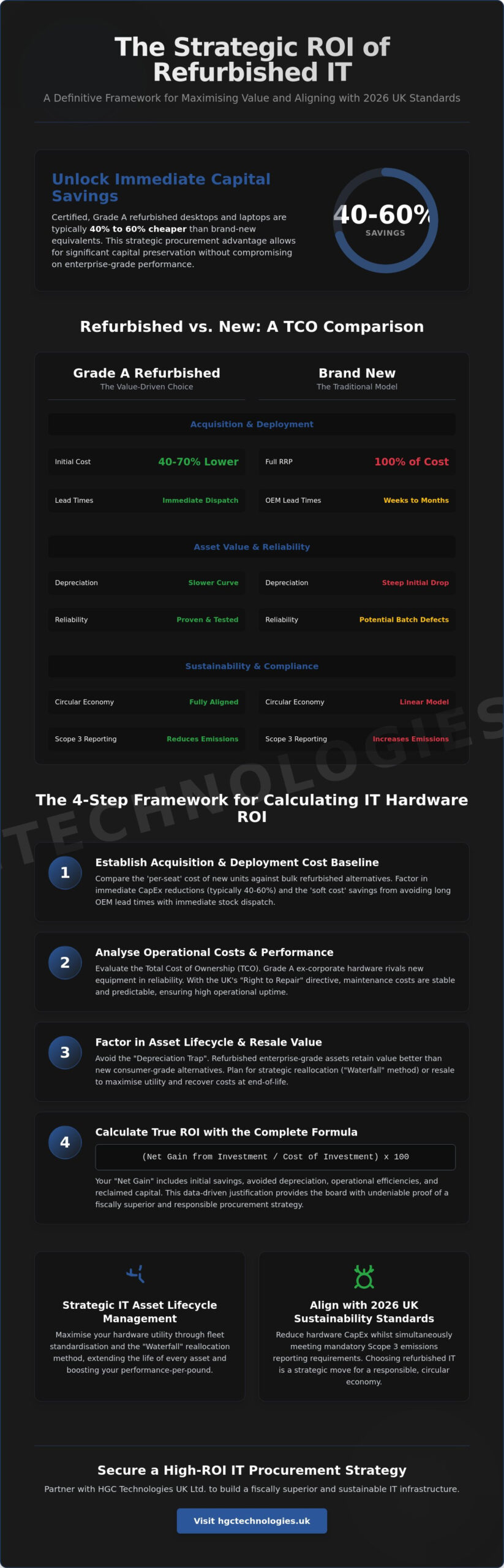
Refurbished vs. New: A Total Cost of Ownership (TCO) Comparison
A comprehensive Total Cost of Ownership (TCO) analysis exposes the hidden financial leakages inherent in buying new hardware. Whilst procurement teams often fixate on the initial invoice, the real cost is buried within the “Depreciation Trap”. New IT assets typically lose 30% of their market value the moment they are unboxed. For a UK enterprise deploying hundreds of units, this represents a massive, immediate hit to the balance sheet that can never be recovered. Calculating ROI on refurbished IT equipment requires a shift in perspective, viewing hardware not as a one-off expense but as a multi-year asset that must retain its utility and value for as long as possible.
The opportunity cost of over-spending on new hardware is equally significant. Every pound tied up in the “new-gear premium” is capital that isn’t being invested in software development, cybersecurity, or talent acquisition. By opting for Grade A refurbished units, businesses can redirect substantial savings into high-impact strategic areas, effectively doubling the utility of their IT budget whilst maintaining access to premium, enterprise-grade specifications.
Depreciation Curves: A Financial Comparison
Visualising the first 24 months of an asset’s life reveals a stark contrast in value retention. New hardware follows a steep, punishing curve that only begins to level off after the second year of use. Conversely, Grade A refurbished equipment enters your inventory at a price point that has already absorbed that initial collapse. This protects your balance sheet from aggressive write-downs and ensures a more stable asset valuation. When managing a bulk IT fleet, this flatter curve means your hardware represents a more resilient store of value if you choose to liquidate or trade in units at the end of their lifecycle.
Maintenance and Longevity Realities
A common misconception suggests that refurbished gear requires more frequent repairs. In reality, ex-corporate hardware is engineered to far higher standards than consumer-grade new technology. These units undergo “Burn-in” testing, a process where components are stressed to identify potential faults before they reach the end user. This makes them inherently more stable than a batch of new laptops that haven’t faced real-world rigorous use. Using bulk Dell refurbished laptops as a benchmark, enterprises find that these machines easily support modern requirements, including Windows 11 compatibility and advanced security protocols. This longevity ensures that your ROI remains high well into the future, providing a stable platform for your workforce without the premium price tag.
Strategic IT Asset Lifecycle Management to Maximise Returns
Maximising the financial return on your hardware requires more than a savvy initial purchase. It demands a sophisticated lifecycle strategy that protects profit margins and stabilises cash flow over several years. Whilst previous sections focused on calculating ROI on refurbished IT equipment at the point of entry, long-term gains are secured through how these assets are deployed and re-circulated within your organisation. A well-executed management plan ensures that you extract every ounce of utility from your investment before the asset reaches its final retirement.
Consistency is the foundation of operational efficiency. By sourcing identical hardware batches through bulk procurement, IT departments can drastically reduce the complexity of driver updates, imaging, and hardware repairs. This uniformity eliminates the “hidden” technical debt associated with managing a fragmented fleet. Furthermore, implementing the “Waterfall” method allows you to re-allocate high-spec laptops from power users to administrative roles after three years. This internal circulation is vital when calculating ROI on refurbished IT equipment, as it spreads the initial cost across multiple user lifecycles and identifies the “Sweet Spot” where maintenance costs remain low but equipment holds secondary market value.
Standardisation and Procurement Efficiency
Bulk HP or Lenovo batches allow for a streamlined support infrastructure. This standardisation reduces the overhead of maintaining diverse spare parts. For specific roles, custom-built PCs offer high performance without bloated costs. To avoid CapEx spikes, many UK enterprises organise a rolling refresh cycle, replacing 20% to 25% of their fleet annually to maintain a predictable budget.
The Role of Quality Grading in ROI
Grade A is the only standard for professional ROI. Grade C units often represent a false economy due to cosmetic damage and failure rates. HGC Technologies UK Ltd. maintains rigorous Grade A standards for all wholesale batches to ensure reliability and excellence. If you are ready to standardise your infrastructure with premium assets, you can request a wholesale quote for Grade A hardware tailored to your needs.
Partnering with HGC Technologies UK Ltd. for High-ROI IT Procurement
Strategic procurement requires more than just data; it requires a supply chain partner capable of delivering at scale. HGC Technologies UK Ltd. provides this infrastructure, ensuring that the theoretical gains identified when calculating ROI on refurbished IT equipment are actually realised in your quarterly reports. By specialising in the wholesale distribution of Tier-1 brands like Dell, HP, and Lenovo, we provide the hardware consistency necessary for enterprise-level deployments across the country. Our national coverage ensures that your organisation receives a steady supply of high-performance assets, regardless of your geographic footprint.
Resellers and corporate procurement officers rely on our expertise to bypass the volatility often found in global OEM supply chains. We maintain a robust inventory of original smartphones and enterprise servers, allowing organisations to respond to growth opportunities without typical lead-time constraints. This speed-to-market is a critical component of ROI that is often overlooked in traditional procurement models. By securing hardware when it’s needed, you eliminate the productivity gaps that occur whilst waiting for new manufacturing cycles to complete.
Wholesale Sourcing for Resellers and Enterprises
Direct wholesale sourcing offers a clear path to capital preservation. By purchasing in volume from HGC Technologies UK Ltd., enterprises avoid the layered costs and financing overheads associated with complex lease-to-own models. This direct approach ensures you receive authentic, original smartphones and hardware batches that have passed our rigorous quality assessments. It’s a transparent process designed to give you absolute control over your IT assets from the moment of acquisition. Our model focuses on providing high-demand models in large volumes, ensuring your team has the tools they need to maintain a competitive edge.
Custom Configurations for Maximum Utility
Not all workloads are created equal. Whilst bulk laptops serve the majority of your workforce, specific departments require tailored power. We provide custom-built PCs designed to match your specific software requirements, alongside scalable server solutions that grow in tandem with your data needs. This precision eliminates waste, ensuring you only pay for the performance your business actually uses. This level of technical tailoring is essential for calculating ROI on refurbished IT equipment with accuracy, as it aligns hardware expenditure directly with operational output. If you are ready to refine your hardware utility, contact our team today to optimise your IT procurement strategy and secure your organisation’s technical future.
Future-Proofing Your Enterprise Hardware Strategy
Mastering the financial framework for calculating ROI on refurbished IT equipment is no longer a niche skill; it’s a fundamental requirement for the modern procurement leader. By shifting your focus from initial acquisition costs to the total cost of ownership, you protect your organisation from the aggressive depreciation associated with new assets. We’ve explored how Grade A standards and strategic lifecycle management can extend hardware utility whilst significantly boosting your bottom line and sustainability credentials.
Founded in 2020 with a focus on UK enterprise excellence, HGC Technologies acts as your authoritative partner in technology wholesale. We specialise in custom-built business PCs and servers, alongside a consistent supply of Grade A Dell, HP, and Lenovo units. Our commitment to quality ensures your infrastructure remains a strategic advantage rather than a financial burden, providing the stability your business needs to thrive.
Explore our bulk refurbished hardware and start maximising your IT ROI today. Secure your competitive advantage and build a more resilient, sustainable future for your business infrastructure.
Frequently Asked Questions
How do you calculate the ROI of refurbished IT equipment specifically?
ROI is calculated by dividing the net gain from the investment by the initial cost of the hardware and multiplying the result by 100. When calculating ROI on refurbished IT equipment, you must account for the avoided “new-gear premium” and the significantly flatter depreciation curve. This ensures your financial report reflects the true value reclaimed over the asset’s extended lifecycle.
Is the lifespan of refurbished IT equipment shorter than new hardware?
Not necessarily, particularly when dealing with enterprise-grade machines from Dell, HP, or Lenovo. These units are engineered for a seven to ten-year operational life, yet they are typically refreshed by original owners after just three years. Refurbishing these assets at the mid-point of their life leaves years of high-performance utility for the secondary user.
What are the hidden costs of buying refurbished IT in bulk?
The most common hidden cost is battery degradation, as lithium-ion cells naturally lose capacity over several years. Buyers should also consider the logistics of imaging and deploying non-standardised batches. Sourcing Grade A units from a reputable wholesaler mitigates these risks by ensuring consistent hardware specifications and tested battery health across the entire fleet.
How does refurbished IT equipment impact corporate sustainability (ESG) goals?
Choosing refurbished hardware is a direct way to reduce a company’s carbon footprint and support the circular economy. It prevents functional electronics from becoming e-waste and avoids the massive “embodied carbon” cost associated with manufacturing new devices. This alignment is increasingly vital for UK companies meeting new Scope 3 emissions reporting standards.
Can refurbished hardware handle modern enterprise software and security updates?
Yes, provided the hardware meets the necessary technical requirements. Most ex-corporate laptops produced from 2019 onwards include the TPM 2.0 chips required for Windows 11 and advanced security encryption. This ensures that your refurbished fleet remains fully compatible with modern software stacks and enterprise-level cybersecurity protocols.
What is the average cost saving when switching to refurbished business laptops?
Enterprises typically realise savings between 40% and 60% when opting for refurbished hardware over brand-new equivalents. These substantial capital expenditure reductions allow procurement officers to either secure higher-specification machines for their teams or redirect the saved budget toward other critical digital transformation projects.
How do I choose between different grades (A, B, C) for the best ROI?
Grade A hardware consistently delivers the highest ROI for professional environments because it offers like-new functionality and appearance. Whilst Grade C equipment has a lower entry price, the potential for higher failure rates and user dissatisfaction often leads to increased support costs. Investing in Grade A ensures reliability and maintains employee productivity.
Does HGC Technologies provide warranties on their wholesale refurbished gear?
HGC Technologies projects a standard of excellence by supplying premium, ex-corporate hardware to resellers and enterprises across the UK. Because every wholesale requirement is unique, you should contact our specialist team directly to discuss the specific support terms and warranty options available for your particular batch of laptops or servers. recover value through buyback

Business Continuity with Refurbished Hardware: A 2026 Strategic Guide
Certified refurbished enterprise hardware offers cost savings of up to 70% compared to brand-new uni

Wholesale Smartphones for Employees: 2026 Procurement Guide
Your mobile procurement strategy is now a critical security operation rather than a simple hardware

Reducing Capital Expenditure on Business IT: A 2026 Strategic Guide
40% of firms have already delayed or cancelled vital capital expenditures in 2026 due to the volatil
Comments are closed.