
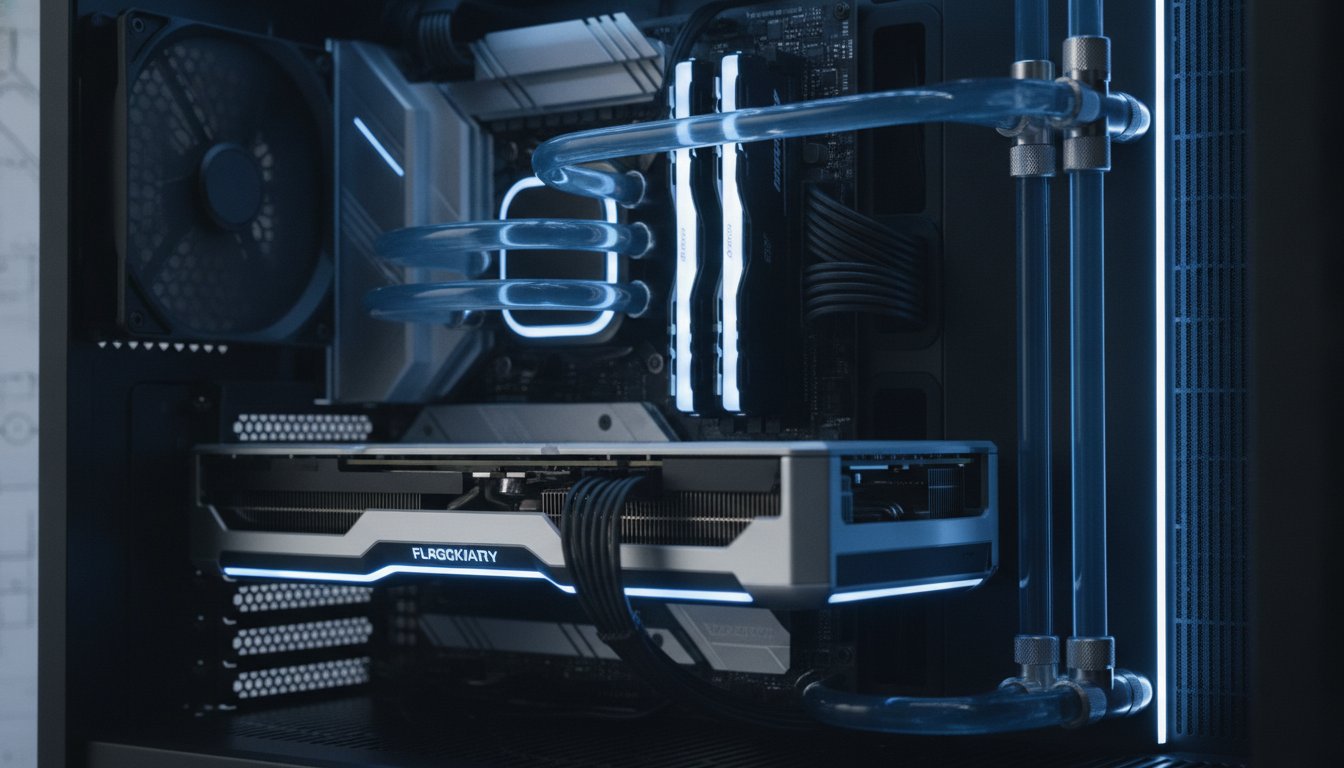
High Performance Workstation Build UK: A 2026 Case Study in Bespoke Engineering
In 2026, the standard office tower isn’t just falling behind; it’s actively bottlenecking the UK’s most ambitious AI and rendering projects. Investing in a high performance workstation build UK is no longer a luxury for creative agencies or data scientists. It’s a strategic necessity to avoid the thermal throttling and hardware limitations that plague mass-market brands. As component prices for DDR5 RAM and flagship GPUs like the RTX 5090 continue to climb due to global AI demand, the margin for error in hardware procurement has vanished.
You’ve likely felt the frustration of a premium OEM unit spinning its fans at max volume while your render speeds crawl, or realised too late that your off-the-shelf purchase lacks the PCIe 5.0 lanes needed for next year’s upgrades. This case study demonstrates how bespoke engineering transforms these technical pains into a silent, thermally optimised powerhouse that delivers a measurable return on investment. We’ll explore the specific component choices, from liquid cooling to scalable storage architectures, that ensure your hardware remains an asset rather than a liability in an AI-integrated workflow.
Key Takeaways
- Understand the fundamental shift from general-purpose computing to local AI processing and why 2026 hardware must be architected for deep learning.
- Discern the vital hardware specifications, including the critical role of ECC memory and PCIe 5.0 bandwidth, that separate professional workstations from standard gaming setups.
- Assess why a high performance workstation build UK offers superior thermal management and bespoke scalability over the “sealed box” limitations of traditional OEM brands.
- Review a practical case study on identifying specific CPU and GPU bottlenecks to reduce rendering times and justify the investment in custom-engineered hardware.
- Gain insights into the procurement benefits of partnering with a specialist provider for custom-built PCs to secure high-demand components in a volatile market.
The Evolution of High Performance Workstation Builds in the UK
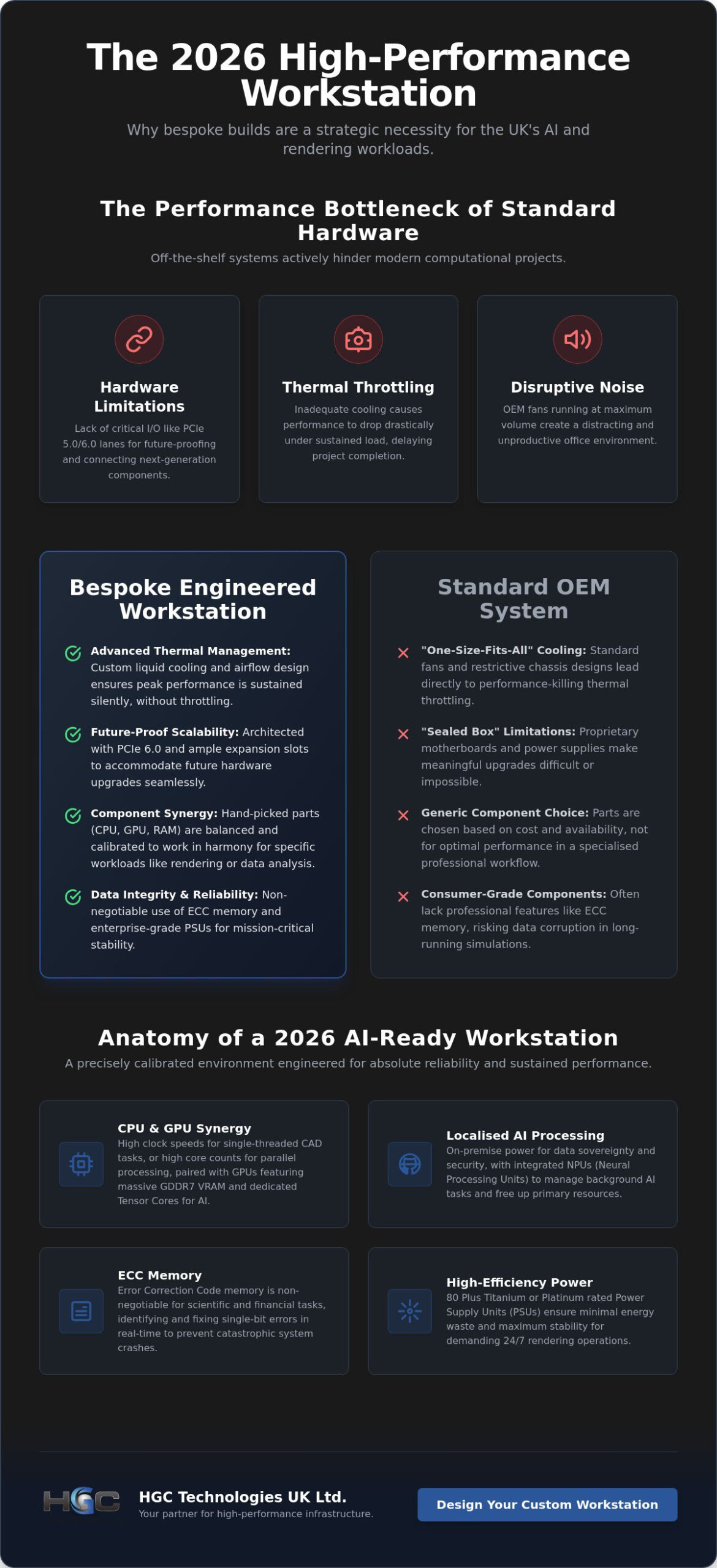
The distinction between a standard office computer and a professional machine has never been more pronounced. By 2026, the high performance workstation build UK market has shifted away from incremental speed bumps toward radical architectural specialisation. Whilst a standard business PC is designed for burst workloads, a modern Workstation is engineered to maintain peak performance under sustained, multi-day computational loads. Standard ex-corporate hardware, whilst excellent for administrative duties, often falls short for specialised creative or scientific tasks. These units lack the power delivery and thermal headroom required for the intensive demands of 8K rendering or complex simulations. Bespoke engineering is now the primary factor in ensuring a machine doesn’t just start fast, but stays fast until the job is finished, regardless of the complexity of the task at hand. This approach moves beyond the “sealed box” constraints of mass-market brands to provide a platform that is truly future-proofed for the next generation of digital tools.
The Rise of the Localised AI Workstation
UK firms are moving away from cloud-only AI due to high recurring costs and the need for data sovereignty. Localised processing allows teams to iterate on private datasets securely, particularly following the implementation of the 2025 Data (Use and Access) Act. To support these intensive workflows, a modern build requires massive GDDR7 VRAM and dedicated Tensor cores. The standardisation of NPU (Neural Processing Unit) integration has also become vital in 2026. These dedicated chips manage background AI tasks whilst the primary GPU is utilised for heavy-duty rendering and data analysis, ensuring that computational resources are allocated with maximum efficiency across the entire system architecture.
Why Thermal Management is the New Performance Metric
Performance in 2026 is defined by heat dissipation. Modern high-end components generate immense thermal energy that standard OEM chassis are not designed to manage. When a system reaches its thermal limit, it triggers thermal throttling, which reduces performance to prevent damage. This causes project deadlines to slip and increases long-term wear on the silicon. Bespoke engineering prioritises advanced airflow and liquid cooling to ensure “silent performance.” This is vital for open-plan UK offices, where a high performance workstation build UK must run at 100% load without creating disruptive noise or compromising the operational lifespan of the hardware.
The Anatomy of a 2026 Enterprise Workstation
A professional machine is more than just a collection of fast parts; it’s a precisely calibrated environment designed for absolute reliability. In 2026, a high performance workstation build UK relies on hardware that prioritises data integrity and sustained throughput over the transient peak speeds found in consumer gaming rigs. Whilst gaming PCs are built for entertainment, enterprise hardware focuses on High-Performance Computing (HPC) principles to aggregate resources for demanding computational tasks. Error Correction Code (ECC) memory has become a non-negotiable requirement for scientific, financial, and engineering applications. It identifies and fixes single-bit memory errors in real time, preventing the catastrophic system crashes that can occur during multi-day simulations or complex data processing.
The transition to PCIe 6.0 standards in 2026 has doubled storage bandwidth, allowing for instantaneous data transfer across the system bus. Powering these high-draw components requires exceptional Power Supply Unit (PSU) efficiency. Choosing 80 Plus Titanium or Platinum rated units ensures minimal energy waste and maximum stability for 24/7 rendering tasks. For organisations requiring these exact specifications, our range of custom-built PCs provides the architectural reliability needed for mission-critical operations. This level of bespoke engineering ensures that every watt of power is utilised effectively, maintaining system health over years of intensive use.
CPU and GPU Synergy: Balancing Cores and Clock Speed
UK industries have divergent needs that dictate the choice of silicon. Architectural firms often require high-clock-speed processors to handle single-threaded CAD tasks, whilst research centres demand high-core-count chips for parallel processing. Modern 3D rendering and complex simulations now frequently utilise multi-GPU configurations to distribute the immense workload across several thousand CUDA or Stream cores. To achieve maximum efficiency in 2026 workflows, the system must maintain a precise ratio of at least two CPU threads for every 8GB of dedicated GPU memory.
Storage Architectures for Massive Datasets
Modern datasets have grown to a scale where standard storage solutions create significant bottlenecks. NVMe RAID arrays are now essential for real-time 8K video editing and large-scale data analysis, providing the necessary read and write speeds to keep the processor fed with data. To prevent system lag, bespoke builds utilise a tiered storage strategy with separate physical drives for the operating system, scratch files, and long-term archives. These high performance workstation build UK configurations allow for sophisticated storage controllers that offer better redundancy and throughput than any standard OEM model.
Bespoke Build vs OEM: The Strategic Choice for UK Firms
Choosing between a global OEM and a specialist UK builder is a decision that impacts the entire hardware lifecycle. Major brands often deliver a “sealed box” experience, where proprietary motherboards and non-standard power connectors limit future flexibility. In contrast, a high performance workstation build UK provides an open architecture that prioritises modularity and long-term strategic value. This choice allows firms to integrate their hardware into broader bespoke PC builds for business strategies, ensuring that every unit is a precise match for the company’s operational goals. It moves the conversation from simple procurement to long-term infrastructure planning.
Procurement from a specialist UK builder offers agility that global mass-manufacturers cannot replicate. Whilst a global brand might offer a standard warranty, a local partner understands the specific regulatory and logistical environment of the UK market. There is a persistent misconception that bespoke builds are less reliable than brand-name workstations. In reality, bespoke engineering utilises high-grade, off-the-shelf components from leading manufacturers, often outperforming the budget-optimised parts found inside mass-produced towers. Reliability is built into the design through rigorous stress testing and component synergy that generic builds simply don’t receive. Every machine is an investment in stability.
Scalability and the “Right to Repair”
Bespoke systems thrive on standardised parts. This adherence to industry standards means that as technology evolves, components like GPUs, storage drives, and RAM can be swapped or upgraded without replacing the entire system. Contrast this with proprietary OEM designs that often force a total hardware refresh when a single component becomes obsolete. Adopting an “upgrade-first” IT policy allows UK businesses to reduce capital expenditure whilst meeting environmental sustainability targets. It’s a pragmatic approach to technology that extends the useful life of a high performance workstation build UK significantly, providing a much higher return on investment over a five-year period.
Customisation Beyond the Internal Components
The advantages of bespoke hardware extend to the physical work environment. Builders can specify chassis with superior noise dampening for quiet offices or select cases with specific port layouts to suit bespoke desk configurations. Beyond the hardware, every machine arrives with pre-configured software environments and BIOS optimisations tailored to the client’s specific software stack. For those hesitant to leave the familiarity of brand names, we recommend exploring our guide on Custom PC Builder UK: Myth-Busting the Move from OEM to Bespoke Business Hardware. This level of granular control ensures the hardware works for the user, rather than the user adapting to the hardware’s limitations.
Case Study: Designing an AI-Ready Rendering Workstation
Consider the logistical challenges faced by a London-based architectural firm in 2026. Their design team is struggling with render times that frequently exceed twelve hours, delaying client presentations and stalling the iterative creative process. To remain competitive, they require a 60% reduction in processing time whilst ensuring their hardware can support new AI-assisted generative design plugins. A generic high performance workstation build UK from a mass-market vendor cannot solve this; the solution requires a machine tuned specifically for their software ecosystem. The first step of any high-performance build is a comprehensive workload audit.
This philosophy of precision tuning is common across various high-performance sectors; for instance, to see how specialist software calibration can enhance your vehicle’s engine performance, you can check out Naked Frog Vehicle Tuning.
Step 1: Identifying the Computational Bottleneck
Our engineers began by performing a granular assessment of the firm’s current hardware performance whilst running Revit and V-Ray. We discovered that whilst Revit tasks were bottlenecked by single-core CPU clock speeds, the V-Ray rendering engine was pinned at 100% GPU utilisation until the system triggered thermal throttling. This forced the hardware to downclock, extending render times unnecessarily. By matching the hardware to the specific “engine” of the software, we identified that a high-frequency processor paired with a multi-GPU configuration was essential. This setup ensures that the CPU handles the complex geometry of Revit whilst the GPUs manage the heavy lifting of the final render and TensorFlow-based AI denoising.
Step 2: Component Integration and Thermal Testing
The physical assembly of such a machine prioritises high-volume airflow and meticulous cable management to eliminate internal hot spots. We apply the same rigorous engineering standards used to configure server hardware UK enterprises use for data centres. This includes a 24-hour “burn-in” phase where the system is pushed to its absolute limits under maximum thermal load. This validation process is designed to detect “infant mortality” in silicon components before the machine is deployed in a production environment. For this architectural firm, the result was a stable, silent powerhouse that achieved the desired 60% reduction in render times without a single system failure during overnight processing.
If your current hardware is failing to keep pace with your project deadlines, our team can help you design a machine that eliminates these bottlenecks. Explore our range of custom-built PCs to see how bespoke engineering can transform your firm’s productivity and technical reliability.
Implementing High-Performance Infrastructure with HGC Technologies
HGC Technologies stands as the premier partner for UK organisations navigating the complexities of modern computational requirements. We don’t just assemble computers; we engineer high-performance platforms that serve as foundational business assets. Our established wholesale background provides a distinct strategic advantage, allowing us to source premium components reliably whilst other vendors struggle with supply chain volatility. By securing the latest GDDR7 GPUs and high-density DDR5 kits directly, we ensure that every high performance workstation build UK we deliver meets the exact specifications required for 2026 workflows. This commitment to quality transforms hardware from a disposable tool into a long-term investment that supports your firm’s growth and technical ambitions.
Technical reliability is the cornerstone of our operations. We recognise that for a business, downtime is more than an inconvenience; it’s a significant financial risk. Our consultation process focuses on understanding your specific software stack and operational environment to eliminate the bottlenecks identified in previous sections. Whether you are a boutique creative studio or a large-scale research facility, our approach ensures that your hardware infrastructure is robust, silent, and thermally optimised for continuous professional use; for the physical logistics of installing or relocating heavy technical assets, Silver Knight Haulage & Machineries Ltd provides the specialist machinery moving expertise required.
From Individual Workstations to Enterprise Clusters
Bridging the gap between high-end desktops and complex server environments is a core strength of our service. Many of our clients find that their needs evolve from a single high performance workstation build UK into a requirement for centralised processing power. We facilitate this transition by integrating bespoke workstations with refurbished servers UK wholesale solutions. This creates a unified hardware ecosystem that simplifies IT management and ensures consistent performance across your entire network. Our focus remains on strategic procurement, providing the reliability of enterprise-grade hardware with the flexibility of custom-engineered configurations.
Get Started with a Technical Consultation
Modernising your hardware infrastructure begins with a detailed technical consultation. Our experts work directly with your IT decision-makers to draft a custom build quote that addresses your industry’s unique challenges. We operate a direct sales model to ensure maximum transparency and efficiency, removing the unnecessary layers of communication found with mass-market resellers. This collaborative approach allows us to fine-tune BIOS settings and software environments before the hardware even reaches your office. Contact HGC Technologies today to begin the process of architecting a hardware solution that secures your firm’s place at the forefront of UK innovation.
Securing Your Competitive Edge Through Bespoke Engineering
The transition from standard OEM units to a dedicated high performance workstation build UK represents a fundamental shift in how businesses approach technology procurement. By prioritising bespoke engineering, you ensure that your hardware remains a scalable asset capable of handling the most intensive AI and rendering workloads of 2026. We’ve explored how the synergy between high-frequency processors, ECC memory, and advanced thermal management eliminates the bottlenecks that traditionally stall project deadlines. Moving beyond the “sealed box” mentality allows your firm to maintain a silent, professional environment whilst achieving a clear return on investment through hardware longevity.
HGC Technologies is a specialist in bespoke PC and enterprise server solutions, providing the authoritative UK-based technical expertise needed to architect these complex systems. Our direct wholesale sourcing of premium components ensures that your business bypasses supply chain volatility to secure the latest flagship hardware. Whether you’re upgrading a single creative suite or implementing an enterprise-wide infrastructure overhaul, our specialists are ready to guide your technical strategy with precision and reliability.
Contact HGC Technologies for a Bespoke Workstation Consultation today to discuss your specific industry requirements. Embrace the future of computational power with a partner dedicated to excellence and technical reliability.
Frequently Asked Questions
What is the difference between a high-performance workstation and a gaming PC?
A professional workstation prioritises data integrity and 24/7 operational reliability over the transient frame rates of a gaming PC. Whilst gaming rigs use consumer-grade silicon, a high performance workstation build UK utilises ECC memory and workstation-class GPUs with certified drivers for software like Revit or AutoCAD. These machines are engineered to handle sustained 100% loads for days at a time without the thermal throttling that often affects consumer chassis.
How much RAM do I really need for a workstation build in 2026?
For a professional workstation in 2026, 64GB of DDR5 RAM has become the functional minimum for creative and engineering tasks. If your workflow involves local AI processing or complex 8K video editing, 128GB or 256GB is recommended to prevent the system from relying on slower swap files. High-capacity kits ensure that massive datasets remain in the fastest memory tier, significantly reducing latency during intensive computational operations.
Is it better to have more CPU cores or a higher clock speed for rendering?
The ideal choice depends on whether your software utilises single-threaded or multi-threaded processes for its primary tasks. Rendering engines like V-Ray scale almost perfectly with higher core counts, making chips with 32 or 64 cores highly effective. Conversely, CAD modelling and viewport performance often rely on the highest possible clock speed on a single core. A balanced high performance workstation build UK often seeks a middle ground to satisfy both requirements.
Can I use refurbished components in a high-performance workstation build?
Whilst we specialise in refurbished laptops for administrative use, we recommend utilising new silicon for the primary CPU and GPU in high-performance workstations. This ensures you benefit from the latest architectural efficiencies and full manufacturer warranties. You can, however, use refurbished enterprise-grade chassis or secondary storage solutions to manage costs without compromising the stability of the core computational components.
What are the thermal requirements for a multi-GPU workstation in a standard office?
Multi-GPU setups generate significant heat that requires a high-volume airflow chassis or a custom liquid cooling loop to maintain stability. In a standard UK office, silent operation is vital, so we utilise large-diameter fans and acoustic dampening to dissipate heat without creating disruptive noise levels. Proper thermal management prevents the system from downclocking, ensuring that your render times remain consistent throughout the entire working day.
How often should a professional workstation be upgraded or replaced?
Most UK firms find that a three to five-year replacement cycle provides the best balance between capital expenditure and technical performance. By the fourth year, the performance gap between existing hardware and new generations often results in measurable productivity losses. However, because bespoke builds use standardised parts, you can often extend this lifespan by performing targeted upgrades to the GPU or RAM rather than replacing the entire machine.
Does HGC Technologies provide technical support for custom workstation builds?
HGC Technologies provides comprehensive technical support for every custom-built machine we deliver to our clients. Our team of specialists is available to assist with hardware diagnostics, BIOS optimisations, and driver configurations specific to your software stack. We act as a long-term partner, ensuring that your high-performance infrastructure remains operational and efficient long after the initial deployment phase is complete.
What is the lead time for a bespoke workstation build in the UK?
The typical lead time for a bespoke workstation build is between 7 and 14 working days from the finalisation of the specification. This duration allows our engineers to source high-demand components, perform meticulous assembly, and complete the 24-hour stability testing described in our case study. We maintain a transparent procurement process, providing regular updates on the status of your build as it moves through our technical facility.

The Hidden Costs of Cheap Refurbished Laptops: A 2026 Procurement Guide
The cheapest invoice in your procurement queue might actually be the most expensive mistake your IT

How to Vet a Refurbished Laptop Supplier: A 2026 UK Procurement Guide
Refurbished PC sales in the UK nearly doubled between the end of 2024 and late 2025, marking a defin

Training Staff on New Refurbished Equipment: The 2026 Business Checklist
In 2026, the hallmark of a sophisticated IT strategy isn't the presence of brand-new hardware, but t
Comments are closed.