

Capex vs Opex IT Hardware UK: Why Buying Refurbished Wins in 2026
Why are UK businesses still paying a premium for hardware they will never own, especially when interest rates on IT leases have climbed alongside the Bank of England’s 3.75% base rate? It’s understandable why the Opex model traditionally appealed to finance directors seeking predictable monthly outgoings and cash flow preservation. You likely feel the pressure to keep your fleet current whilst managing tightening budgets and increasingly stringent sustainability targets. However, the shifting economic landscape of 2026 has fundamentally changed the capex vs opex IT hardware UK debate for savvy procurement teams.
This article will show you how to reclaim control of your technology stack and significantly lower your total cost of ownership by pivoting to a strategic Capex model. Buying refurbished equipment isn’t just about initial savings; it’s a sophisticated financial move that leverages current tax benefits and avoids the debt trap of modern leasing. We’ll explore the latest 2026 HMRC updates, including the 40% First-Year Allowance and the simplification of the VAT Capital Goods Scheme. You’ll also learn how owning your assets simplifies compliance with the new digital waste tracking regulations arriving in October 2026, ensuring your business remains both profitable and responsible.
Key Takeaways
- Understand why the 2026 HMRC Capital Allowance updates and the new 40% First-Year Allowance make outright ownership more tax-efficient than traditional leasing for many UK organisations.
- Discover how to reduce your Total Cost of Ownership (TCO) by 40-60% by opting for bulk refurbished enterprise-grade hardware from leading brands like Dell, HP, and Lenovo.
- Evaluate the capex vs opex IT hardware UK debate through a strategic lens to avoid the rising interest rates and restrictive debt cycles associated with modern leasing models.
- Learn how full asset control simplifies compliance with mandatory digital waste tracking and stricter WEEE regulations coming into force in late 2026.
- Utilise our professional decision framework to assess your organisation’s cash reserves and internal capacity before committing to a long-term procurement strategy.
Understanding Capex vs Opex for IT Hardware in the UK
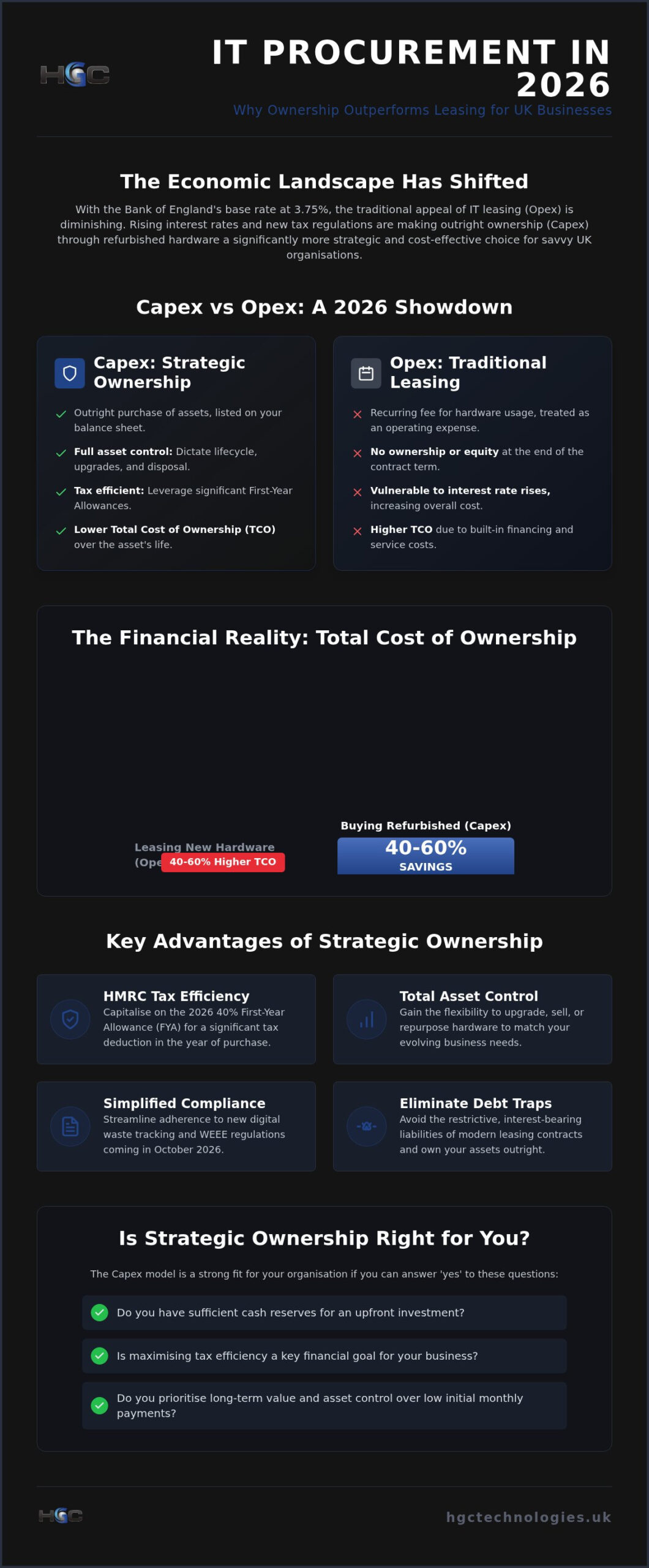
The decision to procure technology through Capital Expenditure (Capex) or Operating Expenditure (Opex) is no longer just a matter of accounting preference. It’s a strategic choice that dictates your firm’s long-term agility and financial health. Understanding Capex vs Opex is fundamental for any technical decision-maker tasked with managing a modern fleet. Capex involves the outright purchase of equipment, such as bulk Dell or Lenovo laptops, which then reside on your balance sheet as a fixed asset. Conversely, Opex models treat hardware as a service, where you pay a recurring fee to use equipment you don’t own. In 2026, the UK market has seen a distinct pivot back toward ownership. With the Bank of England base rate holding at 3.75% as of June 2026, the hidden costs of financing through Opex leases have become increasingly difficult for CFOs to justify. This shift in capex vs opex IT hardware UK strategy reflects a growing desire for asset lifecycle control and the capture of residual value.
Accounting differences between these two models are stark. Capex purchases are capitalised on the balance sheet and depreciated over their useful life, whilst Opex payments are typically treated as monthly operating expenses on the profit and loss (P&L) statement. This choice impacts everything from your corporation tax liability to your company’s debt-to-equity ratio. In a climate where every penny of the budget must be defended, the transparency of ownership is winning over the complexity of long-term rental agreements.
The Financial Impact of Capex Ownership
Ownership provides a level of asset control that leasing simply cannot match. When you purchase hardware outright, you dictate the lifecycle, maintenance schedule, and eventual disposal. In UK accounting, these items are treated as depreciating assets. Whilst the value on paper decreases over time, the real-world utility of high-spec ex-corporate hardware often outlasts the accounting lifecycle. Capex for IT hardware is defined by the immediate acquisition of full asset control and the elimination of ongoing interest-bearing liabilities. Businesses can now take advantage of the new 40% First-Year Allowance (FYA) introduced in January 2026, allowing for significant tax deductions in the year of purchase. This makes the outright purchase of refurbished units a highly tax-efficient move for the current financial year.
The Predictability of Opex Leasing
Many UK organisations historically favoured Opex for its perceived predictability. It’s an attractive proposition for startups or firms with volatile cash flows who need to preserve capital for core operations. However, this predictability comes at a steep price. Over a standard 36-to-48-month refresh cycle, the Total Cost of Ownership (TCO) for leased units often exceeds the cost of outright purchase by a substantial margin. You are essentially paying for the convenience of a rental agreement. As interest rates on business loans start at approximately 6% in mid-2026, the “interest-free” veneer of many Opex programmes has largely vanished. This leaves businesses with expensive, long-term commitments that offer zero equity at the end of the term.
Leasing Laptops vs Buying Refurbished UK: A Direct Comparison
Comparing the acquisition of 100 new leased units against 100 bulk refurbished units reveals a stark contrast in financial trajectory. Whilst leasing often presents a lower day-one cost, it tethers your organisation to a rigid payment schedule that rarely accounts for the actual utility of the hardware. In the current capex vs opex IT hardware UK landscape, the “low monthly cost” of Opex can be deceptive. A fleet of refurbished laptops from premium lines like the Dell Latitude or Lenovo ThinkPad series provides the same enterprise-grade performance for a fraction of the total commitment. This upfront Capex investment eliminates the debt burden and allows your procurement team to focus on performance rather than monthly interest payments.
Flexibility is where the Capex model truly outshines leasing. When you own your hardware, you retain the right to sell, upgrade, or repurpose it as your business evolves. If your team expands or a specific department requires higher specs, you aren’t stuck in a restrictive contract. You can simply trade in your existing assets. Many organisations find that sourcing bulk refurbished laptops provides the necessary agility to scale without the financial friction of early lease termination fees.
Total Cost of Ownership (TCO) Breakdown
A standard three-year refresh cycle highlights the hidden costs of the Opex model. With typical business loan interest rates starting at 6% in 2026, and often reaching much higher for IT-specific leases, the total amount paid over 36 months frequently dwarfs the original retail price. Admin fees and mandatory “service” charges further inflate the cost. Conversely, Capex ownership allows you to capture the residual value of the asset. At the end of three years, an owned Dell or HP laptop still holds significant resale value on the secondary market. This residual return effectively lowers your TCO, whereas a lease leaves you with zero equity at the end of the term.
Tax Efficiency and HMRC Capital Allowances
UK tax legislation in 2026 offers compelling reasons to choose Capex. Under the Annual Investment Allowance (AIA), most UK businesses can claim 100% of the cost of IT hardware, including refurbished equipment, against their taxable profits in the year of purchase. This allowance covers expenditure up to £1,000,000, which is more than sufficient for most SME fleet refreshes. If your organisation isn’t eligible for full expensing, the new 40% First-Year Allowance introduced in January 2026 provides another powerful route to immediate tax relief.
Choosing refurbished gear also aligns with the UK Government’s circular economy strategy, which encourages the re-use of devices to meet national sustainability goals. By purchasing ex-corporate hardware, you aren’t just saving money; you’re actively participating in a more responsible procurement cycle. To ensure you maximise these benefits, we always recommend consulting with a qualified accountant to optimise your specific hardware tax strategy based on the latest HMRC rates.
The Strategic Advantage of Bulk Refurbished Hardware
Ownership is now affordable. For many UK SMEs, the primary deterrent for choosing Capex over Opex was the substantial upfront capital required to refresh a fleet with brand-new machines. Bulk refurbished hardware effectively removes this barrier. By sourcing equipment that has already undergone its primary depreciation cycle, you bypass the most expensive years of an asset’s life. In the capex vs opex IT hardware UK comparison, refurbished gear represents a “third way” that combines the low entry cost of a lease with the long-term equity of ownership. You can often secure a Grade A enterprise laptop for roughly the same cost as a single year’s leasing payments on a new unit.
Performance doesn’t have to suffer for the sake of the budget. Grade A refurbished units from premier lines like the Dell Latitude, Lenovo ThinkPad, or HP EliteBook are built to much higher standards than the consumer-grade laptops found in high-street retailers. These machines feature magnesium alloy chassis, spill-resistant keyboards, and superior thermal management. They are designed for 40-plus hour work weeks, meaning a three-year-old corporate machine will often outlast a brand-new “budget” consumer model. Choosing refurbished allows you to access these premium specifications for 40-60% less than the original retail price.
Enterprise-Grade Quality at Scale
Maintaining consistency across a growing team is a common procurement challenge. When you buy in bulk, you ensure that every staff member uses identical hardware, which simplifies IT support and driver management. Bulk Dell refurbished laptops are a staple for UK offices because of their modular design and ease of repair. Sourcing these in large batches allows your internal IT team to maintain a “gold image” for deployments, reducing the time spent on individual setup and troubleshooting. This level of uniformity is often difficult to achieve with ad-hoc purchases or restrictive leasing pools.
Sustainability and the Circular Economy
Procurement is no longer just about the bottom line; it’s about responsibility. Meeting ESG (Environmental, Social, and Governance) goals is a priority for modern UK organisations. The carbon footprint of manufacturing a single new laptop is significant, often exceeding 300kg of CO2. By opting for wholesale refurbished computers UK, you extend the lifecycle of existing technology and drastically reduce your company’s e-waste contribution. This shift towards a circular economy model doesn’t just look good on a sustainability report. It demonstrates a forward-thinking approach to resource management that resonates with clients and stakeholders alike.
Decision Framework: Which Model Suits Your Organisation?
Selecting the right financial model requires more than a simple spreadsheet calculation. It demands an honest assessment of your operational reality. A robust capex vs opex IT hardware UK decision framework should guide you through five critical milestones before you commit your budget. This methodical approach ensures that your procurement strategy aligns with both your current cash flow and your long-term growth objectives.
- Step 1: Assess your cash reserves. Review your balance sheet. If your organisation has healthy cash reserves, the long-term savings of Capex ownership are undeniable. If you rely on monthly revenue stability to cover every operational cost, Opex might be your only path, despite the higher total cost.
- Step 2: Audit your technical capacity. Owning your fleet means your team is responsible for the lifecycle. Determine if you have the internal resource to manage maintenance, or if you prefer the “hands-off” nature of a managed lease.
- Step 3: Question the 24-month refresh myth. Most enterprise workflows don’t require the bleeding edge of processor technology every two years. High-quality refurbished units often serve a business perfectly for four or five years, significantly boosting your ROI.
- Step 4: Verify tax eligibility. Consult your tax advisor to check your eligibility for UK Capital Allowances. Ensure your business can claim the 100% Annual Investment Allowance or the 40% First-Year Allowance available in 2026.
- Step 5: Benchmark market rates. Request detailed quotes from a wholesale laptop distributor UK to see the real-world price difference between leasing new and buying refurbished.
The “Green Opex” vs “Green Capex” debate is also a vital consideration in 2026. Whilst leasing companies often claim sustainability through hardware returns, “Green Capex” through refurbished procurement is frequently superior. It prevents the carbon-intensive manufacturing of new units entirely and keeps existing high-quality machines in the circular economy for longer. Take the first step in optimising your procurement by exploring our bulk refurbished hardware inventory today.
When to Choose the Capex Refurbished Model
This path is ideal for established organisations seeking maximum ROI. It serves as the antidote to high-interest debt cycles and restrictive contracts. Ownership is particularly beneficial for companies that want to avoid the 6% to 20% interest rates typical of the 2026 business loan market. Furthermore, if your operations require custom built business PCs or specialised server configurations, the Capex model allows for bespoke tailoring that leasing companies rarely permit.
When Opex Might Still Make Sense
Opex remains a viable tool for specific scenarios. Early-stage start-ups with limited capital and no established credit history often find leasing the only way to secure necessary equipment. It also suits teams scaling so rapidly that hardware requirements change month-to-month, making asset ownership a potential logistical burden. Finally, it remains a choice for organisations with absolutely zero internal IT resource who require the maintenance packages often bundled into Opex “as-a-service” agreements.
Securing Your IT Future with HGC Technologies UK Ltd.
Selecting the right procurement model is only half the battle; the second half is finding a supplier that respects your bottom line. HGC Technologies UK Ltd. operates as the premier partner for UK organisations that have recognised the strategic superiority of ownership. We don’t offer complex leasing agreements or high-interest financing. Instead, we focus on transparent, outright sales that allow you to bypass the debt cycles discussed in this guide. This approach ensures you maintain full asset control whilst avoiding the hidden fees and administrative burdens of Opex-based models. In the evolving capex vs opex IT hardware UK landscape, our goal is to provide the high-quality infrastructure your business needs without the financial friction of traditional credit.
Our inventory is curated to meet the demands of modern enterprise workloads. We specialise in bulk batches of Grade A equipment from the world’s most reliable manufacturers. Whether you are seeking bulk Lenovo refurbished laptops for a remote workforce or high-end HP and Dell workstations for intensive processing, we provide the scale and consistency required for a professional rollout. By focusing on ex-corporate machines, HGC Technologies UK Ltd. ensures that every unit in your Capex investment meets a standard of durability that consumer-grade alternatives simply cannot match.
Wholesale Expertise You Can Trust
Quality assurance is the cornerstone of our operations. Every refurbished unit undergoes a rigorous testing and certification process to ensure it performs as intended from day one. We operate a direct supply model, which means we eliminate unnecessary middlemen to pass the maximum possible savings on to your organisation. This streamlined approach to procurement allows your budget to go significantly further, often enabling you to refresh a larger portion of your fleet than initially planned. With UK-wide delivery and dedicated support, HGC Technologies UK Ltd. serves national enterprises and resellers with the speed and precision that the fast-moving technology sector demands.
Custom Solutions for Enterprise Needs
We understand that off-the-shelf solutions don’t always fit specific technical requirements. That’s why we offer bespoke PC and server builds designed to handle your unique workloads. Our technical team works closely with you to specify components that align with your operational goals. Beyond laptops and desktops, we also support mobile workforces by sourcing original smartphones wholesale UK. This comprehensive approach to hardware procurement ensures that every facet of your IT estate is built on a foundation of quality and value. Contact HGC Technologies UK Ltd. today for a tailored quote that fits your Capex budget and secures your organisation’s technological future.
Future-Proof Your Procurement Strategy
The economic climate of 2026 has made the transition from passive leasing to active asset management a necessity rather than a choice. By prioritising ownership, your organisation escapes the burden of rising interest rates whilst capturing the full residual value of enterprise-grade equipment. We’ve explored how refurbished Dell, HP, and Lenovo units provide the high-level performance required for modern workloads at a fraction of the cost of new leased fleets. This strategic pivot fundamentally redefines the capex vs opex IT hardware UK debate, shifting the focus from temporary cash flow ease to long-term financial resilience and sustainability.
HGC Technologies UK Ltd. acts as your specialist partner in this transition. We provide guaranteed Grade A refurbished quality and direct wholesale prices without the hidden interest or fees of a lease. Our methodical approach to refurbishment ensures that every bulk procurement reflects the high standards your business deserves. Take control of your technology lifecycle and build a more profitable, responsible future today.
Optimise your IT budget with HGC Technologies UK Ltd.: Browse our bulk refurbished range
Frequently Asked Questions
What is the main difference between Capex and Opex for IT hardware?
Capital Expenditure (Capex) involves the outright purchase of hardware, making it a fixed asset on your balance sheet. Operating Expenditure (Opex) involves leasing or subscribing to equipment as a monthly service. The capex vs opex IT hardware UK choice fundamentally changes whether you own the technology or simply pay for its temporary use.
Is buying refurbished laptops better for my balance sheet than leasing?
Ownership is generally superior for balance sheet health because it builds company equity. Unlike a lease, which represents a continuous liability, owned assets increase your total asset value. This can improve your creditworthiness and make your financial position more attractive to investors or lenders during future funding rounds.
Can UK businesses claim tax back on refurbished IT equipment?
UK businesses can claim significant tax relief on refurbished equipment through Capital Allowances. You can deduct the cost of qualifying hardware from your taxable profits, reducing your overall corporation tax bill. This applies to both new and refurbished ex-corporate machines used for business purposes within the UK.
Why is leasing laptops often more expensive than buying refurbished in the long run?
Leasing involves interest rates, management fees, and the lessor’s profit margin, which accumulate over the contract term. Refurbished hardware costs significantly less upfront and carries no ongoing interest. By avoiding these finance charges, your total cost of ownership remains predictable and substantially lower over a standard three-year cycle.
Does refurbished hardware qualify for the Annual Investment Allowance (AIA)?
Refurbished IT hardware fully qualifies for the Annual Investment Allowance (AIA) in the UK. This allows your business to claim 100% of the purchase cost against taxable profits in the first year, up to the current £1,000,000 threshold. It’s an exceptionally efficient way to refresh your fleet whilst minimising tax liability.
What happens to the hardware at the end of an Opex leasing contract?
You typically return the equipment to the leasing company at the end of the term. This leaves your organisation with no residual value and often results in additional charges for wear and tear. You are then forced to start a new lease, creating a perpetual cycle of debt with zero asset ownership.
How do I transition from a leasing model to a Capex ownership model?
Start by auditing your upcoming lease expirations and replacing those units with bulk refurbished purchases. This phased approach allows you to transition to a capex vs opex IT hardware UK model that suits your cash flow. It eliminates the need for a massive single-day capital outlay whilst steadily building your owned asset base.
Is refurbished hardware as reliable as new equipment for corporate use?
Grade A ex-corporate hardware is often more reliable than brand-new consumer machines because it’s built to enterprise standards. These units feature robust magnesium alloy chassis and high-end internal components designed for continuous professional use. Every unit is rigorously tested to ensure it meets strict performance benchmarks before being deployed to your team.

Managing Mixed-Age Laptop Fleets: Guide for UK IT Teams
Maintaining a patchwork of hardware is often viewed as a necessary cost-saving measure, yet the hidd

Refurbished Laptop Grading Standards UK: The 2026 Procurement Guide
A "Grade A" laptop from one wholesaler is frequently a "Grade B" disappointment from another, forcin

What to Check When Buying Bulk Used Laptops: A 2026 Procurement Checklist
A single BIOS lock in a batch of fifty laptops isn't just a technical hurdle; it's a complete write-
Comments are closed.