

Managing Mixed-Age Laptop Fleets: Guide for UK IT Teams
Maintaining a patchwork of hardware is often viewed as a necessary cost-saving measure, yet the hidden drain on your IT resources suggests otherwise. When your department is stretched between supporting legacy machines and deploying the latest NPU-equipped models, the resulting friction can cripple productivity. Managing a mixed-age laptop fleet shouldn’t feel like a constant battle against driver conflicts and security gaps. It’s a complex balancing act that requires more than just reactive fixes; it demands a strategic approach to hardware lifecycle management.
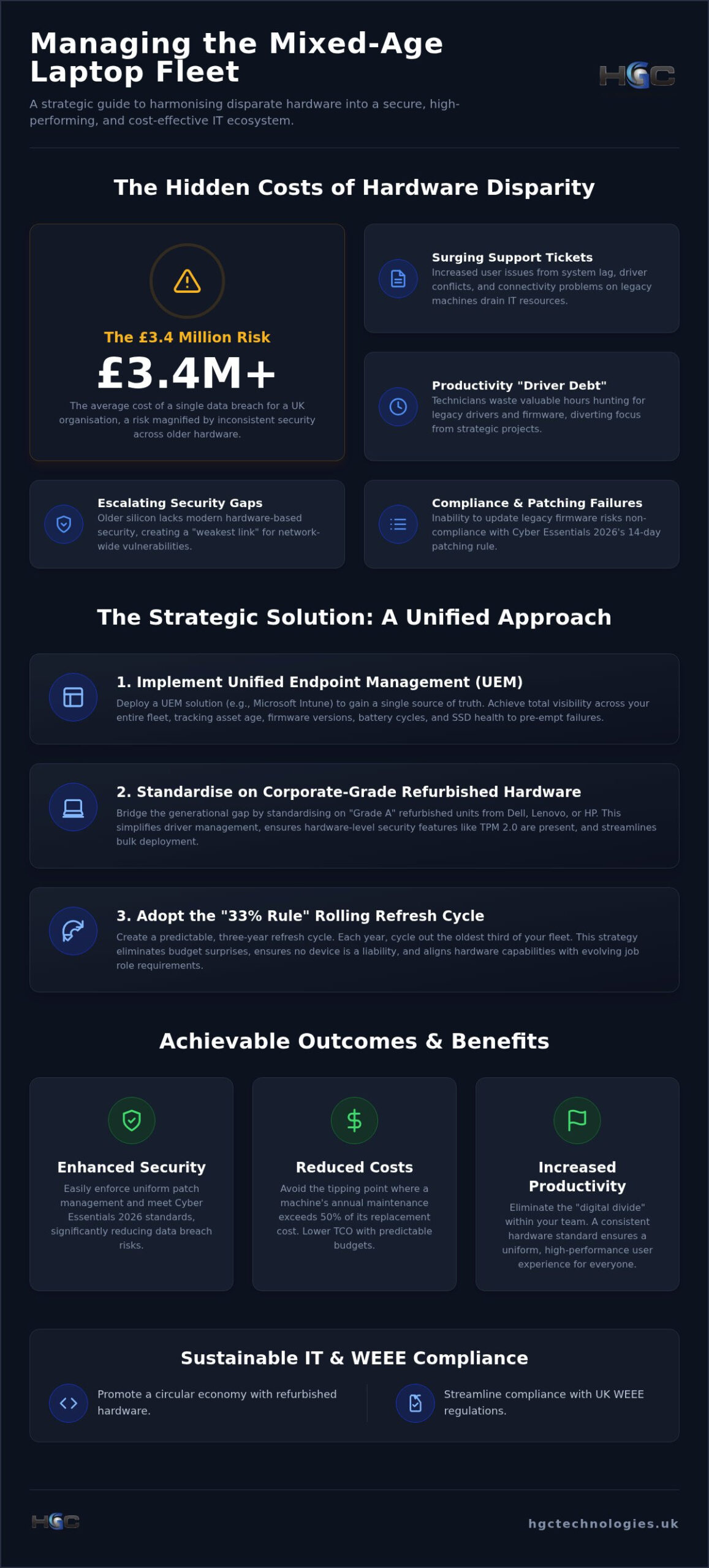
You probably agree that the current landscape of hybrid work and evolving threats makes hardware consistency feel like a distant dream. With the average cost of a UK data breach now exceeding £3.4 million, the stakes for your security compliance have never been higher. This guide will show you how to harmonise disparate hardware generations into a secure, high-performing ecosystem whilst significantly reducing procurement costs. We’ll explore how standardising on corporate-grade refurbished units can bridge the generational gap, ensure your team meets the 14-day patching requirements of Cyber Essentials 2026, and streamline your compliance with the latest WEEE regulations.
Key Takeaways
- Identify the hidden operational costs and support ticket surges caused by hardware disparity within your organisation.
- Discover how to implement a Unified Endpoint Management (UEM) strategy for effectively managing a mixed-age laptop fleet whilst maintaining total visibility.
- Learn why standardising on “Grade A” refurbished Dell, Lenovo, or HP units simplifies driver management and enhances security compliance.
- Master the “33% Rule” to create a predictable, cost-effective hardware refresh cycle that aligns with specific job role requirements.
- Understand the strategic advantages of bulk procurement for harmonising disparate hardware generations into a high-performing IT ecosystem.
Understanding the Challenges of a Mixed-Age Laptop Fleet
A mixed-age fleet is often the legacy of staggered procurement cycles, rapid hiring phases, or reactive IT spending. In the UK, many organisations find themselves balancing 2026-era NPU-equipped laptops alongside five-year-old machines that predate the hybrid work revolution. Managing a mixed-age laptop fleet creates a fragmented environment where IT teams are forced to juggle multiple hardware standards simultaneously. This isn’t just an administrative headache; it’s a persistent drain on your most valuable technical resources.
The financial drain of hardware disparity isn’t always obvious on a balance sheet. It manifests in “driver debt,” where IT staff spend hours hunting for legacy firmware to keep older Dell, Lenovo, or HP units compatible with modern software. This fragmentation causes a surge in support tickets, as users on older hardware experience system lag and connectivity issues that their colleagues on newer machines avoid. When your technical experts are busy troubleshooting five-year-old Wi-Fi cards, they aren’t focusing on strategic infrastructure improvements.
Security risks also escalate as hardware ages. Older silicon often lacks the hardware-based security features, such as modern encryption acceleration, required for today’s sophisticated threat landscape. These machines become the “weakest link” in your network, providing a potential entry point for attackers who exploit vulnerabilities that newer processors have already mitigated at the chip level.
The Performance Gap and Employee Productivity
Disparate boot times and processing speeds do more than slow down workflows; they erode team morale. When an employee on an older laptop takes ten minutes to join a video call whilst a colleague is ready in seconds, it creates a “digital divide” within the office. Standardising software loads becomes a nightmare when you’re trying to run the same resource-heavy applications on vastly different RAM and CPU generations. You’ve reached a critical tipping point when the annual maintenance cost of an older unit approaches 50% of the cost of a high-quality refurbished replacement. At this stage, the hardware is no longer an asset; it’s a liability.
Security and Compliance Vulnerabilities
Compliance is the most critical hurdle for fragmented fleets. Modern operating systems frequently require TPM 2.0 for full security functionality, a feature often missing or outdated on legacy machines. Enforcing uniform patch management is nearly impossible when firmware updates for older models are no longer released. To meet the updated Cyber Essentials 2026 standards, UK businesses must ensure all critical patches are applied within 14 days. If your legacy hardware can’t support these updates, you’re risking a non-compliance penalty and increasing the likelihood of a data breach, which currently costs UK firms an average of over £3.4 million.
Implementing Unified Management for Total Fleet Visibility
Achieving total visibility is the first step toward effectively managing a mixed-age laptop fleet. Without a centralised dashboard, your IT team is essentially flying blind, reacting to failures rather than preventing them. A robust Unified Endpoint Management (UEM) solution, such as Microsoft Intune or ManageEngine Endpoint Central, allows you to bridge the gap between legacy hardware and modern cloud-native devices. These tools provide a single source of truth, categorising every asset by model, purchase date, and current firmware version.
Automating the onboarding process is essential for maintaining this visibility. Whether you’re integrating brand-new units or high-quality refurbished Dell or Lenovo laptops, zero-touch provisioning ensures that every device enters the ecosystem with the correct security profiles. You should also configure your UEM to track physical wear indicators. Monitoring battery cycle counts and SSD health across the entire lifecycle allows you to identify failing components before they result in unplanned downtime or data loss.
Standardising the Software Image
Consistency across a fragmented fleet depends on a hardware-agnostic deployment strategy. Cloud-based tools like Windows Autopilot enable you to deliver a uniform user experience regardless of whether the machine was manufactured in 2021 or 2026. The primary challenge lies in managing driver packages for multiple generations of hardware. Driver Injection is a method where specific hardware drivers are added to a deployment image during the installation process to ensure fleet-wide stability across different models. By maintaining a curated library of verified drivers for your core Dell and HP models, you eliminate the “blue screen” errors that often plague older machines running modern operating systems.
Real-Time Monitoring and Proactive Maintenance
Proactive maintenance turns a reactive support desk into a strategic asset. Set up automated alerts for hardware failure signals, such as thermal throttling or recurring disk errors, which are more common in older silicon. Tracking “last seen” timestamps and real-time patch status is vital for eliminating security dark spots where legacy machines might have fallen out of compliance. Regular remote health checks and automated disk clean-ups can significantly extend the operational life of older units. This methodical approach ensures that even your oldest machines meet the rigorous 14-day patching requirements mandated by Cyber Essentials 2026, keeping your entire ecosystem resilient against evolving threats.
Maintenance Strategies to Harmonise Disparate Hardware
Brand standardisation is the bedrock of a stable IT infrastructure. When you limit your environment to Dell, Lenovo, or HP, you drastically reduce the variety of firmware and drivers your team must manage. These manufacturers provide enterprise-grade support cycles that often outlast consumer models by several years. Establish a “Grade A” standard for all refurbished additions to ensure aesthetic and functional parity across the board. This prevents a “digital divide” where staff feel disadvantaged by older hardware. For roles requiring extreme processing power, integrating custom-built PCs into your ecosystem can relieve the pressure on your laptop fleet, allowing portable units to be reserved for mobile users. Managing a mixed-age laptop fleet becomes significantly easier when the hardware foundation is built on reliable, corporate-grade silicon.
Component Upgrades vs Replacement
Deciding whether to revive or retire a device is a calculation of long-term value. For a three-year-old laptop, a simple RAM upgrade to 32GB or a transition to a faster NVMe SSD can provide a performance boost that rivals 2026 entry-level models. However, the cost-benefit analysis shifts for four-year-old units, particularly regarding battery health. If a replacement battery costs more than 20% of the unit’s residual value, procurement is often the wiser path. Partnering with a reputable wholesale laptop distributor UK ensures you have a reliable pipeline for these Grade A units when upgrades are no longer viable. This approach allows you to maintain a high performance floor without the capital expenditure of a total fleet replacement.
Managing Firmware and BIOS Divergence
Firmware consistency is the final piece of the harmonisation puzzle. Centralising BIOS updates through manufacturer-specific tools, such as Dell Command or HP Image Assistant, prevents generational security gaps from forming. This is especially critical for meeting the 14-day patching window required by Cyber Essentials 2026. Proprietary charging standards also pose a significant hurdle in mixed fleets. By narrowing your hardware to just two primary brands, you can standardise on universal USB-C docking stations. This reduces cable clutter and support tickets whilst ensuring that your IT team isn’t bogged down by a dozen different power adapter variants. A methodical maintenance schedule, combined with brand discipline, turns a fragmented fleet into a unified, high-performing asset.
Developing a Cost-Effective Rolling Refresh Cycle
Budget stability is often the greatest casualty of a reactive IT policy. When an entire fleet reaches obsolescence simultaneously, the resulting capital expenditure spike can derail other strategic projects. Adopting the 33% Rule ensures a predictable financial rhythm by refreshing one-third of your hardware every year. This methodical approach to managing a mixed-age laptop fleet prevents the accumulation of technical debt whilst ensuring your users always have access to functional, secure technology. You can then categorise users based on their specific performance needs. High-demand roles, such as developers or data analysts, receive the latest NPU-equipped units, whilst administrative staff remain productive on high-quality, three-year-old corporate models.
Planning for End of Life (EOL) dates is equally vital. Because the 2026 landscape requires strict adherence to modern OS security standards, you must identify which processor generations can no longer support mandatory encryption or 14-day patching cycles. Leveraging the secondary market for your decommissioned units allows you to recoup residual value, which can then be reinvested into your next procurement phase. This creates a self-sustaining cycle that reduces the net cost of every new acquisition.
Budgeting for Hardware without Financing
Calculating the Total Cost of Ownership (TCO) reveals that direct purchase models frequently offer a superior return on investment compared to restrictive leasing programmes. By avoiding long-term interest and hidden fees, you retain full control over your assets and their eventual disposal. Maintaining a buffer stock of bulk refurbished Dell or Lenovo laptops allows for rapid deployment when new hires join or hardware fails unexpectedly. This strategy ensures your operations never grind to a halt due to supply chain delays or component shortages, providing a level of agility that new-only procurement cannot match.
The Sustainable IT Lifecycle
Sustainability is no longer a peripheral concern; it’s a core corporate responsibility. Implementing a circular hardware policy reduces your organisation’s carbon footprint by extending the useful life of silicon through professional refurbishment. When devices finally reach the end of their functional life, you must comply with the 2026 WEEE regulations. This involves using licensed waste carriers and retaining duty of care certificates for all e-waste. Secure data destruction is non-negotiable. Given that the average cost of a UK data breach now exceeds £3.4 million, a simple factory reset is insufficient. Ensure every retired asset undergoes a certified data-wipe to maintain your GDPR compliance and protect your corporate reputation.
Sourcing Reliable Bulk Hardware to Harmonise Your Fleet
Strategic procurement is the final engine of fleet harmony. Buying in bulk allows your IT team to replace fragmented, consumer-grade models with uniform, corporate-grade silicon that shares a common driver set. This approach is the most effective method for managing a mixed-age laptop fleet because it eliminates the unpredictability of one-off, reactive purchases. Ex-corporate units from Dell, Lenovo, and HP remain the industry’s gold standard for a reason. They’re engineered for longevity, ease of repair, and extended firmware support cycles that consumer models simply don’t offer. When you source through a dedicated UK wholesaler, you’re not just buying hardware; you’re securing a predictable foundation for your entire ecosystem.
Standardising on Trusted Brands
Consistency is the primary antidote to support ticket surges. By focusing your procurement on a narrow selection of enterprise models, you simplify the administrative burden on your technical staff. Choosing bulk Dell refurbished laptops provides your team with reliable Latitude or Precision units known for their modular design and robust BIOS management tools. For organisations that prize keyboard ergonomics and legendary durability, bulk Lenovo refurbished laptops offer the ThinkPad’s proven track record in hybrid work environments. Wholesale HP EliteBook options further round out a standardised office environment, ensuring that every user, regardless of their machine’s age, experiences a premium build quality. For specialised enterprise needs that go beyond the laptop, integrating custom-built PCs and dedicated server solutions ensures your high-performance infrastructure remains as stable as your mobile fleet.
Ensuring Quality with Professional Refurbishment
Grade A certification is non-negotiable for corporate hardware deployment. This grading ensures that every unit meets a strict aesthetic and functional standard, preventing the “hand-me-down” perception that can damage employee morale. Professional refurbishment must include the use of authentic components; third-party batteries or substandard screens can compromise the 2026 security and performance standards we’ve discussed. HGC Technologies UK Ltd. specialises in this high-tier procurement, acting as a knowledgeable guide for UK resellers and corporate IT teams. By providing a direct sales model for ex-corporate Dell, Lenovo, and HP units, we help you bridge the generational gap without the complexities of leasing programmes. This methodical sourcing strategy ensures that your mixed fleet operates as a single, high-performing asset that meets every UK compliance requirement whilst protecting your bottom line.
Future-Proofing Your IT Infrastructure with Strategic Procurement
Successfully managing a mixed-age laptop fleet requires shifting from reactive repairs to a proactive lifecycle strategy. By implementing unified management tools and adhering to strict brand standardisation, you can eliminate the friction of hardware disparity. This methodical approach ensures your budget remains predictable whilst your team stays productive on reliable, corporate-grade silicon. Transitioning to a circular hardware model isn’t just about cost savings; it’s about building a resilient, sustainable ecosystem that meets modern security standards without the need for restrictive leasing programmes.
HGC Technologies UK Ltd. has been an authoritative expert in enterprise-grade hardware since 2020. We specialise in Grade A refurbished Dell, Lenovo, and HP units, providing UK-wide delivery on all bulk orders to help you standardise your environment with ease. Sourcing bulk refurbished laptops for your fleet? Explore our wholesale range today. You have the power to turn a fragmented inventory into a high-performing asset that drives your organisation forward with confidence and clarity.
Frequently Asked Questions
What are the main risks of managing a mixed-age laptop fleet?
Primary risks include security vulnerabilities in legacy silicon and the “driver debt” of maintaining multiple firmware versions. Inconsistent user experiences often lead to higher support ticket volumes and reduced employee morale. Failing to meet the 14-day patching requirements of Cyber Essentials 2026 is a significant compliance risk for those managing a mixed-age laptop fleet without a unified strategy.
How often should a UK business refresh its laptop hardware?
Most UK businesses should aim for a three to four-year refresh cycle to maintain performance and security. Adopting a “33% Rule” allows you to replace one-third of your hardware annually, ensuring budget stability. This methodical approach prevents technical debt from accumulating whilst keeping your workforce equipped with modern, high-performing technology that supports the latest operating system requirements.
Can I manage Windows and Mac laptops in the same fleet effectively?
Yes, you can manage both effectively using modern Unified Endpoint Management (UEM) tools like Microsoft Intune or Omnissa Workspace ONE. These platforms provide a single dashboard to enforce security policies and software deployments across different operating systems. Standardising your configurations ensures that all users receive a consistent experience regardless of their hardware choice, reducing the administrative burden on your IT team.
Is it better to buy new or refurbished laptops for a growing team?
Refurbished corporate-grade laptops often provide a superior ROI for growing teams compared to consumer-grade new units. Grade A refurbished Dell, Lenovo, and HP models offer the same durability and enterprise features at a significantly lower cost. This allows you to standardise your fleet quickly whilst preserving capital for other strategic IT projects without sacrificing hardware reliability or build quality.
What software is best for managing a disparate hardware fleet?
Microsoft Intune and ManageEngine Endpoint Central are leading choices for 2026. These UEM solutions excel at managing a mixed-age laptop fleet by providing granular control over driver updates and security patches. They offer the visibility needed to track hardware health and compliance across disparate hardware generations from a single pane of glass, which is essential for proactive maintenance.
How do I ensure data security when offboarding old laptops?
You must use certified data destruction software that meets UK GDPR and WEEE requirements. A standard factory reset is insufficient for corporate data; instead, employ tools that provide a certificate of destruction for every retired asset. This protects your organisation from the financial and reputational damage of a data breach, which now costs UK firms over £3.4 million on average.
Does a mixed-age fleet increase IT support costs significantly?
Support costs typically rise as hardware ages due to increased failure rates and complex troubleshooting. Fragmented fleets require IT staff to manage multiple driver sets and proprietary charging standards, which drains technical resources. Standardising on two primary brands and using high-quality refurbished units helps to mitigate these rising operational expenses by creating a more predictable and manageable environment.
What is the most cost-effective way to standardise an aging laptop fleet?
Bulk procurement of Grade A refurbished laptops is the most cost-effective standardisation strategy. By purchasing identical ex-corporate models, you create a uniform hardware baseline that simplifies deployment and maintenance. This approach allows you to harmonise your fleet’s performance without the massive capital outlay required for a total fleet replacement with brand-new machines, ensuring long-term fiscal stability.

Laptops for Temp Staff & Contractors: 2026 UK Guide
Procuring brand-new hardware for short-term projects is no longer a sustainable strategy for the agi

How Refurbished IT Impacts Business Cash Flow: A 2026 Strategic Guide
Your next fleet of enterprise laptops could be a drain on your balance sheet or a catalyst for growt

Sourcing Older Laptop Models for Compatibility: A 2026 Guide
A laptop with the right model name can still fail to run the software or connect to the peripherals