
How to Choose Refurbished Laptops for Resale: The 2026 Professional Guide
Profitable hardware resale is built on the consistency of ex-corporate stock rather than the unpredictable nature of consumer-grade bargains. When you are choosing refurbished laptops for resale in 2026, the margin between a successful quarter and a logistical nightmare often depends on the technical standards of your sourcing partner. You likely recognise the frustration of receiving a shipment where “Grade A” feels like a suggestion rather than a standard, or managing high return rates because batteries simply can’t hold a charge. It’s a common challenge that can quickly erode your bottom line.
This guide will help you master the art of sourcing high-margin, reliable hardware that meets 2026 technical requirements, such as Windows 11 version 26H1 compatibility. We’ll provide a repeatable sourcing framework focused on premium Dell, Lenovo, and HP inventory that protects your margins and minimises failure rates. You will learn how to identify ex-corporate stock that keeps your customers coming back whilst ensuring your inventory remains relevant in a market shaped by new right-to-repair laws and strict corporate sustainability reporting.
Key Takeaways
- Learn to distinguish professional refurbishment from standard second-hand sales to build a reputation for reliability and transparency in the B2B market.
- Master the technical requirements for 2026, ensuring every unit in your inventory is fully compatible with the latest Windows 11 security updates and performance benchmarks.
- Develop a rigorous framework for choosing refurbished laptops for resale that prioritises consistent grading standards and eliminates the risk of high return rates.
- Discover why focusing on ex-corporate stock from Dell, HP, and Lenovo provides the best balance of performance, repairability, and long-term resale value.
- Establish a scalable procurement strategy that moves your business beyond fragmented marketplace buys into professional, high-margin wholesale operations.
The Fundamentals of Sourcing Refurbished Laptops for Resale
Profitability in the secondary hardware market is not found in the bargain bin. Instead, it resides in the predictable performance of high-specification machines retired from corporate environments. Success in choosing refurbished laptops for resale requires a shift from a consumer mindset to a professional procurement strategy. Whilst a consumer looks for the lowest price on a single unit, a professional reseller looks for batch consistency and a verifiable chain of custody. In 2026, the market demands absolute transparency. Buyers are no longer satisfied with vague descriptions; they require assurance that their hardware meets modern security standards and remains compatible with the latest OS builds.
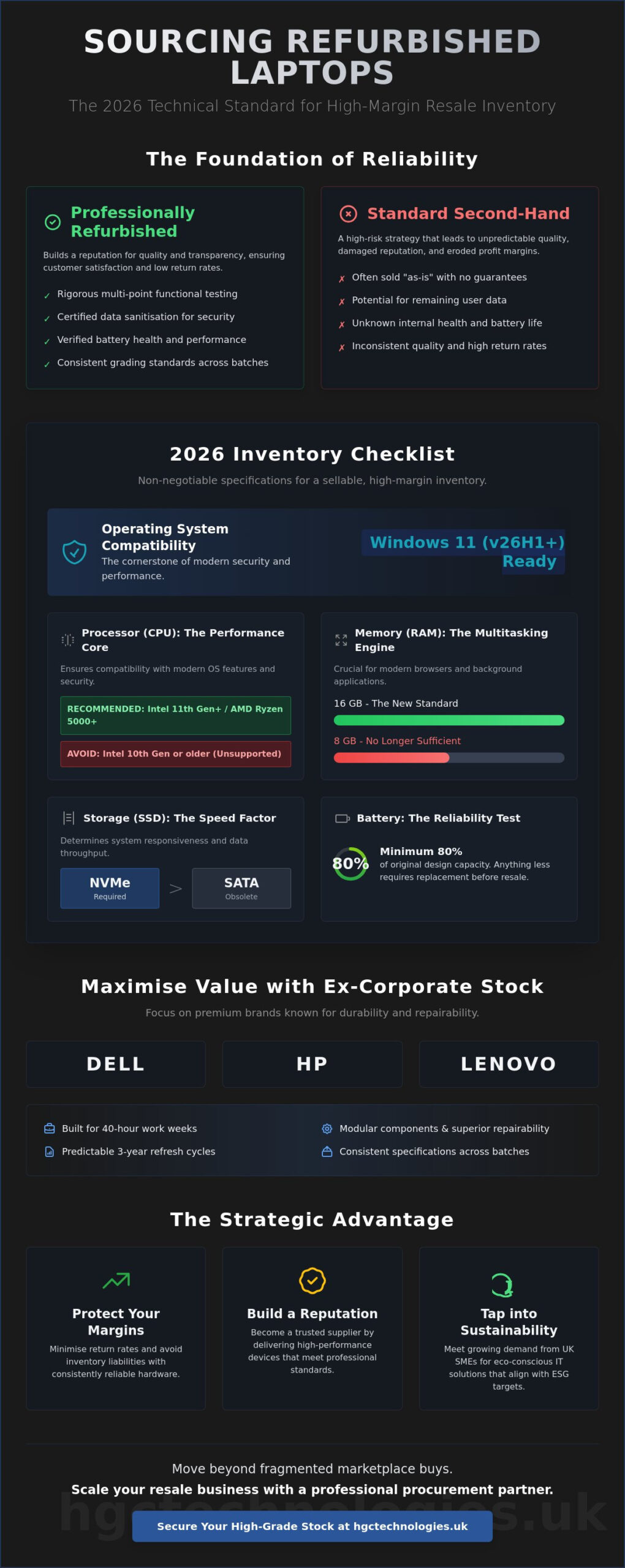
Specialising in ex-corporate hardware provides a distinct strategic advantage. These machines, typically sourced from Fortune 1000 refresh cycles, are built with premium materials designed for 40-hour work weeks. Unlike consumer models found in high-street shops, business-grade laptops from Dell, HP, and Lenovo offer superior repairability and modular components. Understanding the IT asset lifecycle is crucial. Most large organisations refresh their fleets every three years, which means the secondary market is currently seeing a steady influx of 11th and 12th-generation Intel units. These machines are the “sweet spot” for resellers, offering the perfect balance of modern performance and accessible wholesale pricing.
Refurbished vs. Used: Why the Distinction Matters for Your Reputation
Your reputation as a reseller depends entirely on the distinction between a “used” laptop and a professionally refurbished one. A used device is often sold “as-is” with no guarantee of internal health or data security. Professional Refurbishment (electronics) involves a rigorous multi-point inspection, including battery health diagnostics, thermal management checks, and certified data sanitisation. Selling unvetted stock from random marketplaces is a high-risk strategy that leads to inconsistent grading and unsustainable return rates. When you communicate the value of refurbishment to your customers, you aren’t just selling hardware; you’re selling the peace of mind that comes with a device that has been restored to its peak operational state.
The Rise of Sustainable IT Procurement in the UK
The circular economy has moved from a corporate buzzword to a primary driver of demand amongst UK SMEs. Business owners are increasingly under pressure to meet ESG (Environmental, Social, and Governance) targets, making refurbished hardware an attractive alternative to buying new. Positioning your business as an eco-conscious provider allows you to tap into this growing segment of the market. Extending a laptop’s lifecycle by three years significantly reduces the demand for raw material extraction and prevents the high-energy carbon expenditure required to manufacture a new replacement unit. By choosing refurbished laptops for resale that meet high technical standards, you help your clients reduce their Scope 3 emissions whilst securing your own profit margins.
Essential Technical Specifications for a Sellable Inventory in 2026
Hardware standards have undergone a fundamental shift. For professionals choosing refurbished laptops for resale, the criteria for a “sellable” unit now revolve around operating system longevity and modern interface support. You cannot rely on the hardware baselines of the previous decade. In 2026, a machine that struggles with Windows 11 version 26H1 is a liability rather than an asset. Modern users expect instantaneous responsiveness, which makes certain specifications non-negotiable if you intend to maintain healthy margins and low return rates.
Memory and storage have reached a critical tipping point. Whilst 8GB of RAM was once the gold standard for office work, it is no longer sufficient for a professional resale inventory. Modern browsers and background security applications now consume the majority of that capacity before a user even opens a spreadsheet. You should aim for 16GB as your primary offering. Similarly, standard SATA SSDs are being phased out in favour of NVMe drives. These provide the high-speed data throughput required for modern productivity. A Kearney survey on consumer trends highlights that today’s buyers are more educated about performance metrics than ever before. They won’t accept sluggish hardware, even at a discount.
Connectivity is another area where you cannot afford to compromise. USB-C charging and Thunderbolt support have moved from “premium features” to “essential requirements”. Most corporate environments now use universal USB-C docking stations. If your stock lacks these ports, you’re excluding a massive portion of the B2B market. Sourcing bulk Lenovo refurbished laptops that feature these modern standards ensures your inventory remains compatible with the peripherals your customers already own.
The Windows 11 Threshold: TPM 2.0 and CPU Generations
The most significant hurdle in 2026 is the Windows 11 CPU requirement. You must avoid Intel 7th Generation and older processors entirely. These chips lack the necessary architecture to officially support the latest OS builds, making them obsolete for professional resale. Ensure every unit in your batch features TPM 2.0. This security module is mandatory for Windows 11 and future security updates. Selling hardware that cannot receive official patches is a sure way to destroy customer trust and invite legal complications regarding data security.
Battery Health and Screen Quality Standards
Cosmetic grading is only half the battle. You need to establish a strict 80% minimum battery health threshold for your inventory. Units falling below this mark often lead to immediate complaints and costly returns. Screen quality is equally vital. Train your team to identify pressure marks, “dead pixels”, or backlight bleed that only appears on white backgrounds. Verifying this at scale requires professional diagnostic software that can pull internal health reports from the BIOS, allowing you to vet entire batches of bulk HP refurbished laptops without manually testing every individual key or pixel.
Decoding Refurbished Grades and Batch Consistency
Grading is the universal language of the secondary market, yet it remains one of the most misunderstood areas for those choosing refurbished laptops for resale. Whilst many suppliers claim to offer “Grade A” stock, the reality often varies wildly between batches. To protect your margins, you must establish an internal standard that matches industry expectations. This prevents the “reseller trap” where inconsistent stock leads to unexpected return rates and erodes the trust you’ve built with your client base. A successful resale operation relies on being able to predict exactly what will be inside every box that arrives at your warehouse.
Effective inspection involves separating cosmetic wear from functional integrity. A laptop might have minor scuffs on the outer casing (Grade B cosmetic) but maintain 100% functional health with a pristine screen. Conversely, a “Grade A” exterior could hide thermal throttling or failing keyboard backlights. Adhering to government e-waste guidelines helps frame this process as part of a responsible circular economy. By prioritising refurbishment over recycling, you ensure that high-value components remain in use whilst being transparent about their physical condition. Accurate descriptions are your best defence against customer dissatisfaction; don’t just sell a grade, sell a detailed standard.
Grade A vs. Grade B: Where is the Profit Sweet Spot?
Grade A stock often commands a premium price, but the margins can be tighter due to the high initial procurement cost. The profit “sweet spot” frequently lies in Grade B stock, especially when targeting education or NGO sectors where budget is the primary driver. These clients often accept minor cosmetic imperfections in exchange for high-performance internals. However, avoid the temptation to buy Grade C stock with the intent to refurbish it yourself. The labour costs and part procurement for screen replacements or palm rest repairs often exceed the potential resale value, turning a bargain into a deficit.
The Importance of Batch Consistency in Wholesale
Managing logistics becomes significantly easier when you source uniform batches of the same model. Resellers prefer “clean” lots because they simplify driver management, warranty support, and parts harvesting. It’s far more efficient to support fifty Dell Latitude 7420s than fifty different consumer-grade models. Sourcing through reputable providers of wholesale computers UK ensures you receive consistent grading across bulk orders. This reliability allows you to scale your operations without the headache of individual unit variations, ensuring that your first unit is as high-quality as your five-hundredth.
Strategic Brand Selection: Maximising Resale Value
Market recognition dictates resale velocity. When you are choosing refurbished laptops for resale, your inventory should reflect the brands that IT managers already trust. In the UK corporate landscape, three names dominate: Dell, HP, and Lenovo. These manufacturers control the majority of the enterprise market, which ensures a steady supply of high-quality ex-corporate stock and a robust secondary market for parts. Opting for “niche” or consumer-orientated brands is a common mistake for new resellers. Whilst a boutique brand might offer a high-specification screen, it lacks the professional infrastructure required for scalable business support and long-term repairability.
Repairability is the foundation of a sustainable resale margin. Professional-grade machines are designed to be serviced, with modular components that can be swapped in minutes. This accessibility allows you to upgrade RAM or replace a keyboard without risking damage to the chassis. Brands like Dell and Lenovo provide detailed service manuals and diagnostic tools that simplify the refurbishment process. If you invest in brands with low parts availability, a single failed component can turn a profitable unit into e-waste. Stick to established enterprise lines to ensure your stock remains liquid and your maintenance costs stay predictable.
Dell Latitude and Precision: The Corporate Favourites
Sourcing bulk Dell refurbished laptops is often the safest starting point for any resale operation. The Latitude 5000 and 7000 series are particularly prized for their legendary durability and consistent design language across multiple generations. These machines are built to withstand the rigours of travel and constant use, making them a reliable choice for your end-customers. The widespread standardisation of Dell spare parts ensures that resellers can source replacement components quickly and affordably, protecting long-term margins. For clients requiring high-end performance, the Precision mobile workstations offer significant resale value due to their ISV certifications and powerful thermal management systems.
Lenovo ThinkPad and HP EliteBook: Performance and Style
The Lenovo ThinkPad T-series maintains a dedicated cult following that directly translates into high resale prices and fast turnover. Known for their industry-leading keyboards and robust magnesium alloy roll cages, ThinkPads are often the first choice for developers and writers. Similarly, the HP EliteBook range balances professional aesthetics with enterprise-grade security features like integrated privacy screens and self-healing BIOS. When comparing the top three, HP often leads in modern chassis design, whilst Lenovo is favoured for its tactile user experience. Both brands offer exceptional build quality that far exceeds anything found in the consumer market, ensuring your customers receive a premium product that feels “as new”.
Ready to secure high-demand stock for your business? Explore our latest inventory of professionally refurbished enterprise laptops and start building your high-margin resale portfolio today.
Scaling Your Resale Business with HGC Technologies
Scaling a hardware resale operation requires a fundamental shift in procurement strategy. Moving beyond fragmented marketplace buys allows you to eliminate the variables that often stifle growth. When you are choosing refurbished laptops for resale, the primary objective is to find a partner that provides batch consistency and technical reliability at scale. A professional wholesale model offers the stability needed to forecast your quarterly performance with confidence. By focusing on direct procurement and avoiding the administrative burden of third-party financing or lease-to-own programmes, you maintain a lean operation that can react quickly to market opportunities.
Stock availability is often the biggest bottleneck for growing resellers. A dedicated UK wholesaler acts as a buffer against global supply chain fluctuations, ensuring you have the inventory to meet client demands during peak refresh cycles. This reliability allows you to commit to larger contracts with local SMEs or educational institutions, knowing your supply line is secure. You are no longer just a participant in the market; you become a dependable link in the circular economy, providing high-quality ex-corporate hardware that meets the performance benchmarks established in the previous sections of this guide.
Why HGC Technologies is the Strategic Partner for UK Resellers
HGC Technologies serves as an authoritative guide for businesses navigating the complexities of bulk procurement. We provide immediate access to high-volume, professionally graded stock from the industry leaders: Dell, HP, and Lenovo. Our national UK coverage ensures that your business receives reliable, timely deliveries regardless of your location. Every unit undergoes rigorous testing protocols to verify component health and data sanitisation, ensuring that the authentic hardware you receive meets the premium standards your customers expect. This commitment to excellence helps you maintain high margins and low return rates as you scale.
Moving Beyond Laptops: Custom Builds and Servers
Diversifying your inventory is a proven method for increasing average order value and deepening client relationships. Whilst laptops provide high-velocity sales, offering custom-built PCs for specialised business tasks or enterprise-grade server solutions allows you to capture a larger share of your clients’ IT budgets. This strategic expansion transforms your business into a comprehensive technology provider. You can support a client’s entire infrastructure, from the mobile hardware in their employees’ hands to the servers powering their internal networks. Contact the team today to organise your first bulk procurement order and establish a supply chain built for professional scale.
Securing Your Competitive Advantage in the 2026 Market
The secondary hardware market is no longer a niche sector; it’s a primary engine for sustainable business growth. Success depends on moving beyond a bargain-hunting mentality and adopting a rigorous, technical approach to procurement. By prioritising Windows 11 compatibility, maintaining strict grading standards, and focusing on established enterprise brands, you position your business for long-term profitability. Master the art of choosing refurbished laptops for resale by partnering with specialists who understand the nuances of ex-corporate lifecycle management.
HGC Technologies has been dedicated to professional IT standards since 2020. We specialise in providing bulk ex-corporate hardware for UK resellers, offering reliable national delivery across the United Kingdom. This infrastructure allows you to focus on your sales strategy whilst we handle the complexities of sourcing and testing. View our latest wholesale stock of refurbished Dell, HP, and Lenovo laptops to ensure your inventory meets the high expectations of today’s business buyers. Your journey towards a scalable, high-margin resale operation starts with a commitment to quality hardware.
Frequently Asked Questions
Is it profitable to resell refurbished laptops in 2026?
Reselling refurbished hardware remains highly profitable in 2026. The global market is valued at approximately USD 7 billion this year, driven by corporate ESG targets and the rising cost of new silicon. Resellers who focus on high-quality ex-corporate stock can maintain strong margins. Your success in choosing refurbished laptops for resale depends on sourcing batches that meet modern technical specifications whilst keeping procurement costs manageable.
What is the best brand of refurbished laptop for resale?
Dell, HP, and Lenovo are the superior choices for a professional resale inventory. These brands dominate the enterprise sector, ensuring a consistent supply of spare parts and high market recognition. Their business-grade lines, such as the Latitude, EliteBook, and ThinkPad series, are built for durability and ease of repair. This modularity allows you to perform upgrades or maintenance quickly, protecting your profit margins and reducing the risk of dead stock.
How do I check the battery health on a bulk batch of laptops?
Manual testing is inefficient for large volumes of hardware. You should utilise professional diagnostic software or pull internal battery reports directly from the BIOS at the point of ingestion. Aim for a minimum health threshold of 80% to ensure customer satisfaction. Providing these health reports as part of your sales documentation builds immediate trust and significantly reduces the likelihood of returns due to poor battery performance.
Will refurbished laptops still get security updates in 2026?
Refurbished devices will continue to receive security updates as long as they meet the hardware requirements for Windows 11 version 26H1. This includes having a compatible processor and TPM 2.0. You must verify that your stock supports the latest June 2026 security updates to ensure long-term viability. Avoid Intel 7th Gen or older units, as these are increasingly vulnerable and lack official support for modern OS builds.
What is the difference between Grade A and Grade B refurbished laptops?
Grade A units are in “like new” condition with minimal to no visible cosmetic blemishes. They are ideal for premium business clients who prioritse aesthetics. Grade B units are fully functional but feature minor cosmetic wear, such as light scratches or scuffs on the casing. These units often provide a better price-to-performance ratio for education or non-profit sectors where budget is the primary concern over physical perfection.
Do I need a specific licence to resell refurbished tech in the UK?
You don’t typically need a specific licence to resell tech in the UK, but you must comply with the Consumer Rights Act 2015. This legislation ensures that all goods are of satisfactory quality and fit for purpose. If your operations involve handling large volumes of electronic waste, you may need to register as a waste carrier with the Environment Agency. Always check with your local authority to confirm you meet all regional trading standards.
How can I ensure the data on refurbished laptops has been properly wiped?
A simple factory reset is insufficient for professional resale. You must use certified data erasure software that follows ADISA or NIST standards to ensure all previous user data is irrecoverable. Providing a data destruction certificate for each batch is a critical requirement for B2B clients. This level of transparency protects both you and your customers from potential data breaches and ensures compliance with modern data protection regulations.
Should I offer a warranty on the refurbished laptops I resell?
Offering a warranty is essential for establishing credibility in the secondary market. A 12-month warranty is the industry standard for professional resellers and provides the reassurance necessary to close bulk B2B deals. It demonstrates confidence in your refurbishment process and helps justify a higher resale price. Ensure your warranty terms clearly define what is covered, such as hardware failure, whilst excluding accidental damage or software issues caused by the end-user.

Outfitting a New Office with IT Hardware: The 2026 Procurement Checklist
A server configuration that cost your business £10,208 last year will likely set you back over £11

Sustainable IT for CSR: A UK Business Guide for 2026
The UK generates approximately 1.9 million tonnes of e-waste annually, yet the 2026 WEEE collection

Refurbished TPM 2.0 Laptops: 2026 Bulk Buying Guide
With Windows 11 now powering nearly 70% of desktop devices and Windows 10 mainstream support firmly
Comments are closed.