
Reducing Capital Expenditure on Business IT: A 2026 Strategic Guide
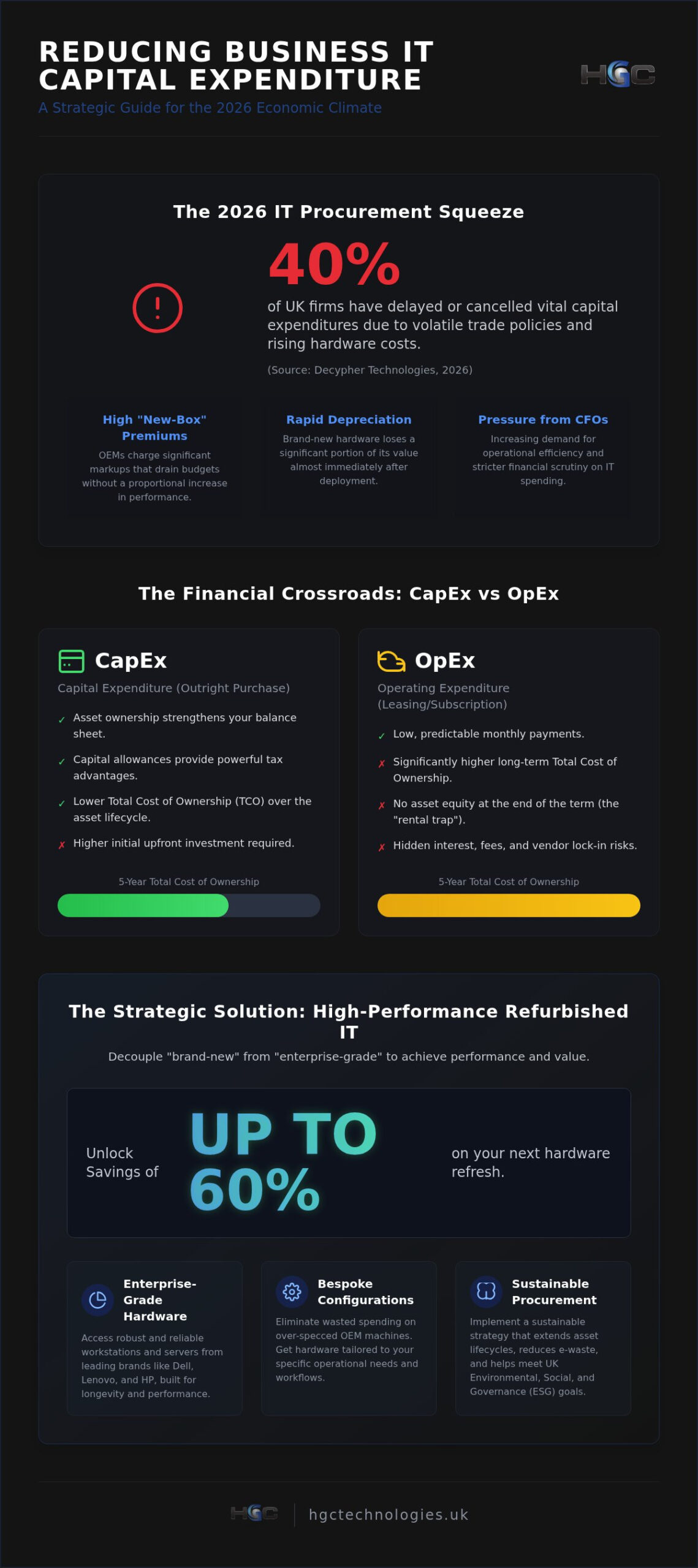
40% of firms have already delayed or cancelled vital capital expenditures in 2026 due to the volatile nature of global trade policies and rising hardware costs (Decypher Technologies, 2026). It’s a frustrating reality for many UK decision-makers who face relentless pressure from CFOs to trim upfront spending without compromising on operational speed. You likely recognise the dilemma: brand-new enterprise hardware is becoming prohibitively expensive, whilst the hidden long-term costs of leasing continue to erode your bottom line. Consequently, reducing capital expenditure on business IT has become a primary strategic objective for the coming year.
This guide provides a definitive roadmap for achieving this by decoupling “brand-new” from “enterprise-grade” performance. You’ll discover how to slash procurement costs by leveraging high-tier refurbished hardware and bespoke configurations that outperform standard OEM models. We’ll examine how to implement a sustainable procurement strategy that meets UK ESG goals and provides your team with robust Dell, Lenovo, or HP workstations that are built to last.
Key Takeaways
- Identify why the 2026 economic climate necessitates a shift from “buying new” to strategic asset management to protect your bottom line.
- Master the art of reducing capital expenditure on business IT by comparing the long-term total cost of ownership between CapEx and OpEx models.
- Unlock significant savings of up to 60% by integrating high-performance refurbished workstations from Dell, Lenovo, and HP into your hardware refresh cycle.
- Eliminate wasted spending on over-specced OEM machines by utilising bespoke server and PC configurations designed for your specific operational needs.
- Leverage a direct wholesale procurement model to avoid the hidden interest and fees associated with third-party leasing programmes.
The Burden of Traditional IT Procurement in 2026
IT Capital Expenditure (CapEx) is the total cost of acquiring and preparing physical technology for business use. This accounting category, often defined broadly as Capital Expenditure (CapEx), encompasses the initial purchase price of hardware alongside the costs of delivery and installation. Whilst high upfront investment was once viewed as a hallmark of corporate growth, the 2026 economic landscape has forced a strategic pivot. Today, reducing capital expenditure on business IT isn’t just a financial preference; it’s a requirement for maintaining agility in a volatile market.
Current data shows that 40% of firms have delayed or cancelled capital expenditures this year due to concerns surrounding trade policy and tariffs (Decypher Technologies, 2026). This cautious atmosphere has led UK businesses to prioritising “sustaining” operations over the traditional “buying new” cycle. The “new-box” premium charged by Original Equipment Manufacturers (OEMs) often drains corporate reserves without providing a proportional increase in performance. When the cost of entry for a hardware refresh becomes too high, it creates a tipping point where CapEx becomes a literal barrier to necessary technical progress.
Why Traditional CapEx Models are Faltering
Rapid hardware depreciation rates in the mid-2020s mean that brand-new workstations lose significant value almost the moment they’re deployed. This financial sting is exacerbated by global supply chain volatility, which keeps UK procurement prices high and unpredictable. Many organisations also waste capital by purchasing over-specced, off-the-shelf machines. These standard OEM builds often include expensive components that the average office user doesn’t require, leading to thousands of pounds in wasted investment across a large fleet.
The Pressure on UK IT Budgets
CFO expectations have shifted dramatically toward operational efficiency. The post-inflationary market doesn’t allow for “growth at all costs” mentalities. IT leaders are now expected to deliver high-performance environments whilst strictly reducing capital expenditure on business IT to satisfy more rigorous financial scrutiny. This pressure creates a demand for procurement strategies that avoid the “new-box” tax whilst still delivering the reliability and power of enterprise-grade hardware from brands like Dell, Lenovo, and HP. Transitioning away from bloated OEM contracts allows businesses to reclaim their budgets and invest those funds into areas that drive genuine competitive advantage.
CapEx vs OpEx: Deciding the Best Financial Path
Many UK businesses are lured by the promise of low monthly payments. Whilst shifting IT spending to an Operating Expenditure (OpEx) model through cloud services or leasing seems like an easy win for reducing capital expenditure on business IT, the reality is often more complex. Over a five-year lifecycle, the Total Cost of Ownership (TCO) for leased or subscription-based hardware frequently exceeds the cost of outright purchase. You aren’t just paying for the silicon; you’re paying for the provider’s profit margin and financing overhead. True financial efficiency requires a deeper look at how these models impact your long-term cash flow and asset equity.
The Hidden Risks of the OpEx-Only Strategy
Relying solely on OpEx introduces subscription fatigue and long-term interest burdens. Unlike owned hardware, leased machines offer zero equity at the end of their term. You’ve essentially paid for the asset several times over without ever owning it. Additionally, cloud infrastructure costs can be notoriously variable. A fixed-cost on-premise server solution provides predictable expenditure that cloud models often lack, especially as data egress fees and storage scales. When you own the hardware, you control the costs, avoiding the “rental trap” that keeps many IT departments in a state of perpetual debt to vendors.
Maximising Balance Sheet Strength
Owning your hardware assets directly improves your company valuation. For UK Ltd companies, these assets sit on the balance sheet and provide tangible equity that can be leveraged during audits or funding rounds. Capital allowances on equipment, including high-tier refurbished units, allow you to use depreciation as a powerful tax tool to offset profits. By purchasing in bulk, you can lower the per-unit CapEx significantly compared to individual retail purchases. This strategy aligns perfectly with a “Hybrid Procurement” model. Use OpEx for highly scalable software where flexibility is paramount, but keep your core hardware as a capital asset. This approach ensures your business remains agile whilst building a foundation of physical infrastructure that you actually own. By choosing direct wholesale procurement, you eliminate the middleman and the associated leasing fees, ensuring every pound spent adds direct value to your organisation’s net worth.
The Strategic Role of Refurbished Hardware in CapEx Reduction
Refurbished hardware has emerged as the premier “CapEx-lite” strategy for 2026. It allows organisations to maintain enterprise-grade performance whilst significantly reducing capital expenditure on business IT. By integrating high-tier refurbished units into your refresh cycle, your business can achieve 40-60% savings compared to the initial outlay required for new equipment. This isn’t merely a cost-cutting exercise; it’s a strategic reallocation of capital that allows you to stretch your budget across a much larger fleet of high-performance machines.
The reliability of Grade A refurbished units has effectively dismantled the “used” stigma that once hindered B2B procurement. These machines are sourced from professional environments where they were well-maintained and are subsequently subjected to rigorous testing. Performance benchmarks for enterprise-grade hardware often show that a two-year-old flagship workstation outperforms a brand-new, consumer-grade alternative. This makes refurbished gear a robust, reliable asset for any professional office environment.
Sourcing Enterprise-Grade Quality at Wholesale Prices
Purchasing bulk Dell refurbished laptops has become the gold standard for UK offices seeking to maximise their technical capabilities. High-tier business lines like the Dell Latitude, Lenovo ThinkPad, and HP EliteBook are engineered for longevity and ease of repair, qualities often missing in modern consumer builds. Grade A refurbished units are often indistinguishable from new machines for end-users, providing a premium experience without the associated “new-box” tax. By sourcing these machines at wholesale, you secure a uniform fleet that simplifies IT support whilst keeping upfront costs manageable.
The Circular Economy: A CFO’s Secret Weapon
Sustainability is now a core financial driver for UK businesses. Meeting ESG targets through circular IT procurement allows you to reduce your organisation’s carbon footprint without increasing your budget. Sourcing wholesale refurbished computers UK wide supports corporate social responsibility goals by extending the lifecycle of premium technology. Refurbished enterprise hardware provides the same 3-5 year lifecycle as new equipment at a fraction of the capital cost. This approach proves that fiscal responsibility and environmental consciousness are not mutually exclusive. It allows your business to project a forward-thinking image whilst protecting the bottom line through intelligent, responsible asset management.
Optimising Asset Lifecycle and Custom Specifications
Buying standard OEM hardware is often an exercise in over-investment. Most off-the-shelf machines come with pre-configured specifications that exceed the actual requirements of the average office user. This phenomenon, known as “spec-creep”, is a significant yet avoidable drain on corporate reserves. By moving away from generic builds and focusing on targeted performance, you take a major step toward reducing capital expenditure on business IT. Strategic procurement isn’t just about finding a lower price; it’s about ensuring every component you pay for serves a specific operational purpose.
Extending the lifecycle of your current assets also offers a powerful alternative to total fleet replacement. Often, a simple memory or storage upgrade can revitalise a high-tier workstation, pushing its useable life past the traditional three-year mark. When replacement is necessary, timing your CapEx for maximum volume discounts is essential. Aligning your procurement with wholesale cycles allows you to secure premium hardware at a fraction of the retail cost, ensuring your budget covers more units without sacrificing quality.
Bespoke Builds for Specific Business Roles
Tailoring custom built business PCs UK wide allows you to avoid paying for unused features. If an administrator primarily uses cloud-based applications and basic office software, they don’t require the same high-end graphics processor as your creative team. Conversely, your designers need targeted power that standard builds often fail to provide efficiently. This role-based configuration also applies to server solutions. By configuring servers for exact workload requirements, you save on initial hardware costs and reduce long-term power consumption. This precision ensures that your capital is invested in performance rather than unnecessary “extra” features that offer no ROI.
Lifecycle Management Strategies
Implementing a staggered refresh cycle is a proven method for smoothing out heavy capital demands. Rather than facing a massive financial hit every four years to replace an entire fleet, you can refresh a quarter of your hardware annually. This approach keeps your technology modern whilst making cash flow more predictable. Standardising on specific models, such as the Dell 7000 series, further reduces maintenance costs by ensuring parts and software images are uniform across the organisation. Additionally, integrating original smartphones into a unified communications strategy ensures your mobile workforce remains productive on reliable, enterprise-supported devices.
Speak with our specialist team to customise your next hardware refresh and eliminate wasted capital on over-specced machines.
Future-Proofing Your IT Budget with HGC Technologies
HGC Technologies UK Ltd acts as a strategic partner for organisations prioritising fiscal responsibility and technical excellence. By providing direct access to premium refurbished hardware, we enable our clients to bypass the inflated “new-box” premiums typically associated with OEM refreshes. Our professional refurbishment and configuration process ensures that every device meets rigorous performance standards, offering a reliable alternative that supports your long-term infrastructure goals. We focus on delivering high-tier assets that provide the reliability your team demands whilst reducing capital expenditure on business IT.
Enterprise-Level Solutions without the Enterprise Price Tag
Accessing a wholesale laptop distributor UK model allows for significant volume discounts that retail channels simply cannot match. This direct procurement approach is a cornerstone of modern financial management. Unlike leasing programmes that burden your balance sheet with 36 months of interest and hidden fees, our direct sales model ensures you own your assets from day one. We also specialise in custom server solutions tailored for UK SMEs and large enterprises, ensuring your data centre reflects your exact workload requirements rather than a vendor’s arbitrary sales target. Paying upfront for refurbished gear eliminates the long-term debt cycle, allowing you to reallocate those saved interest payments into other areas of technical innovation.
Getting Started with Leaner IT Procurement
Successful transitions to a more efficient procurement model begin with a comprehensive audit of your current hardware fleet. Identifying specific refresh opportunities allows you to target departments for upgrades whilst maintaining others, creating a staggered and manageable capital demand. We invite you to request a bespoke quote for bulk laptops or custom server builds that align with your specific technical and financial parameters. Our team provides professional consultations to help you map out a 2026 IT roadmap that balances high performance with strict cost control. This methodical approach ensures your next hardware refresh is both precise and cost-effective.
Scalable growth requires a foundation of resilient, high-quality technology that doesn’t drain your corporate reserves. Building a partnership with HGC Technologies means moving beyond transactional buying. We act as a knowledgeable guide, simplifying complex wholesale processes and ensuring your business remains at the forefront of technical capability without the unnecessary financial strain of traditional procurement. Our commitment to excellence and sustainability ensures that your IT infrastructure is a resilient asset that supports your organisation’s growth and ethical values. Contact our specialists today to begin your audit and secure a leaner, more robust technical future.
Securing Your 2026 Technical Advantage
The 2026 economic landscape demands a shift from passive procurement to active asset management. By prioritising high-tier refurbished hardware and bespoke configurations, you eliminate the wasted capital inherent in standard OEM cycles. This approach ensures your organisation maintains enterprise-grade performance whilst reducing capital expenditure on business IT. Direct ownership provides the equity and tax advantages that leasing simply cannot match, establishing a foundation of physical assets that remain under your total control.
As a specialist wholesaler of Dell, Lenovo, and HP, HGC Technologies UK Ltd provides the expertise needed to navigate this transition with confidence. Our direct sales model removes the burden of hidden interest or leasing fees, allowing you to invest directly in quality rather than financing overheads. Contact HGC Technologies UK Ltd today for a bespoke wholesale quote on refurbished IT hardware and discover how our bespoke server and PC configurations can transform your infrastructure. Taking control of your procurement strategy today builds a more sustainable, resilient, and profitable technical future for your business.
Frequently Asked Questions
What is the most effective way to reduce IT capital expenditure?
The most effective strategy involves decoupling “brand-new” from “enterprise-grade” by prioritising high-tier refurbished hardware. By sourcing Grade A machines at wholesale prices, organisations can achieve savings of 40-60% compared to retail prices for new equipment. This approach allows for reducing capital expenditure on business IT whilst maintaining technical performance. Combining this with bespoke configurations ensures you don’t overspend on unnecessary components or “new-box” premiums.
Is refurbished hardware as reliable as new equipment for business use?
Yes, Grade A refurbished enterprise hardware is often more reliable for professional use than brand-new consumer-grade machines. These units are sourced from corporate environments and undergo rigorous testing and professional configuration before resale. High-tier business lines like Dell Latitude or Lenovo ThinkPad are engineered for durability and longevity. They typically offer a 3-5 year lifecycle that matches or exceeds that of standard new builds at a significantly lower cost.
How does buying refurbished IT equipment impact a company balance sheet?
Purchasing refurbished IT equipment creates tangible assets on your balance sheet, improving your company’s overall valuation. Unlike leasing, which is an ongoing expense with zero equity, direct ownership allows you to claim capital allowances and use depreciation as a tax management tool. This strategy strengthens your financial position by building a foundation of physical infrastructure that your business owns outright, free from the interest burdens of third-party financing.
Can I still get brand-name reliability from Dell or HP when buying refurbished?
You can absolutely maintain brand-name reliability by sourcing from a specialist wholesaler that focuses exclusively on flagship enterprise lines. Brands like Dell, HP, and Lenovo design their professional workstations with modular components that are easy to maintain and upgrade. Buying these through a professional refurbishment process ensures you receive the same build quality and performance as a new unit, but without the inflated initial investment or the “spec-creep” of retail models.
Does HGC Technologies offer leasing or financing for hardware?
HGC Technologies operates a direct sales model and does not offer leasing or financing programmes. This approach is intentional, as it ensures our clients avoid the hidden interest costs and long-term debt associated with third-party IT leasing. By paying upfront for high-quality refurbished hardware, businesses can achieve a lower total cost of ownership. This strategy is central to reducing capital expenditure on business IT by eliminating recurring interest payments that drain corporate reserves.
How do custom PC builds help in reducing business IT costs?
Custom PC builds allow organisations to eliminate “spec-creep” by tailoring every component to the specific role of the end-user. Standard OEM builds often include expensive features, such as high-end graphics cards or excessive storage, that the average office worker doesn’t require. By configuring workstations for exact workload requirements, you avoid wasting capital on unused features. This precision ensures your IT budget is spent solely on performance that drives ROI.
What are the tax benefits of buying refurbished IT hardware in the UK?
UK businesses can leverage capital allowances to offset the cost of refurbished hardware against their taxable profits. Since these units are sitting on your balance sheet as owned assets, you can claim tax relief through the Annual Investment Allowance (AIA) or similar schemes. This makes refurbished procurement a highly tax-efficient strategy. It allows you to refresh your technical infrastructure whilst significantly lowering your corporation tax liability, providing a double financial benefit.
How does the circular economy help with IT procurement budgets?
The circular economy enables businesses to meet ambitious ESG targets without the premium costs often associated with “green” initiatives. By choosing refurbished equipment, you extend the lifecycle of premium technology and reduce the carbon footprint of your procurement process. This sustainable approach allows you to align your IT procurement budget with corporate social responsibility goals. It proves that environmental consciousness can actively support, rather than hinder, your organisation’s financial health.

Refurbished vs Open-Box Laptops: 2026 IT Procurement Guide
The cheapest laptop on an invoice often turns into your most expensive operational headache once dep

Sustainable IT Hardware UK: The 2026 Strategic Procurement Explainer
Sales volumes for refurbished PCs in Britain nearly doubled between late 2024 and 2025, cementing th
Refurbished Laptop DOA: Warranty and Return Options
A refurbished laptop that arrives dead on arrival is handled under the seller’s stated return or w