

Enterprise Server Hardware Procurement Guide: The 2026 Strategic Framework for UK Businesses
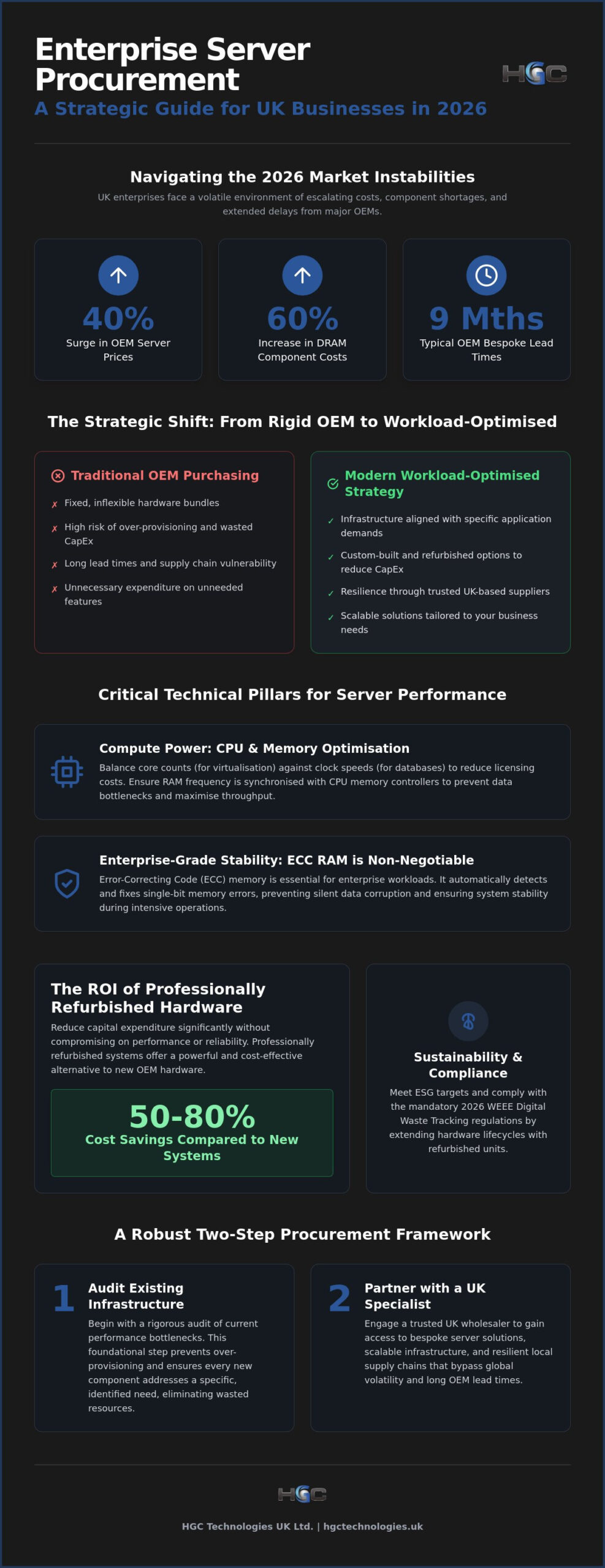
Major OEM server prices surged by as much as 40% in the first quarter of 2026, leaving many UK businesses trapped between escalating costs and nine-month lead times. You likely recognise the frustration of waiting for bespoke configurations whilst component prices for DRAM climb by 60%. This enterprise server hardware procurement guide serves as your strategic framework to navigate these market instabilities and secure high-performance infrastructure on your own terms.
We understand that aligning complex technical specifications with actual workload demands is a persistent challenge for IT decision-makers. This guide promises to help you master these complexities by prioritising cost-optimisation and custom-built solutions that offer a scalable alternative to standard OEM models. We will examine how to reduce your CapEx significantly, ensure compliance with the latest 2026 WEEE digital waste tracking regulations, and build a reliable hardware strategy with a trusted UK partner.
Key Takeaways
- Transition from rigid OEM purchases to a workload-optimised approach that aligns your server infrastructure with specific application demands.
- Learn to balance CPU core counts against clock speeds and prioritise ECC RAM density to ensure enterprise-grade stability for your most critical tasks.
- Utilise this enterprise server hardware procurement guide to identify how custom-built and professionally refurbished systems can reduce CapEx without compromising on reliability.
- Master a two-step procurement strategy that begins with a rigorous audit of existing bottlenecks to prevent over-provisioning and wasted resources.
- Discover how partnering with a specialist UK wholesaler provides access to bespoke server solutions and scalable infrastructure tailored to your corporate environment.
Defining the 2026 Enterprise Server Procurement Landscape
Procurement has evolved into a rigorous lifecycle management process. It is no longer a simple transaction; it is a strategic engineering decision. For UK enterprises, the 2026 market presents a volatile environment where major manufacturers have implemented price hikes of up to 40%. Relying on traditional, rigid purchasing models often leads to unnecessary expenditure and operational delays. This enterprise server hardware procurement guide provides the framework needed to navigate these pressures whilst maintaining a competitive technical edge.
Strategic sourcing has emerged as the essential methodology for balancing high-performance requirements with fiscal responsibility. Instead of accepting fixed OEM bundles, businesses are now looking at the component-level value of their infrastructure. The shift toward workload-optimised hardware ensures that every pound spent aligns with specific operational outcomes. Additionally, UK data centres now face stricter 2026 energy efficiency standards. Hardware selection is now a matter of regulatory compliance as much as it is about raw processing power. Every watt consumed must translate into measurable business output to satisfy both the balance sheet and environmental auditors.
This focus on power-to-output ratios is a hallmark of modern industrial design; for example, professional hydroponic operations using specialists like Discount Hydro often explore LED Grow Lights to ensure that their energy consumption is precisely tuned for maximum productivity.
Identifying Core Business Workloads
Precise workload mapping is the foundation of a successful build. A server optimised for high-transaction databases requires different server-class hardware than a unit dedicated to dense virtualisation or high-capacity file storage. Avoid the trap of over-specifying. It is a costly mistake that drains budgets without providing tangible performance gains. Technical leaders must assess scalability with a critical eye. You should determine if your operations require the latest innovations on a three-year refresh cycle or if a five-year lifecycle better suits your long-term ROI objectives. Planning for actual usage rather than theoretical peaks prevents wasted capital and reduces your total cost of ownership.
The 2026 Shift: Sustainability and Local Resilience
Corporate responsibility is now inseparable from technical procurement. The introduction of mandatory Digital Waste Tracking under WEEE regulations in October 2026 means businesses must be meticulous about hardware lifecycles. Choosing professionally refurbished units helps meet these ESG targets whilst offering cost savings of 50-80% compared to new systems. Relying on UK-based suppliers like HGC Technologies provides a level of resilience that global vendors cannot match during periods of supply chain volatility. Custom-built configurations allow specialised UK sectors to bypass the nine-month lead times typical of traditional OEMs. This localised approach ensures your infrastructure remains agile and your operations stay uninterrupted, regardless of global component shortages.
Critical Technical Specifications for Server Performance
Precision engineering defines the difference between a high-performing data centre and a costly bottleneck. Selecting the right components requires a granular understanding of how different hardware layers interact under pressure. This enterprise server hardware procurement guide focuses on the technical pillars that ensure your infrastructure remains resilient and responsive as your data requirements grow. For those seeking rigorous efficiency benchmarks, Federal guidance on energy-efficient server procurement provides a robust framework for consolidating hardware and reducing operational costs whilst maintaining peak performance.
Compute Power: CPU and Memory Optimisation
The choice between single and dual-socket configurations dictates more than just raw speed; it determines your total memory bandwidth and available PCIe lanes for expansion. High core counts are the standard for dense virtualisation, yet specific database applications often perform better with higher clock speeds on fewer cores to reduce licensing costs. The synchronisation between RAM frequency and CPU memory controllers is critical; mismatched speeds often create data bottlenecks that throttle the processor’s true throughput capacity. In any enterprise environment, Error Correction Code (ECC) memory is non-negotiable. It prevents silent data corruption by detecting and fixing single-bit errors, ensuring system uptime during intensive cycles. If you require a machine tailored to these specific technical demands, exploring bespoke server solutions can bridge the gap between off-the-shelf limitations and enterprise-grade performance.
Storage Architectures: Speed vs Redundancy
Storage is no longer just about capacity; it’s about the protocol. The transition from SATA SSDs to NVMe has revolutionised high-throughput applications by significantly reducing latency and increasing IOPS. However, speed must be balanced with data integrity. RAID 10 remains the preferred choice for performance-heavy database workloads due to its superior mirror-and-stripe redundancy. Conversely, RAID 5 or 6 offers a better balance for general file storage where capacity is the priority. Integrating tiered storage allows you to combine high-speed NVMe drives for “hot” data with high-capacity HDDs for archival purposes, creating a cost-effective hierarchy that doesn’t sacrifice user experience.
Network connectivity acts as the final link in this technical chain. Whilst 1GbE was once sufficient, 10GbE or even 25GbE has become the new baseline for UK businesses handling modern workloads. This increased bandwidth is essential for preventing congestion during backups, virtual machine migrations, and high-volume data transfers. Selecting hardware that supports these higher speeds ensures your server won’t become a restricted point in an otherwise fast network.
The ROI of Refurbished vs Custom-Built Server Hardware
The financial argument for traditional OEM procurement is weakening as sticker prices soar. This enterprise server hardware procurement guide advocates for a more nuanced approach to capital expenditure. Whilst brand-new systems offer the comfort of a factory seal, they often carry a “newness premium” that doesn’t translate into proportional performance gains. Professionally refurbished units frequently provide a superior price-to-performance ratio, allowing UK businesses to reallocate budget toward software optimisations or network upgrades. Research indicates that certified refurbished enterprise servers can deliver cost savings of 50-80% compared to new OEM systems, providing a massive advantage for organisations managing tight CapEx budgets.
Reliability is frequently cited as a concern for non-new hardware, yet this is largely a misconception. Enterprise-grade components are engineered for longevity; refurbished units often undergo more rigorous individual testing than off-the-shelf systems. These units have already survived the “infant mortality” phase where manufacturing defects typically surface. Perhaps more importantly, custom builds and refurbished stock bypass the nine-month lead times currently crippling OEM supply chains. You can often deploy a bespoke solution in weeks rather than quarters, ensuring your infrastructure grows at the speed of your business rather than at the pace of a manufacturer’s backlog.
Breaking the “New is Always Better” Stigma
Professionally refurbished hardware isn’t just “used” equipment; it’s a strategic asset. Grade A hardware is sourced from mission-critical environments where it was maintained under strict climate controls and professional oversight. Each component undergoes extensive soak testing and individual inspection to ensure it meets original performance benchmarks. Last-generation processors often provide roughly 95% of the processing power of the newest releases for about 40% of the financial outlay. This makes refurbished gear the logical choice for redundant systems, backup servers, or development environments where peak theoretical throughput isn’t the primary requirement. It’s a pragmatic way to secure high-performance enterprise server hardware procurement guide standards without the inflated price tag.
Bespoke Configurations for Specialised UK Sectors
Bespoke configurations allow specialised UK sectors to engineer systems that generic off-the-shelf models cannot match. Creative agencies might require high-density GPU arrays for 3D rendering, whilst fintech firms need specific FPGA cards for low-latency trading. Building to exact specifications ensures you aren’t paying for unused features or proprietary bloat that often comes bundled with OEM packages. For a deeper look at the current market options and how custom builds stack up, consult this resource on enterprise server hardware UK for comprehensive comparisons. This tailored approach ensures your infrastructure is a precise tool designed for your specific workload rather than a generic compromise.
Developing a Robust Procurement and Lifecycle Strategy
A successful procurement strategy requires a departure from reactive purchasing. It demands a structured framework that anticipates growth whilst managing the inherent risks of a volatile global market. This enterprise server hardware procurement guide provides a methodical five-step approach to ensure your infrastructure remains a high-performance asset rather than a depreciating liability. By following this roadmap, technical leaders can align their hardware investments with precise operational goals.
- Step 1: Audit Infrastructure. Conduct a rigorous review of your current stack to identify genuine performance bottlenecks, such as CPU throttling or storage latency, before committing to new capital.
- Step 2: Define Requirements. Establish strict technical specifications based on actual application usage rather than theoretical maximums to prevent the common mistake of over-provisioning.
- Step 3: Evaluate Vendors. Prioritise partners who offer dedicated technical support, high levels of customisation, and a physical UK presence to mitigate shipping delays.
- Step 4: Calculate TCO. Project a five-year Total Cost of Ownership that includes initial acquisition, power consumption, cooling, and escalating maintenance fees.
- Step 5: Plan for ITAD. Develop an IT Asset Disposal strategy that complies with the mandatory Digital Waste Tracking regulations coming into effect in October 2026.
Calculating Total Cost of Ownership (TCO)
Acquisition price is only the starting point of your financial commitment. High-density rack servers demand significant power and cooling resources, which can often exceed the initial hardware cost over a standard lifecycle. Maintenance costs typically escalate after the third year as hardware components age and out-of-warranty support premiums increase. Opting for a direct-sale model from a UK wholesaler provides a distinct financial advantage over complex leasing programmes. This approach eliminates the interest-heavy cycles of recurring payments and gives you full ownership of your assets from day one. If you are looking to optimise your budget without sacrificing quality, you can browse custom server solutions that offer transparent, direct-sale pricing.
Security and Compliance in the Supply Chain
Integrity begins at the point of origin. Verifying firmware integrity and ensuring total supply chain transparency is essential for protecting your data from hardware-level vulnerabilities. Purchasing through established UK wholesalers significantly reduces the risks associated with gray-market hardware, which often lacks proper documentation or valid warranty support. Reliable suppliers ensure that every component meets UK-specific data protection and security standards. This localised oversight provides a level of reassurance that is difficult to achieve when sourcing from disparate international vendors. By maintaining a clean, documented supply chain, you safeguard your organisation against both technical failures and regulatory breaches.
Partnering with HGC Technologies for Scalable Infrastructure
HGC Technologies stands as the UK’s premier wholesaler for bespoke server solutions, acting as a visionary guide for businesses outgrowing standard OEM limitations. Our approach simplifies the technical and financial complexities outlined in this enterprise server hardware procurement guide, providing a direct route to high-performance infrastructure without the bureaucratic delays of global manufacturers. By operating as a UK-based partner, we ensure that your technical requirements are met with precision and local expertise. We prioritise reliability and cost-effectiveness, offering a direct sales model that eliminates the hidden overheads often found in complex leasing or financing programmes. This transparency allows technical decision-makers to invest in high-specification hardware with absolute confidence in their long-term ROI.
Choosing a partner who understands the intersection of international capability and localised service is essential for 2026. We act as a trailblazer in the market, shaping procurement standards through a commitment to excellence and a deep understanding of the technology lifecycle. Our configurations are designed to be resilient, ensuring that your business stays ahead of the “AI Demand Shock” and other market instabilities. We provide the stability your organisation needs to maintain a competitive advantage, delivering custom-built systems that are engineered for your specific corporate workloads.
Why UK Enterprises Choose HGC Bespoke Solutions
Expertise in Dell, HP, and Lenovo server configurations allows us to deliver tailored solutions that generic off-the-shelf models simply cannot match. We recognise that professional refurbishment is a cornerstone of a responsible and sustainable IT lifecycle. By sourcing Grade A hardware, we deliver systems that offer enterprise-grade performance at a significantly lower price point than brand-new equivalents. This allows you to scale your data centre capabilities whilst adhering to strict CapEx constraints. For organisations seeking a holistic approach to their entire IT estate, our role as a wholesale laptop distributor UK serves as a vital reference point for sourcing consistent, high-quality hardware across all business departments, from the server room to the mobile workforce.
Streamlining Bulk Procurement and Deployment
Large-scale hardware rollouts require a partner capable of maintaining rigorous standards across multiple sites. HGC Technologies manages the intricacies of bulk procurement, ensuring that every unit in a national deployment meets the exact technical benchmarks established during your initial audit. This consistency is vital for maintaining security protocols and simplifying long-term maintenance cycles. As a dedicated national partner, we offer the stability and reach needed to support UK organisations through rapid expansion or essential infrastructure refreshes. Don’t let supply chain delays dictate your growth. Take the next step in securing your technical future and consult with HGC Technologies for your 2026 server infrastructure needs to ensure your hardware strategy is both resilient and future-proof.
Future-Proofing Your Enterprise Infrastructure
Mastering the 2026 landscape requires more than just a purchase; it demands a strategic alignment of hardware with your specific operational workloads. This enterprise server hardware procurement guide has highlighted the critical importance of moving beyond rigid OEM models in favour of custom-built, workload-optimised systems. By prioritising high-performance refurbished components and calculating a comprehensive five-year TCO, your organisation can bypass global supply chain delays whilst meeting stringent new sustainability standards. It’s time to transition from reactive spending to a proactive, lifecycle-oriented hardware strategy that protects your balance sheet and your technical edge.
HGC Technologies acts as your authoritative partner in this transition, offering national wholesale distribution and UK-based expert configuration. We specialise in delivering high-performance refurbished Dell, HP, and Lenovo hardware that meets the most demanding corporate specifications. Optimise your infrastructure with HGC Technologies bespoke server solutions to secure a scalable, reliable, and cost-effective future for your data centre. Building a resilient foundation for your business has never been more achievable.
Frequently Asked Questions
What is the difference between a custom-built server and an OEM server?
A custom-built server allows for component-level selection tailored to specific workloads, whilst an OEM server arrives as a pre-configured, branded bundle. Custom configurations provide the flexibility to choose specific CPU clock speeds or RAM densities without paying for unnecessary proprietary features. This enterprise server hardware procurement guide emphasises that bespoke builds often bypass the “brand premium,” delivering better performance-per-pound for specialised UK business applications.
Is refurbished server hardware reliable for mission-critical business applications?
Professionally refurbished enterprise hardware is exceptionally reliable for mission-critical applications because it has already passed the initial failure phase common in new electronics. Every unit undergoes rigorous soak testing and individual component inspection to ensure it meets original factory standards. Choosing Grade A hardware from a trusted UK supplier provides a stable infrastructure that often matches or exceeds the uptime of new OEM systems at a fraction of the cost.
How do I calculate the TCO for a new server deployment in the UK?
To calculate the Total Cost of Ownership, you must combine the initial acquisition price with projected power, cooling, and maintenance expenses over a five-year period. Factor in the cost of out-of-warranty support and the potential financial impact of deployment delays. Using a direct-sale wholesale model helps keep these costs predictable by eliminating the interest payments and hidden fees associated with complex hardware leasing programmes.
What are the most important server specifications for virtualisation in 2026?
High core-count processors and dense ECC RAM are the most vital specifications for virtualisation in 2026. You must ensure your hardware supports high-bandwidth NVMe storage to manage multiple simultaneous I/O requests without latency. Additionally, your network architecture should support 10GbE or 25GbE as a baseline to prevent bottlenecks during virtual machine migrations and high-volume data transfers across your corporate network.
Can I upgrade a custom-built server more easily than a branded OEM model?
Custom-built servers offer significantly easier upgrade paths because they rely on non-proprietary, industry-standard components. Unlike branded OEM models that often require specific, high-cost parts to maintain compatibility, custom builds allow you to source RAM, storage, or NICs from various manufacturers. This open architecture prevents vendor lock-in and ensures you can scale your infrastructure as your technical requirements evolve without being restricted by proprietary hardware limitations.
Why should a UK business choose a local wholesaler over a global distributor?
Selecting a local UK wholesaler ensures faster lead times and more responsive technical support compared to global distributors. Local partners possess a thorough understanding of UK-specific regulatory environments, including the 2026 WEEE digital waste tracking mandates. This proximity reduces shipping volatility and ensures your enterprise server hardware procurement guide strategy remains compliant with national data protection and environmental security standards.
Does HGC Technologies offer financing or leasing for server hardware?
HGC Technologies does not offer financing or lease-to-own programmes for any of our hardware solutions. We focus on a direct wholesale model that provides the most competitive national pricing for outright purchases. This strategy allows UK businesses to maintain full ownership of their assets from day one, avoiding the long-term interest costs and financial complexities often associated with traditional enterprise hardware leasing.
What is the typical lead time for a custom enterprise server build?
Lead times for custom enterprise builds typically range from a few days to several weeks, depending on the complexity of the configuration. This is a significant advantage over the nine-month delays frequently reported by major OEM manufacturers in 2026. By maintaining a robust local inventory of components, we can build, test, and deploy bespoke server solutions quickly, ensuring your business operations remain agile and uninterrupted.

UK GDPR: 2026 Procurement Guide for Used IT Hardware
Research by the University of Hertfordshire's Cyber Security Centre found that 65% of second-hand me

Avoiding Laptop Supply Chain Disruption UK: A 2026 Strategic Guide
Did you know that the global surge in AI development has effectively hijacked 70% of the world’s c

How to Order Custom Specification PCs in Bulk: A 2026 Procurement Guide
In 2026, the era of treating bulk PC procurement as a simple commodity purchase is officially over.
Comments are closed.