

Security Risks of Improperly Wiped Laptops: A 2026 Enterprise Guide
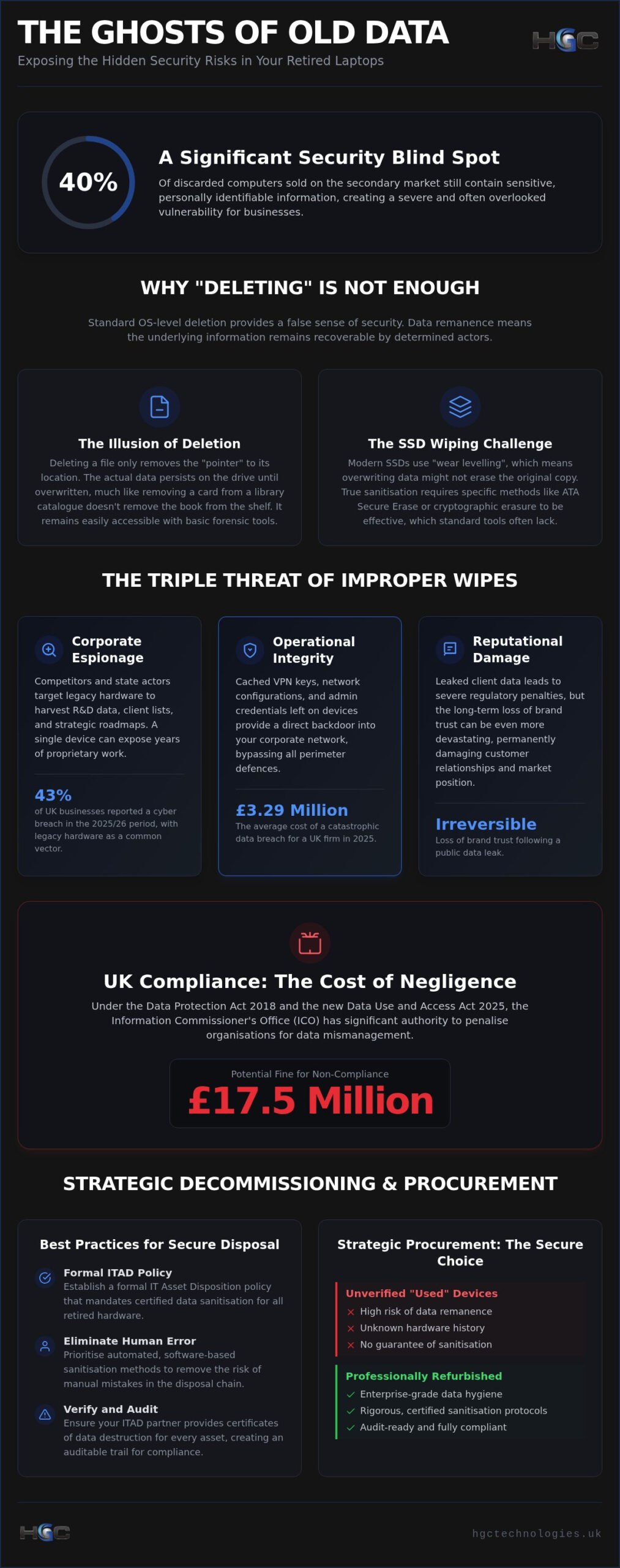
Did you know that roughly 40% of discarded computers sold on the secondary market still contain sensitive, personally identifiable information? This alarming statistic highlights the severe security risks of improperly wiped laptops that many organisations overlook during routine hardware refreshes. You probably recognise that a standard factory reset won’t stop a determined actor, yet the complexity of modern storage makes “clean” disposal feel like a moving target.
It’s natural to feel uneasy about the evolving regulatory landscape, especially with the Information Commissioner’s Office now authorised to issue fines of up to £17.5 million under the Data Use and Access Act 2025. This guide promises to demystify the data vulnerabilities hidden in your retired hardware and shows you exactly how to protect your business from the “ghosts” of old data. You’ll gain a thorough understanding of the technical mechanics of data remnance, identify the latest UK legal requirements, and learn how to verify a secure sanitisation programme that stands up to any audit.
Key Takeaways
- Understand the mechanics of data remnance and why standard OS-level deletion fails to protect your organisation from sophisticated recovery tools.
- Identify how to mitigate the security risks of improperly wiped laptops by defending against corporate espionage and targeted phishing attacks.
- Navigate your legal obligations under the Data Protection Act 2018 and the evolving role of the ICO in auditing hardware decommissioning.
- Establish a formal IT Asset Disposition (ITAD) policy that prioritises automated sanitisation to eliminate human error from your disposal chain.
- Learn why sourcing professionally refurbished hardware from a specialist wholesaler ensures enterprise-grade data hygiene that unverified “used” devices cannot match.
Beyond the Bin: Why Standard Deletion Fails to Protect Data
Emptying the recycle bin or formatting a drive provides a false sense of security for many IT managers. Most operating systems don’t actually remove data when you hit “delete”. Instead, they simply remove the “pointer” or index entry that tells the system where the file is located. The actual bits and bytes remain on the platter or flash chip until they’re eventually overwritten by new information. This phenomenon, known as Data remanence, is the core technical reason behind the security risks of improperly wiped laptops.
Think of it like a library catalogue. Removing a book’s entry from the index card doesn’t physically remove the book from the shelf; it just makes it harder for the librarian to find. For a data recovery specialist or a malicious actor using basic forensic software, the “book” is still exactly where it was left. This “ghost in the machine” allows even formatted drives to be read with ease by anyone with a modest level of technical skill. Data sanitisation is the deliberate process of making data recovery impossible even when subjected to advanced laboratory forensic tools.
The HDD vs SSD Challenge
Traditional “shredding” software often fails on modern Solid State Drives (SSDs) because they manage data differently than old Hard Disk Drives (HDDs). SSDs use a process called wear levelling to distribute write operations across the drive to extend its lifespan. This means that even if you tell the software to overwrite a specific file, the drive’s controller might write that new data to a different physical location, leaving the original data intact in an “unmapped” block. TRIM commands help manage space but don’t guarantee immediate erasure. To truly clear an SSD, you must use specific cryptographic erasure methods or ATA Secure Erase commands that target the entire storage pool rather than individual files.
The Risk of Recoverable Metadata
Even if a drive appears empty, residual metadata and file fragments can reveal sensitive organisational structures or user behaviours. Cached credentials, browser cookies, and local email fragments often persist on devices that haven’t undergone a professional wipe. Whilst physical drive encryption like BitLocker is a vital prerequisite for active devices, it isn’t a total solution for hardware decommissioning. If the recovery key is compromised or remains accessible, the “wiped” data becomes a goldmine for attackers. Partnering with a reputable wholesale laptop distributor UK ensures that the hardware you procure has been subjected to rigorous, enterprise-grade sanitisation protocols that go far beyond simple formatting.
The Triple Threat: Primary Security Risks of Improperly Wiped Laptops
The security risks of improperly wiped laptops extend far beyond simple file recovery. They represent a systemic vulnerability that can dismantle an organisation’s competitive advantage and operational stability. When a device leaves your perimeter without professional sanitisation, you are essentially handing over a detailed blueprint of your operations to the highest bidder.
Corporate espionage remains a primary concern for the enterprise sector. Competitors or state-sponsored actors often target legacy hardware to harvest R&D data, strategic roadmaps, and sensitive client lists. This isn’t a theoretical threat. Recent government surveys show that 43% of UK businesses reported experiencing a cyber breach in the 2025/26 period, with legacy hardware serving as a silent, often overlooked, vector for these attacks.
Beyond intellectual property, operational integrity is at stake. Improperly cleared machines frequently contain cached VPN keys, local network configurations, and administrative credentials. These “keys to the kingdom” allow attackers to bypass perimeter defences entirely. This can lead to catastrophic breaches, which cost UK firms an average of £3.29 million in 2025. The financial fallout is compounded by the long-term reputational damage that occurs when client data is leaked, often resulting in a permanent loss of brand trust.
Intellectual Property and Trade Secrets
Strategic plans, blueprints, and financial forecasts are often stored locally by employees for convenience. If these files aren’t permanently destroyed through professional sanitisation, they can end up in the hands of dark web data brokers who specialise in corporate intelligence. Whilst a 2017 study found that 40% of devices on the secondary market contained personally identifiable information, the risk to corporate trade secrets is often even more damaging for long-term market positioning.
The Human Element: Personal Data Leaks
Modern work-from-home habits have blurred the lines between personal and professional device usage. It’s common to find personal photos, banking details, and private passwords on corporate machines. Employers have an ethical and legal obligation to protect their staff during the decommissioning process. Failing to do so doesn’t just invite legal trouble; it destroys internal trust and exposes individuals to identity theft and sophisticated social engineering attacks.
Choosing to source professionally refurbished hardware from a trusted partner ensures that these risks are mitigated before the equipment ever reaches your desk. By prioritising hardware that has undergone rigorous data destruction, you protect your organisation’s secrets and your employees’ privacy simultaneously.
UK Compliance and the Law: The Cost of Non-Sanitisation
The legal landscape for data protection in the United Kingdom has reached a new level of stringency following the full implementation of the Data Use and Access Act 2025 (DUAA). This legislation, which builds upon the foundations of the Data Protection Act 2018 and the UK GDPR, mandates a rigorous approach to hardware decommissioning. Organisations can no longer plead ignorance when legacy devices end up on the secondary market with intact data. Failing to mitigate the security risks of improperly wiped laptops is now viewed as a fundamental failure of an organisation’s “Duty of Care”.
The Information Commissioner’s Office (ICO) has demonstrated a clear shift toward issuing fewer but significantly larger penalties to signal its intolerance for systemic negligence. For serious breaches, the ICO can issue fines of up to £17.5 million or 4% of a company’s global annual turnover. In the first half of 2026 alone, the ICO issued monetary penalties totalling over £15 million, including a landmark £14.4 million fine issued to Reddit. These figures underscore the financial imperative of establishing a robust, programmatic media sanitisation strategy before any hardware leaves your facility.
Regulatory Standards to Follow
Adhering to recognised frameworks is the only way to ensure legal defensibility during an audit. The National Institute of Standards and Technology (NIST) published SP 800-88 Rev. 2 on 26 September 2025, which remains the gold standard for media sanitisation. Whilst the historical HMG Infosec Standard No. 5 (IS5) still provides context for UK government work, modern enterprise environments prioritise NIST’s programmatic approach. You must ensure that every decommissioned device is accompanied by a verifiable “Audit Trail” and a formal Certificate of Destruction. These documents serve as your primary evidence that the security risks of improperly wiped laptops have been professionally addressed.
The Legal Risk for IT Resellers
Liability doesn’t end with the initial owner; it flows through the entire supply chain. IT resellers and procurement officers face significant legal exposure when handling wholesale refurbished computers UK if they cannot prove the provenance of the data sanitisation. The UK’s “Right to Repair” initiatives have increased the volume of hardware moving through secondary markets, making it even more critical to verify that your suppliers follow enterprise-grade decommissioning standards. A single oversight in the chain can lead to a multi-million pound fine and a permanent loss of commercial standing.
Best Practices for Secure Hardware Decommissioning
Establishing a formal IT Asset Disposition (ITAD) policy is your first line of defence against data breaches. This policy should define a standardised path for every device, ensuring that no hardware is left in unsecured storage or disposed of through unverified channels. Without a structured framework, the security risks of improperly wiped laptops grow as the volume of retired hardware increases. Trust is not a policy; you need a system that removes ambiguity from the decommissioning process.
Human error is often the root cause of data leaks. Automating the wiping process removes the variability of manual intervention and ensures consistency across large batches of hardware. Unlike outdated tools such as DBAN, which often fail to address the complexities of modern SSD architecture, automated enterprise solutions target the entire storage pool effectively. Once the sanitisation is complete, you should verify the results using independent forensic tools before the device leaves your perimeter. Maintaining a record that pairs every serial number with its specific sanitisation status creates a bulletproof audit trail for regulatory compliance.
Software vs Physical Destruction
Software-based sanitisation is the ideal choice for functional hardware. It allows your organisation to recover value from retired assets and supports the transition to sustainable IT hardware UK. Repurposing hardware through professional refurbishment reduces electronic waste and environmental impact whilst maintaining strict data integrity. However, if a drive is physically faulty and cannot be accessed by software, mechanical shredding or degaussing is the only safe alternative to prevent forensic recovery. Every drive must be accounted for, regardless of its operational state.
Selecting a Professional Partner
Your choice of partner determines the integrity of your decommissioning chain. Prioritise providers who hold ISO 27001 certification, as this demonstrates a commitment to high-standard information security management. Ask which erasure software they employ; industry leaders like Blancco or White Canyon provide the granular reporting needed for modern audits. A professional partner must provide a transparent chain of custody that tracks the device from your facility to the final point of sanitisation. This documentation is your primary shield against future legal claims or ICO enquiries.
Ready to upgrade your fleet with enterprise-grade equipment that meets these rigorous standards? You can source bulk refurbished laptops from HGC Technologies UK Ltd. to ensure your procurement strategy prioritises both security and value.
Strategic Procurement: Sourcing Secure Refurbished Hardware
Procurement shouldn’t be an afterthought in your security strategy. Choosing a wholesale laptop distributor UK that understands the technical nuances of data sanitisation is essential for maintaining a secure perimeter. Many organisations focus solely on the disposal of their own hardware whilst ignoring the intake of unverified devices. This oversight reintroduces the security risks of improperly wiped laptops into your environment through the back door. A professional partner ensures that every device entering your building has been subjected to the same rigorous standards you apply to those leaving it.
There’s a profound difference between “used” hardware and “professionally refurbished” units. Used devices, often sourced from unverified marketplaces, come with fragmented histories and remnants of previous user data that can interfere with your network’s integrity. In contrast, professional refurbishment involves a controlled, documented process of data destruction and hardware validation. This ensures that every unit in a batch of bulk Dell refurbished laptops arrives with a guaranteed clean slate, ready for immediate corporate deployment without the risk of residual malware or legacy data.
The HGC Standard for Refurbished Units
Our HGC standard involves a comprehensive lifecycle management process that goes far beyond a surface-level clean. We implement rigorous hardware testing and complete OS re-imaging to ensure every bulk Lenovo refurbished laptops order meets enterprise-grade expectations. This methodical approach extends across our entire inventory, including original smartphone supplies and high-performance server solutions. By standardising your hardware through a trusted partner, you eliminate the variability that often leads to security vulnerabilities. We act as a knowledgeable guide, simplifying the procurement process whilst maintaining the highest standards of data hygiene.
Building a Future-Proof IT Infrastructure
Building a balanced fleet often requires a strategic mix of custom-built PCs for specialised tasks and refurbished laptops for general mobility. This hybrid approach allows for high-performance output whilst maintaining cost-efficiency and environmental responsibility. Sourcing from a single, reliable wholesaler simplifies your internal security audits and ensures a consistent standard of data hygiene across your entire infrastructure. It allows you to focus on growth rather than worrying about the provenance of your hardware. Contact us today to discuss your secure hardware requirements for 2026 and discover how our professional solutions can protect your organisation from catastrophic breaches.
Securing Your Organisation’s Digital Future
Data sanitisation is no longer a peripheral IT concern; it’s a foundational pillar of modern risk management. We’ve seen how standard deletion methods fail to address the technical realities of modern storage, leaving businesses vulnerable to corporate espionage and severe regulatory penalties. Effectively managing the security risks of improperly wiped laptops requires a shift from reactive disposal to a proactive, programmatic sanitisation strategy that prioritises verifiable results over simple formatting.
HGC Technologies acts as your knowledgeable partner in this journey. As a UK-based authoritative tech leader and specialist wholesaler for Dell, HP, and Lenovo, we provide the enterprise-grade solutions your organisation demands. From bespoke server configurations to custom-built PCs, our commitment to excellence ensures your hardware lifecycle remains secure and efficient. It’s time to replace uncertainty with professional reliability.
Secure your business with professionally refurbished hardware from HGC Technologies and take the final step toward total data integrity. We’re ready to help you build a safer, more sustainable IT infrastructure today.
Frequently Asked Questions
Does a factory reset completely wipe a laptop?
A standard factory reset is rarely sufficient for enterprise-grade security. Whilst it may appear to clear the drive, it often only removes the file indexing system, leaving the actual data intact on the physical disk. Malicious actors can use basic recovery software to retrieve sensitive information from these sectors. Professional sanitisation is required to ensure that all data blocks are overwritten, effectively mitigating the security risks of improperly wiped laptops.
Is it safe to donate old laptops to charity without professional wiping?
Donating hardware without professional sanitisation is a significant risk. Charities often lack the specialist tools or technical expertise to perform enterprise-grade data destruction. If a donated device is subsequently sold or stolen, your organisation remains legally liable for any data breach that occurs. You should always provide a certificate of destruction or ensure the hardware is professionally cleared before it leaves your control to avoid legal repercussions.
How many times should a hard drive be overwritten for security?
Modern NIST 800-88 guidelines suggest that a single-pass overwrite is often sufficient for modern hard disk drives. However, higher security environments may still require multiple passes or specific cryptographic erasure depending on the sensitivity of the data. The focus has shifted from the number of passes to the rigorous verification of the result. For SSDs, traditional overwriting is less effective, and specific firmware-based commands are necessary to ensure the entire storage pool is cleared.
What is the difference between data deletion and data sanitisation?
Data deletion merely removes the “address” of the file, making it invisible to the operating system whilst the data remains on the physical media. Data sanitisation is a deliberate, permanent process that makes data recovery impossible even with advanced forensic equipment. Sanitisation includes methods like overwriting, degaussing, or physical destruction. This provides a level of security that standard deletion or formatting simply cannot match in a professional business environment.
Can data be recovered from a physically damaged hard drive?
Specialist forensic laboratories can often recover data from drives that have suffered physical damage, fire, or water immersion. Simply breaking a drive or “bricking” the software does not guarantee data security. If the platters or flash chips remain intact, the information is potentially accessible to determined actors. This is why professional degaussing or industrial shredding is recommended for hardware that is no longer operational and cannot be software-wiped.
Are SSDs harder to wipe than traditional HDDs?
SSDs present unique challenges due to wear levelling and TRIM commands, which move data across the drive to extend its lifespan. Standard overwriting software might miss data stored in “unmapped” blocks that are not currently visible to the OS. To address the security risks of improperly wiped laptops using SSDs, you must use specific ATA Secure Erase commands. These methods ensure that every cell on the flash memory is cleared or rendered unreadable.
What are the GDPR requirements for disposing of old laptops?
Under the UK GDPR and the Data Protection Act 2018, organisations must implement appropriate technical measures to ensure data security. This includes the secure destruction of personal data when hardware is decommissioned. You are required to maintain a clear audit trail and demonstrate that you have taken reasonable steps to prevent unauthorised access. Failure to comply can result in ICO fines of up to £17.5 million or 4% of global turnover.
Should I remove the hard drive before selling my laptop to a wholesaler?
Removing the drive is a common tactic, but it significantly reduces the resale value of the hardware and creates an e-waste problem. Partnering with a professional wholesaler like HGC Technologies UK Ltd. allows you to keep the hardware intact. We specialise in high-standard hardware lifecycle management, ensuring that every unit is professionally cleared. This approach maintains the value of your assets whilst providing the security of an enterprise-grade sanitisation process.

How Refurbished Hardware Impacts Company Image: A 2026 Strategic Guide
The most influential organisations in 2026 are no longer defined by the factory seal on their hardwa

Matching Laptop Specifications to Job Roles: The 2026 UK Procurement Guide
Most UK businesses are effectively wasting a third of their IT budget by over-speccing machines for
Dell Latitude 7420: The 2026 Business Procurement & Specification Guide
The most expensive laptop in the 2026 catalogue isn't necessarily the most efficient choice for your