

Matching Laptop Specifications to Job Roles: The 2026 UK Procurement Guide
Most UK businesses are effectively wasting a third of their IT budget by over-speccing machines for roles that will never push a processor beyond its basic idle state. Mastering the art of matching laptop specifications to job roles is no longer just a technical task; it’s a strategic necessity for the 2026 procurement cycle. You likely recognise the frustration of paying a premium for high-end workstations that are ultimately used for little more than email and basic spreadsheets, whilst other departments struggle with lagging hardware that stifles output.
We agree that finding the balance between performance and cost is a constant challenge, especially with the added complexity of the Procurement Act 2023 and mandatory digital waste tracking. This guide provides a clear framework to help you precisely align hardware tiers with job descriptions to maximise productivity and eliminate procurement waste. We will examine how to build a future-proofed fleet using high-performance refurbished Dell, Lenovo, and HP laptops, ensuring your hardware lasts a full lifecycle without exceeding your budget.
Key Takeaways
- Master a strategic framework for matching laptop specifications to job roles to eliminate the hidden costs of over-speccing whilst ensuring peak performance for every department.
- Identify the 2026 hardware baselines, including why 16GB of RAM is now the absolute minimum for professional multitasking and how to select between traditional and AI-ready processors.
- Utilise a tiered procurement model to categorise your workforce, allowing for precise hardware allocation that supports everything from general administration to data-intensive financial analysis.
- Discover why refurbished enterprise-grade hardware from Dell, Lenovo, and HP provides superior durability and security features compared to brand-new consumer models.
- Streamline your IT lifecycle by creating a standardised menu of three to four hardware models, reducing procurement complexity and long-term maintenance overheads.
The Strategic Importance of Matching Laptop Specifications to Job Roles
Precision is the cornerstone of modern IT strategy. In the current economic climate, procurement is no longer a simple exercise in volume purchasing; it’s a granular assessment of how specific hardware enables specific human output. UK enterprises often fall into the trap of “over-speccing” to avoid complaints, yet this habit creates a significant, silent drain on corporate capital. Conversely, providing under-powered machines to high-pressure teams creates a different kind of waste: friction. When a device lags during a client presentation or a complex data render, the cost isn’t just measured in seconds of delay, but in employee frustration and eventual turnover. Mastering the art of matching laptop specifications to job roles allows leadership to bridge the gap between technical capability and operational efficiency.
Moving away from individual, ad-hoc purchases toward a role-based hardware matrix brings immediate order to your organisation. This structured approach ensures that every department, from HR to engineering, receives tools that are purpose-fit for their daily workflows. It also simplifies the long-term burden on your IT support desk. When your fleet is standardised across three or four distinct tiers, troubleshooting becomes predictable, and spare parts management becomes a streamlined process rather than a logistical nightmare.
The Financial Cost of Misaligned Hardware
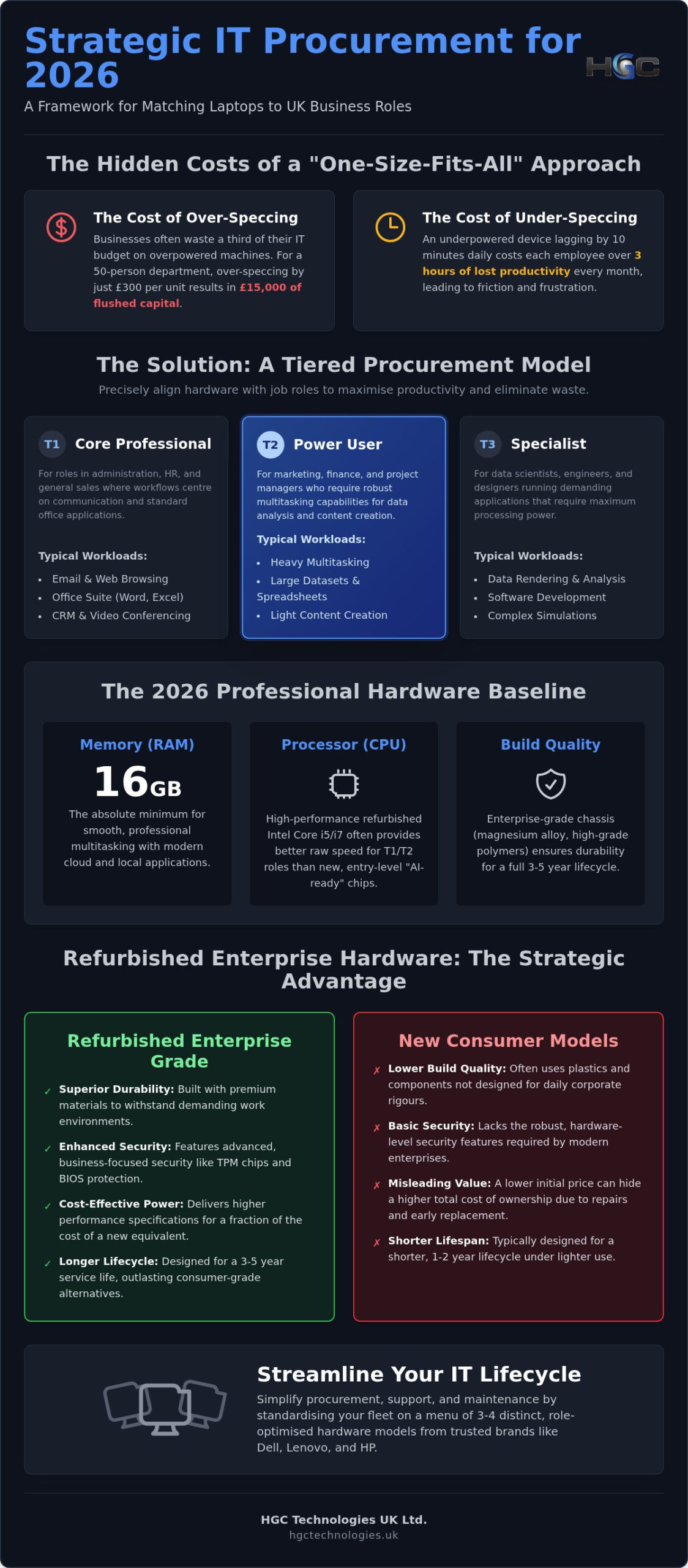
The mathematics of procurement waste are startling when viewed at scale. If a business over-specs a 50-person department by just £300 per unit, it effectively flushes £15,000 of capital away. This is capital that could have been reinvested into higher-tier machines for power users or server infrastructure. However, under-speccing is equally damaging. A machine that takes an extra two minutes to boot or stutters during multitasking can cost an employee ten minutes of productivity every day. Over a standard working month, that equates to over three hours of lost time per staff member. For a modern UK firm, a “one-size-fits-all” approach isn’t just inefficient; it’s a liability that erodes the bottom line.
The 2026 Performance Baseline
Defining the minimum viable specifications for 2026 requires understanding computer performance in the context of modern software demands. Whilst cloud-based workflows have reduced the need for massive local storage, they’ve increased the pressure on memory and connectivity. A professional environment now requires a baseline that can handle simultaneous video conferencing, web-based CRM tools, and local security encryption without breaking a sweat. Beyond the internals, build quality has become a critical performance metric. For mobile workers, a chassis made of magnesium alloy or high-grade polymers is essential to ensure the hardware survives a full three-to-five-year lifecycle amongst the rigours of hybrid travel.
Deciphering the Core Specs: CPU, RAM, and Storage for the 2026 Workplace
Technical specifications are the engine of employee output. Understanding the internal architecture of a machine is vital for matching laptop specifications to job roles effectively, especially as software demands continue to escalate. In 2026, the hardware landscape is strictly divided between traditional raw performance and emerging AI-integrated capabilities. Procurement officers must look beyond marketing labels like “Ultra” or “Pro” to identify the specific components that will actually drive value within their unique operational environment.
Processors and the Rise of AI Integration
The defining shift in 2026 is the inclusion of Neural Processing Units (NPUs) within the CPU package. These dedicated cores handle background AI tasks, such as real-time noise suppression in video calls or local data encryption, without draining the main processor. Whilst brand-new “AI PCs” are marketed heavily, many Tier 1 and Tier 2 roles don’t yet require local AI processing power. For these staff, a high-performance refurbished Intel Core i5 or i7 from a recent generation remains a formidable and cost-effective choice. These traditional chips provide the high clock speeds necessary for smooth multitasking in standard office suites, often outperforming newer, lower-tier “AI-ready” chips in raw speed.
Memory and Storage: The Pillars of Multitasking
Memory is no longer a spec where you can afford to compromise. In 2026, 16GB of RAM has become the absolute minimum for any professional role. Modern browser-heavy workflows, driven by Software-as-a-Service (SaaS) platforms like Salesforce, Microsoft 365, and complex CRM tools, consume memory at a rate that renders 8GB machines obsolete. When a system runs out of physical RAM, it relies on “swapping” data to the storage drive, which causes the micro-stutters and lags that frustrate employees. Investing in bulk refurbished laptops from Dell, Lenovo, or HP allows you to secure these 16GB or 32GB configurations across your entire organisation whilst maintaining a lean budget.
Storage strategy has also shifted from capacity to velocity. The transition to PCIe Gen 4 and Gen 5 NVMe SSDs means that boot times and file transfers are now measured in seconds rather than minutes. For most corporate profiles, a 512GB NVMe SSD represents the definitive sweet spot, providing ample room for local cache and OS files without paying for unused terabytes of capacity. Finally, whilst integrated graphics suffice for 90% of the workforce, dedicated GPUs remain non-negotiable for creative departments and data scientists who require parallel processing power for rendering and complex modelling.
A Tiered Framework: Matching Hardware to Specific Professional Profiles
A structured procurement matrix is the only way to ensure every pound spent delivers a measurable return in productivity. By categorising your workforce into specific tiers, you can simplify the complex task of matching laptop specifications to job roles and eliminate the guesswork that leads to budget leakage. This approach prevents the common error of providing a lightweight ultraportable to a data scientist or a high-end workstation to a receptionist who only requires basic browser access. Establishing these tiers allows your IT department to deploy hardware with surgical precision, ensuring that performance bottlenecks are a thing of the past.
General Administration and Customer Support
Reliability and ergonomic durability are the primary drivers for this tier. Staff in HR, administration, and customer service roles typically engage in high-volume data entry and constant communication via VoIP and video platforms. For these users, bulk Dell refurbished laptops are the gold standard. They offer the necessary chassis resilience and keyboard longevity required for heavy daily use. The baseline for this tier includes:
- Processor: Intel Core i5 (8th Generation or newer)
- Memory: 16GB RAM
- Storage: 256GB NVMe SSD
These specifications handle modern office suites and browser-based CRM platforms with ease. They ensure zero latency during critical customer interactions whilst maintaining a cost-effective procurement profile.
Management and Data-Intensive Analysis
Managers and financial analysts represent the “Excel Power User” profile. Their hardware must handle massive datasets and complex pivot tables whilst remaining portable for a hybrid work schedule. Build quality and advanced security features are essential for these roles, making bulk Lenovo refurbished laptops an ideal choice. The ThinkPad series, in particular, provides the superior keyboard feel and robust security features like TPM 2.0 that leadership teams require. For this tier, prioritise high CPU clock speeds and 32GB of RAM to ensure that intensive data calculations don’t freeze the system during a presentation.
Creative Design and Engineering Workstations
When workloads involve 4K video editing, complex 3D rendering, or CAD engineering, standard mobile hardware often reaches its thermal limits. For these Tier 3 and Tier 4 professionals, a custom built business PC is often the only viable solution. These machines allow for dedicated GPUs with high VRAM counts and colour-accurate displays that are non-negotiable for professional creative output. Large-scale media assets also require secondary high-capacity storage drives to complement the primary NVMe boot disk, ensuring that project files remain accessible without compromising the speed of the operating system.
Why Refurbished Enterprise Hardware Often Outperforms New Consumer Models
The assumption that new hardware always equates to better performance is a procurement fallacy. When matching laptop specifications to job roles, the physical longevity of the device is as critical as the silicon inside. Consumer-grade laptops are often designed for a 24-month lifecycle, prioritising sleek aesthetics and low price points over structural integrity. In contrast, enterprise hardware from manufacturers like Dell, HP, and Lenovo is engineered for the rigours of a 40-hour work week and constant travel. Choosing a high-spec refurbished business machine often provides a more stable and secure platform than a brand-new budget alternative.
Enterprise Build Quality vs Consumer Grade
Professional laptops are typically built to MIL-STD 810G standards, a series of environmental tests that ensure the machine can withstand drops, vibrations, and extreme temperatures. Whilst a brand-new budget consumer laptop might feature a plastic shell that flexes under pressure, a three-year-old HP EliteBook or Dell Latitude utilises a magnesium alloy chassis. This “chassis gap” is vital for UK workforces where hybrid working is the norm. Spill-resistant keyboards and reinforced hinges are standard features in the enterprise world, preventing the accidental damage that often sidelines consumer-grade machines within their first year of service.
The Financial Case for Refurbished Procurement
The depreciation curve of new IT hardware is aggressive, with machines losing a significant portion of their value the moment they leave the box. By opting for refurbished units, you bypass this initial value drop, allowing your budget to stretch much further. This surplus capital can then be redirected into higher-tier peripherals or critical server infrastructure. Grade A refurbishment processes ensure that ex-corporate machines deliver ‘as-new’ performance and aesthetic standards whilst maintaining a significantly lower price point.
Beyond the financial benefits, refurbished hardware is a powerful tool for meeting corporate ESG goals. Since 75-85% of a laptop’s lifetime CO2 footprint is generated during the mining, manufacturing, and assembly stages, extending the life of existing enterprise hardware is one of the most effective ways to reduce your organisation’s Scope 3 emissions. This approach aligns perfectly with the Greening Government Commitments and the broader shift toward a circular economy in the UK. You aren’t just saving money; you’re actively reducing electronic waste and carbon output.
Secure your next fleet of high-performance machines by browsing our bulk refurbished enterprise laptops today.
Implementing a Bulk Procurement Strategy for a Diverse Workforce
Successful IT procurement requires a transition from reactive buying to proactive, role-based strategy. Partnering with a wholesale laptop distributor in the UK provides the scale and technical consistency needed to support a modern organisation. By establishing a “Standardised Menu” of three to four hardware models, you simplify the complex process of matching laptop specifications to job roles. This approach ensures that whilst your workforce is diverse, your hardware remains manageable. Direct sales models offer significantly better value than retail channels, as they provide access to enterprise-grade configurations and bulk discounts that are unavailable to the general public.
Managing the hardware lifecycle also becomes more predictable under a wholesale model. Planning for refreshes every three to five years allows for structured hardware offboarding, which is essential for compliance with the mandatory digital waste tracking regulations coming into force in April 2026. This forward-thinking approach ensures that your organisation remains at the forefront of technology whilst maintaining a strict handle on procurement costs and sustainability obligations.
Fleet Standardisation and Quality Control
Standardisation is the most effective way to reduce the daily burden on your IT support desk. When your fleet is limited to a few specific models from Dell, Lenovo, or HP, technical friction vanishes because driver sets and hardware components are predictable. Consistency in physical ports is equally vital. Ensuring every machine supports universal USB-C or Thunderbolt docking allows for a seamless transition between home and office environments. To maintain these standards, every unit in a bulk batch must meet rigorous ‘Grade A’ refurbishment criteria, ensuring that “refurbished” hardware provides the same reliability and aesthetic quality as a factory-new machine.
Sourcing for Specialised Infrastructure
Mobile hardware does not exist in a vacuum. For roles that demand extreme processing power, such as Tier 3 engineering or data science, you must ensure your laptop fleet integrates perfectly with your enterprise server hardware. This synergy allows power users to offload heavy computations to local servers whilst maintaining mobility. Before signing a wholesale contract, UK procurement managers should verify a final checklist: ensure the supplier complies with the Procurement Act 2023 transparency rules, confirm VAT registration for tax efficiency, and verify that all data destruction meets the latest UK GDPR standards. This holistic view of procurement ensures that your hardware is not just a tool, but a strategic asset that drives long-term business growth.
Strategic Procurement for a Performance-Driven Future
Achieving operational excellence in 2026 requires a shift from generic hardware purchasing to a precise, role-based strategy. By implementing a tiered framework and embracing high-performance refurbished units, your organisation can effectively eliminate budget waste whilst boosting employee satisfaction. The process of matching laptop specifications to job roles ensures that every member of staff possesses the exact tools required to excel without the unnecessary overhead of over-speccing.
As a specialist UK wholesale distributor of Dell, HP, and Lenovo, we offer the direct sales model necessary for maximum procurement savings across your entire organisation. Whether you require standardised enterprise laptops or expert custom-built PC and server solutions, our team is ready to support your long-term business objectives with reliable, high-tier hardware that stands the test of time.
Enquire about bulk refurbished laptop rates for your business today and secure a future-proofed fleet that delivers unmatched value. We look forward to helping you transform your IT infrastructure into a driver of professional success and sustainable growth.
Frequently Asked Questions
Can refurbished laptops handle the latest 2026 AI-driven office software?
Yes, high-tier refurbished machines are fully capable of running 2026 AI-enhanced office suites. Whilst the newest chips feature dedicated NPUs, a refurbished Intel Core i7 or i9 with high clock speeds handles the majority of cloud-integrated AI tasks without performance degradation. For standard professional use, these machines provide more than enough power to process background AI operations smoothly whilst maintaining system stability.
Is 16GB of RAM enough for a standard office worker in 2026?
16GB of RAM is the absolute minimum requirement for a standard office worker in 2026. Modern browser-based SaaS applications and simultaneous video conferencing consume significant memory. Anything less than 16GB leads to system bottlenecking and reduced productivity during multitasking. For roles involving heavy data sets or complex spreadsheets, upgrading to 32GB is the safer long-term investment to ensure future-proofed performance.
What is the difference between consumer-grade and enterprise-grade laptops?
Enterprise-grade laptops are built for durability and longevity, whilst consumer models prioritise low costs and aesthetics. Business machines like Dell Latitudes or ThinkPads use magnesium alloy chassis and feature MIL-STD 810G certification for environmental resilience. They also offer superior serviceability, allowing your IT team to replace components easily; this is rarely possible with glued-together consumer devices designed for a shorter lifecycle.
How do I ensure refurbished laptops are secure for corporate use?
Security is ensured by selecting Grade A refurbished units that include TPM 2.0 and support modern encryption standards. You should partner with a distributor that guarantees BIOS-level data destruction to UK GDPR standards. Implementing a strict matching laptop specifications to job roles policy allows you to ensure every device in the field supports your corporate security protocols and remote management tools.
What laptop specifications are needed for software developers in 2026?
Software developers in 2026 require a minimum of 32GB of RAM and a high-performance multicore processor, such as an Intel Core i7 or i9. Fast NVMe storage is also essential for compiling code and running virtual machines or containers without latency. Whilst a laptop is the standard choice for mobility, some high-end engineering roles may benefit from custom-built PCs to avoid thermal throttling during intensive tasks.
Why is fleet standardisation important for UK businesses?
Fleet standardisation significantly reduces the burden on your IT support desk by creating a predictable hardware environment. It ensures that every employee uses the same port layouts and docking stations, which is vital for hybrid office setups. Standardisation also simplifies the procurement process by allowing you to buy in bulk and maintain a consistent spare parts inventory, ultimately lowering your total cost of ownership.
What are the benefits of buying refurbished laptops in bulk from a UK wholesaler?
Buying from a UK wholesaler offers a direct sales model that bypasses retail markups, providing maximum procurement savings for your organisation. You gain access to large batches of identical “Grade A” units, which is essential for successful fleet standardisation and lifecycle management. Additionally, working with a local specialist ensures your hardware meets UK power standards and regulatory requirements, such as the 2026 digital waste tracking mandates.
Should I choose Dell, Lenovo, or HP for my company’s laptop fleet?
The choice between Dell, Lenovo, and HP often comes down to your existing infrastructure and specific user preferences. Dell is renowned for its robust support ecosystem; Lenovo is favoured for its legendary keyboard ergonomics and build quality; HP is often selected for its advanced security features. All three brands offer excellent enterprise-grade hardware that is ideal for matching laptop specifications to job roles across a diverse workforce.

Ensuring Software Licensing on Refurbished PCs: The 2026 UK Business Guide
Genuine software licensing is the final stage of professional hardware refurbishment; without it, ev

Managing Warranties for a Fleet of Refurbished Laptops: The 2026 Procurement Guide
A 2024 study of 500,000 devices confirmed that enterprise laptop failure rates stay as low as 0.2 pe

Calculating ROI on Refurbished IT Equipment: A Strategic Guide for UK Enterprises
A certified, Grade A refurbished desktop is typically 40% to 60% cheaper than its brand-new equivale
Comments are closed.