

Data Security on Second-hand Business Laptops: A 2026 Procurement Guide
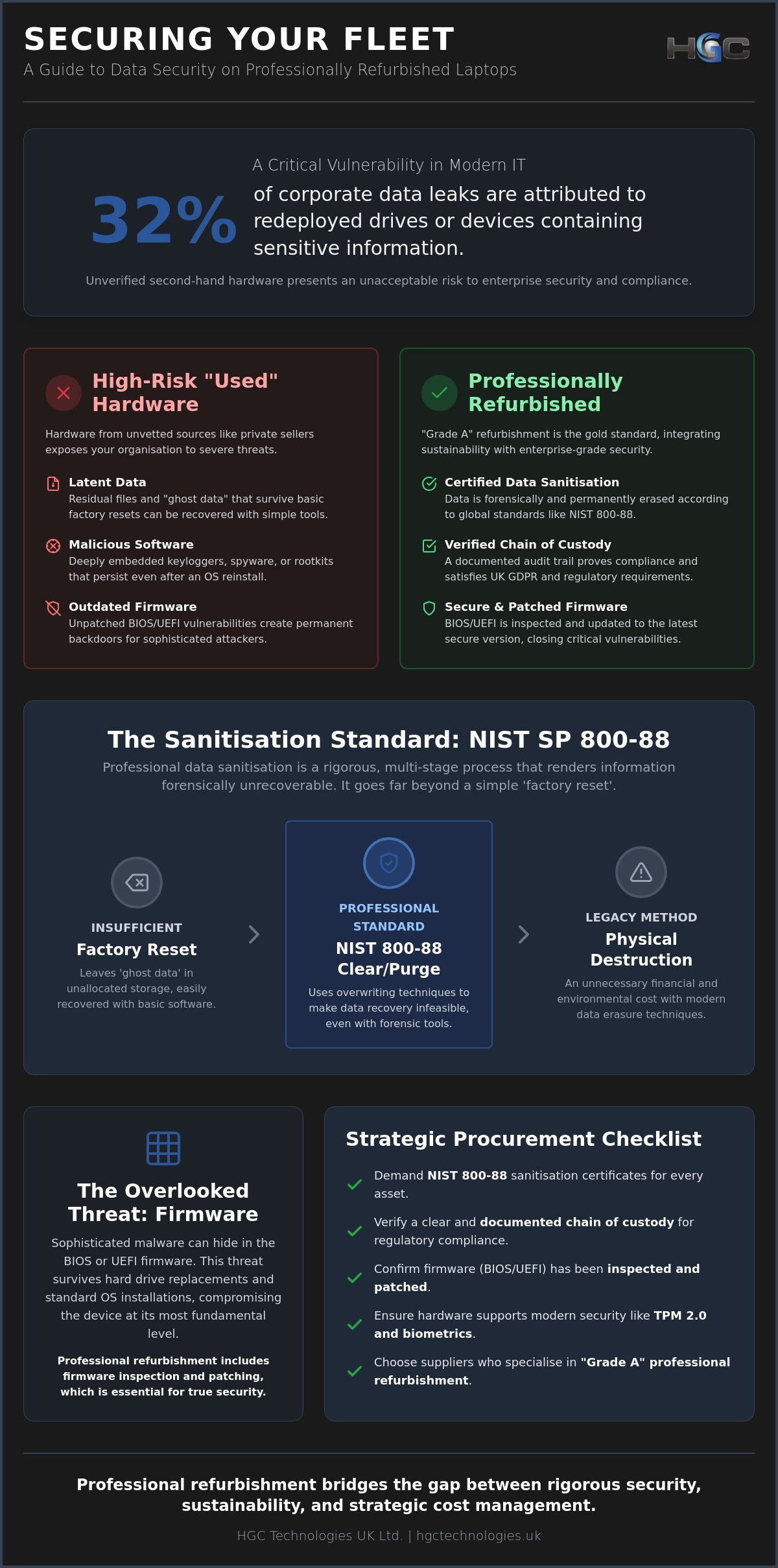
Thirty-two per cent of corporate data leaks are now attributed to redeployed drives or devices that still contain sensitive information. For procurement officers and IT directors, the fear of latent malware or keyloggers often makes the prospect of buying used hardware feel like an unacceptable risk. You’re right to be cautious. With the 2026 updates to CCPA and the stringent EU Waste Shipment Regulations now in effect, compliance anxiety is a valid hurdle to your sustainability goals. This guide will help you master the critical security protocols required to maintain robust data security on second-hand business laptops whilst capitalising on the significant cost-efficiency of refurbished hardware.
We’ll examine the shift toward NIST SP 800-88 Revision 2 governance, explain why professional sanitisation certificates are your best defence against liability, and provide a clear framework for vetting bulk procurement with absolute confidence. It is time to bridge the gap between rigorous security standards and strategic asset management. By the end of this guide, you’ll understand how to secure your corporate ecosystem using hardware-backed features like TPM 2.0 and biometric authentication to ensure your refurbished fleet is as secure as any factory-new alternative.
Key Takeaways
- Distinguish between high-risk used hardware and professionally refurbished units to eliminate common threats from latent data and malicious software.
- Identify the critical role of NIST SP 800-88 Revision 2 standards in maintaining robust data security on second-hand business laptops.
- Learn why securing the BIOS and UEFI firmware is essential for preventing sophisticated rootkits that can survive standard hard drive replacements.
- Implement a strategic procurement checklist to verify supplier sanitisation protocols and ensure hardware remains eligible for ongoing security patches.
- Discover how “Grade A” professional refurbishment serves as the gold standard for integrating corporate sustainability with enterprise-grade data protection.
The Reality of Data Security on Second-hand Business Laptops
Secure procurement is a pillar of modern IT strategy. It’s not merely about the hardware; it’s about the integrity of the data that lives within it. There’s a critical distinction between “used” hardware from a private seller and “professionally refurbished” business laptops from leading brands like Dell, Lenovo, or HP. Private sales often lack the rigorous audit trails required for enterprise compliance, leaving your organisation exposed to three primary risks:
- Latent Data: Residual files from previous users that survive basic deletion methods.
- Malicious Software: Keyloggers or spyware embedded deep within the system by previous owners or third parties.
- Outdated Firmware: Unpatched BIOS or UEFI vulnerabilities that provide backdoors for attackers.
With 38% of organisations experiencing a data leak in the past year, the stakes for hardware procurement have never been higher. This statistic highlights why the reality of data security on second-hand business laptops depends entirely on the sanitisation process. Whilst the financial savings of refurbished procurement are significant, they’re instantly negated by the cost of a single breach. Forward-thinking businesses are now choosing suppliers who provide a documented chain of custody and adhere to professional data sanitisation standards to mitigate these liabilities effectively.
Identifying Latent Threats in Non-Refurbished Hardware
Standard Windows factory resets are insufficient for corporate environments. They often leave “ghost data” in unallocated storage sectors that can be retrieved with basic recovery software. Beyond residual files, unverified hardware can harbour keyloggers or malware pre-installed at the root level. These threats often survive a standard operating system reinstall, meaning you could be deploying a compromised device directly into your network. Hardware-level implants in unverified supply chains represent a sophisticated risk that only professional testing and verification can identify.
The Regulatory Landscape: GDPR and Data Liability
Under UK GDPR, your business is responsible for the data on every device in your fleet, regardless of its origin. Deploying previously owned hardware without a verifiable sanitisation certificate is a major compliance failure. You must be able to prove a clear chain of custody for every asset to satisfy regulatory audits. Failing to verify that a drive has been wiped according to industry standards doesn’t just risk a leak; it creates a legal liability that can result in substantial fines. Professional refurbishment ensures that your data security on second-hand business laptops meets the highest legal and ethical requirements, protecting both your brand and your bottom line.
Understanding Professional Data Sanitisation Standards
Professional data sanitisation is the only verifiable method to ensure data security on second-hand business laptops. It is a rigorous, multi-stage process that renders information unrecoverable, even when subjected to advanced laboratory forensic tools. Unlike a basic deletion or a consumer-level wipe, professional sanitisation addresses every sector of the storage media. Wholesalers are the primary gatekeepers in this ecosystem. They execute these high-level protocols at scale before hardware ever reaches a reseller or end-user, ensuring that the chain of custody remains unbroken and secure.
In previous years, many IT departments resorted to the physical destruction of drives to guarantee security. By 2026, this practice is increasingly viewed as an unnecessary financial and environmental cost. Modern SSD and NVMe technologies allow for total data erasure without damaging the physical asset. This preserves the hardware’s value whilst meeting the most stringent corporate security requirements. The key is moving beyond the “factory reset” and adopting frameworks that are legally defensible and technically absolute.
Beyond the ‘Factory Reset’: NIST 800-88 and ADISA
The global benchmark for these processes is found in the NIST media sanitization guidelines. These protocols categorise sanitisation into “Clear” (protection against standard software recovery) and “Purge” (protection against laboratory-level forensic attacks). For UK-based organisations, ADISA (Asset Disposal and Information Security Alliance) certification provides an additional layer of assurance. These standards differ from consumer software because they require rigorous auditing and verification of the erasure process, providing a robust defence during regulatory inspections.
Software-Level vs. Hardware-Level Erasure
There are several technical paths to achieving a clean slate. Software-level erasure involves overwriting data bits across the entire drive surface multiple times to ensure no “ghost” traces remain. Alternatively, hardware-level commands like “Secure Erase” are built directly into modern SSD firmware. One of the most efficient modern methods is cryptographic erasure. By intentionally destroying the unique encryption key for a drive, the stored data becomes instantly unrecoverable, encrypted noise. This method is particularly effective for high-volume deployments where speed and security are equally vital.
Documentation is the final, non-negotiable step in this process. You must demand a certificate of erasure for every individual unit in your procurement batch. These certificates provide the essential audit trail required for GDPR compliance and internal risk management. If your organisation requires a reliable partner for secure hardware, sourcing bulk Dell refurbished laptops from a supplier that adheres to these verified sanitisation standards is a strategic necessity in the 2026 landscape.
Firmware and BIOS Security: The Overlooked Vulnerabilities
True data security on second-hand business laptops is built from the motherboard upwards. Whilst most discussions focus on storage media, the most persistent threats often reside within the firmware. BIOS and UEFI rootkits are particularly dangerous because they operate independently of the operating system. These malicious scripts can survive a complete hard drive replacement, effectively compromising a device before the first boot sequence even begins. Understanding Data Security In Refurbished Computers requires looking past the screen and into the silicon.
By 2026, TPM 2.0 (Trusted Platform Module) has transitioned from a recommendation to a strict requirement for enterprise environments. This hardware-level security chip is the foundation for modern Windows security features and identity protection. Procurement teams must ensure that every unit in a bulk order has its TPM cleared of previous ownership credentials. A failure to do this can lead to persistent ownership locks that prevent your IT department from enrolling the hardware in your corporate environment or managing encryption keys effectively.
Managing Secure Boot and TPM 2.0 in Refurbished Units
Secure Boot is your first line of defence against unauthorised bootloaders and rootkits. You must verify that this feature is active and that the platform keys are reset to factory defaults. When sourcing refurbished business laptops, confirm that the hardware fully supports the security requirements of Windows 11 and 12. This ensures your fleet remains compliant with modern encryption, credential guard, and virtualisation-based security protocols. A professional wholesaler will have already audited these settings to ensure seamless deployment into your network.
The Risk of BIOS Passwords and Computrace
Locked BIOS settings are a common hurdle in second-hand procurement that can cripple an IT rollout. If a previous owner has set a supervisor password, your IT team will be unable to modify boot orders, disable unused ports, or update security settings. Even more critical is the presence of “Absolute Persistence”, formerly known as Computrace. This tracking software is designed to survive wipes and re-installs to help recover stolen assets. However, if it remains active from a previous corporate owner, it represents a significant back-door risk. You must ensure that any such tracking is deactivated at the factory level and that all units are firmware-unlocked. Vetting units for these firmware-level locks before they enter your inventory is a prerequisite for maintaining data security on second-hand business laptops and ensuring long-term hardware longevity.
A Strategic Procurement Checklist for Secure IT Assets
Procurement is a risk management exercise. When you’re managing a fleet rollout, the primary objective is to eliminate variables that could compromise your network. Establishing a rigorous framework for data security on second-hand business laptops ensures that your cost-saving measures don’t introduce technical debt or security gaps. This structured approach moves beyond simple price comparisons and focuses on the technical integrity of every asset you acquire.
- Step 1: Verify Sanitisation Protocols. Request documented proof that the wholesaler follows NIST SP 800-88 Revision 2 or ADISA standards. A simple verbal assurance isn’t enough for a corporate audit.
- Step 2: Assess the Security Horizon. Check the manufacturer’s support site to confirm the hardware isn’t approaching its end-of-life (EOL) date. You need a minimum three-year window for firmware and driver updates.
- Step 3: Sample Batch Auditing. Conduct a physical and firmware-level audit of a small percentage of your order. Check for BIOS locks, active tracking software, and the presence of TPM 2.0.
- Step 4: Clean OS Deployment. Never rely on a pre-installed operating system. Wipe every drive and apply your organisation’s secure deployment image to ensure a known, hardened environment.
- Step 5: Log and Trace. Maintain a serial-number-based log for full asset traceability. This creates a clear chain of custody from the moment the hardware leaves the warehouse to its eventual decommissioning.
Vetting Your Wholesale Partner
Your choice of supplier is the most significant factor in your security strategy. Ask specific questions about their refurbishment facility: Do they have on-site technical expertise? Do they specialise in enterprise-grade brands like Dell, Lenovo, and HP? Reliable wholesale refurbished computers UK should always be accompanied by a clear grading system and a comprehensive testing report. This transparency is what separates professional wholesalers from high-risk private sellers.
Lifecycle Management and Manufacturer Support
Hardware longevity is intrinsically linked to security. Sourcing bulk Lenovo refurbished laptops or similar business-class machines provides an advantage because these manufacturers offer extended support cycles for their corporate lines. Avoid consumer-grade models that lack the necessary microcode updates to patch emerging vulnerabilities. By balancing immediate savings with a long-term security horizon, you protect your organisation from the hidden costs of premature hardware obsolescence.
Effective procurement requires a partner who understands the intersection of value and vulnerability. If you’re ready to upgrade your fleet without compromising your standards, view our security-verified bulk laptop inventory to find the ideal hardware for your next deployment.
Why Professional Refurbishment is the Gold Standard for Security
Professional refurbishment represents the intersection of environmental responsibility and enterprise-grade protection. It’s a comprehensive engineering process that treats every device as a blank slate. By choosing this path, organisations ensure that data security on second-hand business laptops is hard-coded into the procurement cycle rather than added as an afterthought. This approach reduces the attack surface by delivering units with clean, authorised operating system installs that are free from the bloatware or factory-level vulnerabilities often found in consumer-grade retail hardware.
Adhering to “Grade A” standards is about more than just aesthetic appeal. It serves as a guarantee of hardware integrity. A Grade A unit has undergone rigorous physical inspection to ensure that ports haven’t been tampered with and that internal components remain in peak condition. This level of scrutiny is vital for maintaining a secure perimeter. When you deploy a fleet of Grade A machines, you’re providing your staff with reliable tools that meet the same functional and security benchmarks as factory-new equipment whilst supporting your corporate ESG goals.
The HGC Technologies UK Ltd. Quality Assurance Process
Our commitment to excellence is defined by a methodical multi-point inspection that verifies both the physical and digital health of every asset. We manage bulk data sanitisation for our extensive Dell, HP, and Lenovo inventories using the high-level protocols discussed earlier in this guide. This ensures that every drive is verified as empty and every BIOS is returned to its secure factory state. We don’t just sell hardware; we provide units that are ready for immediate, secure corporate deployment, allowing your IT team to focus on high-level strategy rather than troubleshooting individual machines.
Scaling Secure IT Infrastructure in the UK
Resellers and IT managers face the unique challenge of communicating complex security concepts to their own end-users. As a leading wholesale laptop distributor UK, HGC Technologies UK Ltd. acts as a strategic partner that simplifies this process. We provide the technical documentation and audit trails necessary to prove that data security on second-hand business laptops is absolute. Our expertise extends beyond portables to include custom-built PCs and server solutions, enabling you to build a bespoke, secure environment tailored to your specific operational needs.
HGC Technologies UK Ltd. remains the trusted partner for national IT procurement because we never sacrifice security for scale. We understand that in 2026, a secure IT infrastructure is the foundation of business stability. By choosing professionally refurbished hardware, you’re not just saving on capital expenditure; you’re investing in a proven, sustainable, and highly secure technology lifecycle that protects your most valuable corporate assets.
Securing Your Corporate Future with Sustainable Hardware
Deploying a high-performance fleet doesn’t require a compromise on integrity. By prioritising NIST-compliant sanitisation and rigorous firmware audits, you can achieve enterprise-grade data security on second-hand business laptops whilst meeting ambitious sustainability targets. We’ve established that the distinction between risk and reliability lies in the professional refurbishment process and a transparent chain of custody.
Since 2020, HGC Technologies UK Ltd. has served as a trusted UK wholesale partner, specialising in premium Dell, Lenovo, and HP enterprise hardware. We understand that your reputation depends on the technical stability of your infrastructure. Our rigorous protocols ensure that every unit arrives ready for immediate, secure deployment, backed by the audit trails your compliance team requires. It’s time to leverage the strategic advantage of high-quality refurbished assets without the anxiety of latent threats.
Browse our secure range of bulk refurbished laptops today and discover how we can help you scale your IT capabilities with absolute confidence. Your journey toward a more efficient and secure technology lifecycle starts with a partner who shares your commitment to excellence.
Frequently Asked Questions
Is data really unrecoverable after a professional wipe?
Yes, provided the process follows NIST 800-88 Revision 2 “Purge” standards. Unlike a basic deletion, professional sanitisation uses advanced software to overwrite every bit of the storage media or executes a cryptographic erase. These methods ensure that even laboratory-level forensic tools cannot retrieve any traces of previous information, providing a definitive clean slate for your next deployment.
Do refurbished laptops come with a fresh operating system?
Most professionally refurbished units are delivered with a clean, authorised version of the operating system. This is a vital step because it eliminates the bloatware, tracking software, and residual user profiles often found on “used” machines. For bulk corporate rollouts, receiving units with a baseline install allows your IT department to apply your own hardened, company-specific security image with minimal friction.
Can a second-hand laptop have a hidden BIOS password?
It’s a common issue with unvetted “used” hardware. A hidden supervisor password can prevent your IT team from enforcing boot policies or updating security settings. Professional wholesalers audit every machine to ensure all firmware locks are removed before sale. This ensures your IT department has full administrative control over the hardware from the moment it arrives at your facility.
What is the difference between NIST 800-88 and a standard format?
A standard format simply removes the file index, whilst NIST 800-88 ensures the actual data bits are unrecoverable. Think of it as the difference between removing a book’s table of contents and burning every page in the library. NIST-compliant sanitisation is the only method that provides a legally defensible audit trail for compliance officers and satisfies stringent UK GDPR requirements.
Are older refurbished laptops still safe if they don’t get updates?
Safety is directly tied to the manufacturer’s support lifecycle. If a laptop no longer receives microcode or firmware updates, it becomes a liability regardless of how clean the operating system is. When maintaining data security on second-hand business laptops, you should always procure models with an active support horizon to ensure you’re protected against emerging hardware-level exploits.
How do I verify the security of a bulk batch of laptops?
Verification relies on a documented chain of custody and serial-number-specific audit trails. You should request sanitisation certificates for every unit and conduct a spot-check on a sample of the hardware to verify that TPM 2.0 is cleared and Secure Boot is active. A reputable wholesale partner will provide this data transparently to facilitate your organisation’s internal risk management processes.
Does HGC Technologies UK Ltd. provide certificates of data erasure?
Yes, we issue individual sanitisation certificates for every unit we process. This documentation is critical for your organisation’s internal audit trail and satisfies the requirements of GDPR or CCPA. By providing a verifiable link between the device’s serial number and its erasure status, we help you mitigate the legal risks associated with hardware redeployment whilst ensuring total transparency.
Is TPM 2.0 essential for data security on second-hand business laptops?
It’s the cornerstone of modern endpoint protection. Without TPM 2.0, you cannot utilise advanced features like Windows Hello or hardware-backed BitLocker encryption effectively. As we move through 2026, enterprise security policies increasingly mandate this chip to maintain a consistent “root of trust” across the fleet, making it a non-negotiable for data security on second-hand business laptops.

Refurbished Server Setup: 2026 Small Business Guide
The most reliable server for your company's 2026 expansion isn't sitting in a manufacturer's warehou

Refurbished Hardware for Disaster Recovery: Practical Guide
Could refurbished hardware strengthen your recovery plan, or create another point of failure? The an
Refurbished Laptop Grades Explained: A 2026 Strategic Procurement Guide
With the UK refurbished electronics market projected to reach a staggering $24.37 billion by 2035, t
Comments are closed.