

Upgrading Business Laptop Fleet UK: The 2026 Asset Recovery Guide
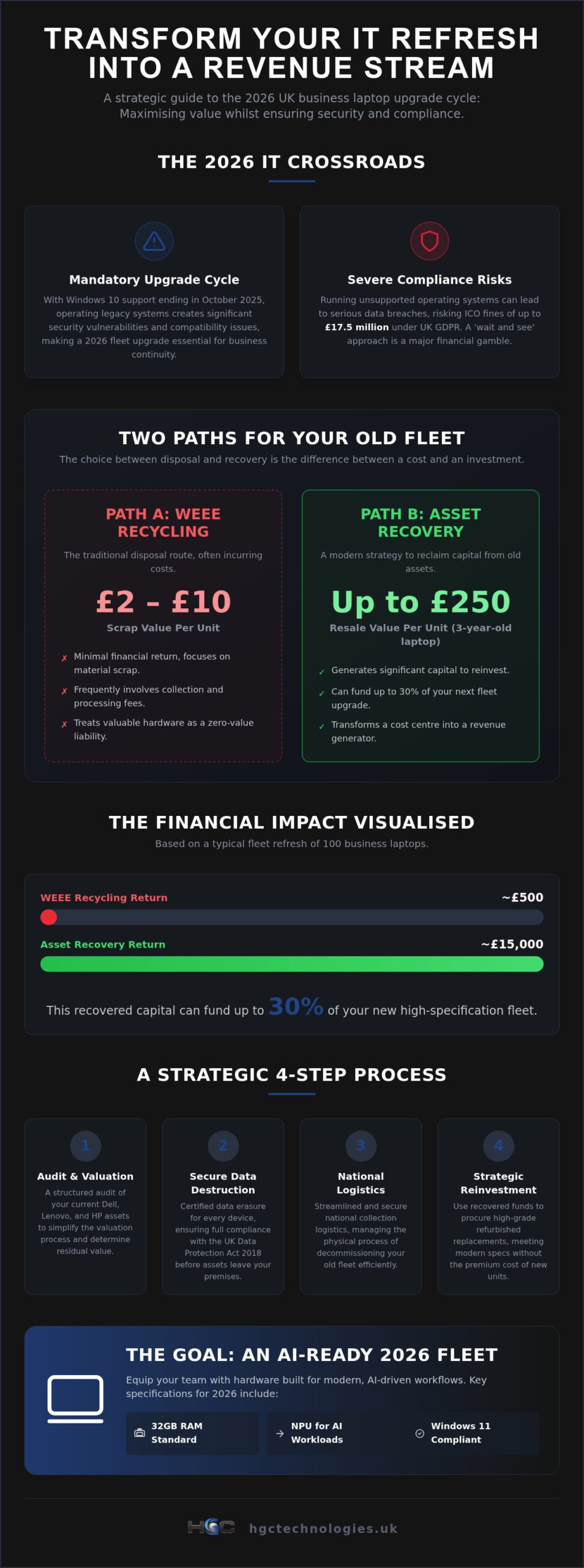
A typical three year old business laptop can still command a resale value of up to £250, yet many UK firms allow this capital to evaporate in dusty storage cupboards. When you’re upgrading business laptop fleet UK operations in 2026, the traditional view of hardware disposal as a mere cost centre is entirely outdated. You likely recognise the logistical headache of coordinating national collections and the anxiety of meeting the strict data erasure standards required by the Data (Use and Access) Act 2025. It’s a complex balance of security, sustainability, and fiscal responsibility that requires a more sophisticated approach than simple recycling.
This guide demonstrates how to transform your refresh cycle into a strategic asset recovery programme that actively funds your next move. You’ll learn how to execute a seamless fleet upgrade whilst maximising ROI through strategic bulk asset recovery and secure data destruction. We will outline the steps to secure the highest residual value for your old units, allowing for a smooth transition to high-spec Dell or Lenovo fleets that meet the modern 32GB RAM and NPU standards required for today’s AI-driven workflows.
Key Takeaways
- Understand why asset recovery delivers significantly higher returns than standard WEEE recycling by leveraging the residual value of your decommissioned hardware.
- Navigate the legal complexities of the UK Data Protection Act 2018 to ensure every device undergoes certified data destruction before leaving your premises.
- Learn the most efficient methodology for upgrading business laptop fleet UK operations to meet the rigorous hardware demands of the 2026 corporate environment.
- Discover how a structured audit of your current Dell, Lenovo, and HP assets simplifies the valuation process and streamlines national collection logistics.
- Explore the strategic advantages of a direct wholesale model for sourcing premium refurbished replacements whilst eliminating unnecessary middleman fees.
Navigating the 2026 Business Laptop Upgrade Cycle in the UK
UK IT procurement has reached a definitive turning point. With the support for Windows 10 having ended in October 2025, many UK SMEs are now operating with significant security vulnerabilities and compatibility issues. Upgrading business laptop fleet UK operations in 2026 is no longer a matter of preference; it’s a fundamental requirement for operational continuity and data protection. Adopting an ‘Asset Recovery’ mindset allows IT managers to view decommissioned hardware as a financial resource rather than a logistical burden. This shift in perspective ensures that the residual value of old assets helps fund the transition to modern, AI-ready workstations.
The Windows 11 Compliance Deadline
Modern corporate environments require hardware that supports TPM 2.0 and specific processor architectures to maintain Windows 11 integrity. Running unsupported operating systems exposes your business to unpatched vulnerabilities and potential ICO fines, which can reach up to £17.5 million for serious data breaches under UK GDPR. A ‘wait and see’ approach is a gamble that risks both your reputation and your balance sheet. Ensuring your fleet meets these standards is the only way to guarantee long-term stability and compliance in an increasingly hostile cyber environment.
Identifying the Right Time to Upgrade
The debate between a three-year and five-year lifecycle has shifted towards the shorter end of the spectrum in 2026. As hardware ages, the cost of maintenance often eclipses the investment required for a refresh. You’ll notice signs of decline through increased helpdesk tickets, battery failures, and visible frustration amongst staff. High employee turnover is frequently linked to inadequate tools, making a modern fleet a key component of staff retention. It’s often more cost-effective to refresh early whilst your current units still hold significant resale value.
The performance ceiling of legacy business hardware is reached when the physical components can no longer execute modern, AI-integrated software without significant latency or system instability.
Transitioning to a modern fleet requires a focus on sustainability and value. Instead of simply disposing of old units, businesses should prioritise responsible e-waste recycling and professional refurbishment. This approach ensures that your old Dell, Lenovo, or HP assets are either returned to the circular economy or processed in accordance with the latest 2026 WEEE regulations. By choosing high-grade refurbished replacements from a direct wholesaler like HGC Technologies UK Ltd., you can secure the 32GB RAM and NPU specifications required for contemporary workflows without the premium price tag of brand-new units.
Asset Recovery vs Recycling: Maximising ROI on Your Old Fleet
Choosing between asset recovery and standard recycling is often the difference between a budget deficit and a balanced sheet. When upgrading business laptop fleet UK operations, many organisations default to WEEE recycling out of habit. The profit gap is immense. While recycling focuses on the safe disposal of hazardous materials, asset recovery focuses on the reclamation of capital. By identifying units with resale potential, you transition from a disposal cost centre to a revenue generating procurement strategy.
Financial Comparison: Recovery vs Disposal
Professional asset recovery generates tangible liquidity from hardware that is often written off as zero value. The financial disparity between these two paths is stark. A single three year old business grade laptop typically holds a resale value between £100 and £250. In contrast, the scrap value for that same device often languishes between £2 and £10. When managing hundreds of units, the difference is substantial. Consider the following breakdown for a typical fleet refresh:
- WEEE Recycling: Often incurs collection fees and provides minimal scrap returns of £2 to £10 per unit.
- Asset Recovery: Can fund up to 30% of your next fleet upgrade by capturing the residual value of Grade A or B units.
- Tax Advantages: Selling depreciated IT assets through a wholesale channel can simplify your balance sheet and provide clear capital for reinvestment.
Adhering to the ICO guide to data security throughout this process ensures that your pursuit of ROI remains legally sound. You don’t have to sacrifice security for profit; a professional recovery partner provides certified data destruction as part of the valuation process.
The Circular Economy in UK IT
Sustainability is now a core metric for UK procurement officers and business owners alike. By feeding your old units back into the wholesale refurbished IT equipment UK ecosystem, you’re directly supporting the circular economy. This approach significantly reduces Scope 3 emissions by extending the usable life of high quality components, rather than resorting to energy intensive raw material extraction. It’s a tangible way to enhance your corporate social responsibility reports with real data on e-waste diversion. By evaluating your asset recovery options with a direct wholesaler, you can unlock capital that would otherwise be lost to the scrap heap whilst ensuring your old hardware finds a second life in the UK market.
Data Security and GDPR Compliance in Bulk Hardware Disposal
Legal accountability has never been higher for UK enterprises. The Data (Use and Access) Act 2025, which amended the UK GDPR and the Data Protection Act 2018, introduced a statutory data-protection complaints process that took effect in June 2026. When upgrading business laptop fleet UK assets, the Information Commissioner’s Office (ICO) holds the original data controller responsible for any breach that occurs during the disposal process. Fines of up to £17.5 million or 4% of global annual turnover are a sobering reality for firms that treat hardware decommissioning as an afterthought. This is why a structured approach to upgrading business laptop fleet UK hardware must prioritise software-based sanitisation over physical shredding.
Physical destruction is often viewed as the safest route, but it’s a blunt instrument that destroys the residual value discussed in previous sections. Modern software-sanitisation allows you to meet the highest security standards whilst preserving the unit for resale. It ensures that your organisation remains compliant whilst contributing to the circular economy.
Professional Data Sanitisation Standards
To remain compliant, UK firms should look for sanitisation protocols that align with NIST 800-88 or the HMG IS5 standards. These methodologies ensure that data isn’t just hidden, but rendered unrecoverable through advanced overwriting techniques. Software-based wiping is essential for maintaining the hardware integrity required for the refurbished market. It’s a precise process that requires specific tools tailored to the storage medium in question.
Solid State Drives (SSDs) require cryptographic erasure or specific firmware-level “Purge” commands because traditional block-overwrite methods used for Hard Disk Drives (HDDs) can leave data traces in wear-levelling or over-provisioned areas. Using the wrong technique doesn’t just risk a breach; it can also lead to hardware failure or reduced performance, impacting the eventual valuation of your batch. Professional partners use certified software to target these hidden areas, ensuring a complete wipe that a standard factory reset simply cannot achieve.
The Importance of Certification
A valid Certificate of Data Destruction (CoDD) is your primary defence during an ICO audit. This document must specify the serial number of each device, the method of sanitisation used, and the date of completion. It’s the final link in a secure chain of custody that begins the moment the laptops leave your office and move through the logistics network. Without this documentation, your business remains legally exposed if any data is later recovered from a sold asset.
Liability doesn’t vanish just because the hardware has been collected. You remain the data controller until a certified partner provides proof of sanitisation. Vetting your wholesale partner’s security protocols is therefore a critical step in the procurement cycle. Ensure they provide a transparent audit trail and utilise industry-recognised tools to guarantee that every byte of corporate intelligence is permanently erased before the hardware enters its second life.
A Step-by-Step Guide to Organising Your Fleet Upgrade
Executing a successful transition requires more than just buying new hardware. When upgrading business laptop fleet UK operations, you must manage the exit of your old assets with the same precision as the arrival of the new ones. This systematic approach ensures that you capture every pound of residual value whilst maintaining operational continuity. A well-organised upgrade cycle minimises downtime and provides a clear audit trail for both financial and compliance purposes.
Step 1: The Inventory Audit
Visibility is the foundation of any asset recovery strategy. You can’t accurately value what you haven’t measured. Conduct a comprehensive audit of your current Dell, Lenovo, and HP assets to determine their market worth. Record the processor generation, RAM capacity, storage type, and physical screen condition for every unit. Categorise your batch into Grade A (near-mint), Grade B (minor cosmetic wear), and Grade C (heavy use but functional) units. This level of detail allows for a precise valuation and prevents surprises during the collection process. Refer to our bulk Dell refurbished laptops guide to understand which specific configurations currently command the highest demand in the UK wholesale market.
Step 2: Choosing a Strategic Wholesale Partner
The choice of partner directly impacts your final ROI. Working with a wholesale laptop distributor UK specialist who operates a direct sales model is often more profitable than using a broker. Brokers frequently add a layer of commission that reduces your return; direct buyers provide a more transparent valuation. Ensure your chosen partner has national logistical capability to handle bulk collections securely and efficiently. This is also an opportune time to evaluate your wider infrastructure. Many firms choose to coordinate their laptop refresh with an update to their enterprise server hardware UK systems for a total integrated refresh.
Logistics shouldn’t be an afterthought. Organising the transport of hundreds of units across the UK requires secure, tracked vehicles and a clear chain of custody. Once your old fleet is collected and processed, you can deploy your high-grade refurbished replacements. This circular approach allows you to step up to premium Dell or Lenovo models with 32GB RAM and integrated NPUs without the capital expenditure typically associated with brand-new procurement. To begin your transition, you can contact us for a bulk fleet valuation and discover the true market value of your current IT assets.
Strategic IT Procurement with HGC Technologies UK
HGC Technologies UK Ltd. occupies a unique position as a national wholesaler specialising in Grade A refurbished hardware. When you’re upgrading business laptop fleet UK operations, you need a partner that understands the intersection of international scale and local expertise. Our direct wholesale model is designed to eliminate middleman fees, ensuring that the capital you recoup from asset recovery goes further. We provide a comprehensive service that covers the entire lifecycle of your technology, from the initial procurement of high-spec Dell, Lenovo, and HP units to the final, secure decommissioning of your legacy fleet.
A Partner for the Entire IT Lifecycle
HGC isn’t just a supplier; we act as a knowledgeable guide through the complexities of wholesale procurement. We help you recoup maximum residual value from your old assets whilst simultaneously sourcing your next bulk Lenovo refurbished laptops or Dell workstations. Beyond laptops, our expertise extends to custom-built PCs and bespoke server solutions tailored for integrated infrastructure. This holistic approach ensures that your hardware remains stable and aligned with the latest industry standards. Resellers and corporate clients prefer our model because it prioritises long-term value and reliability over short-term gains.
Get Started with a Fleet Valuation
Initiating your upgrade roadmap begins with a professional bulk valuation. Our UK-based team provides a transparent assessment of your current inventory, factoring in the specific processor generations and physical conditions identified in your audit. This consultation allows us to design a procurement strategy that fits your 2026 budget and performance requirements. We manage the national logistics and collection process to ensure a zero-disruption transition for your staff. By coordinating the removal of old units with the delivery of high-grade replacements, we keep your operations running smoothly.
Our commitment to certified data destruction and premium refurbishment standards provides the peace of mind necessary for modern business leaders. We don’t just participate in the market; we shape it by maintaining high standards and strategic alliances across the UK. Trusting HGC Technologies means choosing a trailblazer that values sustainability and ethical responsibility as much as technical excellence. Reach out to our team today to secure a valuation that reflects the true worth of your assets and sets the stage for your next phase of growth.
Future-Proof Your Enterprise with Strategic Asset Recovery
Navigating the 2026 technology landscape requires a shift from simple disposal to proactive asset management. By prioritising recovery over basic recycling, your organisation can capture significant residual value from legacy hardware to fund essential infrastructure growth. This strategic approach ensures that upgrading business laptop fleet UK operations is a financially sustainable process rather than an unpredictable capital drain. You’ve seen how professional sanitisation protects your reputation whilst the circular economy supports your broader corporate responsibility goals.
HGC Technologies UK Ltd. stands ready to facilitate this transition through our direct wholesale model, which eliminates middleman fees to maximise your ROI. We specialise in Grade A refurbished Dell, Lenovo, and HP systems, supported by national UK collection and secure logistics. Our team handles the complexities of bulk decommissioning, allowing you to focus on your core business objectives with absolute confidence in your data security and hardware performance.
Take the first step towards a more efficient and profitable refresh cycle today. Request a Professional Fleet Valuation from HGC Technologies UK to unlock the hidden capital in your current assets and empower your workforce with the next generation of business technology.
Frequently Asked Questions
How many units are required for a bulk sale in the UK?
A bulk sale typically involves a minimum of 20 units to ensure logistical efficiency and maximum ROI for the client. Whilst we can review smaller batches for high-specification hardware, the wholesale model is most effective when processing larger volumes. This threshold allows us to deploy our national collection network and provide a competitive valuation that accounts for the administrative and transport costs involved in the asset recovery process.
Can we sell a mix of Dell, HP, and Lenovo laptops in one batch?
We actively encourage mixed batches containing Dell, HP, and Lenovo hardware. As specialists in these three primary brands, our valuation team can accurately assess the market value of a diverse inventory in a single transaction. This simplifies the process when you’re upgrading business laptop fleet UK operations that have accumulated different brands over several procurement cycles, providing a unified audit trail and a single point of contact for your entire decommissioned fleet.
What is the difference between Grade A and Grade B refurbished laptops?
Grade A units are in near-mint condition with minimal to no visible signs of previous use. Grade B laptops are fully functional but may feature minor cosmetic imperfections, such as light scratches on the casing or slight wear on the keyboard. Both grades undergo the same rigorous technical testing and data sanitisation processes. The distinction primarily affects the residual value we can offer, with Grade A units commanding the highest wholesale prices.
Do you provide on-site data destruction for high-security environments?
Our security protocols focus on a highly secure chain of custody and professional off-site certified data destruction. We utilise tracked national logistics to transport your assets to our processing centre, where they undergo professional sanitisation using industry-recognised software. Every device is processed in accordance with the Data (Use and Access) Act 2025, and you receive a comprehensive Certificate of Data Destruction for your compliance records, ensuring total peace of mind for high-security environments.
How long does the collection and valuation process typically take?
The initial valuation of your fleet is typically completed within 48 hours of receiving your detailed inventory audit. Once the valuation is accepted, we aim to coordinate the national collection of your assets within three to five working days. This methodical pace ensures that all logistics are precisely organised and that your staff experience zero disruption during the transition to your new refurbished Dell or Lenovo hardware.
Will you accept laptops with minor cosmetic damage or missing chargers?
We accept hardware with minor cosmetic damage, as these units are often suitable for our Grade B or Grade C refurbishment channels. Missing chargers or peripherals are also not a barrier to sale; however, these factors will be reflected in the final wholesale valuation. Our goal is to maximise the recovery of every asset, ensuring that even imperfect units contribute to your procurement budget rather than being lost to the scrap heap.
How does HGC Technologies ensure GDPR compliance during disposal?
We ensure full GDPR compliance by employing software-based sanitisation that meets NIST 800-88 standards. This process renders all data unrecoverable, including information stored on hidden sectors of SSDs and HDDs. By providing a formal audit trail and a Certificate of Data Destruction for every serial number, we help you meet the accountability requirements of the UK Data Protection Act 2018. This rigorous approach significantly reduces the risk of costly ICO fines.
Can I trade in my old fleet directly against the cost of upgraded units?
You can certainly use the value of your old fleet to offset the cost of high-specification replacements from our inventory. This integrated approach is a cornerstone of our service, allowing you to move seamlessly from legacy hardware to premium refurbished Dell or Lenovo laptops. By positioning HGC as your single partner for both asset recovery and procurement, you eliminate middleman fees and streamline the financial complexity of upgrading business laptop fleet UK infrastructure.

BYOD Policy vs Corporate-Owned Refurbished Laptops: The 2026 Strategic Comparison
The long-held belief that letting employees use their own devices saves your budget is a costly misc

Refurbished Laptop Grades Explained: The 2026 UK Business Procurement Guide
The UK's refurbished electronics market reached a valuation of £7.6 billion in 2025, yet many procu

UK GDPR: 2026 Procurement Guide for Used IT Hardware
Research by the University of Hertfordshire's Cyber Security Centre found that 65% of second-hand me