

Business Continuity with Refurbished Hardware: A 2026 Strategic Guide
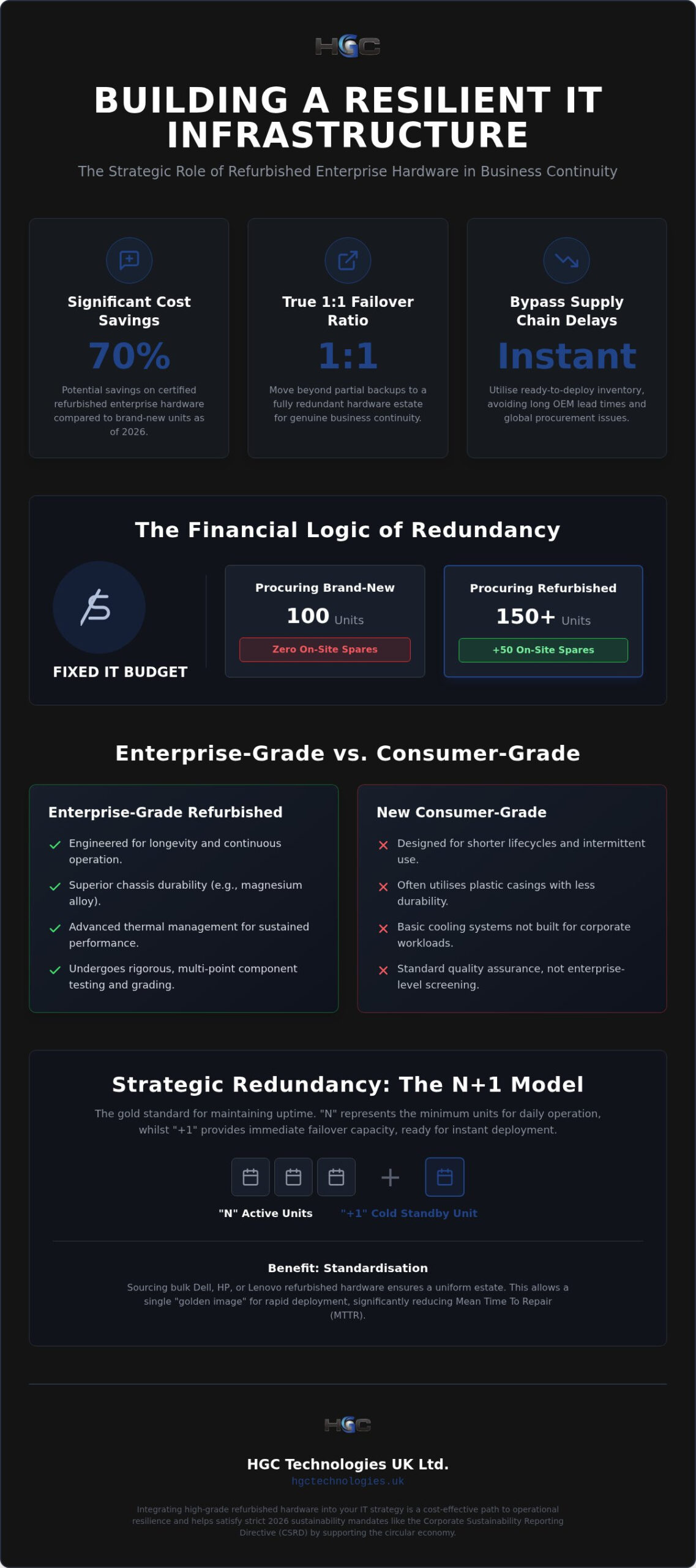
Certified refurbished enterprise hardware offers cost savings of up to 70% compared to brand-new units as of 2026. This significant margin allows organisations to finally achieve true business continuity with refurbished hardware, moving beyond partial backups to a resilient 1:1 failover ratio. Most IT leaders agree that maintaining redundant “cold” standby units is a financial burden when buying new, especially whilst navigating long lead times. You shouldn’t have to compromise your disaster recovery posture due to procurement delays or capital constraints.
This guide demonstrates how to leverage high-grade Dell, Lenovo, and HP systems to build a robust, cost-effective infrastructure. You’ll learn how to secure your operations whilst satisfying strict 2026 sustainability mandates like the CSRD. We will examine the growth of the circular economy and provide a structured roadmap for rapid deployment and estate standardisation. By the end of this strategic guide, you’ll possess a clear blueprint for a redundancy plan that protects both your operations and your bottom line.
Key Takeaways
- Learn how to implement an N+1 redundancy model using high-grade refurbished laptops to ensure your workforce remains productive during unexpected hardware failures.
- Discover how to strengthen your business continuity with refurbished hardware by achieving a 1:1 failover ratio at a fraction of the cost of brand-new equipment.
- Bypass global supply chain delays and long lead times by utilising ready-to-deploy inventory for urgent hardware replacements or estate expansions.
- Identify the essential steps for auditing mission-critical dependencies and integrating custom-built servers into your secondary disaster recovery sites.
- Understand why enterprise-grade refurbished hardware provides superior reliability and longevity compared to new consumer-grade alternatives for corporate environments.
The Role of Refurbished Hardware in Modern Business Continuity
Business continuity often focuses on cloud synchronisation and off-site data centres, but the physical hardware layer is frequently the weakest link in the chain. True resilience requires a strategy that addresses device failure at the endpoint and server level. Within the framework of business continuity planning, hardware availability determines how quickly an employee returns to productivity after a system crash. Achieving robust business continuity with refurbished hardware allows organisations to bypass the Continuity Gap, which is the critical window of downtime between a device failure and the arrival of a replacement.
Strategic sourcing bridges this gap by maintaining a local buffer of high-quality assets. Instead of waiting weeks for OEM shipments or navigating unpredictable retail stock, businesses can deploy pre-configured units instantly. This proactive approach ensures that hardware becomes a reliable component of your disaster recovery plan rather than a reactive procurement headache. It’s about ensuring the physical tools of trade are always within reach when primary systems fail.
Why Enterprise-Grade Refurbished Gear Wins
Reliability is non-negotiable for redundancy roles. Consumer-grade laptops often lack the chassis durability and advanced thermal management required for consistent business use. In contrast, ex-corporate Dell and HP lines are engineered for longevity and ease of maintenance. When you source wholesale refurbished computers UK, you’re acquiring Grade A hardware that has undergone rigorous component testing and cosmetic grading. These units meet strict performance baselines, ensuring they function as seamless replacements that can handle professional workloads without compromise.
The Financial Logic of Redundancy
Redundancy is often sacrificed due to budget constraints. Buying 100 brand-new units might exhaust a department’s capital expenditure, leaving zero room for spares. However, that same budget can often secure 150 high-grade refurbished units. Those 50 additional laptops serve as an immediate on-site insurance policy. If a primary unit fails, the spare is already in the building, imaged, and ready for deployment. This strategy reduces the pressure on operational expenditure by eliminating emergency courier fees and the high cost of lost productivity. It’s a pragmatic method for scaling your disaster recovery posture whilst maintaining a lean technology budget.
Strategic Redundancy: Building a Hardware Buffer Estate
Resilience isn’t accidental; it’s engineered. The N+1 redundancy model is the gold standard for maintaining uptime across corporate environments. In this framework, “N” represents the minimum number of units required for daily operation, whilst “+1” (or more) provides the immediate failover capacity. Adopting this approach allows IT departments to follow the principles outlined in the NIST Contingency Planning Guide, ensuring that hardware failures don’t escalate into service outages. By prioritising business continuity with refurbished hardware, organisations can afford to keep these “cold standby” units on-site, ready for instant deployment without overextending the annual budget.
Standardising with Bulk Dell Refurbished Laptops
Uniformity is the secret to rapid recovery. When your redundant estate consists of varied makes and models, driver management becomes a logistical nightmare during a crisis. Sourcing bulk Dell refurbished laptops ensures that every spare unit in your locker shares identical components and firmware. This consistency allows your IT team to maintain a single “golden image” for the entire fleet, making the “swap and go” process seamless. Standardising your hardware estate significantly reduces the mean time to repair (MTTR) by eliminating the need for bespoke troubleshooting during a device failure. If you need to align your infrastructure, you can view our bulk inventory to find matching batches of enterprise systems.
Managing the Spare Pool
A buffer estate is only useful if the hardware remains operational whilst in storage. It’s vital to implement a rotation policy where “cold” spares are swapped into active use every quarter to maintain battery health and ensure critical software updates are applied. This proactive maintenance prevents “dead-on-arrival” scenarios when a spare is desperately needed during an emergency.
Beyond laptops, this strategy extends to the wider infrastructure. Custom PC builds can be utilised to create identical desktop environments for secondary failover sites, ensuring staff experience zero friction when switching locations. Similarly, keeping a stock of original smartphones ensures that your mobile workforce remains connected if the primary office network or hardware fails. Bulk procurement of these assets creates a cohesive, predictable environment that can survive significant disruption without the high costs associated with new retail hardware.
Supply Chain Resilience and Legacy Support
The global supply chain remains unpredictable. Recent years have demonstrated that relying solely on new hardware leaves organisations vulnerable to chip shortages and shipping bottlenecks. When a critical system fails or a department needs to expand rapidly, waiting months for an OEM shipment isn’t a viable option. Building business continuity with refurbished hardware provides a strategic bypass. It allows procurement teams to access “instant inventory” that is already on the shelf and ready for immediate configuration. This agility is the foundation of a resilient operation that doesn’t grind to a halt due to external logistics failures.
Bypassing Procurement Lead Times
Delivery speeds often define the difference between a minor hiccup and a major corporate crisis. Whilst new enterprise servers can carry lead times of 12 weeks or more, a professional wholesale laptop distributor UK can typically dispatch high-grade units within 48 hours. This speed allows IT managers to use refurbished assets as a “bridge” during long-term infrastructure upgrades.
If your primary rollout is delayed by manufacturing queues, deploying refurbished units ensures your staff stay productive in the interim. It’s a pragmatic solution that prioritises uptime over waiting for the latest model to leave a distant factory. This flexibility ensures that your expansion plans remain on schedule, regardless of global manufacturing volatility.
Maintaining Legacy Infrastructure
Hardware failure in specialised sectors like manufacturing or laboratory research often presents a unique challenge: software compatibility. Many industrial control systems or proprietary lab programmes rely on specific legacy ports or older operating systems that new hardware no longer supports. A “like-for-like” replacement strategy is essential here. Sourcing identical refurbished units ensures that your specialised custom PC builds or server environments remain operational without requiring a complete software overhaul.
Refurbished servers play a vital role in maintaining older database environments during slow migration phases. They provide a stable, known platform whilst you transition to newer technologies at a manageable pace. This continuity prevents the catastrophic data loss or operational downtime that occurs when legacy hardware finally gives out and no modern equivalent exists. This reliance on known hardware standards is why business continuity with refurbished hardware remains a top priority for technical decision-makers in 2026.
Implementing Refurbished Hardware into Disaster Recovery Plans
Integrating hardware into a disaster recovery (DR) strategy requires a methodical approach. It isn’t enough to simply own spares; those spares must be integrated into a living plan. To achieve business continuity with refurbished hardware, organisations should follow a structured five-step implementation process. A robust strategy for business continuity with refurbished hardware turns a potential catastrophe into a manageable IT event.
- Audit: Map every mission-critical hardware dependency across your departments to understand what must be replaced first.
- Identify: Pinpoint “High-Availability” requirements, specifically for server infrastructure that cannot tolerate any downtime.
- Source: Procure matching refurbished units to populate your secondary “warm” or “cold” failover sites.
- Test: Perform quarterly synchronisation and failover drills to verify asset readiness and data integrity.
- Document: Create clear “Swap-Out” guides that allow non-technical staff to deploy replacement hardware if IT personnel are unavailable.
Server Continuity and High Availability
Building a secondary site often fails at the budget stage when using new equipment. By utilising enterprise server hardware UK, you can construct a redundant cluster for a fraction of the usual cost. This affordability allows for the purchase of identical server nodes, which is a prerequisite for seamless “vMotion” or “Live Migration” capabilities. When your nodes match, virtual machines can transition between physical hosts without dropping a single packet. This hardware-level redundancy provides a massive cost-benefit advantage over expensive cloud failover fees, which often include high monthly retention costs and unpredictable egress charges during a recovery event.
The “Grab-and-Go” Laptop Kit
Business resilience also depends on the mobility of your key personnel. Creating emergency “Grab-and-Go” kits ensures that executive and IT leadership can remain operational regardless of the state of the primary office. These kits should contain pre-imaged refurbished laptops that are ready for immediate login. To ensure these users stay connected, include original smartphones wholesale UK to provide dedicated tethering and secure communication channels. Standby units must undergo regular BIOS and firmware updates to ensure they remain compatible with the latest security patches and network protocols. To begin building your hardware buffer, explore our current wholesale availability and secure your estate today.
Scaling Your Continuity Strategy with HGC Technologies
HGC Technologies UK Ltd. serves as an authoritative partner for organisations seeking to secure their infrastructure against unforeseen disruption. We specialise in the bulk supply of corporate IT solutions, ensuring that every asset in your failover estate meets the highest performance standards. Our rigorous refurbishment process involves deep-level component diagnostics and comprehensive data sanitisation, ensuring that every device achieves Grade A reliability. This commitment to excellence transforms refurbished assets into mission-critical tools for your business continuity with refurbished hardware strategy.
Our wholesale model is specifically designed to support large-scale projects without the delays typical of retail procurement. We simplify the complexity of wholesale processes, acting as a knowledgeable guide for technical decision-makers. By focusing on high-performance hardware and strategic alliances, we help businesses build a resilient foundation that prioritises long-term value over short-term gains. This proactive approach ensures that your hardware redundancy is a source of strength rather than a logistical bottleneck.
Bulk Procurement for National Resilience
National resilience requires significant scale. We possess the capacity to supply hundreds of matching Dell, HP, or Lenovo units, allowing for complete estate-wide backup. This volume is essential for organisations aiming to achieve a high spare-to-user ratio, providing an immediate safety net for the entire workforce. Our direct sales model ensures you receive premium hardware without the unnecessary overheads or complexities of financing programmes. With our extensive UK coverage, we facilitate rapid equipment replacement, ensuring your operations remain stable regardless of your geographic footprint.
Custom Configurations for Expert Failover
Expert failover often requires more than standard specifications. We provide custom-built PC and server configurations tailored for specific business environments and bespoke continuity needs. Our technical experts work closely with IT managers to match existing specifications, ensuring that failover nodes integrate seamlessly with your current network architecture. Whether you require a specific internal component for a legacy application or a high-availability server cluster for a secondary disaster recovery site, we provide the precision required for seamless integration. Consult with HGC Technologies for your continuity hardware needs and discover how our strategic sourcing can protect your organisation from the unexpected.
Future-Proofing Your Operations with Strategic Hardware
Resilience in 2026 requires a fundamental shift from reactive procurement to proactive redundancy. By integrating high-grade refurbished assets, you bridge the critical continuity gap whilst maintaining a lean technology budget. The ability to deploy matching Grade A Dell, Lenovo, or HP units from a local buffer ensures that your workforce stays online, regardless of global supply chain volatility or chip shortages. Achieving robust business continuity with refurbished hardware is no longer a compromise; it’s a strategic advantage that allows for a 1:1 failover ratio across your entire estate.
Founded in 2020, HGC Technologies is a specialist UK wholesaler dedicated to high-performance corporate solutions. We provide expert custom server and PC configurations alongside bulk inventory to ensure your secondary sites are always ready for instant deployment. Take control of your disaster recovery posture and ensure your organisation remains stable through any disruption. Secure your business continuity with HGC Technologies wholesale hardware today.
Frequently Asked Questions
Is refurbished hardware reliable enough for a disaster recovery site?
Grade A refurbished enterprise hardware is exceptionally reliable for disaster recovery because it undergoes more rigorous testing than new consumer devices. High-performance Dell and Lenovo lines are designed for 24/7 corporate environments, making them ideal for “cold standby” roles. By choosing business continuity with refurbished hardware, you’re using proven components that have already survived the initial “infant mortality” failure phase common in brand-new electronics.
How does refurbished hardware improve supply chain resilience?
Refurbished hardware provides immediate supply chain resilience by eliminating the traditional 12-week lead times associated with new OEM orders. Whilst manufacturing delays often stall infrastructure projects, wholesale refurbished units are available for 48-hour dispatch. This “instant inventory” allows IT managers to respond to hardware failures or sudden workforce expansions without being at the mercy of global chip shortages or international shipping bottlenecks.
Can I get matching bulk quantities of refurbished laptops for my entire team?
Yes, sourcing matching bulk quantities is a core advantage of working with a specialist wholesaler like HGC Technologies. We provide identical batches of Dell or Lenovo laptops, which is essential for estate standardised driver management. This uniformity ensures that your IT department can maintain a single “golden image” across both your active fleet and your redundant backup stock, simplifying support during a crisis.
What is the difference between Grade A and Grade B refurbished hardware for continuity?
Grade A refurbished hardware is the standard for continuity because it shows minimal cosmetic wear and has passed exhaustive functional diagnostics. It’s essentially indistinguishable from new equipment in a professional setting. Grade B units may have minor scratches or scuffs; whilst they’re functionally sound, Grade A is preferred for secondary disaster recovery sites where visual professionalism and component longevity are primary requirements.
How much can a business save by using refurbished gear for redundancy?
Businesses can achieve cost savings of 60% to 70% by opting for certified refurbished enterprise hardware instead of new units as of 2026. These savings allow organisations to afford a 1:1 failover ratio, which would be financially impossible with a new-only procurement strategy. By reducing capital expenditure on redundant assets, you can reallocate funds toward critical cybersecurity measures or high-availability software synchronisation tools.
Does refurbished hardware support the latest operating systems like Windows 11?
Most enterprise-grade refurbished hardware from recent years fully supports Windows 11 and its subsequent updates. These systems include the necessary TPM 2.0 security chips and compatible processor architectures required for modern secure boot environments. We ensure that all bulk laptops and custom PCs meet these technical requirements, allowing your business continuity with refurbished hardware to remain aligned with current software security standards.
How do refurbished servers compare to new ones in a high-availability cluster?
Refurbished servers perform identically to new ones in high-availability clusters, provided the internal specifications match. When nodes share the same processor generation and memory capacity, features like vMotion or Live Migration function seamlessly. Using refurbished server nodes allows you to build a redundant cluster on a budget, ensuring that virtual machines can transition between physical hosts without any operational downtime during a failure.
What happens if a refurbished unit fails during a continuity event?
If a refurbished unit fails during a continuity event, you should immediately deploy a spare from your N+1 buffer estate. Having a “cold standby” pool of pre-configured laptops or servers ensures that a single hardware failure doesn’t halt your recovery efforts. Because refurbished assets are so cost-effective, you can afford to keep multiple spares on-site, allowing for an instant swap-out that minimises mean time to repair.

Circular Economy IT Procurement UK: The 2026 Strategic Guide for Enterprises
Manufacturing a single new laptop requires roughly 190,000 litres of water, and nearly 85% of its li

Energy Efficiency of Refurbished Laptops: A Practical Guide
A refurbished laptop isn’t automatically less energy-efficient than a new one. The energy efficien

Refurbished Laptop Multitasking: A 2026 Guide
You don't need a four-figure budget to eliminate the stuttering video calls and frozen browser tabs