

Circular Economy IT Procurement UK: The 2026 Strategic Guide for Enterprises
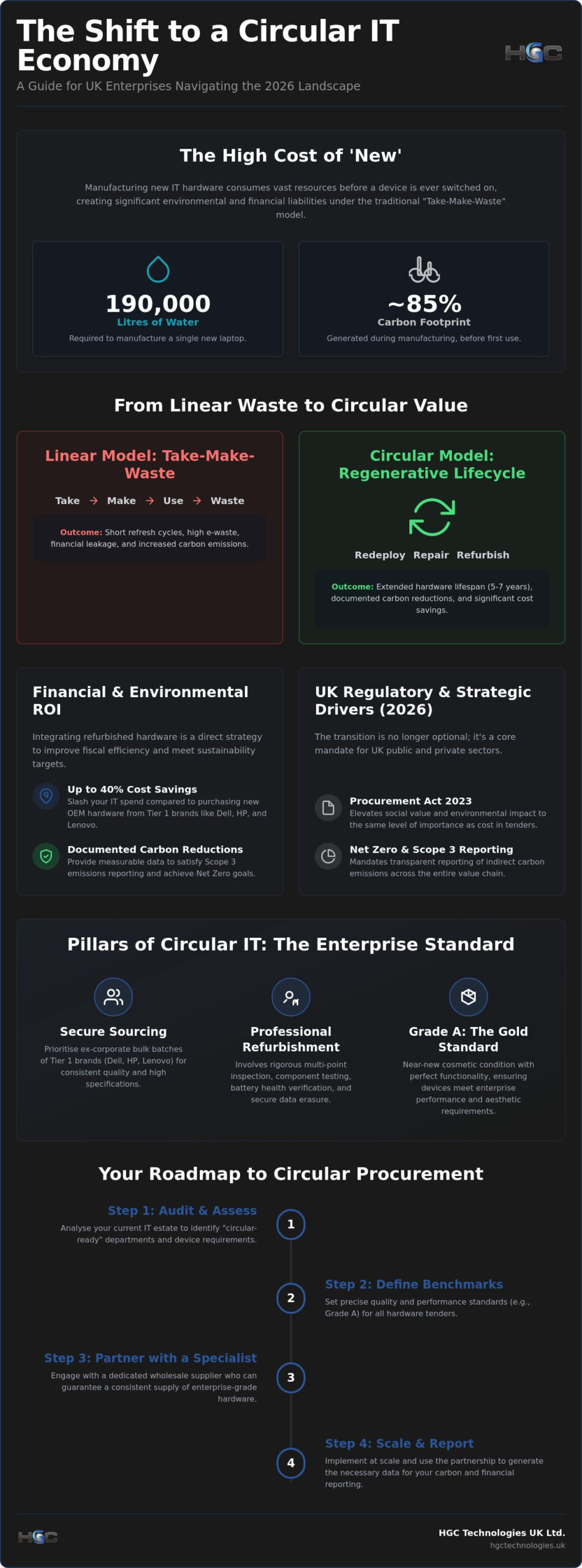
Manufacturing a single new laptop requires roughly 190,000 litres of water, and nearly 85% of its lifetime carbon footprint is created before the device is ever switched on. For British enterprises, the traditional model of buying new is no longer just an environmental burden; it’s a fiscal liability. As of 2026, the shift towards circular economy IT procurement UK has moved from a niche sustainability goal to a core mandate for both public and private sectors. You’re likely facing intense pressure to meet Net Zero targets whilst managing the soaring costs of new OEM hardware. It’s a difficult balance to strike when you also need the absolute reliability of Tier 1 brands like Dell, HP, and Lenovo.
We understand that uncertainty regarding the quality of refurbished equipment often holds back large-scale transitions. However, you can transform your IT procurement from a linear cost centre into a circular strategic asset that delivers documented carbon reductions. This guide explores how to secure a reliable bulk supply of enterprise-grade hardware that slashes your IT spend by up to 40%. We’ll examine the 2026 regulatory landscape, including Scope 3 reporting requirements, and provide a roadmap for scaling your infrastructure without compromising on performance or reliability.
Key Takeaways
- Transition from linear “take-make-waste” models to regenerative lifecycles to meet stringent UK Net Zero 2050 targets by 2026.
- Master the industry grading standards for refurbished hardware to ensure bulk batches consistently meet your enterprise performance and aesthetic requirements.
- Realise up to 40% cost savings and significant carbon reductions by integrating circular economy IT procurement UK into your long-term infrastructure strategy.
- Learn how to audit your current IT estate to identify “circular-ready” departments and set precise quality benchmarks for hardware tenders.
- Scale your digital infrastructure with Tier 1 brands like Dell, HP, and Lenovo by partnering with a dedicated wholesale specialist.
What is Circular Economy IT Procurement in the 2026 UK Market?
The era of disposable enterprise technology has officially ended. In 2026, circular economy IT procurement UK has evolved from a sustainability footnote into a mandatory pillar of corporate strategy. It represents a fundamental transition from the outdated “take-make-waste” linear model to a regenerative lifecycle. Organisations are no longer just buying devices; they’re managing a continuous flow of technical value. This shift is critical for delivering on the UK’s trajectory toward Net Zero 2050, as the manufacturing phase alone accounts for up to 85% of a laptop’s total carbon footprint.
Refurbished hardware serves as the cornerstone of this new model. By prioritising high-spec, ex-corporate machines from Tier 1 brands like Dell, HP, and Lenovo, businesses can maintain peak performance whilst drastically reducing their environmental impact. Standard procurement often ignores the hidden costs of e-waste and rapid depreciation. Circular sourcing, however, ensures that every asset is utilised to its maximum potential through professional refurbishment and strategic redeployment. It’s a method that turns a necessary expense into a long-term strategic asset.
The Shift from Linear to Circular Infrastructure
Traditional linear models are designed for obsolescence, creating significant financial leakage through short refresh cycles and disposal fees. In 2026, the focus has shifted toward durability and repairability as primary hardware standards. Circular procurement is a regenerative system that keeps IT assets at their highest value for the longest duration. By adopting circular procurement principles, enterprises can ensure their hardware remains in use for five to seven years rather than the typical three; this is achieved through modular upgrades and professional maintenance. This approach eliminates the “buy-break-replace” cycle that has historically drained IT budgets.
UK Regulatory Drivers for Circularity
The Procurement Act 2023 has transformed the UK tender landscape, making social value and environmental impact as important as initial cost. Businesses must now provide transparent data on Scope 3 carbon emissions, which include all indirect emissions within the value chain. Defra’s 2026 initiative, which targets 90% refurbishment for its mobile devices, sets a clear benchmark for the private sector to follow. Choosing refurbished hardware isn’t just about saving money anymore. It’s about fulfilling legal reporting obligations and demonstrating a commitment to the UK’s greening government commitments. It’s a practical, measurable way to deliver on net-zero promises during UK Net Zero Week and beyond, providing the documented carbon reductions that modern stakeholders demand.
The Pillars of Circular IT: Refurbishment, Repair, and Grading
Success in circular economy IT procurement UK depends on moving beyond high-level policy into the technical reality of hardware. Professional refurbishment acts as the primary engine of this transition. It isn’t merely a process of cleaning a device; it involves a rigorous, multi-point inspection that includes component testing, battery health verification, and secure data erasure. By prioritising the use of original components during this process, specialists ensure that the hardware retains the performance characteristics and reliability intended by the original manufacturer.
Sourcing from ex-corporate bulk batches offers the most secure path for enterprise buyers. These machines are typically high-specification models from Tier 1 brands like Dell, HP, or Lenovo that have been maintained under strict corporate service contracts. This consistency is a core element of the Government Digital Sustainability Alliance recommendations, which advocate for the strengthening of secondary markets to reduce the environmental impact of the UK’s digital estate. For procurement teams, these bulk batches provide the scale and uniformity needed to equip entire departments without the variability found in smaller, ad-hoc retail lots.
Grade A Refurbishment: The Enterprise Standard
Grade A represents the gold standard for professional environments. These devices are in near-new condition, showing minimal signs of previous use, which makes them ideal for client-facing staff and executive teams. Grade A refurbished Dell laptops, for example, provide the premium aesthetic and high-speed performance required by modern offices whilst avoiding the steep depreciation of new OEM hardware. This focus on top-tier quality is a significant factor in current wholesale refurbished computers UK market trends, where demand for enterprise-grade “as-new” equipment continues to outpace supply.
Hardware Lifecycle Management
Effective circularity requires a structured approach to asset management. Instead of reactive, ad-hoc purchases, organisations should organise a staggered refresh cycle that feeds retired assets back into the refurbishment loop. This creates a regenerative system where hardware is never truly wasted. Custom-built business PCs contribute to this by offering a modular design; specific components like RAM or storage can be upgraded to meet evolving software demands without replacing the entire unit.
Centralising your infrastructure through professional server solutions also plays a vital role. By shifting the heavy processing load to a central server, the functional lifespan of edge devices like laptops and PCs can be extended by several years. If you’re ready to build a more resilient and sustainable estate, you can view our latest bulk hardware arrivals to see how Tier 1 refurbished equipment fits into your 2026 strategy.
Financial and Environmental ROI: Why Refurbished Hardware Wins
Financial efficiency is the natural byproduct of circularity. When evaluating circular economy IT procurement UK, the Total Cost of Ownership (TCO) provides a much clearer picture than the initial sticker price alone. New OEM hardware carries a heavy “premium tax” and suffers from aggressive depreciation the moment it’s deployed. In contrast, enterprise-grade refurbished units have already bypassed this initial value drop. This allows organisations to maintain a much higher residual value over the asset’s lifecycle, turning what was once a sunk cost into a recoverable asset.
The linear model also hides significant costs in its tail end. Disposing of end-of-life electronics through traditional channels often incurs WEEE compliance fees and secure data destruction charges. A circular approach replaces these expenses with value recovery. By partnering with a specialist that understands the secondary market, enterprises can ensure that hardware is either refurbished for redeployment or harvested for parts. For those looking to extend these sustainable practices to international markets, working with a B2B export trading company Abu Dhabi can help bridge the gap between domestic supply and global demand. This shift protects budgets against the OEM price inflation seen throughout 2026, where supply chain volatility has pushed the cost of new silicon to record highs.
Direct Cost Savings for UK Enterprises
Budget holders often realise immediate savings of up to 40% when switching to a circular model. These capital gains are particularly evident when sourcing bulk Dell refurbished laptops, where the price-to-performance ratio far exceeds that of entry-level new machines. Wholesale procurement enables IT managers to specify higher-grade processors and larger memory configurations that would otherwise be cost-prohibitive. Furthermore, purchasing these assets directly allows businesses to avoid the “financing trap” of long-term leases, which often include hidden interest rates and restrictive end-of-term conditions. Direct ownership provides the flexibility to sweat the assets or upgrade on your own schedule.
Environmental Impact and ESG Reporting
The environmental benefits of circularity are now a requirement for modern ESG reporting. Investors and stakeholders in 2026 demand granular data on carbon avoidance. Refurbishing a single laptop saves approximately 150kg to 200kg of CO2 emissions, providing a tangible metric for corporate sustainability reports. This is achieved by bypassing the resource-heavy manufacturing phase, which accounts for the vast majority of a device’s total ecological footprint. By opting for a refurbished laptop batch, an enterprise can document a massive reduction in its Scope 3 emissions. This proactive stance on carbon reduction significantly improves an organisation’s ESG score, making it more attractive to green-focused investment funds and public sector tender boards.
Implementing a Circular Procurement Strategy: A Practical Guide
Moving from abstract sustainability goals to a functional circular economy IT procurement UK strategy requires more than just goodwill. It demands a structured operational shift. Begin by auditing your current IT estate to identify “circular-ready” departments. Not every user requires a brand-new workstation. Administrative teams, educational environments, and customer service hubs are often the most effective starting points for integrating high-spec refurbished units. By mapping hardware requirements to specific job roles, you avoid over-provisioning and reduce the total volume of hardware in circulation. This role-based provisioning is a primary lever for reducing your organisation’s overall carbon footprint.
Step-by-Step Sourcing for UK Businesses
Efficient sourcing starts with redefining your technical requirements. Instead of specifying “new” models in your tenders, define your needs based on performance benchmarks like processor generation, RAM capacity, and storage speeds. This allows you to access premium Tier 1 equipment that often outperforms entry-level new hardware at a fraction of the cost. Once performance is defined, vet your suppliers for stock consistency and quality control. A reliable wholesale laptop distributor UK should offer direct access to bulk batches, ensuring that every device in your rollout matches the same aesthetic and technical grade. This consistency simplifies your internal imaging and deployment processes, making the transition manageable for your IT support teams.
Overcoming Common Procurement Objections
The most persistent hurdle is the perceived “reliability” gap. However, data-driven failure rates for enterprise-grade refurbished hardware are often comparable to new consumer-grade equipment. This is because corporate machines are designed for 24/7 durability and undergo more rigorous individual testing during the refurbishment process than a standard factory line check. Software compatibility is also a primary concern for IT leads. When sourcing bulk Lenovo refurbished laptops, ensure the hardware supports the latest security protocols and operating system requirements, such as TPM 2.0 for Windows 11 and beyond. Finally, manage your logistics by partnering with a provider capable of coordinated bulk deliveries across multiple UK sites, ensuring your transition to circularity is as seamless as a traditional rollout. To begin your transition, you can browse our current wholesale inventory and secure your next hardware batch today.
Scaling Circularity with HGC Technologies: Your UK Wholesale Partner
Achieving a sustainable IT estate requires a partner capable of delivering both technical precision and wholesale volume. HGC Technologies UK Ltd. serves as the essential infrastructure partner for circular economy IT procurement UK, bridging the gap between high-level sustainability goals and the physical reality of hardware deployment. By operating a direct sales model, we maintain absolute quality control over every bulk batch of Dell, HP, and Lenovo equipment that enters our facility. This eliminates the unpredictability often found in the secondary market, providing enterprises with a stable, high-performance foundation for their digital growth.
Sourcing from a single specialist offers a distinct strategic advantage. It ensures your entire fleet remains consistent in terms of technical specifications and aesthetic grading, which significantly simplifies long-term maintenance and internal support. Whether you’re equipping a central office or a distributed workforce, our focus on Tier 1 hardware ensures circularity never comes at the cost of operational reliability. We’re dedicated to helping you move away from the restrictive financing models of new OEM leases, allowing you to own your assets outright and manage their lifecycle with complete autonomy.
Wholesale Solutions for Resellers and Schools
Large-scale educational rollouts and reseller partnerships demand a level of stock consistency that retail-focused refurbishers simply cannot match. We provide the necessary volume to support hundreds of users simultaneously, ensuring schools can provide students with high-spec technology whilst staying within tight budgets. Resellers can also improve their margins by offering sustainable, enterprise-grade solutions that meet the growing demand for circularity amongst their own clients. This extends to mobile infrastructure; our supply of original smartphones provides a reliable, cost-effective alternative for corporate fleets, ensuring connectivity remains high whilst the environmental footprint remains low.
Custom Enterprise Infrastructure
Circularity isn’t limited to the devices in your employees’ hands. It must extend to the very core of your data centre. We specialise in configuring enterprise server hardware UK to meet specific performance requirements, allowing organisations to build scalable, sustainable infrastructure. For specialised business environments, our high-performance custom builds offer a modular path forward, where individual components can be upgraded as your technical needs evolve. This holistic approach ensures every layer of your IT environment contributes to your Net Zero 2050 targets. If you’re ready to transform your procurement model, contact HGC Technologies to discuss your circular IT procurement requirements and secure a more sustainable future for your organisation.
Leading the Transition to Sustainable Digital Infrastructure
The transition from linear consumption to a regenerative model is the most significant shift in enterprise technology management this decade. By prioritising high-grade refurbished hardware, your organisation can meet stringent carbon reporting requirements whilst protecting budgets from the rising costs of new equipment. Success in 2026 requires a partner that understands the technical nuances of bulk refurbishment and the logistical demands of a nationwide rollout.
HGC Technologies UK Ltd. is an authoritative UK wholesale partner, specialising in bulk Dell, HP, and Lenovo laptops alongside expert custom-built PC and server solutions. Adopting a robust strategy for circular economy IT procurement UK doesn’t mean compromising on performance; it means making a sophisticated choice for long-term fiscal and environmental value. Secure your bulk circular IT hardware from HGC Technologies UK Ltd. and begin your transition to a more resilient digital estate today. Your next refresh cycle is a prime opportunity to lead your industry toward a more sustainable and profitable future.
Frequently Asked Questions
What is the primary benefit of circular economy IT procurement for UK businesses?
The primary benefit of circular economy IT procurement UK is the simultaneous reduction of capital expenditure and environmental impact. By shifting away from the linear “buy-dispose” cycle, businesses can reduce their hardware spend by up to 40% whilst fulfilling their corporate responsibility mandates. This model ensures that high-value materials remain in the economy longer, providing a more resilient and cost-effective supply chain for the long term.
How do refurbishment grades like Grade A impact IT procurement?
Grading standards provide the transparency needed to match hardware to specific organisational roles and budgets. Grade A units offer an “as-new” aesthetic suitable for client-facing staff and executives, whilst lower grades provide functional reliability for back-office or educational environments at a reduced cost. This allows procurement teams to precisely allocate their budget based on the visual and technical requirements of each department without over-spending.
Can refurbished hardware meet the performance needs of modern UK enterprises?
Refurbished enterprise-grade hardware consistently meets the performance demands of modern business software and security protocols. Because machines from Tier 1 brands like Dell, HP, and Lenovo are engineered for durability, their internal components are significantly more robust than consumer-grade alternatives. This ensures that even ex-corporate models can comfortably handle modern multitasking, cloud-based applications, and the latest operating system updates.
How does circular IT procurement contribute to Net Zero 2050 goals?
Circular procurement is a critical tool for meeting Net Zero 2050 targets by drastically reducing Scope 3 emissions within the value chain. Initiatives like Defra’s move to refurbished devices demonstrate that carbon emissions can be reduced by as much as 44% compared to buying new. This prevents the release of embedded carbon from the manufacturing phase and provides a tangible, documented metric for annual ESG reporting and sustainability audits.
Is it possible to source refurbished laptops in bulk for large organisations?
Large organisations can easily source refurbished laptops in bulk through dedicated wholesale specialists that manage high volumes of identical models. This consistency is vital for IT departments that need to deploy standardised software images and maintain a uniform fleet across multiple sites. Partnering with a wholesaler ensures that every device in a rollout matches the same aesthetic and technical grade, simplifying long-term support and maintenance.
What should I look for in a wholesale IT hardware supplier in the UK?
You should look for a supplier that operates a direct sales model and maintains absolute quality control over their bulk batches. A reliable partner will focus on Tier 1 brands and provide clear, documented grading standards for every unit. It’s also beneficial to choose an “infrastructure partner” that can provide bespoke configurations and server solutions, ensuring they can support your entire circular economy IT procurement UK strategy from a single source.
How does the Procurement Act 2023 affect circular technology sourcing?
The Procurement Act 2023 has shifted the focus of UK tenders toward “most advantageous” outcomes, placing a higher weighting on social value and environmental impact. This means that sustainability is no longer an optional extra but a core part of the evaluation process. For enterprises bidding on public sector contracts, demonstrating a circular approach to IT hardware can be the deciding factor in winning a high-value tender.
Are refurbished servers a viable option for UK data centres?
Refurbished servers are a highly viable and cost-effective option for scaling UK data centre infrastructure. They allow organisations to expand their storage and processing power without the massive lead times or costs associated with new OEM server solutions. When configured by specialists, these units provide the reliability needed for scalable infrastructure whilst contributing to a more modular and sustainable data centre strategy that avoids unnecessary e-waste.

Bespoke PC Builds for Business: A 2026 Strategic Procurement Guide
The standard corporate workstation is no longer a safe investment. It's a bottleneck disguised as a

How to Build an Effective IT Procurement Strategy for UK SMEs in 2026
The traditional model of IT hardware acquisition is failing the modern British business. As we move

Custom PCs for Design Agencies: 2026 Procurement Guide
Your agency's most expensive overhead isn't your studio rent or your premium software subscriptions;
Comments are closed.