
Custom PCs for Design Agencies: 2026 Procurement Guide
Your agency’s most expensive overhead isn’t your studio rent or your premium software subscriptions; it’s the cumulative seconds lost to every lagging Photoshop brushstroke and frozen export screen. Whilst many creative directors accept these delays as an unavoidable part of high-resolution production, this technical friction directly erodes your billable hours and team morale. Investing in custom PC builds for graphic design agencies isn’t merely about chasing the latest specifications. It’s a strategic move to ensure your workstations can keep pace with the demanding 2026 creative suite without the constant threat of hardware failure.
You deserve a standardised fleet of high-performance machines that deliver consistent results across your entire team. This guide provides a comprehensive roadmap for workstation procurement, showing you how to eliminate creative bottlenecks and maximise productivity through bespoke hardware configurations. We’ll examine the current hardware landscape, including the impact of rising DDR5 costs and the necessity of PCIe 5.0 storage for seamless file management. By the end of this article, you’ll understand how to secure long-term reliability and a superior return on investment for your agency’s infrastructure.
Key Takeaways
- Identify the hidden financial costs of hardware lag and why consumer-grade units cannot sustain a professional 24/7 studio environment.
- Discover why 64GB of RAM and PCIe 5.0 storage have become the essential benchmarks for high-performance custom PC builds for graphic design agencies.
- Learn how to balance single-core clock speeds for Photoshop with multi-core processing power for motion graphics and video editing workflows.
- Implement a strategic procurement lifecycle that uses hardware parity to reduce IT downtime and maintain consistent performance across your creative team.
- Understand the critical relationship between bespoke workstations and enterprise server solutions for managing high-resolution assets at scale.
The Agency Bottleneck: Why Off-the-Shelf PCs Stifle Creativity
Standard retail computers are engineered for volume, not creative precision. Whilst they may suffice for administrative tasks, they lack the architectural integrity required for a modern studio. Most off-the-shelf units from major manufacturers rely on proprietary motherboards and power supplies that lock your agency into a rigid, disposable ecosystem. These components make future repairs or hardware refreshes nearly impossible, forcing a total replacement when a single part fails. By investing in custom PC builds for graphic design agencies, you’re choosing a modular approach that ensures your technology remains an asset rather than a liability.
The software landscape in 2026 has become increasingly resource-intensive. Tools like Adobe Creative Cloud Pro for teams now demand specialised hardware to manage AI-driven features and high-resolution assets efficiently. Generic OEM builds often skimp on the high-speed storage and thermal management necessary to keep these applications running smoothly. This leads to the “laggy” brushstrokes in Illustrator and stuttering previews in After Effects that frustrate your most talented designers and slow down your entire production pipeline.
The Billable Hour Problem
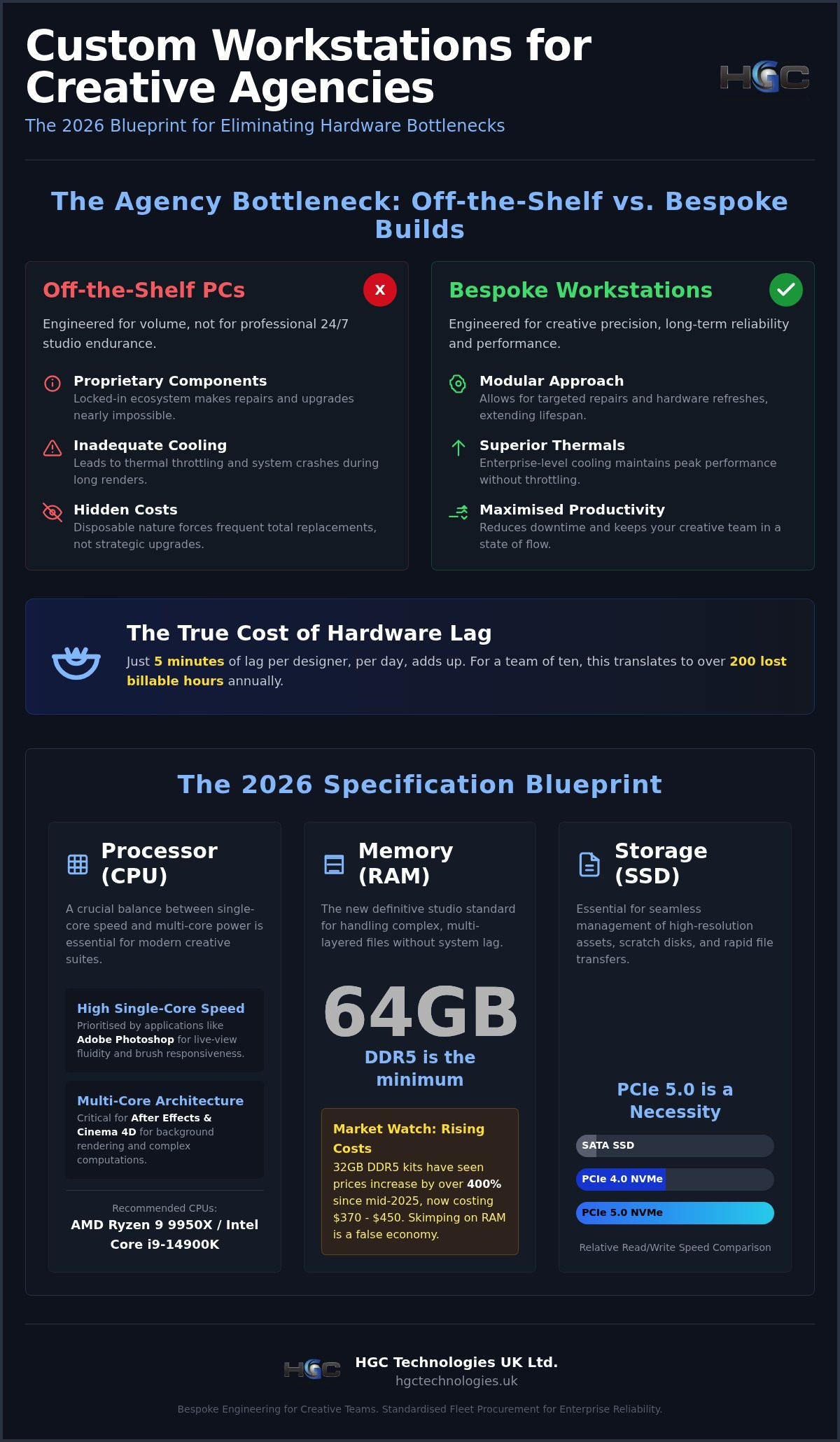
The true cost of inadequate hardware is found in your agency’s profit margins. If a designer loses just five minutes a day to hardware lag or slow file exports, that results in nearly 21 hours of lost productivity per person annually. For a team of ten, you’re looking at over 200 billable hours vanishing into thin air. High-performance workstations mitigate this risk by providing the stability and speed required to keep creative momentum alive. Using a high-performance workstation ensures that your team spends their time designing, not waiting for a progress bar to finish.
In the context of a 2026 design workflow, a bottleneck is any hardware limitation that prevents a creative professional from executing their ideas at the speed of thought.
Stability vs. Raw Speed
Many agencies mistakenly believe that high-end “gaming” PCs are suitable for professional work. While these machines often boast impressive raw speeds, they’re built for short bursts of intensity rather than the 24/7 endurance required in a studio environment. Professional custom PC builds for graphic design agencies prioritise component quality over aesthetic gimmicks like RGB lighting. A gold-rated power supply and a professional-grade motherboard are far more valuable to your uptime than a flashy chassis.
Reliability comes from superior thermal management and robust power delivery. When a machine is tasked with a six-hour render, consumer-grade cooling often fails, leading to thermal throttling or system crashes. Bespoke builds allow for the integration of enterprise-level cooling solutions that maintain peak performance without compromising the lifespan of the hardware. This focus on endurance ensures that your workstations remain reliable partners in your agency’s growth.
The 2026 Specification Blueprint for Graphic Design
Selecting the right components for custom PC builds for graphic design agencies requires a nuanced understanding of how modern creative software utilises hardware. In 2026, the performance gap between consumer-grade machines and professional workstations has widened significantly. High-resolution asset management and AI-assisted design tools now demand a precise balance of single-core speed, massive memory bandwidth, and lightning-fast storage. Relying on outdated benchmarks or generic advice often leads to procurement errors that can haunt an agency’s productivity for years.
Processor and Memory Synergy
The heart of a design workstation must be tailored to the specific applications your team uses most. Whilst Adobe Photoshop still prioritises high single-core clock speeds, applications like After Effects and Cinema 4D 2026.3.1 thrive on the multi-core architecture found in processors like the AMD Ryzen 9 9950X or the Intel Core i9-14900K. The Ryzen 9 9950X, with its MSRP of $649, has become a staple for agencies requiring a versatile balance of live-view fluidity and background rendering power.
Memory requirements have also shifted. 64GB of RAM is now the definitive studio standard for handling complex, multi-layered files without system paging. Although 32GB DDR5 kits have seen price increases of over 400% since mid-2025, reaching costs between $370 and $450, skimping on capacity is a false economy. High memory bandwidth is essential for large-format print work and high-resolution video textures, ensuring that data moves between the CPU and RAM without causing the dreaded “application not responding” dialogue.
Graphics and Visual Processing
GPU acceleration is no longer exclusive to 3D rendering; it now powers essential effects in Illustrator and InDesign. For modern agency workflows, a graphics card with at least 16GB of VRAM is non-negotiable. The NVIDIA GeForce RTX 5090 represents the pinnacle of this technology, though its extreme price volatility in 2026, sometimes exceeding $5,000, makes strategic procurement vital. Professional custom PC builds for graphic design agencies should almost always utilise NVIDIA Studio drivers over gaming variants to ensure maximum stability and compatibility with creative suites.
Integrating high-performance displays and graphics cards ensures that what your designers see on screen is an accurate representation of the final output. This visual precision must be backed by a storage architecture that doesn’t falter during massive file transfers. PCIe 5.0 (NVMe Gen5) SSDs have become the new benchmark, offering double the speed of the previous generation. A 2TB PCIe 5.0 drive, typically priced around $400, is essential for high-speed scratch disks and active project storage.
If you’re looking to standardise your studio’s performance, you might consider how custom-built PCs can be tailored to your specific software requirements.
Software-Specific Optimisation for Agency Workflows
Hardware power is wasted without software-level alignment. Professional custom PC builds for graphic design agencies must be configured to handle the specific operational quirks of the 2026 creative suite. Whilst Photoshop depends heavily on single-threaded performance for brush responsiveness and filter application, Premiere Pro and After Effects 2026.3.1 require massive multi-core throughput and high VRAM to handle real-time playback of 4K timelines. Even vector design in Illustrator demands careful hardware tuning to ensure smooth performance when working with thousands of complex paths and AI-generated patterns.
Adobe Creative Cloud 2026 Optimisation
Optimising your workstations requires more than just raw power. Every agency IT manager should ensure that hardware acceleration settings are correctly configured across all Creative Cloud Pro for teams applications. This allows the GPU to take over repetitive tasks like image rotation and zooming, which frees up the CPU for more complex background calculations. In a high-pressure studio environment, these small efficiencies accumulate into significant time savings over a project’s lifecycle.
Managing the cache is another critical factor. Dedicated SSDs for software scratch space are non-negotiable for professional creative work. By isolating the scratch disk from the operating system and project drives, you prevent the data traffic jams that lead to system freezes during heavy exports. The integration of NVMe Gen5 storage reduces Adobe Premiere render times by providing the extreme read/write speeds necessary to process high-bitrate video streams without data-transfer bottlenecks.
The Networked Agency
High-performance workstations don’t exist in a vacuum. To truly eliminate creative friction, your custom PC builds for graphic design agencies must include 10GbE networking as standard. This ensures your machines can communicate effectively with server solutions for business UK, allowing designers to open massive files directly from the server without the “file-open” lag typical of standard 1GbE connections. High-speed internal networking is the backbone of a modern collaborative studio.
Reducing this latency is vital for collaborative editing and asset retrieval. When your internal networking matches the speed of your local storage, your team can treat centralised servers as an extension of their own machine. This synergy between individual workstation power and robust server infrastructure allows for a more fluid creative process. It ensures that your agency’s collective output isn’t held back by outdated connectivity standards, allowing for seamless integration across the entire team.
Scalable Procurement: Creating a Studio Standard
Efficiency in a creative studio is often a product of technical predictability. Whilst many directors focus on individual workstation power, the true strategic advantage lies in hardware parity across the entire team. Implementing standardised custom PC builds for graphic design agencies transforms IT management from a reactive struggle into a proactive strategy. When every designer uses an identical hardware configuration, software deployment becomes uniform and unpredictable performance variances are virtually eliminated.
Agencies should target a lifecycle refresh every 36-48 months to maintain a competitive edge. This window ensures your hardware remains compatible with the escalating demands of 2026 creative software whilst retaining a reasonable resale value for the outgoing units. To guarantee immediate reliability, every machine must undergo 24-hour stress testing before it enters the studio. This rigorous quality control identifies potential component failures under heavy load, ensuring that your designers don’t experience downtime during critical project deadlines.
The Fleet Management Approach
Standardising your internal components significantly reduces the complexity of your IT infrastructure. By maintaining a uniform fleet, you minimise the need for an extensive inventory of spare parts and simplify the troubleshooting process. If a specific software bug emerges in a video rendering workflow, having hardware parity allows your technical team to replicate and resolve the issue across all workstations simultaneously. HGC Technologies specialises in providing these consistent custom built business PCs UK, ensuring that every unit in your agency meets a singular, high-performance standard.
Future-Proofing the Agency
Strategic procurement requires a forward-thinking approach to component selection. We prioritise motherboards that support next-generation PCIe standards and “over-spec” the power supply units to accommodate future GPU upgrades. This modularity means that when the next leap in visual processing occurs, you can upgrade specific components like the graphics card without needing to replace the entire workstation. Creating a roadmap for phased hardware rollouts allows your agency to manage capital expenditure whilst ensuring that your most resource-intensive departments always have access to the latest technology.
If you’re ready to standardise your studio’s infrastructure, you can explore our range of custom-built PCs designed for professional creative environments.
The HGC Advantage: Bespoke Engineering for Creative Teams
Choosing a technology partner is a decision that impacts your agency’s operational stability for years. At HGC Technologies, we don’t just assemble components; we engineer solutions that address the specific friction points in your creative pipeline. Our expert consultancy service translates your team’s artistic requirements into precise technical specifications. Whether your designers are grappling with 3D renders or complex vector illustrations, our custom PC builds for graphic design agencies are designed to eliminate the hardware bottlenecks that stifle innovation.
Reliability is the cornerstone of our assembly process. Every machine undergoes rigorous professional stress testing for 24 hours before it leaves our facility. This ensures that when your new workstations arrive, they’re ready for immediate production without the risk of early-life component failure. We provide national UK support, positioning ourselves as a reliable partner for corporate tech procurement that understands the high-stakes environment of a professional studio.
Beyond the Workstation
Modern agencies require a holistic approach to their computing infrastructure. We specialise in the synergy between local workstation power and centralised storage. By integrating our custom PC builds for graphic design agencies with high-performance enterprise server hardware UK, we create a seamless ecosystem for asset management and collaborative editing. This ensures that your technical backbone is as scalable as your creative ambitions.
Our support extends beyond the design desk. We help agencies maintain a consistent standard across all departments by sourcing complementary bulk Dell refurbished laptops for account managers and administrative staff. This comprehensive service allows you to manage your entire technology lifecycle through a single, authoritative partner, ensuring hardware parity and simplified IT support across your whole organisation.
Getting Started with HGC
Our engagement begins with a deep-dive consultation to identify your agency’s specific software hurdles and performance goals. We analyse your current workflow to determine where hardware upgrades will yield the highest return on investment. From the initial specification phase to the final delivery, we maintain a streamlined procurement timeline that respects your project deadlines. Our methodical approach ensures that your transition to high-performance hardware is smooth, precise, and purpose-driven.
Ready to upgrade your studio’s capabilities? Contact HGC Technologies to discuss your agency’s custom PC requirements and discover how bespoke engineering can transform your creative output.
Securing Your Agency’s Creative Future
Strategic hardware procurement is a cornerstone of agency growth. By moving beyond the limitations of off-the-shelf retail units, you protect your studio from the hidden costs of cumulative technical friction. Standardising your fleet with high-performance workstations ensures that every team member operates with the same level of reliability and speed. This approach doesn’t just reduce IT support tickets; it directly maximises your billable hours by keeping your designers focused on their craft rather than their loading screens.
Investing in professional custom PC builds for graphic design agencies allows you to align your infrastructure with the specific demands of the 2026 software landscape. As an authoritative expert in B2B technology procurement, HGC Technologies provides the specialist UK custom PC and server configurations needed to sustain a high-output production environment. Our proven track record in high-performance computing solutions ensures that your agency remains a trailblazer in a competitive market.
Optimise your agency productivity with bespoke custom PC builds from HGC Technologies
We’re ready to help you build a technical foundation that empowers your creative team to produce their best work yet.
Frequently Asked Questions
Why should a design agency choose custom PC builds over brand-name workstations?
Custom builds eliminate the proprietary hardware limitations and generic specifications found in retail units. Brand-name workstations often use non-standard motherboards and power supplies that prevent modular upgrades or easy repairs. A bespoke machine allows for exact component selection, ensuring your agency invests in hardware that directly addresses your specific software bottlenecks. This approach provides a higher return on investment by extending the machine’s lifecycle through targeted part replacements rather than full system disposals.
How much RAM is actually necessary for a graphic design PC in 2026?
64GB of RAM has become the essential baseline for professional graphic design workstations in 2026. Whilst 32GB might suffice for basic vector work, modern AI-accelerated features and high-resolution asset management quickly exhaust lower capacities. For agencies handling complex 4K video editing or 3D rendering, 128GB is increasingly recommended to prevent system paging. Investing in high-speed DDR5 or DDR6 kits ensures that your creative team can multitask across the full Adobe suite without performance degradation.
Are custom-built PCs as reliable as Dell or HP for a business environment?
Custom-built PCs often exceed the reliability of mass-produced workstations because they use higher-quality, off-the-shelf components. Unlike OEM builds that may compromise on power supply units or cooling to reduce costs, bespoke machines prioritise endurance and thermal management. Every unit undergoes 24-hour stress testing before delivery to ensure stability under heavy production loads. This professional-grade assembly process provides a level of reliability that matches or surpasses traditional corporate hardware for 24/7 studio environments.
What graphics card is best for Photoshop and After Effects in 2026?
The NVIDIA GeForce RTX 5090 is the premier choice for high-end creative work, providing the VRAM and CUDA cores necessary for fluid motion graphics. However, the AMD Radeon RX 9070 XT offers a compelling alternative for agencies focused on high-speed vector rendering and 4K video editing. Choosing a card with at least 16GB of VRAM is vital for 2026 workflows. Using NVIDIA Studio drivers rather than gaming variants ensures maximum stability and optimised performance across the entire Adobe suite.
Can custom PCs be easily integrated into our existing agency server network?
Custom PC builds for graphic design agencies are designed for seamless integration into existing 10GbE or high-speed network environments. We configure each machine with professional networking hardware to ensure rapid asset retrieval from your centralised servers. This synergy between the workstation and your server infrastructure reduces “file-open” lag and facilitates collaborative editing. Our technical team ensures that every build is compatible with standard enterprise protocols, allowing for a smooth deployment alongside your current hardware.
How long does the procurement and build process take for an agency-wide refresh?
A typical agency-wide refresh takes between two to four weeks from the final specification approval to national UK delivery. This timeline includes the procurement of high-demand components, precision assembly, and our mandatory 24-hour stress testing phase. We coordinate the rollout to minimise disruption to your studio’s ongoing projects. Our streamlined consultation process ensures that we identify your requirements quickly, allowing for a methodical and efficient deployment of your new high-performance computing infrastructure.
Do custom builds come with a warranty suitable for professional business use?
Yes, all our custom-built PCs include a comprehensive warranty designed for the specific needs of business and corporate clients. We understand that downtime is a significant cost for creative agencies; therefore, our support structure focuses on rapid resolution and component replacement. This professional-grade coverage ensures that your investment is protected against hardware failure throughout its operational lifecycle. Our national UK service provides peace of mind that expert technical assistance is always available to maintain your studio’s uptime.
What is the best way to future-proof an agency’s hardware investment?
Future-proofing is best achieved by selecting motherboards that support the latest PCIe standards and over-specifying your power supply unit. This modular strategy allows your agency to upgrade individual components, such as GPUs or storage drives, as software requirements evolve. Prioritising custom PC builds for graphic design agencies ensures that you aren’t locked into a closed ecosystem. By choosing high-quality, non-proprietary parts, you extend the machine’s relevance and delay the need for a total fleet replacement.

Refurbished Laptops for NGOs UK: A Strategic 2026 Procurement Resource
With only 8% of UK charities reporting that their technology is well-integrated as of June 2026, the

Refurbished Laptop Grading Standards UK: The 2026 Procurement Guide
A "Grade A" laptop from one wholesaler is frequently a "Grade B" disappointment from another, forcin

Standardising Company Laptops Cost-Effectively: A 2026 Procurement Guide
What if the key to a perfectly uniform IT fleet wasn't found in the latest manufacturer catalogue, b