

Standardising Company Laptops Cost-Effectively: A 2026 Procurement Guide
What if the key to a perfectly uniform IT fleet wasn’t found in the latest manufacturer catalogue, but in a smarter approach to procurement? Many technical decision-makers feel trapped by the rising costs of hardware refreshes, whilst simultaneously battling the support nightmares caused by mixed-brand environments. You likely recognise that a fragmented fleet is a security risk and a persistent drain on your team’s productivity. This guide explores how standardizing company laptops cost-effectively allows you to reclaim your budget without sacrificing the performance or reliability your staff require to remain competitive.
We’ll show you how to source identical batches of premium refurbished Dell, Lenovo, or HP hardware to create a seamless, easily imaged fleet that lasts a full lifecycle. By opting for Grade A enterprise devices, your business can bypass the premium price tag of new equipment whilst maintaining the highest standards of hardware consistency. By the end of this article, you’ll understand how to achieve total uniformity and reduced overheads through strategic, sustainable sourcing that supports both your bottom line and your ESG goals.
Key Takeaways
- Reduce IT support complexity and deployment times by transitioning from fragmented, mixed-brand hardware to a unified fleet with a single driver set.
- Discover how standardizing company laptops cost-effectively is achieved through high-grade refurbished enterprise devices that outperform new consumer models at a lower price point.
- Identify the most reliable hardware families, such as Dell Latitude and Lenovo ThinkPad, to ensure long-term parts availability and fleet stability.
- Master the process of defining a base specification and auditing your current estate to facilitate a seamless, large-scale rollout without disrupting daily operations.
- Leverage the benefits of sourcing large, identical batches of hardware from a specialist wholesaler to maintain consistency across your entire infrastructure.
The Strategic Value of Standardising Your Company Laptop Fleet
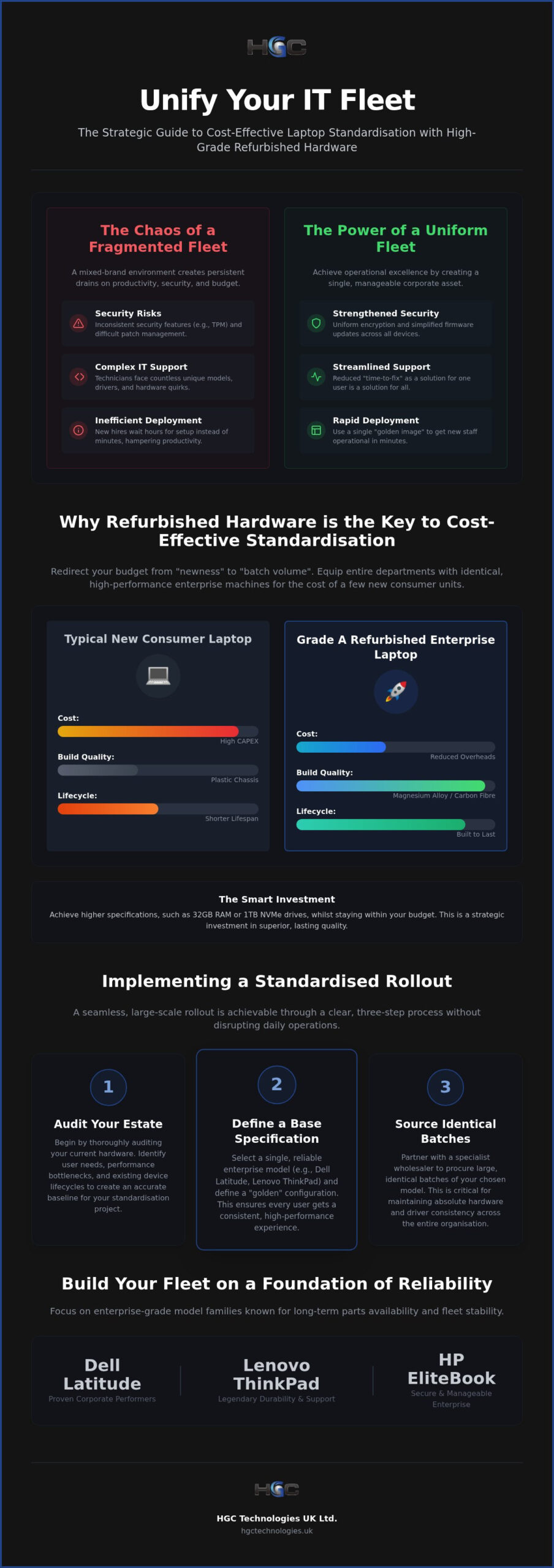
Efficiency isn’t just about speed; it’s about consistency. The Strategic Value of Standardising your hardware estate lies in the elimination of technical debt that accumulates through ad-hoc purchasing. When you focus on standardizing company laptops cost-effectively, you transform a fragmented collection of devices into a manageable corporate asset. This shift drastically reduces the burden on your IT department whilst ensuring every employee operates on a reliable, high-performance platform. It’s a move from reactive firefighting to proactive fleet management.
Managing a fleet with fifty different driver sets is a logistical nightmare that hampers productivity. Standardisation allows your technical team to maintain a single “golden image” that can be deployed across hundreds of identical Dell, Lenovo, or HP units. This means a new hire can be up and running in minutes, not hours. Predictable maintenance also becomes a reality. If a screen cracks or a battery fails, having a uniform fleet means you can keep a small stock of identical spare parts. You won’t need to cross-reference model numbers or worry about compatibility issues with docking stations and peripherals.
Streamlining IT Support and Maintenance
A mixed-brand fleet significantly increases “time-to-fix” metrics for internal helpdesks. Technicians must troubleshoot unique hardware quirks for each individual model, which drains expensive resources and delays resolutions. Fleet uniformity acts as a primary driver for reduced support tickets by ensuring that a solution for one user is a solution for all. Common docking stations and power adapters mean users can move between desks or offices without carrying a tangle of cables, fostering a truly flexible work environment. This level of hardware synergy is only possible when you commit to a unified procurement strategy.
Strengthening Corporate Security Posture
Security inconsistencies often stem from varying device generations and mismatched hardware features. By standardizing company laptops cost-effectively, you ensure consistent TPM (Trusted Platform Module) and encryption standards are active across your entire organisation. This uniformity simplifies patch management and remote updates, particularly for mobile workers who are often the most vulnerable to cyber threats. It also streamlines the process of meeting UK Cyber Essentials requirements, as you can verify the firmware and security status of your entire fleet through a single protocol. Achieving this level of control is essential for any business serious about protecting its data in 2026.
Why Refurbished Hardware is the Key to Cost-Effective Standardisation
High capital expenditure (CAPEX) often prevents firms from achieving fleet uniformity. When you buy brand-new hardware, you’re frequently forced into staggered refreshes that create a patchwork of different models across your organisation. Standardizing company laptops cost-effectively requires breaking this cycle. By redirecting budget from “newness” to “batch volume”, you can equip an entire department with identical, high-performance machines for the price of just a few retail units. This strategic shift allows you to achieve uniformity without the premium price tag of the latest generation.
Maximising IT Budgets with Circular Technology
Choosing refurbished hardware doesn’t mean compromising on performance. A 2024 or 2025 enterprise model still offers exceptional processing power for 2026 workflows. These machines are built with magnesium alloys and carbon fibre, outlasting brand-new consumer-grade laptops that rely on plastic chassis. Adopting a robust IT equipment lifecycle policy helps businesses transition to these circular solutions successfully. This approach allows you to secure higher specifications, such as 32GB of RAM or 1TB NVMe drives, whilst staying well within your original procurement budget. You aren’t just saving money; you’re investing in superior build quality that lasts.
Understanding Grade A Wholesale Standards
Reliability is paramount for corporate environments. Grade A refurbished units are indistinguishable from new devices to most users, featuring minimal cosmetic wear and fully tested internal components. To maintain driver consistency, it’s vital to partner with a reputable wholesale laptop distributor UK. This ensures you receive large batches of identical hardware revisions, rather than a mix of varying models that complicate your software imaging process. When every device in a batch shares the same internal architecture, your deployment becomes a “one-click” operation.
Direct purchase models also offer a strategic advantage over leasing programmes. You own the assets outright, removing interest payments and restrictive return conditions. This ownership, combined with the environmental benefits of choosing circular tech, significantly boosts your ESG (Environmental, Social, and Governance) credentials. If you’re ready to upgrade your estate, you can browse bulk refurbished laptop batches that meet your specific technical requirements and performance standards.
Selecting the Right Brands for Long-Term Fleet Stability
Choosing a manufacturer is a strategic decision that dictates the next three to five years of your IT operations. Whilst consumer markets chase the newest aesthetics, enterprise procurement prioritises parts availability and chassis resilience. Standardizing company laptops cost-effectively relies on selecting a brand that maintains consistent internal architectures across several years of production. This stability ensures that your support team isn’t constantly re-learning hardware layouts or troubleshooting unique BIOS conflicts. Selecting the right brand creates a foundation for a predictable, manageable estate.
The Dell Latitude Advantage for Fleet Uniformity
Many technical leads consider bulk Dell refurbished laptops the gold standard for large-scale deployments. The Dell 7000 series, particularly models like the 7420, remains highly relevant for 2026 office environments due to its exceptional thermal management and robust port selection. These devices are designed for easy serviceability, allowing for quick RAM or SSD upgrades without specialised tools. Sourcing Dell spare parts in the UK is remarkably straightforward due to their extensive supply chain and widespread adoption in the corporate sector. This availability makes them a low-risk choice for organisations aiming for maximum uptime and minimal disruption.
Lenovo ThinkPads and HP EliteBooks as Alternatives
If your workforce includes heavy data entry or content creation teams, bulk Lenovo refurbished laptops are often the preferred choice. The T-series and X-series are legendary for their ergonomic keyboards and spill-resistant designs, offering a tactile experience that consumer models simply cannot match. Alternatively, HP EliteBooks provide a compelling balance between premium aesthetics and hardened security. Their Wolf Security suite offers hardware-enforced protection that is ideal for remote workers operating outside the corporate firewall. Both brands utilise high-grade materials like carbon fibre and aluminium, ensuring the hardware survives the rigours of a full corporate lifecycle amongst a mobile workforce.
Beyond mobile devices, consider how fixed workstations and servers integrate into your ecosystem. Standardisation should extend to your back-end infrastructure to ensure seamless data flow and management. Custom-built PCs and professional server solutions allow you to tailor performance for specific departments, such as creative teams or data analysts, whilst maintaining a unified management protocol across the entire business. By standardizing company laptops cost-effectively alongside your core infrastructure, you create a resilient environment that is easy to scale and support as your business grows.
Implementing a Standardised Rollout Without Business Disruption
Successful transitions depend on meticulous preparation rather than sheer speed. Before placing an order, conduct a comprehensive audit of your existing estate and specific user requirements. This phase identifies which departments require high-performance workstations and which can operate on a standard mobile specification. Standardizing company laptops cost-effectively is only possible when you eliminate the guesswork and buy exactly what your team needs. A phased rollout ensures that IT support isn’t overwhelmed, allowing for a smooth transition that maintains business continuity throughout the refresh cycle.
Defining Your Corporate Base Specification
In 2026, 16GB of RAM is the absolute floor for fluid multitasking in a professional environment. Pair this with a 256GB or 512GB NVMe SSD to ensure rapid boot times and efficient local data caching. Whilst the choice between 13-inch ultraportables and 15-inch productivity machines often depends on job roles, aim for a single chassis family to keep peripherals compatible. Hybrid work also demands high-quality integrated webcams and a versatile port selection, including USB-C and HDMI, to minimise the need for external dongles. Defining these parameters early prevents specification creep and keeps procurement focused on strategic value.
Logistics and Lifecycle Procurement
Efficient deployment relies on modern imaging tools such as Microsoft Autopilot, which allow for zero-touch provisioning. This technology enables your IT team to ship a device directly to a remote worker, where it automatically configures itself upon login. To handle hardware failures or rapid headcount growth, always maintain a buffer stock of identical units. Partnering with a reliable wholesale tech hardware supplier UK ensures you have access to consistent batches of Grade A equipment whenever a refresh is required. This consistency is the backbone of a manageable IT estate.
Establishing a long-term lifecycle programme means you aren’t caught off guard by ageing hardware. By standardizing company laptops cost-effectively through scheduled batch updates, you create a predictable replacement cycle that aligns with your financial planning. This structured approach removes the chaos of emergency purchasing and ensures every member of your team operates on reliable, high-specification hardware. If you’re ready to begin your transition, you can view our current bulk laptop inventory to find the perfect base model for your 2026 fleet.
Sourcing Your Standardised Fleet with HGC Technologies UK
Strategic procurement is the final piece of the puzzle. Whilst previous chapters have outlined the logistical and financial benefits of uniformity, the success of your strategy depends on the reliability of your supplier. HGC Technologies UK Ltd. specialises in bridging the gap between high-level corporate requirements and the practicalities of bulk hardware acquisition. By focusing on standardizing company laptops cost-effectively, we provide the foundation for IT estates that are as resilient as they are economical. We act as a professional partner that simplifies the transition from a fragmented estate to a unified, manageable asset base.
Bulk Procurement for UK Enterprises and Resellers
Consistency is our priority. We organise identical batches of Grade A refurbished hardware to ensure that your IT department receives a uniform shipment every time. This eliminates the frustration of “mixed bags” that often plague secondary market purchases. Our direct sales model facilitates immediate hardware ownership, removing the complexities of third-party financing whilst allowing you to capitalise on your assets from day one. To complete your digital ecosystem, we also offer a steady supply of original smartphones and mobile hardware, ensuring your entire workforce remains connected through a unified and secure platform.
A Trusted Partner in Professional IT Infrastructure
Our expertise extends deep into the hardware architectures of Dell, Lenovo, and HP. We don’t just supply equipment; we understand the entire technology lifecycle. For departments with specialised requirements, such as engineering or creative design, we provide bespoke custom PC builds that offer high-performance alternatives to standard mobile units. We also support your back-end operations by integrating enterprise server hardware UK into your wider infrastructure. This ensures your data centre matches the reliability and performance of your end-user devices, creating a truly synchronised environment.
Choosing HGC Technologies means entering a long-term partnership built on trust and rigorous quality control. Every device undergoes a professional refurbishment process that meets the highest industry standards, giving you total confidence in your 2026 fleet rollout. Standardizing company laptops cost-effectively is a journey towards operational excellence, and we’re here to guide you through every stage of the process. If you’re ready to transform your IT estate and reduce your support overheads, you can contact HGC Technologies for a bespoke wholesale quote today.
Future-Proofing Your IT Estate for 2026 and Beyond
Achieving a unified IT environment is no longer a luxury reserved for the largest corporations. By focusing on Grade A refurbished enterprise hardware from manufacturers like Dell, Lenovo, and HP, your organisation can eliminate the technical debt associated with fragmented fleets. You’ve seen how this approach slashes support overheads whilst maintaining a premium user experience. standardizing company laptops cost-effectively isn’t just about immediate budget savings; it’s a strategic investment in operational stability and long-term security.
HGC Technologies UK Ltd. stands as your authoritative partner in this transition. As a specialist in bulk refurbished stock with a transparent direct sales model, we provide the batch consistency required for seamless rollouts. Our UK-based wholesale expertise ensures that your procurement process is efficient and reliable. It’s time to move beyond the high CAPEX of new hardware and embrace a more sustainable, high-performance future for your team. Secure your standardised fleet with HGC Technologies today and build a more resilient IT estate.
Frequently Asked Questions
Is standardising company laptops really more cost-effective than buying whatever is on sale?
Yes, standardisation is significantly more economical over the long term because it reduces the Total Cost of Ownership (TCO). Whilst a consumer laptop sale might offer a lower initial price, the hidden costs of managing multiple driver sets and unique hardware issues quickly erode those savings. By standardizing company laptops cost-effectively, you streamline helpdesk operations and ensure that your technical team spends less time troubleshooting individual hardware quirks.
How many identical laptops do I need to buy to consider it a standardised fleet?
There is no rigid number, but most organisations begin to see the benefits of standardisation once they reach batches of 10 to 20 identical units per department. For larger enterprises, standardising across hundreds of devices allows for the implementation of automated deployment tools. The goal is to reach a volume where your IT team can maintain a single software image for the majority of your workforce.
Can I get the same warranty on refurbished laptops as I do on new ones?
Warranty terms for refurbished hardware depend on the supplier, but professional refurbishers often provide comprehensive coverage that rivals new retail agreements. It’s essential to verify specific terms with your wholesale partner before purchasing. Choosing Grade A devices from a specialist wholesaler ensures the hardware has undergone rigorous testing, providing a level of reliability that supports a full corporate lifecycle without the risk of unmanaged downtime.
What are the best laptop models for standardisation in 2026?
The Dell Latitude 7000 series, particularly the 7420, remains a premier choice for 2026 fleets due to its exceptional build quality and parts availability. Lenovo ThinkPad T-series and X-series models are also highly recommended for their durability and ergonomic keyboards. These enterprise-grade families are designed for longevity, making them ideal for businesses that require consistent hardware across a three to five year refresh cycle.
How do I manage driver updates for a standardised fleet of refurbished Dell laptops?
Managing a standardised Dell fleet is simplified through tools like Dell Command | Update or Microsoft Endpoint Manager. Because all devices in your batch share the same internal architecture, you can push a single driver package across the entire estate simultaneously. This unified approach eliminates the need for manual updates on individual machines, ensuring that your security patches and firmware remain consistent across the organisation.
What happens if a specific model becomes unavailable for future procurement?
If a specific model reaches end-of-life, the best strategy is to transition to the next generation within the same hardware family. Manufacturers like Dell and Lenovo typically maintain driver commonalities and docking station compatibility across successive iterations of their enterprise lines. This allows you to continue standardizing company laptops cost-effectively even as hardware evolves, ensuring that your core infrastructure remains largely unchanged during procurement shifts.
Is it better to standardise on one brand or one specific model?
Ideally, you should standardise on one specific model for each department to maximise the efficiency of your software imaging. If that isn’t possible, standardising on a single brand and hardware family is the next best option. This ensures that your technical team only needs to manage one primary ecosystem, which simplifies the procurement of spare parts and maintains a consistent user experience for your staff.
How does standardising laptops help with remote work security?
Standardisation ensures that every remote device has identical security features, such as TPM chips and BIOS-level encryption, which are easier to manage centrally. When your fleet is uniform, you can push security patches and remote wipes with absolute certainty that they’ll function correctly on every machine. This level of control is vital for protecting sensitive corporate data when employees are operating outside the traditional office firewall.

Custom Built PCs for Business UK: The 2026 Procurement Guide
Settling for standard OEM specifications is a silent tax on your team's productivity. When procuring

Avoiding Laptop Supply Chain Disruption UK: A 2026 Strategic Guide
Did you know that the global surge in AI development has effectively hijacked 70% of the world’s c

Pre-installing Custom Software on Bulk Laptops: The 2026 UK Procurement Guide
With DRAM prices forecast to rise by 125 per cent across 2026, the era of buying cheap and fixing la