

Custom Server Solutions for UK SMEs: 2026 Strategic Guide
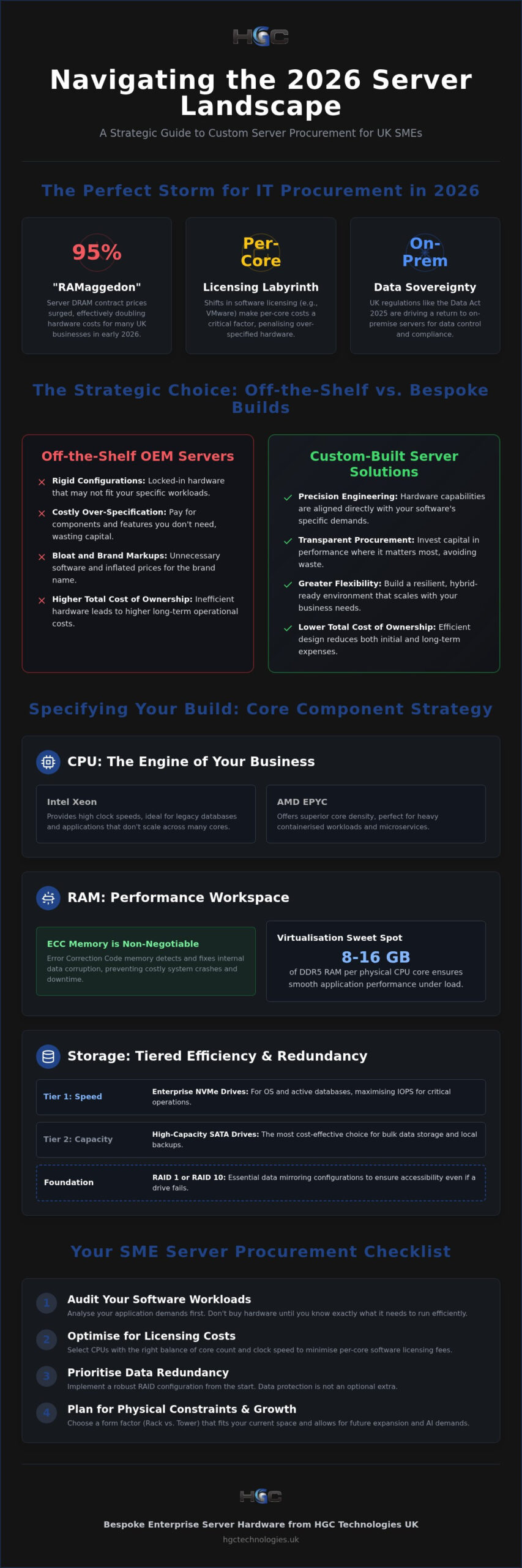
Did you know that server DRAM contract prices surged by 95% in early 2026, effectively doubling the cost of off-the-shelf hardware for many UK businesses? This “RAMaggedon” event has made traditional procurement a minefield for IT leaders who must also contend with the Cyber Security and Resilience Bill and shifting licensing models. Finding cost-effective custom server solutions for UK SMEs is no longer just about hardware; it’s about strategic survival in a volatile market.
You likely recognise that the era of buying for the brand name is over, especially as VMware migrations drive a shift toward Hyper-V and Proxmox. You need infrastructure that scales with AI demands without the bloat of unnecessary OEM features. This strategic guide promises to help you master the complexities of 2026 procurement, from managing component shortages to choosing bespoke hardware that fits your specific applications. We’ll examine how to lower your total cost of ownership whilst building a resilient, hybrid-ready environment that protects your data and your bottom line.
Key Takeaways
- Understand the strategic resurgence of on-premise hardware as a vital tool for maintaining data sovereignty and navigating the 2026 UK regulatory environment.
- Master component specification to mitigate the impact of “RAMaggedon” price volatility whilst choosing the most efficient CPU architecture for your specific workloads.
- Evaluate the practical advantages of tower versus rack form factors to ensure your hardware investment aligns with your physical office constraints and future growth plans.
- Implement a structured procurement checklist that prioritises software workload audits and redundancy levels to eliminate the risk of under-powered infrastructure.
- Discover how custom server solutions for UK SMEs from HGC Technologies UK provide a lower total cost of ownership and greater flexibility than standard OEM models.
Navigating the 2026 Server Landscape for UK Small Businesses
Efficiency has become the primary metric for British business technology in 2026. For many firms, custom server solutions for UK SMEs are no longer a luxury but a strategic necessity to combat rising operational costs. To grasp what is a server in this modern context, you must view it as a precision instrument rather than a generic commodity. Unlike off-the-shelf OEM models that arrive with rigid, pre-set configurations, a bespoke build allows you to align hardware capabilities directly with your software’s specific demands.
The “Silicon Squeeze” of 2026 has made this alignment critical. With component prices for RAM and SSDs reaching historic highs, buying an over-specified machine from a traditional vendor is a costly mistake. Custom builds offer a transparent procurement route, allowing businesses to prioritise performance where it matters most. This shift is also driven by a fundamental change in how software interacts with physical hardware, particularly regarding virtualisation and security.
The Impact of Software Licensing on Hardware Choice
Licensing models now dictate hardware specifications more than ever before. Following the significant pricing shifts for VMware in previous years, most UK SMEs have transitioned to Microsoft Hyper-V, which is included with Windows Server 2025, or open-source alternatives like Proxmox. These platforms require careful CPU core management to stay cost-effective. Since licensing is often billed per core, an improperly specified server can lead to thousands of pounds in wasted software fees. Custom configurations allow you to select high-frequency CPUs with lower core counts, maximising performance whilst minimising your annual licensing liability.
Data Sovereignty and the Return to On-Premise
Data sovereignty is driving a notable resurgence in on-premise infrastructure amongst British firms. The full implementation of the Data (Use and Access) Act 2025 (DUAA) has placed stricter requirements on how UK businesses manage and protect personal data. Relying solely on the public cloud often introduces complexities regarding data location and compliance that many SMEs now find unacceptable. By investing in robust local enterprise server hardware UK businesses can ensure their data remains within their physical control. This “re-shoring” of data isn’t just about compliance; it’s about performance. Local servers provide the low-latency environment required for 2026’s AI-driven applications and real-time data processing, creating a hybrid balance that the public cloud alone cannot match.
Specifying Your Build: Core Components for SME Performance
Precision in component selection has never been more critical. As we navigate the “RAMaggedon” of 2026, the “Silicon Squeeze” has transformed procurement from a routine task into a high-stakes strategic decision. With server DRAM contract prices rising by a staggering 90-95% in the first quarter of 2026, every gigabyte must be justified by a specific business outcome. Choosing custom server solutions for UK SMEs allows you to bypass the “one size fits all” waste often found in pre-configured units, ensuring your capital is invested in performance rather than brand-name markups.
CPU and RAM: The Engine of Your Business
Selecting between Intel Xeon and AMD EPYC depends entirely on your virtualisation strategy. Intel Xeon 6 processors often provide the high clock speeds necessary for legacy databases that don’t scale well across multiple cores. Conversely, the AMD EPYC 4000 series offers superior core density, making it the preferred choice for businesses running dozens of microservices or heavy containerised workloads. Regardless of the processor, Error Correction Code (ECC) memory is a non-negotiable requirement for any enterprise build; it detects and fixes internal data corruption, preventing the system crashes that lead to expensive downtime. For 2026 virtualisation workloads, an optimal RAM-to-core ratio is typically between 8GB and 16GB of DDR5 memory per physical CPU core to ensure smooth application performance under load.
Storage and Data Redundancy
Storage architecture in 2026 is about tiered efficiency. You should utilise enterprise-grade NVMe drives for your operating system and active databases to take advantage of their superior IOPS. For bulk data and local backups, high-capacity SATA drives remain the most cost-effective choice. Implementing a RAID 1 or RAID 10 configuration ensures that your data remains accessible even if a drive fails, which is a fundamental component of following UK government cybersecurity guidance for protecting business assets.
Redundancy must extend to your power delivery. A custom build should always include dual, hot-swappable power supplies connected to independent circuits. This prevents a simple fuse blow or PSU failure from taking your entire operation offline. If you’re unsure which configuration balances these needs against your budget, exploring bespoke server solutions can help you identify the exact specifications required for your office environment. By focusing on these core components, you create a foundation that is both resilient and ready for the AI-driven demands of the coming years.
Form Factors and Hardware Strategies: Rack, Tower, or Refurbished?
The physical footprint of your infrastructure is as vital as the silicon inside. For businesses operating in high-cost UK urban centres, choosing the right chassis can drastically impact long-term operational overheads. Custom server solutions for UK SMEs allow for a tailored approach that respects your physical space as much as your technical requirements. Whether you are outfitting a quiet office or a dedicated server room, the chassis you select dictates your cooling strategy, noise levels, and future upgrade paths.
Tower vs Rack: Which Suits Your Office Environment?
Tower servers are often the superior “plug-and-play” option for smaller offices lacking dedicated IT facilities. They operate with significantly lower noise levels and rely on standard ambient cooling, making them ideal for placement under desks or in ventilated cupboards. These units are self-contained and require no additional mounting hardware, which simplifies initial setup for teams without on-site technical staff. However, they can become cumbersome as you add more units to your network, as each requires its own floor space and power connection.
Rack-mounted enterprise server hardware UK configurations are designed for density and systematic scaling. If you have a dedicated server cabinet, rack units allow you to stack multiple machines vertically, which vastly improves cable management and power distribution. This form factor is the gold standard for businesses that anticipate rapid growth. Adding a new node or an additional storage array is a modular process that doesn’t require a complete redesign of your office layout. Whilst they require more active cooling and generate more noise, the space-saving benefits for a growing firm are unmatched.
The Refurbished Advantage for SMEs
Refurbished hardware has emerged as a strategic lever for budget-conscious procurement in 2026. Sourcing through refurbished servers UK wholesale channels provides access to high-tier specifications that might otherwise be financially out of reach due to current component price surges. Professional refurbishment involves rigorous testing and component replacement to ensure reliability standards remain high. This approach isn’t about settling for less; it’s about maximising your specification-per-pound ratio. You can often secure a dual-processor machine with ample RAM for the same price as an entry-level new unit.
This strategy becomes even more powerful when you align your back-end infrastructure with your end-user devices. For instance, integrating your server environment with bulk Dell refurbished laptops creates a cohesive, cost-efficient ecosystem. You can allocate your primary budget toward a high-performance custom server whilst providing your team with reliable, business-grade portable hardware. This balanced procurement model ensures that your entire technical stack is resilient, supportable, and professionally maintained without the premium price tag of a purely “new” fleet. By mixing custom builds for primary tasks and refurbished gear for secondary roles, you create a robust infrastructure that scales with your business goals.
The SME Server Procurement Checklist: From Audit to Installation
Successful procurement starts with an audit, not a brochure. Whilst it’s tempting to focus on the chassis first, your hardware must be a direct response to your software’s hunger for resources. In the 2026 landscape, where “RAMaggedon” pricing and licensing shifts have narrowed margins for error, following a structured checklist ensures that your investment provides long-term value rather than immediate technical debt. This methodical approach allows you to specify custom server solutions for UK SMEs that are balanced for today’s workloads and tomorrow’s growth.
- Step 1: Conduct a thorough audit of current and projected software workloads to identify resource-heavy applications.
- Step 2: Determine your tolerance for downtime to specify the necessary levels of hardware redundancy and failover support.
- Step 3: Evaluate environmental factors, specifically ensuring your office electrical circuits and cooling systems can handle enterprise-grade draws.
- Step 4: Finalise your bespoke hardware specification with a specialist wholesaler to ensure component compatibility and stock availability.
- Step 5: Plan the migration and deployment phase in detail, scheduling work during low-impact hours to minimise business disruption.
Auditing Your Workload and Users
Identifying bottleneck applications is the most critical part of your audit. Applications like SQL databases or AI-driven analytics tools require specific hardware acceleration that a generic server cannot provide. When you specify your build, you must forecast your growth to ensure your infrastructure remains viable for at least five years. For standard office applications in 2026, a ratio of one physical CPU core for every five to eight active users is the industry standard for maintaining responsive performance levels. By adhering to this metric, you prevent the lag that frustrates employees and hampers productivity.
Environmental and Infrastructure Readiness
Enterprise-grade hardware has power requirements that far exceed standard consumer electronics. You must ensure your office electrical circuit can handle the increased load, particularly if you are deploying multiple rack units. An Uninterruptible Power Supply (UPS) is a mandatory addition to any custom build; it protects your sensitive components from UK power grid fluctuations and provides a graceful shutdown window during outages. To create a truly resilient environment, many businesses choose to integrate their infrastructure with custom built business PCs UK to ensure that end-user machines are as reliable as the servers they access. If you are ready to move from planning to procurement, you can consult with our server specialists to begin your bespoke configuration today.
Bespoke Enterprise Server Hardware from HGC Technologies UK
HGC Technologies UK Ltd. acts as a strategic architect for your digital foundation. Whilst mainstream vendors often push “off-the-shelf” boxes with hidden margins, our direct sales model prioritises transparency and technical precision. We specialise in custom server solutions for UK SMEs that eliminate the overhead of unnecessary OEM features and proprietary lock-ins. This approach ensures your capital is spent on high-performance silicon and enterprise-grade reliability rather than marketing premiums or redundant software bundles. Since our incorporation in 2020, we’ve remained dedicated to providing the national UK coverage required for robust, localized hardware support.
Tailored Specifications for Unique Business Needs
Every business environment has distinct requirements that generic hardware fails to address. We work closely with your team to move beyond standard OEM limitations, configuring chassis and internal components for your specific 2026 software stack, whether you are migrating to Hyper-V or deploying Proxmox. Our commitment to excellence involves rigorous testing of every bespoke build to ensure it meets the highest stability standards before deployment. For firms looking to synchronise their entire fleet, acting as a wholesale laptop distributor UK businesses trust allows us to provide a comprehensive IT overhaul. We combine new, custom-built servers with high-quality wholesale hardware to maximise your total value and ensure cross-platform compatibility.
National Support and Reliable Procurement
Reliability is the cornerstone of our service model. We act as a knowledgeable guide, simplifying complex procurement processes for business owners and technical decision-makers across the country. A partnership with HGC Technologies means access to expert hardware advice that evolves with your company’s growth. We don’t just sell equipment; we help you build a scalable infrastructure that survives the “Silicon Squeeze” and thrives in an AI-driven future. By removing the middleman and focusing on direct, bespoke configurations, we provide a lower total cost of ownership whilst maintaining premium quality. Consult with our server experts today to specify a solution that fits your business perfectly.
Future-Proofing Your Infrastructure for 2026 and Beyond
Securing a resilient technical foundation requires a departure from generic, off-the-shelf procurement. As we have explored, the volatility of component pricing and the fundamental shift in virtualisation licensing demand a more surgical approach to hardware specification. By prioritising bespoke builds, you ensure that your investment is dictated by your specific software workloads rather than vendor-imposed limitations. This strategy not only mitigates the impact of current market surges but also establishes a stable environment capable of handling the data sovereignty requirements of the Data (Use and Access) Act 2025.
Selecting custom server solutions for UK SMEs is a definitive step toward long-term operational stability. HGC Technologies UK Ltd. has served as an authoritative UK industry leader since 2020, specialising in high-performance custom business PCs and servers that scale with your ambitions. Our direct wholesale pricing model ensures you receive premium enterprise-grade hardware without the burden of hidden margins. We invite you to take control of your technical roadmap by partnering with a specialist who understands the unique challenges of the British business landscape.
Get a bespoke quote for your SME server solution today and build a foundation that is ready for the next era of digital transformation.
Frequently Asked Questions
How much does a custom server cost for a UK SME in 2026?
Pricing for custom server solutions for UK SMEs depends heavily on your specific workload requirements and component choices. Whilst market prices for RAM and SSDs have fluctuated significantly in 2026, a bespoke build ensures you only pay for the performance your applications actually need. Factors such as CPU core counts, redundancy levels, and chassis type will determine the final investment. We provide transparent procurement to help you balance high-tier specifications with your available budget.
Is it better to buy a tower or a rack server for a small office?
A tower server is generally the superior choice for small offices without dedicated IT rooms because it operates quietly and uses ambient cooling. These units are self-contained and don’t require expensive mounting hardware. If you have a server cabinet and plan to scale your infrastructure rapidly, a rack server offers the density and modularity needed for vertical growth. Your choice should align with your physical space and cooling capabilities.
Can I use refurbished hardware for my primary business server?
Professionally refurbished hardware is a viable and strategic choice for many primary business roles. It allows you to secure higher specifications, such as increased RAM or dual processors, whilst managing your capital expenditure effectively. We ensure all components undergo rigorous testing to meet enterprise reliability standards. Using refurbished gear for secondary roles or redundant nodes is an excellent way to strengthen your infrastructure without exceeding your procurement budget.
What is the “VMware shift” and how does it affect my server choice?
The “VMware shift” refers to the significant licensing model changes that have prompted many UK businesses to migrate toward Microsoft Hyper-V or Proxmox. This transition directly affects your hardware choice because these platforms often have different CPU core requirements to remain cost-effective. Choosing a custom build allows you to select processors that maximise performance whilst minimising the core-based licensing fees that can otherwise inflate your total cost of ownership.
Do I need a dedicated server room for enterprise server hardware?
You don’t strictly need a dedicated server room if you utilise tower chassis designed for office environments. These units are engineered for lower noise outputs and standard ventilation. However, rack-mounted enterprise hardware generates more heat and noise, making a ventilated cabinet or dedicated space highly recommended. Ensuring your office has the electrical capacity and stable ambient temperature is more important than having a separate room for a single unit.
How long should a custom-built business server last?
A well-specified custom-built server should provide reliable service for five to seven years. By forecasting your software growth and auditing your workloads during the procurement phase, you can ensure the hardware remains performant as your data demands increase. Choosing modern standards like DDR5 RAM and NVMe storage helps future-proof the machine against upcoming software updates. Regular maintenance and a stable power supply are essential for reaching this target lifespan.
What is the difference between a custom build and a Dell PowerEdge server?
The primary difference lies in transparency and the elimination of proprietary lock-in. Whilst a Dell PowerEdge is a capable “box” solution, it often includes pre-set configurations and brand-specific components that can be more expensive to replace or upgrade. A custom build allows you to choose every component for its specific performance merits. This results in custom server solutions for UK SMEs that are leaner, easier to maintain, and perfectly aligned with your business applications.
Does HGC Technologies provide installation services for their servers?
HGC Technologies specialises in the expert configuration and supply of bespoke server hardware. We focus on delivering high-performance, ready-to-deploy units that meet your exact technical specifications. Whilst our primary expertise is in procurement and bespoke builds, we provide national UK coverage and transparent advice to ensure your hardware arrives ready for your IT team to integrate. For specific on-site requirements, we recommend discussing your deployment plan with our team during the consultation.

How Refurbished Hardware Impacts Company Image: A 2026 Strategic Guide
The most influential organisations in 2026 are no longer defined by the factory seal on their hardwa

Refurbished vs Open-Box Laptops: 2026 IT Procurement Guide
The cheapest laptop on an invoice often turns into your most expensive operational headache once dep

How to Order Custom Specification PCs in Bulk: A 2026 Procurement Guide
In 2026, the era of treating bulk PC procurement as a simple commodity purchase is officially over.