

Ending ‘Second-Hand Stigma’ at Work: 2026 UK Guide
Why are your top performers still equating “refurbished” with “second-rate” when the hardware on their desks often outperforms brand-new consumer alternatives? For many UK organisations, the transition to circular IT is stalled not by technical limitations, but by a persistent cultural bias. You’ve likely faced the “hand-me-down” grumble from staff who view a pre-owned laptop as a sign of budget cuts rather than a strategic choice. However, overcoming the “second-hand stigma” in the workplace is no longer just about saving money; it’s a vital step for any business serious about meeting 2026 sustainability targets and the requirements of the UK Procurement Act.
We understand that you must balance employee satisfaction with the pressure to hit ESG goals and manage hardware refreshes following the Windows 10 end-of-support deadline. This guide provides a clear strategy for transitioning your organisation to high-performance refurbished IT whilst eliminating bias and improving your bottom line. You’ll discover how enterprise-grade hardware from Dell, Lenovo, and HP maintains performance parity with new devices, often boasting failure rates of under 3%. We will also explore how to frame circular procurement as a mark of corporate maturity, ensuring your team views their hardware as a commitment to excellence.
Key Takeaways
- Learn how to reframe refurbished hardware as a premium “Circular IT” choice to improve employee perception and the day-one unboxing experience.
- Discover actionable strategies for overcoming the “second-hand stigma” in the workplace by implementing rigorous professional grading and data sanitisation standards.
- Understand the performance parity between brand-new devices and enterprise-grade refurbished laptops, ensuring consistent reliability and battery health across your fleet.
- Implement a “top-down” deployment model where executive leadership champions the shift toward sustainable procurement to eliminate cultural bias.
- Identify the essential criteria for selecting a strategic wholesale partner that provides consistent Grade A quality across bulk batches of Dell, Lenovo, and HP hardware.
Understanding the ‘Second-Hand Stigma’ in the Modern British Workplace
The “second-hand stigma” isn’t merely a preference for shiny objects. It’s a deep-seated belief that pre-owned equipment is inherently inferior, prone to failure, or indicative of a firm in financial distress. In British office culture, the equipment on a desk often serves as a silent proxy for an individual’s value within the hierarchy. Overcoming the “second-hand stigma” in the workplace requires addressing these psychological hurdles head-on, recognising that the hardware we use communicates a message about our professional standing.
The Psychological Barrier: Why Employees Favour Brand-New Gear
For many, the unboxing of a factory-fresh device provides a sense of professional validation. This “status symbol” effect remains a powerful motivator in 2026, even as corporate values shift toward sustainability. Employees often harbour anxiety that a refurbished machine will fail during a critical client presentation or lack the processing power for modern software. These fears are largely unfounded. The professional refurbishment process for electronics involves rigorous component-level testing and cosmetic restoration that brings devices up to original factory standards. Refurbished does not mean outdated; it means proven. When staff receive a device that looks and performs like new, the psychological barrier begins to dissolve.
The Cost of Vanity: How New-Only Policies Impact Enterprise ROI
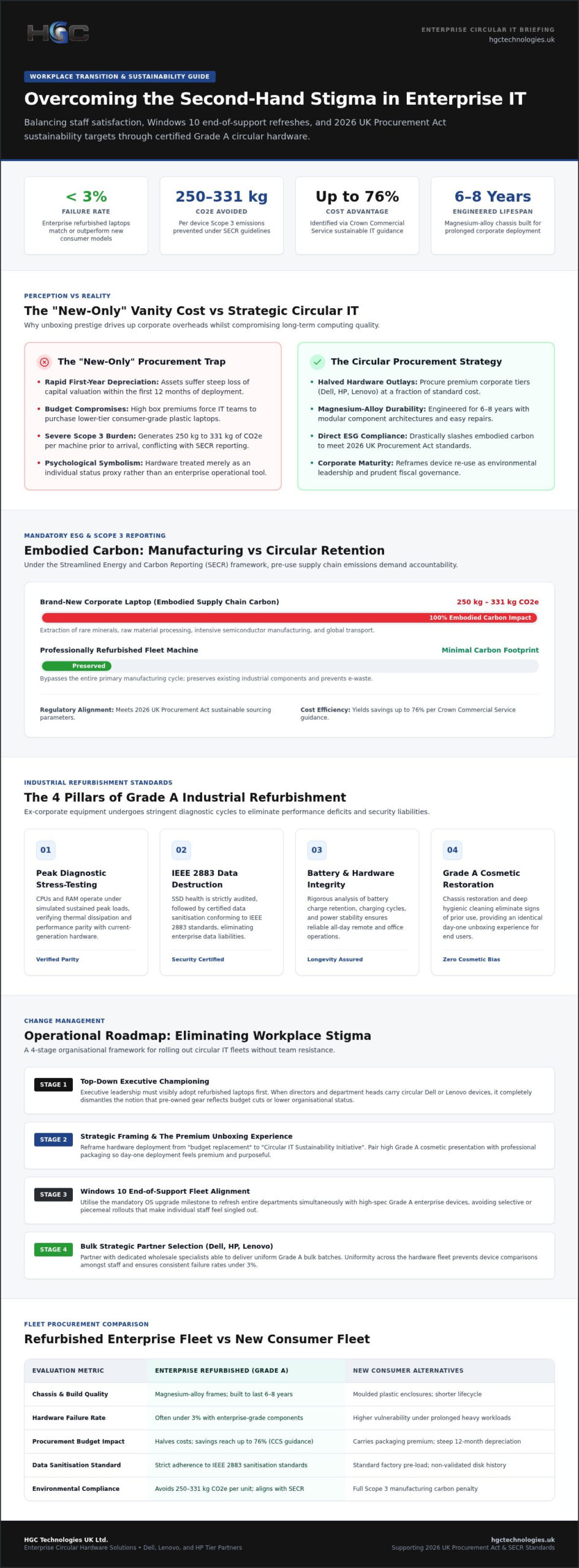
Maintaining a “new-only” procurement policy is becoming an expensive liability for UK enterprises. Brand-new IT assets suffer rapid depreciation, often losing a significant portion of their value within the first 12 months. When organisations insist on new hardware, they aren’t just paying for performance. They’re paying a premium for the box and the “new” label. This vanity comes at a high price, often forcing procurement teams to settle for lower-spec, consumer-grade machines to stay within budget.
Beyond the financial drain, these policies conflict with mandatory ESG reporting. Manufacturing a single new corporate laptop generates between 250 kg and 331 kg of CO2e before it ever reaches a desk. Under the Streamlined Energy and Carbon Reporting (SECR) framework, these Scope 3 emissions are increasingly difficult to justify. By shifting to a value-based strategy, firms can halve their hardware costs and redirect those funds into areas that drive genuine growth. Overcoming the “second-hand stigma” in the workplace transforms IT from a vanity expense into a strategic advantage, allowing for a higher-spec fleet of Dell, Lenovo, or HP machines at a fraction of the traditional cost.
The Evolution of Professional Refurbishment Standards in 2026
Professional refurbishment in 2026 has moved far beyond the basic cleaning of old equipment. It is an industrial-grade process that ensures every component meets or exceeds its original performance parameters. Distinguishing between a “used” device found on a peer-to-peer marketplace and a professionally restored machine is the first step in overcoming the “second-hand stigma” in the workplace. Unlike consumer-grade laptops designed for a short lifecycle, enterprise-grade Dell and Lenovo machines are engineered with magnesium-alloy frames and modular components, built to last between six and eight years.
Beyond ‘Used’: The Rigorous Testing of Ex-Corporate Hardware
A professional refurbishment involves exhaustive diagnostic cycles. Technicians stress-test CPUs and RAM under peak loads to ensure performance parity with current-generation models. In 2026, SSD health is a critical metric; every drive undergoes secure data destruction following IEEE 2883 standards before being verified for longevity. This level of scrutiny often makes ex-lease hardware more reliable than brand-new consumer plastic laptops, which lack the same structural integrity. This transition is supported by Crown Commercial Service guidance on sustainable IT hardware, which highlights that remanufactured devices can offer manufacturer-grade warranties and significant cost advantages of up to 76%.
Grade A Standards: Why Refurbished Laptops Match New Performance
Grade A is the gold standard. It signifies a device with minimal cosmetic wear and 100% functional excellence. Modern visual restoration techniques, including laser-refinishing and high-precision cleaning, make these units virtually indistinguishable from new. Establishing a reliable baseline for your fleet is easier when you invest in bulk Dell refurbished laptops, as consistency in hardware allows for streamlined IT support and imaging.
Choosing a reputable wholesale laptop distributor UK ensures that every batch meets these exacting standards. When your team receives a device that looks pristine and runs flawlessly, the “second-hand” label becomes irrelevant. If you’re ready to upgrade your fleet with enterprise-grade quality, consider how our bulk refurbished hardware solutions can support your 2026 growth strategy. Overcoming the “second-hand stigma” in the workplace starts with providing tools that your employees are proud to use.
Myth vs Reality: Performance, Longevity, and the Reliability Gap
The most significant hurdle in overcoming the “second-hand stigma” in the workplace is the misplaced fear of hardware failure. Many decision-makers assume that pre-owned devices are ticking time bombs. Current data suggests otherwise. Professional refurbished and remanufactured laptops boast failure rates of under 3%, which is directly comparable to the 1% to 3% baseline for brand-new enterprise hardware. This reliability gap is a myth. When you choose ex-corporate models like the Dell Latitude or Lenovo ThinkPad, you’re investing in machines engineered for intensive business use, not the flimsy plastic chassis found in budget consumer retailers.
Do Refurbished Laptops Have a Shorter Lifespan?
Business-class hardware is built to endure. While consumer laptops are often designed with planned obsolescence in mind, enterprise units are modular and repairable. A two-year-old Dell Latitude often outlasts a brand-new budget laptop because its internal components, from cooling fans to magnesium-alloy hinges, are superior. Organisations can further extend this lifecycle through bespoke custom-built PCs and server solutions that utilise high-quality refurbished chassis with upgraded internal components. This approach ensures that the hardware remains compatible with the latest operating systems, such as Windows 11 or the emerging Windows 12, without the need for constant, wasteful replacement cycles.
Addressing the Battery and Screen Quality Concern
Battery health is a frequent point of contention for employees. In 2026, the industry standard for Grade A refurbished units is a minimum of 80% original capacity. Any cell falling below this threshold is replaced during the restoration process. Quality assurance is further bolstered by the BSI Kitemark certification for remanufactured and reconditioned products. This certification requires adherence to BS 8887 standards, ensuring that the equipment is returned to a condition defined as “equal to or better than new.”
Screen quality is equally vital for user satisfaction. Professional grading protocols ensure that Grade A devices feature zero dead pixels and consistent brightness levels. By sourcing bulk batches from a single wholesale partner, IT departments can ensure technical consistency across the entire fleet. This uniformity eliminates the “hardware envy” that often fuels employee complaints, proving that performance and reliability are not exclusive to factory-fresh gear.
Strategies for Organising a Stigma-Free IT Transition
Transitioning to a circular model requires a deliberate shift in internal culture. It is not enough to simply swap hardware; you must reframe the narrative to ensure buy-in at every level. Overcoming the “second-hand stigma” in the workplace is an exercise in change management. By rebranding the initiative as a move toward “Sustainable Tech” or “Circular IT,” you align procurement with modern corporate values rather than appearing to cut corners. This positioning transforms a hardware refresh from a budget-saving exercise into a badge of environmental responsibility.
Start at the top. When senior leadership visibly adopts refurbished Dell or Lenovo hardware, it signals that these devices meet the highest executive standards. If the C-suite continues to receive brand-new equipment whilst the rest of the staff is moved to pre-owned gear, the stigma will persist. Leading by example eliminates the “hand-me-down” perception and establishes the refurbished fleet as the new organisational standard.
Transparency and Internal Communication: Pitching Sustainability
Effective communication is the foundation of a successful rollout. Craft your internal announcements to focus on “Premium Grade” quality and the specific “Eco-Impact” of the transition. You can use internal newsletters to share carbon saving statistics, such as the fact that deploying a certified remanufactured laptop prevents approximately 280 kg to 316 kg of CO2e emissions. Referencing current data on wholesale refurbished IT equipment UK can help contextualise these trends for your team. Organising “Tech Days” allows employees to see and feel the hardware quality before it arrives on their desks, demystifying the refurbishment process.
Pilot Programmes: Proving Quality Through Internal User Testing
Resistance often stems from a fear of the unknown. To counter this, select a “champion” department, such as Sales or Marketing, to test the refurbished fleet for a 30-day period. This pilot programme allows you to gather objective data on productivity and software performance in a real-world setting. Once the initial group reports zero noticeable difference in longevity or speed compared to brand-new units, you have internal advocates to support a full-scale rollout. Establishing a feedback loop ensures that any minor technical hurdles are addressed quickly, maintaining trust in the new system. If you are ready to begin your transition with a proven partner, view our bulk enterprise hardware options to secure consistent Grade A quality for your pilot.
Choosing a Strategic Partner for Sustainable IT Procurement
Selecting the right supplier is the final hurdle in overcoming the “second-hand stigma” in the workplace. Ad-hoc purchasing from fragmented sources often leads to inconsistent user experiences, which only fuels employee skepticism. A strategic partnership with a dedicated wholesaler ensures that every device meets a uniform standard of excellence. Consistency matters. When your IT department supports a fleet of identical bulk batches, troubleshooting becomes predictable and software imaging is simplified. This operational stability reinforces the perception that refurbished hardware is a professional, enterprise-grade choice. You need a partner that offers transparent grading and verifiable testing protocols to maintain this trust over the long term.
The HGC Technologies Advantage: Premium Wholesale Standards
HGC Technologies UK Ltd. provides direct access to bulk Dell, Lenovo, and HP stock, bypassing the retail markup that typically inflates costs for smaller organisations. Our direct wholesale model ensures consistent Grade A quality across every unit, eliminating the risk of receiving “lottery” hardware. We don’t just provide laptops. Our expertise extends to enterprise server hardware UK, allowing for a holistic IT strategy that covers both the end-user and the back-end infrastructure. Every device undergoes rigorous quality control to ensure it arrives in a “stigma-free” condition, ready for immediate deployment without cosmetic or functional flaws. This commitment to excellence ensures that your team feels valued from the moment they unbox their equipment.
Building a Scalable, Eco-Conscious Hardware Strategy
Transition your organisation from reactive buying to a planned, circular hardware lifecycle. This approach integrates high-performance refurbished laptops with original smartphones wholesale UK for your mobile teams, ensuring a unified standard across all mobile and desktop devices. By standardising on Grade A equipment, you meet the statutory weight of the UK Procurement Act 2023 whilst achieving measurable Scope 3 emissions reductions. Accountability is paramount. Choosing a UK-based wholesaler provides the security of local warranties and direct communication, ensuring that any support issues are resolved with the speed your business requires. The future of UK business is refurbished. It’s a strategy that values long-term stability and ethical responsibility over the short-term shine of factory-new gear.
Leading the Circular IT Revolution
The shift toward circular IT is a fundamental requirement for any responsible enterprise. The perceived reliability gap is a relic of the past, as professional refurbishment now delivers performance parity and failure rates that rival brand-new hardware. By prioritising Grade A standards and leading from the executive level, you aren’t just saving on capital expenditure; you’re building a culture that values longevity and strategic procurement.
Overcoming the “second-hand stigma” in the workplace starts with choosing a partner committed to excellence. Consistency in your fleet is vital for seamless IT support, and sourcing bulk batches ensures your team receives identical, high-performance tools. As a specialist in bulk Dell, Lenovo, and HP hardware, HGC Technologies provides the national UK wholesale distribution and rigorous Grade A testing standards your organisation demands.
Secure your Grade A refurbished fleet from HGC Technologies today and transform your IT infrastructure into a driver for environmental success. The tools for a sustainable future are ready for deployment; it’s time to put them on the desks of your most valuable assets.
Frequently Asked Questions
What exactly is the ‘second-hand stigma’ in a business context?
The ‘second-hand stigma’ describes the perception amongst employees that pre-owned hardware is inferior or indicative of corporate cost-cutting measures. In many office environments, equipment serves as a silent status symbol; receiving a used device can lead to staff feeling undervalued. Overcoming the “second-hand stigma” in the workplace requires addressing these cultural assumptions by providing Grade A equipment that matches the aesthetics and performance of brand-new units.
Are refurbished laptops as reliable as brand-new ones for heavy workloads?
Professional refurbished laptops are highly reliable for intensive enterprise tasks. Business-class machines from Dell, Lenovo, and HP are engineered with premium components designed for 24/7 operation. Research indicates that certified refurbished units have failure rates under 3%, which is directly comparable to brand-new enterprise hardware. These devices undergo rigorous stress-testing of CPUs and RAM, ensuring they handle demanding software and heavy workloads with the same stability as factory-fresh alternatives.
How can I convince my employees that refurbished gear isn’t a budget cut?
Reframing the narrative is essential for employee buy-in. Instead of focusing on cost, position the transition as a move toward ‘Circular IT’ or ‘Sustainable Technology’ to align with corporate ESG values. Leading by example is particularly effective; when senior leadership visibly uses refurbished devices, it validates the hardware’s quality. Highlighting the superior build of an enterprise-grade refurbished laptop over a brand-new budget consumer model also helps demonstrate that quality hasn’t been sacrificed.
What are the most important things to check when buying refurbished laptops in bulk?
Consistency and quality assurance are the most critical factors during bulk procurement. You should verify the supplier’s grading standards, ensuring they provide Grade A units with minimal cosmetic wear. Check that battery health meets a minimum threshold, typically 80% of original capacity, and confirm that data sanitisation follows IEEE 2883 standards. Working with a reputable wholesaler ensures that every device in a batch meets the same rigorous testing protocols and includes a professional warranty.
Does using refurbished IT hardware actually help with UK ESG reporting?
Deploying refurbished hardware significantly improves a firm’s environmental profile. Manufacturing a new laptop generates between 250 kg and 331 kg of carbon emissions; choosing refurbished equipment avoids this impact. Under the Streamlined Energy and Carbon Reporting (SECR) framework, UK businesses must account for upstream Scope 3 emissions. Integrating circular IT assets provides auditable data for sustainability reports, demonstrating a commitment to the circular economy whilst reducing the organisation’s total carbon footprint.
What happens if a refurbished laptop fails shortly after purchase?
Reliable wholesale partners provide robust warranties to protect your investment. If a unit fails shortly after deployment, a professional warranty ensures a swift repair or replacement, mirroring the support experience of brand-new hardware. Choosing a UK-based partner like HGC Technologies provides superior accountability and faster turnaround times for support requests. This safety net is a vital component in overcoming the “second-hand stigma” in the workplace, as it guarantees that technical issues won’t hinder productivity.
Is it possible to get matching models when buying refurbished for a large team?
Matching models are readily available through large-scale wholesale distributors. Buying in bulk batches allows organisations to standardise their fleet with identical Dell, Lenovo, or HP models. This uniformity is crucial for IT departments, as it simplifies software imaging and ensures that every employee receives the same high-quality hardware. Maintaining consistency across the team prevents ‘hardware envy’ and ensures that support processes remain efficient and predictable across the entire organisation.
Can refurbished laptops run the latest versions of Windows and security software?
Modern refurbished laptops are fully compatible with current operating systems and security protocols. Enterprise-grade machines from recent lease cycles include the necessary TPM 2.0 chips and processor architectures required for Windows 11 and emerging Windows 12 updates. These devices support advanced security features and modern software suites, ensuring that your organisation remains protected and compliant. Their robust specifications often exceed the requirements of standard office applications, providing a future-proof solution for your IT infrastructure.

Data-Intensive Server Hardware: 2026 Procurement Guide
With server DRAM contract prices surging by up to 95 per cent in early 2026 and major OEMs hiking li

Choosing the Best Custom PC for Video Editing in the UK: 2026 Buying Guide
Your professional workstation is only as fast as its most restrictive bottleneck. Selecting a custom

Lenovo vs HP: The 2026 Comparison for UK Business Procurement
The USD 6.26 billion UK laptop market might be obsessed with AI-powered silicon in 2026, but for the