

Ensuring Software Licensing on Refurbished PCs: The 2026 UK Business Guide
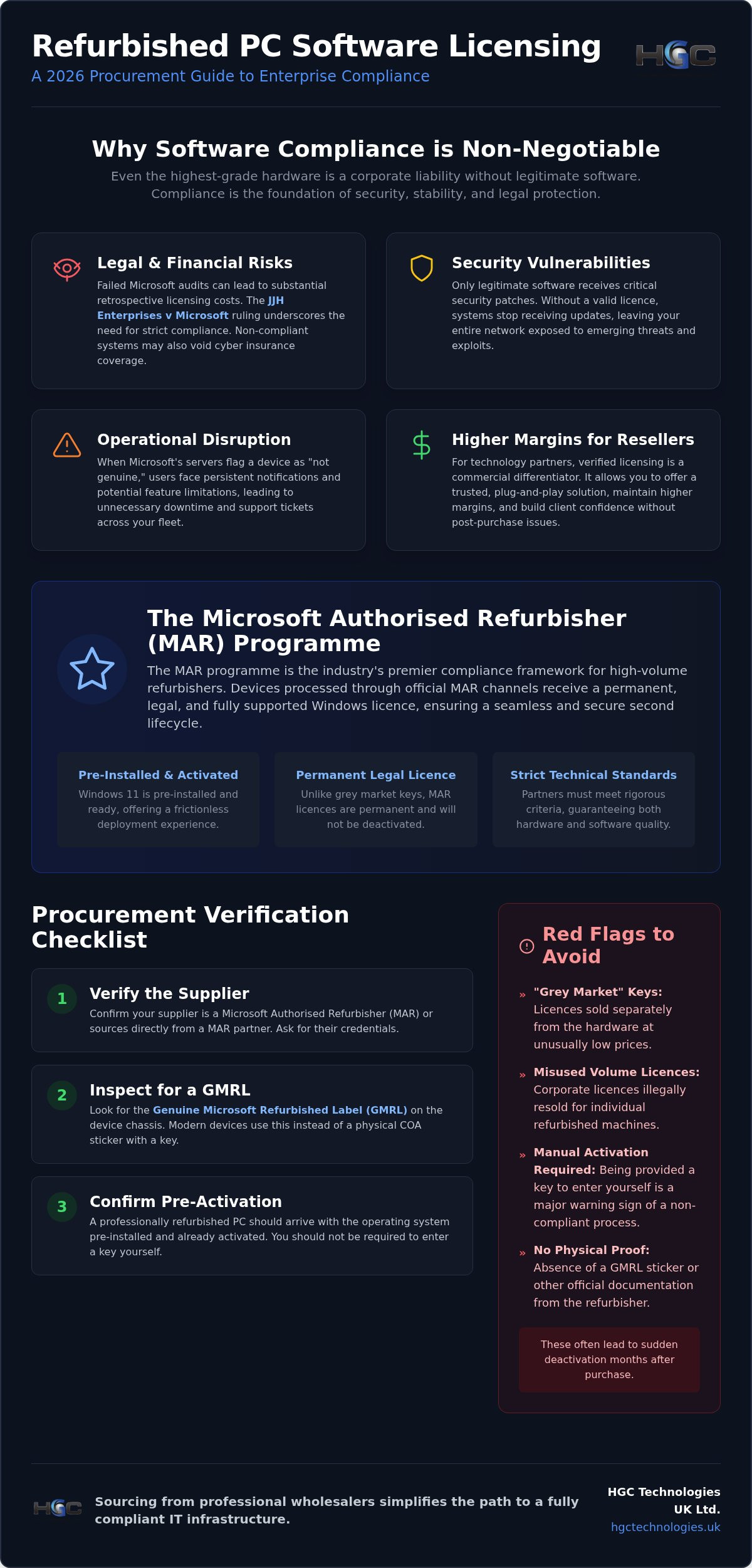
Genuine software licensing is the final stage of professional hardware refurbishment; without it, even the best hardware remains a corporate liability. Many procurement officers worry that a bulk purchase of Dell or Lenovo laptops might lead to a failed Microsoft audit or sudden software deactivation. You shouldn’t have to risk your company’s reputation or operational stability on ambiguous digital rights. Ensuring software licensing on refurbished PCs is about more than just checking a box; it’s about protecting your infrastructure from legal and security vulnerabilities.
This 2026 guide provides the clear framework you need to verify license legitimacy and secure your bulk hardware investments. We’ll explore the July 2026 Court of Appeal ruling in JJH Enterprises Limited v Microsoft and the impact of the Technology Transfer Agreements Block Exemption Order (TTBEO) on your fleet. By the end of this article, you’ll have the confidence to deploy hundreds of devices across your organisation, knowing every single license is permanent, legal, and fully compliant with the latest UK regulations.
Key Takeaways
- Understand why software compliance is as critical as hardware grading for maintaining business continuity and avoiding UK legal penalties.
- Learn to distinguish between original OEM licences and official Refurbished PC licences to ensure your fleet remains active and supported.
- Implement a robust verification checklist for ensuring software licensing on refurbished PCs during bulk procurement to identify non-compliant assets immediately.
- Identify the warning signs of “grey market” keys and misused Volume Licensing that often lead to sudden software deactivation months after purchase.
- Discover how sourcing from professional wholesalers simplifies the path to building a fully compliant, high-margin IT infrastructure for resellers and enterprises.
The Critical Importance of Software Compliance in PC Refurbishment
Professional hardware refurbishment is an incomplete process without a rigorous approach to software. Whilst a high-grade Dell or Lenovo laptop might look pristine, its utility is compromised if the operating system is counterfeit or improperly assigned. Ensuring software licensing on refurbished PCs is a fundamental pillar of corporate risk management, providing the necessary foundation for security and stability. Businesses often focus on hardware specifications, yet a clear understanding software licenses determines whether that hardware is a strategic asset or a corporate liability.
Legitimate software is the only way to guarantee access to critical security patches. Without a valid licence, systems eventually stop receiving updates, leaving your entire network vulnerable to exploitation. This relationship between professional refurbishment and software legitimacy is what separates enterprise-grade equipment from consumer-level secondary market risks. It’s about protecting your infrastructure from the ground up.
Legal and Financial Risks for UK Enterprises
The financial consequences of non-compliance are severe. Microsoft audits are a reality for UK businesses, and a failed inspection can result in substantial retrospective licensing costs. A landmark Court of Appeal ruling on 7 July 2026, in JJH Enterprises Limited v Microsoft, clarified the legal landscape for reselling volume licences, but it also underscored the necessity of following strict exhaustion of rights principles. If your procurement process lacks transparency, you risk falling outside these legal safe harbours. Beyond direct penalties, unlicensed software acts as a red flag for insurers. Most cyber insurance policies require all software to be genuine; if an attack occurs on a non-compliant system, your coverage might be voided. Productivity also takes a hit. When Microsoft’s activation servers flag a device, users face persistent not genuine notifications, leading to unnecessary downtime across your fleet.
Enhancing Resale Value for Technology Partners
For resellers and IT partners, software compliance is a commercial differentiator. Verified licensing allows you to maintain higher margins by offering a plug-and-play solution that clients can trust. By providing devices with a Genuine Microsoft Refurbished Label (GMRL), you eliminate the friction of post-purchase activation issues. This focus on compliance is a hallmark of the leading wholesale refurbished computers UK market. At HGC Technologies, we ensure every device meets these professional standards, allowing our partners to scale their operations without the fear of legal blowback. Trust is the currency of the refurbished market, and genuine software is its most vital security measure.
Deciphering Microsoft Licensing for Refurbished Devices
Navigating the specifics of Microsoft licensing is a critical task for any technical decision-maker. Whilst the hardware might be second-hand, the software rights must be beyond reproach. Ensuring software licensing on refurbished PCs involves identifying whether a device carries its original Original Equipment Manufacturer (OEM) rights or requires a specific “Refurbished PC” licence. This distinction is vital because an OEM licence is technically tied to the original motherboard; if that hardware undergoes significant changes during refurbishment, the original licence may no longer be valid under certain enterprise agreements.
The Microsoft Authorised Refurbisher (MAR) Programme
The Microsoft Authorised Refurbisher (MAR) programme stands as the industry’s premier compliance framework. It’s tailored for high-volume refurbishers who meet strict technical and security criteria, often processing tens of thousands of units annually. For smaller organisations, the Third-Party Refurbisher (TPR) model offers a compliant alternative by sourcing licences through a MAR partner. Devices processed through these official channels receive a pre-installed, pre-activated Windows 11 image. This offers a seamless deployment experience, as the software is already optimised for the hardware. Unlike standard retail keys, which can be easily blocked or revoked if found to be part of a misused batch, MAR licences provide a permanent, legal foundation for a device’s second lifecycle.
Digital Licenses vs Physical COA Stickers
Many procurement managers still look for the traditional “Certificate of Authenticity” (COA) sticker, but modern hardware has moved on. On recent generations of bulk Dell refurbished laptops, physical stickers have been replaced by Digital Product Keys (DPK). These keys are securely embedded within the BIOS or UEFI firmware at the point of manufacture. This shift mirrors modern government software procurement policies that favour digital transparency and tamper-proof security over physical labels that can be peeled off or damaged.
You can easily verify a digital licence by navigating to the “Activation” menu in Windows system settings. If the system confirms it’s “activated with a digital licence”, the hardware is recognised by Microsoft’s servers. However, a new licence is mandatory if the original COA is illegible, the BIOS key is missing, or the device is being upgraded to a different version of Windows. Selecting a supplier that provides professional-grade hardware with these licensing nuances pre-managed is the most efficient way to scale your IT infrastructure without the headache of manual activations.
A Procurement Verification Checklist for Bulk Batches
Establishing a standardised incoming inspection process is the only way to guarantee that your fleet meets both technical and legal requirements. Ensuring software licensing on refurbished PCs begins the moment the hardware arrives at your facility. Relying solely on a supplier’s word is a risk that modern procurement departments can’t afford to take. By implementing a systematic verification checklist, you protect your organisation from the operational disruption caused by sudden software deactivation or failed audits.
Visual and System-Level Inspections
Your first line of defence is a physical and digital audit of each unit. Follow these three steps to verify compliance:
- Step 1: Physical Label Verification. Inspect the chassis for the Genuine Microsoft Label (GML). On older Dell or HP units, this might be a Certificate of Authenticity (COA) sticker located on the base or tucked under the battery compartment. Modern devices often have a small, holographic Windows logo instead.
- Step 2: Command-Line Validation. Boot the device and open the Command Prompt. Type
slmgr.vbs /dliand press enter. A dialogue box will appear showing the licence description. Look for “RETAIL” or “OEM_DM” channels. If you see “VOLUME_KMSCLIENT”, the device may be using a temporary volume key that isn’t appropriate for secondary resale. - Step 3: Edition Matching. Confirm that the installed Windows edition matches your procurement specification. If you’ve ordered Windows 11 Pro, ensure the system hasn’t been “downgraded” to Home or “upgraded” to an unlicenced Enterprise version.
Verifying the Supplier’s Refurbishment Credentials
The integrity of your software depends heavily on the standards of your wholesale laptop distributor UK. A professional partner should provide more than just hardware; they should offer a transparent audit trail for every licence they supply. Ask your distributor for a confirmation of their imaging process. You need to be certain that the OS is a clean installation, free from the bloatware or residual malware that often plagues low-tier refurbished gear.
For large-scale deployments, request documentation that confirms licence injection. This record is invaluable for your internal IT asset register and serves as your primary evidence during a software audit. Professional wholesalers understand these requirements and will proactively provide the necessary compliance data. By documenting these details at the point of entry, you ensure that every asset in your organisation is fully accounted for and legally sound.
Avoiding Grey Market Pitfalls and Volume Licensing Risks
Grey market keys represent the single greatest threat to a successful hardware rollout. Whilst these budget options appear to offer significant savings, they often result in catastrophic failure for the end-user. A rigorous approach to ensuring software licensing on refurbished PCs is the only way to avoid these pitfalls and protect your organisation’s reputation. These keys are frequently sourced from stolen credit cards or are intended for educational institutions in developing markets; once Microsoft identifies the misuse, the activation is revoked without warning.
The impact of using non-genuine software extends far beyond a simple notification on the desktop. When a licence is flagged as invalid, the system may lose access to critical Windows Update services. This leaves your organisation’s data exposed to vulnerabilities that are patched in legitimate versions. Security is not a feature you can afford to lose. A device that cannot update is a ticking time bomb in any corporate network. Ensuring software licensing on refurbished PCs requires a commitment to transparency that many low-tier suppliers simply cannot provide.
The Trap of Cheap Online Product Keys
Retail keys sold at deep discounts on auction sites or third-party marketplaces are a classic procurement trap. These keys are often part of a large batch that has been leaked or stolen. Microsoft frequently blocks these keys en masse during routine audits, leading to hundreds of devices suddenly requiring new, expensive licences. Professional wholesalers like HGC Technologies avoid these shortcuts entirely, preferring to build long-term trust through verified, permanent licensing. We understand that your business continuity depends on software that stays active for the entire lifecycle of the hardware.
Volume Licensing and the “KMS” Misconception
Volume Licensing (VL) is another area where confusion often leads to non-compliance. Some suppliers use Key Management Services (KMS) to activate fleets. KMS is designed for internal corporate networks where devices check in with a central server every 180 days. This is entirely unsuitable for standalone refurbished gear. Once the device leaves that specific network, the activation timer begins to count down. This is particularly relevant when procuring bulk Lenovo refurbished laptops for remote workers or external clients. Without a unique, individually assigned licence, your users will inevitably face “Windows is not genuine” errors. Secure your fleet today by choosing a partner that prioritises compliant hardware procurement over temporary fixes.
Sourcing Compliant Hardware from HGC Technologies
HGC Technologies UK Ltd. operates as more than a simple hardware wholesaler; we act as a strategic compliance partner for organisations that require absolute certainty in their IT infrastructure. Our commitment to professional standards means that hardware quality and software legitimacy are never treated as separate entities. By choosing a specialist who understands the intricate nuances of the UK market, you eliminate the risks associated with fragmented supply chains and ambiguous digital rights. We provide the reliability and scale necessary for resellers and corporate procurement teams to grow with confidence.
Whilst hardware performance is a priority, ensuring software licensing on refurbished PCs remains our primary compliance objective. We understand that your business continuity depends on systems that are not only fast but also legally sound and secure. Our direct sales model ensures a transparent audit trail for every unit, providing you with the documentation required to satisfy even the most rigorous corporate audits. This authoritative approach has established us as a leader in national UK distribution, serving as a knowledgeable guide for clients navigating complex wholesale processes.
High-Standard Refurbishment for Corporate Procurement
Every Dell, HP, and Lenovo system we process undergoes a rigorous refurbishment cycle designed for immediate enterprise deployment. We don’t just clean the chassis; we implement a comprehensive testing and imaging protocol that ensures every device is ready for the workplace. Our internal processes are built to handle bulk orders with precision, ensuring that the software environment is as stable as the hardware itself. Direct procurement from HGC Technologies reduces the risks inherent in the secondary market, as we take full responsibility for the technical and compliance standards of our fleet.
Scalable Solutions for Your IT Infrastructure
Our expertise extends beyond standard laptop rollouts to include bespoke PC builds and complex enterprise server hardware UK configurations. We assist technology partners in maintaining consistency across large fleets, whether you are equipping a corporate headquarters or providing hundreds of devices for schools and NGOs. This methodical approach ensures that every asset is configured for scalable business environments and long-term value.
Securing your 2026 hardware procurement starts with a partner that values responsibility and forward-thinking standards. We invite you to engage with our team to discuss your specific fleet requirements and experience the HGC advantage. By prioritising professional-grade hardware and verified licensing today, you build a resilient foundation for your organisation’s future. Contact us to learn how we can simplify your next bulk deployment through expert logistics and unmatched technical excellence.
Securing Your Infrastructure for the Future
Professional procurement in 2026 requires a strategic focus that extends far beyond physical hardware specifications. The current UK legal landscape demands absolute transparency regarding digital rights and exhaustion principles. Ensuring software licensing on refurbished PCs is the definitive step in transforming a bulk hardware purchase into a secure, long-term strategic asset. By implementing a rigorous verification checklist and avoiding the persistent risks of grey market keys, you protect your organisation from operational downtime and failed audits.
Partnering with an industry leader simplifies this complex technical landscape. HGC Technologies provides expert UK-based wholesale distribution, offering a reliable bulk supply of Dell, Lenovo, and HP enterprise systems. We also act as specialists in bespoke PC and server solutions, ensuring every device in your fleet is configured for peak performance and total compliance. View our range of professionally refurbished bulk laptops today to secure your next deployment. With the right partner, you can scale your IT infrastructure with complete confidence and the assurance of unmatched professional standards.
Frequently Asked Questions
Do refurbished PCs come with a Windows licence by default?
Refurbished PCs don’t automatically include a valid operating system licence; it depends entirely on the supplier’s refurbishment process. Professional wholesalers like HGC Technologies ensure every Dell or HP system is correctly licensed for immediate corporate use. However, some lower-tier sellers provide “bare metal” units or unactivated software. Always verify that your procurement specification includes a pre-installed, genuine Windows licence to avoid the hidden costs of retrospective activation.
What is the difference between an OEM licence and a MAR licence?
An OEM licence is the original software entitlement tied to the hardware by manufacturers like Lenovo or Dell. In contrast, a MAR (Microsoft Authorised Refurbisher) licence is a specific second-life entitlement issued for devices that require a fresh, legal operating system. MAR licences are the gold standard for high-volume deployments, ensuring that the hardware remains fully compliant with Microsoft’s 2026 technical requirements and security standards during its second lifecycle.
Can I use my existing company Volume Licence on refurbished laptops?
You can typically apply a Volume Licence (VL) to refurbished hardware, provided the device already possesses a valid “base” licence, such as an OEM or MAR entitlement. VL is intended as an upgrade or management layer rather than a primary OS licence. The July 2026 Court of Appeal ruling affirmed the legality of splitting volume licences under specific exhaustion principles, making it easier for UK enterprises to manage their software assets legally.
How do I check if a refurbished PC has a genuine Windows 11 Pro licence?
You can verify a genuine Windows 11 Pro licence by navigating to the “Activation” section within the system settings. The status should read “Windows is activated with a digital licence.” For a deeper audit, run the slmgr.vbs /dli command in the Command Prompt to confirm the licence channel. Additionally, inspect the hardware chassis for the Genuine Microsoft Label (GML), which acts as physical proof of a legitimate digital product key.
Is it legal to sell refurbished PCs with “unactivated” Windows?
It’s technically legal to sell hardware without an operating system, but selling devices with unactivated Windows creates significant operational risks for the buyer. Unactivated software eventually restricts access to critical security patches and customisation features, making it a liability for any corporate network. Ensuring software licensing on refurbished PCs at the point of purchase is the only way to guarantee that your fleet remains secure, stable, and fully supported.
What happens if Microsoft detects a non-genuine licence on my business PCs?
If Microsoft flags a licence as non-genuine, your systems will lose access to vital security updates and display persistent desktop notifications. During a formal audit, your organisation could face substantial financial penalties and retrospective licensing costs. This is why ensuring software licensing on refurbished PCs is an essential part of professional IT procurement. It protects your business from the sudden downtime and legal complications associated with grey market keys.
Do I need a new licence if I upgrade the SSD in a refurbished PC?
You don’t need a new licence when upgrading an SSD or RAM in a refurbished PC. Modern Digital Product Keys (DPK) are embedded in the motherboard’s BIOS or UEFI firmware; they recognise the core system identity even if the storage is replaced. A new licence is generally only required if the motherboard itself is swapped out, as Microsoft’s activation servers treat a motherboard change as a new computer requiring a separate entitlement.
Why do some refurbished PCs still have a Windows 7 or 10 sticker?
These legacy stickers are often left on the chassis as a record of the device’s original hardware entitlement. Whilst the sticker might reference Windows 10, the system may have been upgraded to Windows 11 via a digital licence injected during the refurbishment process. These physical labels provide an audit trail for the machine’s history, but the actual activation status is now managed digitally through BIOS-embedded keys rather than physical product codes.

Refurbished Laptop Supplier with Fast UK Delivery: The 2026 Procurement Guide
Retaining Windows 10 hardware in 2026 now costs businesses $61 per device in mandatory security upda

The Reliability of Refurbished Business Laptops: A 2026 Procurement Guide
The brand-new consumer laptop on a retail shelf is often less durable than a three-year-old enterpri

Case Study: Refurbished Laptops in UK Education in 2026
A refurbished laptop project is only as strong as the evidence behind it. The question behind “cas