
IT Asset Depreciation: How to Calculate Cost and Book Value
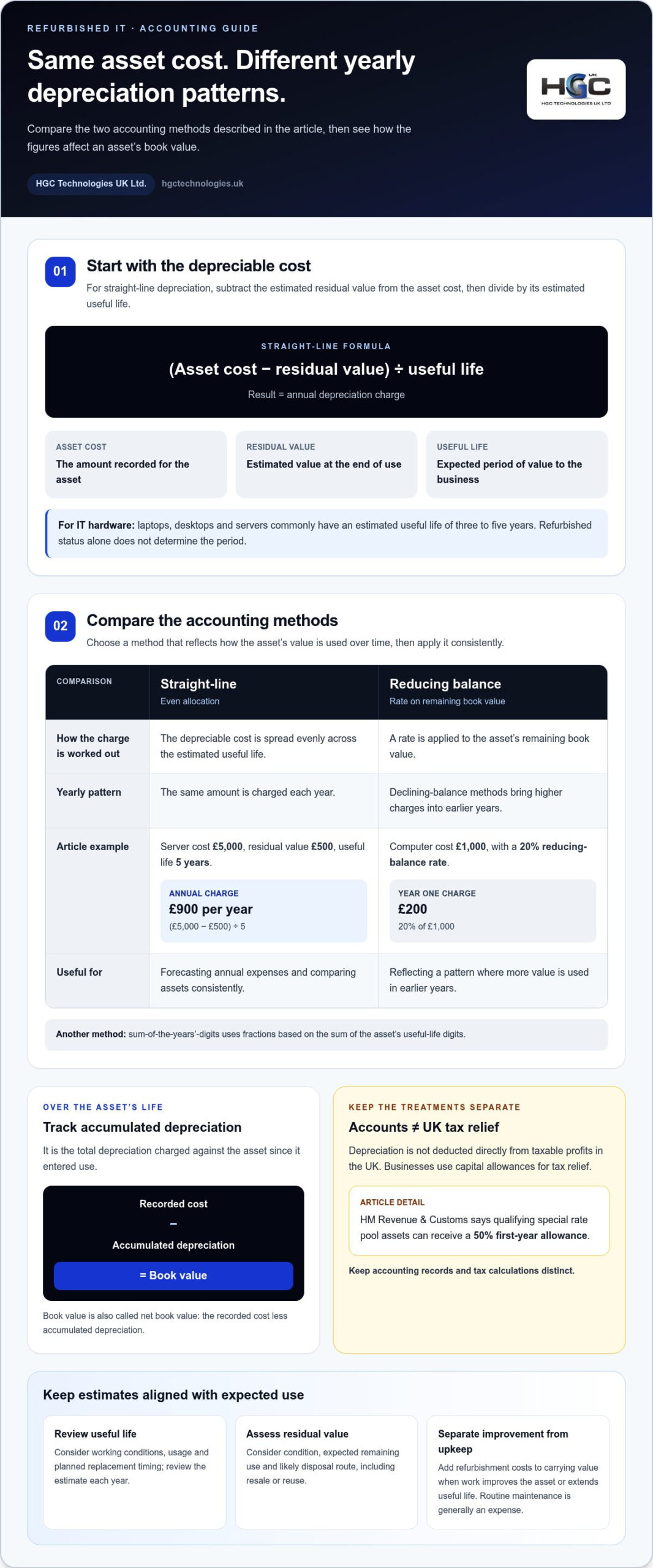
For refurbished IT equipment, calculate straight-line depreciation by subtracting the estimated residual value from the purchase cost, then dividing the result by the asset’s estimated useful life. To understand how to calculate depreciation on refurbished assets, use the amount your business records for the asset and the period it expects to use the equipment. Refurbished status alone does not determine the depreciation period. IT hardware such as laptops, desktops and servers commonly has an estimated useful life of three to five years.
It’s easy to focus on refurbished equipment’s lower purchase cost, but its accounting treatment still matters: depreciation affects reported profit and the asset’s book value over time. This guide explains the calculation, how accumulated depreciation reduces book value, and how accounting depreciation differs from the capital allowances used for UK tax relief. It also covers how expected use and residual value shape the figures, helping you understand how to account for refurbished IT throughout its working life.
Key Takeaways
- Understand how purchase cost, residual value and expected useful life shape a straight-line depreciation calculation.
- See how accumulated depreciation affects an asset’s book value over time.
- Learn why accounting depreciation and UK tax relief use different approaches.
- Explore how to assess refurbished IT assets according to their expected use in your business.
What is IT asset depreciation?
Depreciation allocates an asset’s cost across its expected useful life. For IT hardware, that estimate often falls between three and five years.
Cost, useful life and residual value
Depreciation depends on the asset’s original cost, expected useful life and estimated residual value. Together, these determine how much of its cost is allocated to each accounting period. For example, a £1,500 laptop might be depreciated over three years, depending on its expected use and technological lifespan. A realistic residual value matters too: a higher estimate leaves less cost to depreciate during the asset’s useful life.
Reviewing useful-life estimates
Useful life is the period an asset is expected to provide value to the business, not necessarily its total physical lifespan. Estimate it based on working conditions, usage and planned replacement timing. A computer intended for replacement after three years could have a three-year useful life for depreciation. Review the estimate each year, since changes in workload or technology plans may affect how long the asset remains useful.
A tangible asset is generally depreciated only when its useful life to the business exceeds one year. Reassessing that estimate helps keep the profit and loss charge aligned with expected use. If the business changes its IT refresh plans, update the estimate to reflect the revised period of use.
Adding refurbishment costs to carrying value
Add refurbishment costs to an asset’s carrying value when the work improves it or extends its expected useful life. Routine maintenance is generally treated as an expense instead. This distinction matters because capitalised costs affect the amount depreciated over time. Keep the refurbishment invoice with the asset record, describe the work, and assess whether it provides a lasting benefit or simply restores normal operation.
In the UK, depreciation isn’t deducted directly from taxable profits; businesses use capital allowances for tax relief. HM Revenue & Customs says qualifying special rate pool assets can receive a 50% first-year allowance. This tax treatment is separate from the depreciation method used in the accounts, so keep accounting records and tax calculations distinct.
What is depreciation and how do you calculate it in the UK?
Accounting depreciation allocates an asset’s depreciable cost across its useful life. Straight-line depreciation is a clear starting method for IT equipment.
Straight-line depreciation calculations
Straight-line depreciation charges the same amount each year of an asset’s estimated useful life. It helps businesses forecast annual expenses and compare assets consistently. Use this formula: (asset cost minus residual value) divided by useful life. The result is the annual depreciation charge.
For example, a server costing £5,000, with a £500 residual value and a five-year useful life, depreciates by £900 per year: (£5,000 − £500) ÷ 5. The calculation uses the amount expected to be consumed, not the full purchase cost. Record the annual charge in the accounts and apply the method consistently across the relevant period.
Depreciation methods under UK GAAP
Accounting methods include straight-line and reducing-balance depreciation. The method should reflect how the asset’s value is used over time. Straight-line spreads the depreciable cost evenly, while reducing balance applies a rate to the remaining book value. The choice affects each year’s charge, even when both methods allocate a similar total amount of depreciation over the asset’s life.
For a £1,000 computer, a 20% reducing-balance rate produces £200 depreciation in year one. The Clear Books UK guide gives 20% as an example reducing-balance depreciation rate for a computer costing £1,000. Declining-balance methods bring higher charges into earlier years. The sum-of-the-years’-digits method uses fractions based on the sum of the asset’s useful-life digits.
Choose a method that reflects the pattern of use, apply it consistently, and review your assumptions when circumstances change. Software is treated differently from physical hardware: off-the-shelf software is often amortised over a useful life of three to seven years.
For an IT refresh plan, straight-line depreciation can make annual accounting costs easier to forecast. Businesses planning equipment requirements can also explore bulk refurbished laptops as part of their procurement decisions.
Accumulated depreciation and book value
Accumulated depreciation is the total depreciation charged against an asset since it entered use. Book value, also called net book value, is the asset’s recorded cost less accumulated depreciation. In the balance sheet, these figures show its remaining carrying value for a particular reporting period, rather than just its original cost.
For example, a company van may have an estimated salvage value of £2,000 after five years. Salvage value is the expected amount recoverable when the business stops using the asset. A computer’s estimate should reflect its expected condition and usefulness at disposal, including whether it may retain value for resale or reuse. The residual value reduces the cost depreciated over the asset’s useful life.
To calculate book value at a reporting date, subtract accumulated depreciation from the asset’s recorded cost. If refurbishment expenditure has been capitalised, include it in the carrying value before calculating depreciation for the relevant period. Record the asset’s cost, each period’s charge and any changes to its estimated residual value. This creates a clear trail from purchase to the current financial statement.
Review residual value based on the asset’s condition, expected remaining use and likely disposal route. For refurbished IT, consider whether the equipment is expected to remain serviceable, be sold or be retired when business use ends. These factors inform the estimate, but residual value is not the same as the asset’s book value before disposal.
When the business disposes of an asset, remove its cost and accumulated depreciation from the accounting records. Compare the proceeds with its carrying value at disposal to determine whether the accounts show a gain or loss. Depreciation should cease when the asset’s net book value or carrying amount reaches zero. Regular reviews help keep the balance sheet accurate as equipment ages or its expected use changes.
Depreciation of refurbished IT assets
Refurbished equipment follows the same accounting logic as other IT assets: base depreciation on its recorded purchase cost and expected business use. The key is to distinguish routine repairs from work that changes the asset’s future service potential.
Refurbishment as improvement or repair
Classify refurbishment according to what the work achieves, because its treatment affects the asset’s carrying value and future depreciation. A repair that restores a computer to its previous working condition is generally recorded as an expense. Work that improves capacity or extends expected useful life may be capitalised and then depreciated over the remaining useful life.
For example, replacing a faulty keyboard restores normal operation, while adding a lasting capability may improve the asset. Assess the work performed and the resulting benefit rather than treating every refurbishment invoice the same way.
Records supporting depreciation
Keep a purchase invoice, asset register entry and depreciation schedule for each refurbished device. Record its description, acquisition date, purchase cost, expected useful life, residual value, depreciation method and annual charge. Retain refurbishment invoices and briefly note whether each job was a repair or capital improvement.
These records link the original purchase to later changes in carrying value. For example, an invoice describing a replaced component supports the reason for capitalising the work, while a service note can document a routine repair. Reconcile the schedule with the relevant accounting period and financial statements.
Recalculating depreciation after refurbishment
After a major refurbishment, update the carrying amount and review the asset’s remaining useful life and residual value. For a capitalised improvement, add its cost to the carrying amount, subtract the revised residual value, then allocate the depreciable amount over the remaining useful life. Document the revised estimate and when it takes effect.
If refurbishment replaces a significant component, record the replacement separately where practical. Include the new component’s capitalised cost in the asset records, and remove the replaced component’s carrying amount when it can be identified. This avoids continuing to depreciate a component that is no longer in service.
For procurement planning alongside asset-record decisions, explore bulk refurbished laptops for business requirements.
HGC Technologies UK Ltd.: Bulk Dell Refurbished Laptops
HGC Technologies UK Ltd. supplies bulk refurbished Dell laptops to businesses and technology resellers planning IT purchases. If your asset review points to a need for replacement equipment, refurbished laptops can support your procurement plans while giving each device a clear purchase cost to record for accounting.
Choose from bulk refurbished Dell, Lenovo and HP laptops, or consider custom-built PCs when you need a tailored computer solution. Matching equipment to its intended business use helps you establish consistent asset records, including purchase date, cost and expected useful life. These details support depreciation calculations once the equipment enters service.
For your next business IT purchase, contact HGC Technologies UK Ltd. or visit hgctechnologies.uk.
Make your next IT refresh more deliberate
Knowing how to calculate depreciation on refurbished assets gives your team a stronger basis for planning future technology purchases. Apply that thinking alongside operational priorities: what equipment your people need, how it fits existing workflows, and how it will be recorded when brought into use. This connects procurement decisions with asset management from the outset.
For business IT procurement, HGC Technologies UK Ltd. offers bulk refurbished Dell, Lenovo and HP laptops. This can suit organisations planning a coordinated equipment refresh or resellers sourcing refurbished laptops in bulk. Aligning the purchase with your accounting process helps keep each device’s records clear as it enters service.
Explore the available options and take the next step for your organisation. Contact HGC Technologies UK Ltd. to discuss your business’s refurbished laptop requirements. A considered approach to procurement can help your team plan confidently for the next stage of its IT lifecycle.
Frequently Asked Questions
How is depreciation calculated for refurbished assets?
Apply a consistent accounting method to the refurbished asset’s recognised cost and expected useful life. With straight-line depreciation, subtract estimated residual value, then divide by useful life. The recognised cost is the amount your business records for the asset, not the former owner’s original purchase price. If the equipment’s use changes, assess whether the existing method still reflects its pattern of use.
How do you estimate the useful life and residual value of a refurbished asset?
Estimate useful life based on the device’s condition at purchase, expected workload and planned replacement point. Residual value is the amount the business expects to recover when it stops using the asset, based on its likely condition and disposal route. For example, a laptop assigned to light tasks may remain useful longer than one used intensively each day. Record the assumptions behind both estimates.
What are the UK tax rules for capital allowances on refurbished equipment?
UK businesses use capital allowances, rather than accounting depreciation, to calculate tax relief on qualifying business assets. HM Revenue & Customs says the Annual Investment Allowance lets businesses deduct the full cost of qualifying plant and machinery up to £1 million in the year of purchase; qualifying special rate pool assets can receive a 50% first-year allowance. Keep tax computations distinct from the depreciation schedule in your accounts.

How to Build an Effective IT Procurement Strategy for UK SMEs in 2026
The traditional model of IT hardware acquisition is failing the modern British business. As we move

Managing Mixed-Age Laptop Fleets: Guide for UK IT Teams
Maintaining a patchwork of hardware is often viewed as a necessary cost-saving measure, yet the hidd

How to Present a Refurbished IT Proposal to a CFO: The 2026 Financial Framework
What if your next hardware refresh wasn't just a depreciating liability, but a strategic masterstrok