

Refurbished IT Hardware Compliance Standards UK: The 2026 Enterprise Checklist
Rigorous compliance standards transform secondary computing infrastructure from an operational vulnerability into an enterprise advantage. For corporate procurement leaders, balancing technology lifecycles against statutory liabilities under UK GDPR and environmental legislation often feels like walking an audit tightrope. Informal repair claims and inconsistent testing leave organisations dangerously exposed to data breach penalties and supply chain failures. To mitigate these operational risks, mastering the essential refurbished IT hardware compliance standards UK enterprises operate under has become a non-negotiable procurement discipline.
You shouldn’t have to compromise data integrity or regulatory peace of mind to deploy scalable, cost-efficient technology. In this guide, you will gain a complete operational roadmap covering current UK regulatory frameworks, certified NCSC data sanitisation protocols, and rigorous technical vetting criteria. From updated WEEE regulations to bulk UKCA electrical safety verifications, here is your definitive 2026 checklist for sourcing enterprise-grade hardware safely through compliant wholesale channels.
Key Takeaways
- Master statutory UK regulatory frameworks by distinguishing rigorously certified enterprise refurbishment from unverified second-hand resale.
- Safeguard corporate systems by implementing cryptographically audited sanitisation protocols that satisfy heightened UK GDPR and NCSC assurance benchmarks.
- Deploy an exhaustive inspection framework aligned with refurbished IT hardware compliance standards UK organisations must meet for electrical safety and UKCA compliance.
- Accelerate Scope 3 decarbonisation targets and strengthen commercial tender submissions through auditable circular economy procurement practices.
- Mitigate supply chain risks across bulk technology rollouts by partnering with vetted wholesale distributors offering verifiable chain of custody and multi-point hardware diagnostics.
Understanding UK Regulatory Compliance for Refurbished IT Hardware in 2026
Deploying secondary IT infrastructure requires navigating a complex matrix of statutory mandates. Corporate buyers must draw a sharp line between certified commercial refurbishment and unverified second-hand resale. While casual reselling often involves superficial cosmetic cleaning and informal repairs, robust refurbished IT hardware compliance standards UK organisations rely upon demand full adherence to data privacy, electrical safety, and environmental legislation. Procuring non-compliant IT assets exposes your enterprise to operational disruption, counterfeit components, and severe statutory liabilities.
The Statutory Framework: UK GDPR, Data Protection Act, and WEEE
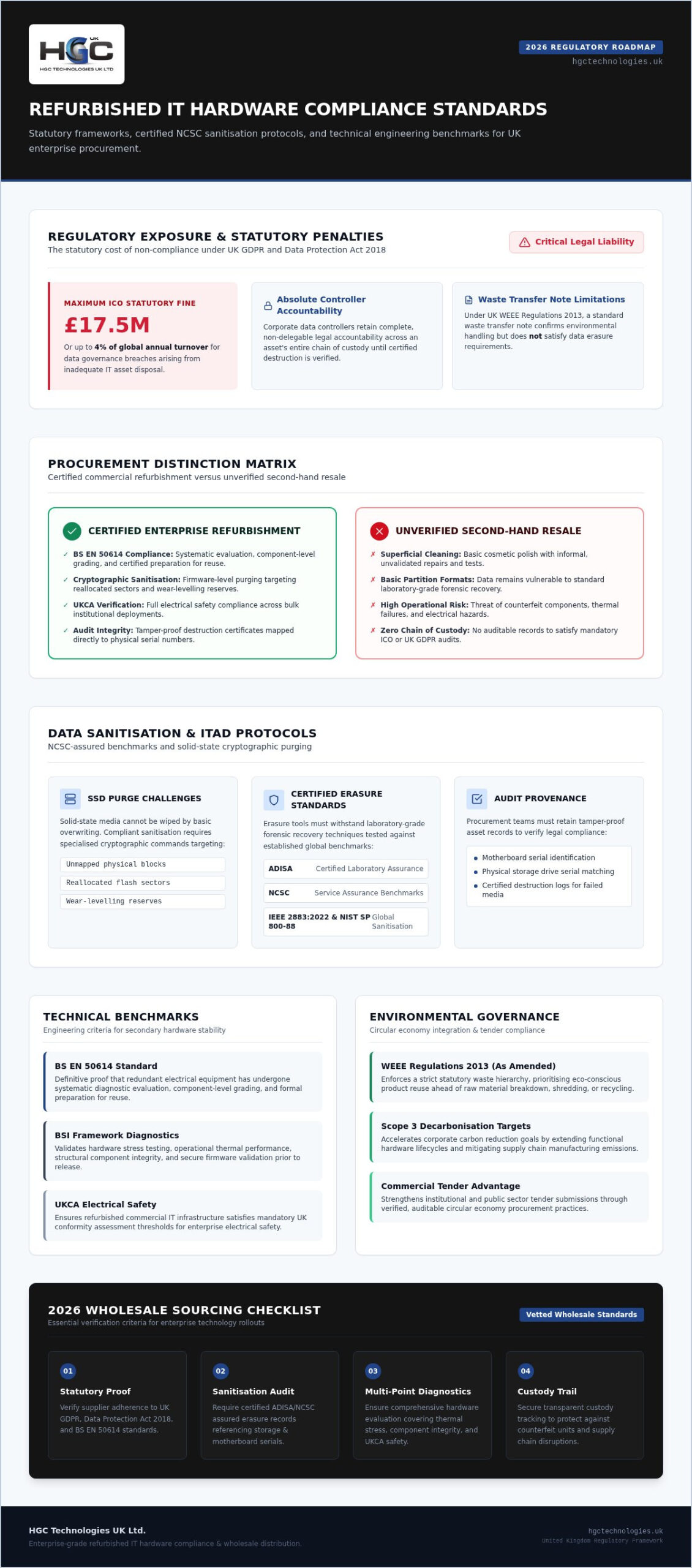
Data privacy and environmental governance dictate national hardware lifecycle rules. Under UK GDPR and the Data Protection Act 2018, corporate data controllers retain absolute accountability for corporate information across an asset’s entire chain of custody. Under current legislation, inadequate IT asset disposal is treated as a critical cybersecurity failure, exposing organisations to Information Commissioner’s Office (ICO) fines of up to £17.5 million or 4% of global annual turnover.
Simultaneously, environmental obligations enforce sustainable lifecycle management. As outlined in foundational resources like the WEEE Directive Explained summary, UK WEEE Regulations 2013 (as amended) mandate eco-conscious reuse prioritisation ahead of raw material breakdown or recycling. Meeting statutory requirements means establishing a clear audit trail; a standard waste transfer note proves environmental handling, but it does not replace the mandatory certification required for complete data destruction.
Essential Technical Benchmarks: BS EN 50614 and BSI Standards
Legal compliance must be anchored by verifiable engineering protocols. For enterprise IT buyers, BS EN 50614 compliance serves as definitive proof that redundant electrical equipment has undergone systematic evaluation, component-level grading, and certified preparation for reuse. This European standard, recognised across the UK, bridges the gap between waste management and product re-entry.
British Standards Institution (BSI) frameworks establish the diagnostic baselines for hardware reliability. These benchmarks govern stress testing, thermal performance, component integrity, and firmware validation. Adhering to vetted refurbished IT hardware compliance standards UK enterprises expect ensures that bulk deployments of commercial devices perform reliably within corporate environments, meeting identical electrical safety and operational thresholds as brand-new assets.
Data Sanitisation and IT Asset Disposal Compliance Protocols
Certified data erasure represents the single most critical compliance hurdle in commercial hardware reuse. A simple operating system restore or basic partition format leaves sensitive corporate information vulnerable to forensic reconstruction. Meeting the strict refurbished IT hardware compliance standards UK organisations require demands continuous chain-of-custody tracking alongside cryptographically audited overwrite algorithms. Without verifiable data destruction, deploying secondary computing assets introduces unacceptable liabilities into your digital environment.
ADISA Certification and Certified Erasure Frameworks
Industry frameworks like ADISA establish definitive benchmarks for testing sanitisation software against laboratory-grade forensic data recovery techniques. Solid-state drives present distinct sanitisation challenges compared to traditional magnetic platters. Solid-state media requires specialised cryptographic commands and firmware-level purging to target unmapped physical memory blocks, reallocated sectors, and wear-levelling reserves. Software-based erasure protocols must align strictly with National Cyber Security Centre (NCSC) service assurance standards, alongside globally recognised benchmarks like IEEE 2883:2022 and NIST SP 800-88.
Verifiable Audit Trails and Asset Destruction Records
Hardware provenance demands rigorous documentation. Procurement teams must secure auditable, tamper-proof destruction records matching physical motherboard and storage serial numbers. If an embedded storage module or drive fails software sanitisation, vendors must provide certified records of physical shredding down to specified particle sizes before equipment reuse. Incomplete chain-of-custody documentation invalidates regulatory data privacy compliance during internal audits, exposing businesses to legal scrutiny.
Reviewing operational criteria for wholesale refurbished computers UK highlights how transparent wholesale supply chains protect business assets. To secure fully documented equipment across bulk deployments, consult with certified wholesale hardware specialists who provide serialised compliance documentation with every delivery.
Comprehensive Compliance Checklist for Procuring Refurbished IT Assets
Deploying an airtight verification checklist prevents defective, insecure, or uncertified machinery from entering active production environments. Procurement professionals cannot rely on passive vendor assurances when onboarding secondary devices. Instead, teams must conduct forensic checks across electrical safety, diagnostic logs, and software provenance. Evaluating your sourcing processes against documented wholesale laptop distributor UK criteria helps establish a repeatable, risk-averse intake workflow across every deployment cycle.
Hardware Integrity and UKCA Electrical Safety Verification
Workplace deployment hinges on baseline electrical safety. Every refurbished chassis and power supply unit (PSU) must bear compliant UKCA markings, confirming conformity with designated British standards. Procuring organisations must mandate formal Portable Appliance Testing (PAT) certification across bulk consignments prior to field rollouts. Testing regimes must also stress-test lithium-ion batteries under peak processing loads, verifying thermal dissipation limits, preventing cell swelling, and confirming a minimum retained operating capacity.
Component Traceability and Grading Transparency
Enterprise procurement requires total visibility into component lineages. When auditing batch consignments, enforce these mandatory validation checks:
- Transparent Grading Baselines: Demand granular criteria separating Grade A cosmetic excellence from minor chassis scuffs (Grade B) or structural blemishes (Grade C).
- OEM Configuration Parity: Ensure internal components, including network adapters, cooling assemblies, and memory modules, mirror original manufacturer enterprise specifications.
- Diagnostic Performance Audits: Require automated testing reports covering panel backlighting uniformity, keyboard key travel, internal motherboard buses, and physical I/O port data rates.
Genuine Licensing and Operating System Integrity
Operating system legitimacy forms a central pillar of refurbished IT hardware compliance standards UK businesses uphold. Certified hardware must carry legitimate digital licenses provisioned through recognised refurbishment authorisations, rather than recycled volume keys that trigger audit violations. Simultaneously, firmware security demands rigorous attention; every incoming unit requires flashing with cryptographically signed BIOS updates to patch historic vulnerabilities before network provisioning.
Technical benchmarks detailed in guides covering bulk Dell refurbished laptops illustrate how component-level testing protocols protect corporate infrastructure. By integrating these strict electrical, cosmetic, and firmware checkpoints into your standard vendor agreements, you systematically eliminate hardware failure risks and safeguard operational uptime across all business divisions.
Environmental Governance and Circular Economy Standards for UK Procurement
Procuring refurbished hardware directly transforms corporate sustainability performance by tackling supply chain emissions at source. Rather than treating end-of-life electronics as disposable surplus, forward-thinking enterprises recognise that extending computing lifecycles preserves the critical embodied carbon bound within complex semiconductor manufacturing. Understanding these environmental realities forms a cornerstone of modern corporate governance. When procurement teams adhere to established refurbished IT hardware compliance standards UK statutory frameworks promote, sustainability ceases to be an abstract ambition and becomes a defensible commercial asset.
Aligning Sourcing with Corporate Scope 3 Decarbonisation
Manufacturing brand-new enterprise computing hardware generates substantial embedded carbon emissions before a single device powers on. Mining rare earth minerals, refining silicon, and assembling multi-layer printed circuit boards represent the most greenhouse gas-intensive phases of a computer’s total footprint. By redeploying certified equipment, organisations immediately prevent the raw material extraction and industrial fabrication cycles tied to newly minted machinery.
Under the UK Sustainability Reporting Standards aligned with international ISSB baselines, corporate entities face strict expectations to quantify and curtail Scope 3 upstream emissions. Meeting these disclosure demands requires robust traceability. Sourcing teams should require documented carbon avoidance calculations grounded in transparent lifecycle assessments rather than unsubstantiated green claims, proving that redundant equipment avoids illegal export and satisfies statutory environmental duties of care.
Social Value and Public Sector Procurement Integration
Statutory shifts have accelerated this circular economic transition across national institutions. The Procurement Act 2023 mandates that public sector contracting authorities evaluate tenders through the lens of the “Most Advantageous Tender” (MAT), requiring significant weighting for environmental and social benefits. Bidding suppliers must prove active carbon reduction strategies rather than relying solely on low pricing bids.
Deploying verified commercial estates provides immediate, demonstrable proof of circular economic alignment for enterprise tenders. Sourcing standardised units like bulk Lenovo refurbished laptops allows IT departments to deliver identical processing capabilities while drastically curtailing e-waste footprints. To integrate fully compliant secondary hardware into your upcoming infrastructure refresh, source audited IT assets from HGC Technologies UK Ltd. to satisfy national environmental benchmarks without operational disruption.
Partnering with Certified UK Hardware Wholesalers for Guaranteed Compliance
Enterprise regulatory compliance depends fundamentally on the rigour and transparency of your wholesale hardware distributor. Procuring secondary assets through unverified channels or spot-market brokers exposes organisations to mismatched component revisions, grey-market hardware, and undocumented chain-of-custody gaps. Vetted wholesale specialists eliminate these operational vulnerabilities by enforcing standardised multi-point diagnostic testing programmes before dispatch. Partnering with dedicated suppliers ensures continuous adherence to the rigorous refurbished IT hardware compliance standards UK enterprises require for large-scale deployments.
Mitigating Supply Chain Risk with Standardised Batch Testing
Fleet uniformity drastically simplifies corporate rollouts. When rolling out hundreds of commercial workstations or corporate notebooks, minor motherboard or wireless card variations can derail operating system imaging and driver deployment. Dedicated wholesale suppliers guarantee batch consistency across proven Dell, Lenovo, and HP commercial lines, running exhaustive diagnostic checks across internal silicon, processor thermals, and memory stability.
Rigorous diagnostic regimes apply equally across mission-critical datacentre infrastructure. Examining high-throughput enterprise server hardware UK procurement specifications demonstrates how comprehensive stress testing validates dual redundant power supplies, backplane controllers, and memory buses under simulated enterprise workloads, guaranteeing mission-critical stability.
Strategic Wholesale Sourcing for Resellers and Enterprises
Direct wholesale arrangements provide inventory predictability that open auctions and fragmented brokers cannot match. For corporate procurement directors and commercial resellers, long-term supply relationships unlock critical operational advantages:
- Total Provenance Transparency: Every consignment includes serialised documentation tracking device origins, configuration changes, and testing histories to satisfy corporate governance audits.
- Guaranteed Supply Continuity: Wholesale distributors maintain rolling stockpiles of enterprise-grade desktop towers, custom PCs, original smartphones, and business laptops to support phased rollout schedules.
- Counterfeit Component Elimination: Direct inspection pipelines verify the authenticity of internal components, shielding corporate networks from uncertified third-party replacement parts.
Aligning with established wholesale distributors transforms secondary technology sourcing from an audit risk into a strategic operational advantage. Securing hardware that strictly meets refurbished IT hardware compliance standards UK statutory frameworks require safeguards corporate data, guarantees electrical safety, and secures scalable technology investments across the nation.
Secure Your Technology Lifecycle with Certified Procurement
Navigating secondary asset sourcing no longer requires balancing budget efficiency against regulatory exposure. By executing a structured intake checklist, verifying cryptographic erasure, and securing UKCA electrical conformity, your organisation transforms hardware refreshes into a defensible competitive advantage. Adhering to rigorous refurbished IT hardware compliance standards UK regulations demand protects brand reputation whilst delivering measurable Scope 3 carbon savings across your estate.
Achieving total compliance requires an uncompromising supply partner. As a specialised nationwide wholesale supplier of refurbished enterprise Dell, Lenovo, and HP laptops, custom PCs, and robust server solutions, HGC Technologies UK Ltd. eliminates procurement uncertainty through multi-point diagnostic testing and direct chain-of-custody transparency. Explore compliant wholesale IT hardware with HGC Technologies to equip your workforce with dependable, standards-compliant systems built for sustainable growth.
Frequently Asked Questions
What legal regulations govern the sale and deployment of refurbished IT hardware in the UK?
Secondary IT equipment in the UK is governed primarily by UK GDPR, the Data Protection Act 2018, and the WEEE Regulations 2013 (as amended). These statutes require verifiable data erasure, safe electrical standards, and prioritised equipment reuse over disposal. Commercial sales must also satisfy the Consumer Rights Act 2015 and the Electrical Equipment (Safety) Regulations 2016, establishing baseline product safety and operational liability across both public and private sectors.
How does an organisation verify that refurbished storage drives comply with UK GDPR?
Organisations verify compliance by obtaining serialised, tamper-evident data destruction certificates generated by certified sanitisation software. These certificates must confirm erasure following recognised benchmarks such as NIST SP 800-88, IEEE 2883:2022, or NCSC standards. Crucially, the records must link directly to the physical storage media’s serial number, confirming cryptographic purging of all sectors or certified physical destruction if solid-state drives fail software sanitisation.
What is the difference between BS EN 50614 and standard electrical safety checks?
BS EN 50614 is a comprehensive technical standard governing the formal preparation of waste electrical equipment for reuse, whereas standard safety checks focus strictly on basic electrical hazards. While routine Portable Appliance Testing (PAT) verifies plug wiring and earth continuity, BS EN 50614 mandates systematic component grading, functional stress testing, diagnostic verification, and complete operational auditing before equipment re-enters commercial circulation.
Is UKCA marking legally mandatory on all refurbished computer equipment and power supplies?
Refurbished equipment and replacement power supplies placed on the UK market must comply with designated UK safety regulations, demonstrated by valid UKCA or CE markings. While original components may retain factory markings, any refurbished units incorporating replacement power delivery systems or modified internal circuitry must satisfy the Electrical Equipment (Safety) Regulations 2016 to ensure safe enterprise deployment across national corporate environments.
Can corporate buyers claim Scope 3 emissions reductions by procuring refurbished laptops?
Corporate buyers can legitimately report Scope 3 emissions reductions under the Greenhouse Gas Protocol by sourcing refurbished laptops instead of newly manufactured systems. Reusing secondary hardware bypasses the emissions-intensive mineral extraction and semiconductor fabrication stages. Aligning with refurbished IT hardware compliance standards UK reporting bodies recognise allows procurement leaders to document auditable carbon avoidance figures based on transparent lifecycle assessments for corporate ESG filings.
How do certified IT refurbishment standards protect businesses against counterfeit components?
Certified refurbishment processes enforce component-level diagnostic audits that verify original equipment manufacturer (OEM) part authenticity against factory specifications. Rigorous testing flags cloned firmware, substandard aftermarket battery cells, and counterfeit memory modules before deployment. By adhering to strict refurbished IT hardware compliance standards UK enterprises demand, certified wholesale distributors inspect motherboards, internal buses, and expansion cards, ensuring all internal hardware remains authentic and secure.
What documentation should an enterprise procurement team demand from a hardware wholesaler?
Enterprise procurement teams must request serialised certificates of data sanitisation, comprehensive multi-point diagnostic testing reports, and documented grading assessments for every asset. Organisations should also demand electrical safety records, including PAT verification for external power supplies, proof of genuine operating system licensing, and clear chain-of-custody documentation tracing the hardware’s provenance from intake through final dispatch.

Managing IT Hardware Refresh Cycles: The 2026 UK Strategic Guide
With RAM prices rising fourfold and SSD costs climbing from £40 to over £150 in early 2026, the tr

UK GDPR: 2026 Procurement Guide for Used IT Hardware
Research by the University of Hertfordshire's Cyber Security Centre found that 65% of second-hand me

Mobile Hardware Distributor UK: The 2026 Strategic Procurement Checklist
Did you know that whilst UK businesses can save up to 50% by sourcing refurbished handsets, a single