

Refurbished Laptop Market Trends UK 2026: What Businesses Need to Know
The cheapest refurbished laptop may be the least useful measure of where the market is heading. For UK businesses and resellers, the more practical question is whether a device meets its intended workload and can deliver value throughout its working life. That distinction sits at the heart of refurbished laptop market trends UK 2026.
Headline growth forecasts can help with planning, but global projections don’t automatically describe UK demand. Consumer retail activity also doesn’t tell the whole story about wholesale supply or corporate buying. To assess the market, separate these signals and weigh them against practical factors such as grading, data erasure, repairability and future software support.
This article examines the forces shaping UK demand, supply and resale, and shows how to distinguish local evidence from broader forecasts and marketing claims. It also sets out what business buyers and resellers can monitor, from procurement priorities to device lifecycle and support. Whether you’re planning a bulk purchase or evaluating resale opportunities, focus on more than the price today: assess how well the devices can serve your organisation over time.
Key Takeaways
- Use refurbished laptop market trends UK 2026 to guide questions, not as a substitute for evidence about your buyer segment.
- Separate corporate, education, reseller and consumer demand to identify which market signals are relevant to your plans.
- Compare grading criteria, testing information and data-handling practices when assessing refurbished laptop batches.
- Check a market claim’s geography, date, sample, methodology and definition before using it in procurement or resale planning.
- Track refresh activity, grade disclosure and software-support eligibility to assess batch suitability and lifecycle value.
What the 2026 UK refurbished laptop market trends reveal
The refurbished laptop market trends UK 2026 are easier to interpret when the market is defined carefully. A refurbished laptop is a device assessed and reconditioned for resale, which may involve testing, repair, cleaning or resetting. Processes and inspection levels vary, so “refurbished” doesn’t guarantee a uniform condition or standard across sellers.
That distinction matters to business buyers. A privately sold second-hand laptop may be offered as-is, without documented reconditioning. Professionally refurbished stock has been through a seller’s refurbishment process, but buyers still need clear information about condition, grading and work carried out. Refurbishment (electronics) provides a general overview of the term and how it differs from used goods.
What counts as a refurbished laptop in market reporting?
Don’t assume every market report uses the same definition. One dataset might count devices processed by specialist refurbishers; another may include broader resale categories or transactions through a particular sales channel. Grading labels can differ between sellers, too. Before comparing figures, establish whether “refurbished” means professionally reconditioned stock, all pre-owned devices or a narrower category, then apply that definition consistently.
The UK market also includes distinct channels: wholesale supply to resellers, corporate procurement, education purchasing and consumer retail. These aren’t interchangeable measures. A rise in consumer listings, for example, doesn’t by itself show that organisations are buying more devices in bulk.
Evidence snapshot: keep the categories separate
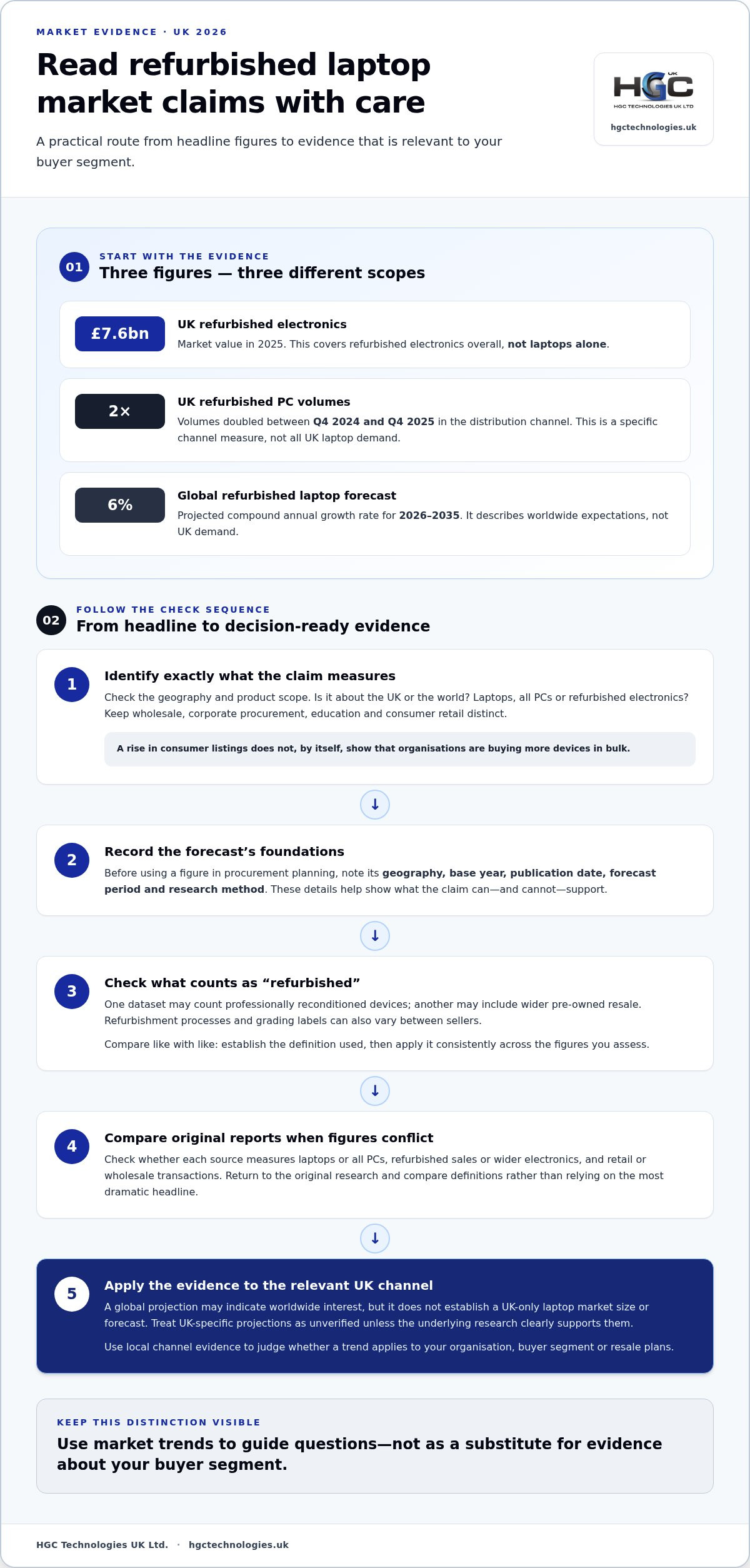
- UK evidence: The UK refurbished electronics market was valued at £7.6 billion in 2025, according to research published on 29 June 2026. This covers electronics, not laptops alone. A distribution report published on 13 February 2026 said refurbished PC volumes in the UK doubled between Q4 2024 and Q4 2025. That finding is specific to PCs sold through distribution.
- Global context: A global refurbished laptop forecast published on 15 August 2026 projects a 6% compound annual growth rate for 2026-2035. It describes worldwide expectations, not UK demand.
- Unverified projection: These figures don’t establish a UK-only laptop market size or forecast. Treat UK-specific projections as unverified unless the underlying research clearly supports them.
How to read 2026 market forecasts responsibly
Before using a forecast in procurement planning, record its geography, base year, publication date, forecast period and research method. Check what it counts: laptops or all PCs, refurbished sales or wider electronics, and retail or wholesale transactions. If figures conflict, return to the original reports and compare their definitions instead of relying on the most dramatic headline.
A global projection can indicate the direction of worldwide interest, but only UK-specific evidence can describe the UK market. Keep that distinction visible in business cases and resale planning. Then use local channel data to judge whether a trend applies to your organisation.
Why UK demand is changing across business and education
Demand for refurbished laptops comes from different types of buyers, each with distinct priorities. Affordability can make refurbished devices worth considering, but organisations also need to plan the full lifecycle: which equipment suits the work, how it will be deployed and when it may need replacing. These pressures help explain the refurbished laptop market trends UK 2026 without suggesting every buyer segment is growing at the same rate.
Corporate and education demand: fit, scale and lifecycle
Corporate procurement teams typically need devices suited to defined work patterns and consistent enough to deploy across a team. Education buyers may have different use cases, but still need to match device capability and quantity to users’ needs. Start by identifying the tasks the laptops must handle, then consider how a refurbished purchase fits existing equipment, deployment processes and future refresh plans.
Bulk buyers may value repeatable specifications and a consistent batch because these can simplify configuration, support and rollout. A corporate refresh can also return devices to the resale and refurbishment supply chain. The timing, condition and volume of returned stock vary, so a refresh cycle is a possible supply source, not a guarantee of a particular batch.
Resellers and wholesale channels: a different demand pattern
Resellers need to consider more than whether a laptop will appeal to an individual customer. Batch consistency, resale suitability and clear product information all affect how confidently they can plan an offer and describe devices to buyers. Wholesale purchasing is shaped by the characteristics of a group of machines, not just the appeal of a single consumer listing.
Differences within a batch can affect a reseller’s stock planning and the work needed to present each device accurately. Corporate buyers may instead focus on whether a group can support a planned deployment. This is why UK wholesale refurbished IT equipment is best considered through batch suitability and intended use, not simply unit price.
Individual buyers often weigh whether a device meets their everyday needs and fits their budget. Businesses and resellers have additional considerations, including procurement processes, deployment consistency and the next stage of the device lifecycle. Treating all these purchases as one demand pool can obscure what is changing in each channel.
Individuals may value affordability and personal suitability, organisations may prioritise fit and planned deployment, and resellers may focus on consistency and resale potential. This distinction turns broad market commentary into questions that are useful for your purchasing decisions.
For business buyers planning a bulk requirement, bulk refurbished laptop supply can form part of a considered device lifecycle strategy.
The 2026 trends reshaping refurbished laptop supply and value
For business buyers, refurbished stock is judged on more than visible condition. Clear grading, documented testing, responsible data handling and ongoing software suitability all affect whether a batch is fit for purpose. Together, these factors help explain the refurbished laptop market trends UK 2026: value depends on evidence about readiness and useful life, not just resale category.
Quality signals: grading, testing and data handling
Grade labels aren’t universal. One supplier’s condition grade may not mean the same as another’s, so look for the criteria behind each label. A refurbished laptop grades guide can explain practical distinctions, but read the grade alongside a description of the device’s condition.
Testing records help organisations understand which checks have been carried out, while information about data erasure helps them assess how previous user data has been handled. For bulk procurement, look at the process across the batch: consistent checks and reporting make it easier to compare stock with deployment needs. A grade alone is not proof of functional testing or data handling.
Software support and circularity claims
Software eligibility is part of lifecycle planning. Microsoft ended support for Windows 10 in October 2025, so organisations assessing refurbished devices should consider operating-system readiness and current Microsoft guidance. Windows 11 compatibility can be a useful indicator, but compatibility today doesn’t guarantee future support. Check each device against your software requirements and planned period of use.
Interest in circular-economy approaches can also influence purchasing, as organisations consider keeping equipment in use for longer rather than replacing it immediately. Treat environmental comparisons carefully. Before repeating a claim about emissions or resource savings, look for its source, the devices and lifecycle stages included, and the assumptions used. Without those boundaries, a headline figure may not reflect the impact of a particular purchase.
Use evidence you can apply. The table below connects market themes to checks that make them relevant to business procurement.
| Trend | Evidence to seek | Potential business implication |
|---|---|---|
| Grading transparency | Written grade criteria and a description of condition | Supports more informed assessment of batch suitability and resale presentation |
| Testing and data handling | Details of checks performed and the data-erasure process | Helps procurement teams evaluate readiness and manage deployment confidence |
| Software support | Compatibility information and current operating-system support guidance | Informs useful-life planning and reduces the risk of sourcing devices that don’t meet software needs |
| Circularity claims | Source, scope, lifecycle boundaries and assumptions behind comparisons | Enables responsible reporting and avoids relying on claims that don’t match the purchase |
Consider these signals together. A device may have an acceptable grade but fail to meet software requirements. It may also be suitable on its own while the batch lacks the consistency a rollout needs. Assess the documentation against the tasks the laptops must perform, your support expectations and the planned lifecycle.
How UK buyers can assess market claims and plan ahead
Market commentary is useful only when its evidence matches the decision you need to make. A forecast about worldwide sales may signal broader interest, but it can’t establish UK business demand or tell a procurement team what to buy. Apply the same checks to headlines, vendor commentary and research reports before using them to shape a plan.
A five-point test for market data
Use this sequence to assess whether a claim is relevant, comparable and transparent enough to inform planning:
- Check the geography. Establish whether the source measures the UK, Europe or the global market. Don’t use a worldwide figure as evidence of UK-specific demand.
- Record the dates. Note the publication date, base year and forecast period. An earlier projection may rely on assumptions that no longer fit the market.
- Identify the sample. Find out whether the research covers business buyers, consumer sales, wholesale distribution or a broader electronics category. Check whether the source explains the data behind its claims.
- Read the definition. Confirm what counts as a refurbished laptop and whether the figures refer to laptops, all PCs or refurbished electronics more broadly.
- Review the method. Look for named research methods, transparent assumptions and data that can be independently attributed. If a headline gives no route back to its evidence, treat it as an unverified signal, not a planning benchmark.
Publication date and forecast period aren’t interchangeable: a report published this year may still project from an earlier base year. Keep those details together when comparing claims, and return to the original report if summaries or extracted figures disagree.
Turn trends into a proportionate procurement watchlist
Rather than reacting to every market prediction, monitor indicators that relate directly to your organisation’s plans. The refurbished laptop market trends UK 2026 provide context, but your procurement requirements, deployment schedule and support needs should determine what you track.
- Refresh activity: Monitor planned replacement cycles and the likely return of devices to resale channels. Timing and batch volumes vary, so use this as a planning signal, not an assurance of supply.
- Batch information: Track specification consistency and the clarity of grading information. For a rollout, variation within a batch may matter more than broad market growth.
- Support eligibility: Keep operating-system requirements and current software-support guidance on the watchlist. Assess whether the devices suit the intended deployment period.
- Demand fit: Compare expected user numbers and deployment timing with the quantity and type of equipment required. Separate a general market trend from a genuine need in your organisation.
Use this bulk laptop procurement guide alongside your internal deployment and lifecycle plans. If your organisation is assessing bulk refurbished laptop requirements, explore HGC Technologies UK Ltd.’s wholesale laptop supply as part of your sourcing review.
What UK refurbished laptop trends mean for wholesale sourcing
For business buyers and resellers, the practical lesson is to use market trends to plan, not to buy on headline growth alone. Assess the evidence behind a market claim, then test sourcing decisions against software support, batch suitability and the role each device must perform. Value comes down to whether the laptops can serve their intended purpose over a realistic lifecycle.
What resellers and corporate buyers should take from the trends
Supply shifts can affect which specifications are available in wholesale channels and how well a batch matches a planned deployment. Build requirements around the work the devices will support, and distinguish essential specifications from preferences. For repeat purchasing, record the specification and condition information that matters to your organisation. That makes future requirements easier to compare without assuming identical batches will always be available.
Transparent product information helps buyers make informed decisions. Clear descriptions of specifications and condition support accurate planning, whether a reseller is preparing devices for resale or a corporate team is assessing a group for internal use. Check how the stock aligns with support requirements and the intended period of use. A low unit price or general market forecast alone cannot establish suitability.
These considerations are central to choosing a UK wholesale laptop distributor: the sourcing relationship needs to fit your requirements, purchasing pattern and product information needs.
A grounded next step for wholesale enquiries
Before making an enquiry, bring the main details together. Note the intended use, approximate volume and specifications necessary for your deployment or resale plan. Include relevant operating-system and support requirements, along with any need for consistency across devices. This creates a clear basis for discussing how wholesale supply fits the business need.
HGC Technologies supplies bulk quantities of professionally refurbished Dell, Lenovo and HP laptops to corporate buyers and resellers across the UK. Its wholesale supply is relevant to organisations assessing refurbished devices as part of procurement and lifecycle planning. Consider the evidence, support readiness and suitability of the requirement together, rather than relying on market commentary alone.
If you’re reviewing bulk requirements, explore HGC Technologies and its wholesale solutions as a step in your sourcing research. Keep the focus on the devices your organisation needs, the information available to assess them and how well they fit the planned lifecycle.
Make your next sourcing decision with confidence
The refurbished laptop market trends UK 2026 are useful context, but the next step is a procurement decision built around your organisation’s needs. Set out the role devices must perform, the specifications that matter and how the purchase fits your refresh plans. Use those requirements to assess options consistently instead of allowing a broad market forecast to set the agenda.
For corporate buyers and technology resellers, HGC Technologies supplies bulk refurbished laptops from Dell, Lenovo and HP across the UK. Consider how wholesale sourcing could support your planned requirement, with suitability and lifecycle value guiding the decision.
Explore HGC Technologies’ wholesale laptop solutions and discuss your bulk requirement. With clear specifications and a measured view of the evidence, you can build a sourcing plan around the devices your organisation needs.
Frequently Asked Questions
Is the UK refurbished laptop market growing in 2026?
Available UK evidence indicates growth in refurbished PC distribution, but it doesn’t establish the size or trajectory of the entire laptop market. A report published on 13 February 2026 stated that UK refurbished PC volumes sold through distribution doubled between Q4 2024 and Q4 2025. Treat that as a channel- and period-specific signal, not proof that every buyer segment or laptop category grew at the same pace.
What is driving demand for refurbished laptops in the UK?
Demand reflects budget considerations, planned device replacement and suitability for particular workloads. For example, an organisation might consider refurbished devices for a defined user group whose software and daily tasks don’t require the newest hardware. Resellers may assess whether a batch fits their customer base, while individual buyers make choices around personal needs. These motivations differ, so no single explanation describes every sale.
Are refurbished laptops a sustainable choice for UK businesses?
They can support a reuse-led approach, but the environmental case depends on the device’s full lifecycle. Consider how long the laptop will remain useful, whether it can meet the intended workload and how it will be managed at the end of use. If reporting environmental benefits, use evidence that explains its assumptions and scope. Don’t apply a general impact figure to a specific purchase without checking how it was calculated.
How does Windows support affect refurbished laptop demand in 2026?
Windows support affects whether a device can meet an organisation’s security and software requirements during its planned use. Microsoft ended Windows 10 support in October 2025, making current support status an important procurement consideration. Check Microsoft’s latest guidance and assess the device’s Windows 11 compatibility separately. Compatibility doesn’t guarantee support indefinitely, so include the expected deployment period and the organisation’s update policy in the decision.
What should a business check when assessing a refurbished laptop market forecast?
First identify what the forecast measures: UK laptop sales, all refurbished PCs or a wider electronics market. Then check its base year, publication date and forecast period, and whether it counts units, revenue or both. A revenue projection can rise without more laptops being sold. Compare the report’s assumptions with your procurement horizon, and don’t use a global projection as a UK budget target.
Why do wholesale refurbished laptop trends matter to resellers?
Wholesale patterns can influence the range and consistency of devices available for resale, affecting stock planning and how resellers present products to customers. A batch with varied specifications may need a different sales approach from a more consistent group. Track product information alongside demand from your own customer base, and allow for refurbished supply to vary as organisations refresh equipment at different times.

Refurbished vs Open-Box Laptops: 2026 IT Procurement Guide
The cheapest laptop on an invoice often turns into your most expensive operational headache once dep

Business Continuity with Refurbished Hardware: A 2026 Strategic Guide
Certified refurbished enterprise hardware offers cost savings of up to 70% compared to brand-new uni

Refurbished Laptop Warranty Standards UK: The 2026 Strategic Reference
What if the security of your entire corporate IT infrastructure rested on a warranty document that l