

Stagger IT Procurement to Balance Payments and Cash Flow
Buying all your IT at once isn’t the only way to meet business needs. Staggering IT procurement to manage cash flow means phasing orders around operational priorities and forecast cash movements, rather than committing to every purchase at once. The aim is to keep essential technology on track while giving finance teams a clearer view of when cash will leave the business.
Unit prices matter, but the lowest quote may not be the best fit if its timing or payment terms put pressure on available cash. A considered purchasing plan can balance these factors while ensuring teams get the equipment they need. This article explains how supplier choices and order quantities influence purchasing decisions, how to weigh timing against forecast uncertainty, and how to use payment terms and spend tracking to plan ahead. It also shows how to account for commitments early, so upcoming IT purchases are visible before invoices arrive.
Key Takeaways
- Phase IT orders around operational priorities and forecast cash movements to avoid concentrating purchases in one period.
- Assess whether a lower unit rate is worth the added uncertainty it may create in monthly cash forecasts.
- Align supplier payment terms with available cash, and use early-payment discounts when the timing makes financial sense.
- Record purchasing commitments early so finance teams can anticipate cash needs before invoices arrive.
1. Supplier selection, lead times and order quantities
Prioritise equipment that supports essential operations, security or planned growth; defer upgrades that teams can manage without. Match each order to its deployment date, so finance can schedule payment nearer operational need rather than purchasing everything together. Compare suppliers on delivery timing, order flexibility and invoice arrangements, as well as unit price. A reliable supply chain depends on knowing when equipment is needed and when its invoice will affect cash.
Ask suppliers to phase delivery or invoice separate batches where their processes allow. A large order can bring several invoices due at once, creating a cash flow spike even if the equipment is deployed gradually. For example, align laptop batches with team onboarding dates, then forecast each expected invoice against available cash. Longer lead times make early planning important: confirm the required delivery window before setting an order date, and include any supplier-stated timing in the purchasing schedule.
Order quantities also shape negotiations. In one purchasing example, a 15% volume discount may be possible for 100 units, but the saving matters only if the order size and payment date suit the forecast. Suppliers may accept Net 45 or Net 60 terms in exchange for consistent order volume. Regular, predictable purchasing can support negotiation and process improvement, while giving both parties clearer visibility. If a supplier faces cash shortages, a business could consider a cash advance in return for future price reductions, weighing the advance against its own working-capital needs.
Leasing or renting isn’t automatically cheaper than buying outright in the UK. Compare the full payment schedule and total commitment with the purchase cost, then consider how long the equipment will be used and whether predictable payments justify the arrangement. Subscription and pay-as-you-go pricing can ease upfront cash demands by spreading payments over time, but recurring charges need to be tracked against ongoing budgets.
For staged UK purchases, forecast VAT cash movements separately from the equipment’s net cost. The timing depends on the transaction’s VAT tax point and the business’s accounting method, so include both in cash planning. Discuss delivery batches, invoice dates, payment flexibility and any process changes that make commitments visible earlier with suppliers.
2. Balancing unit-rate savings against forecast variability
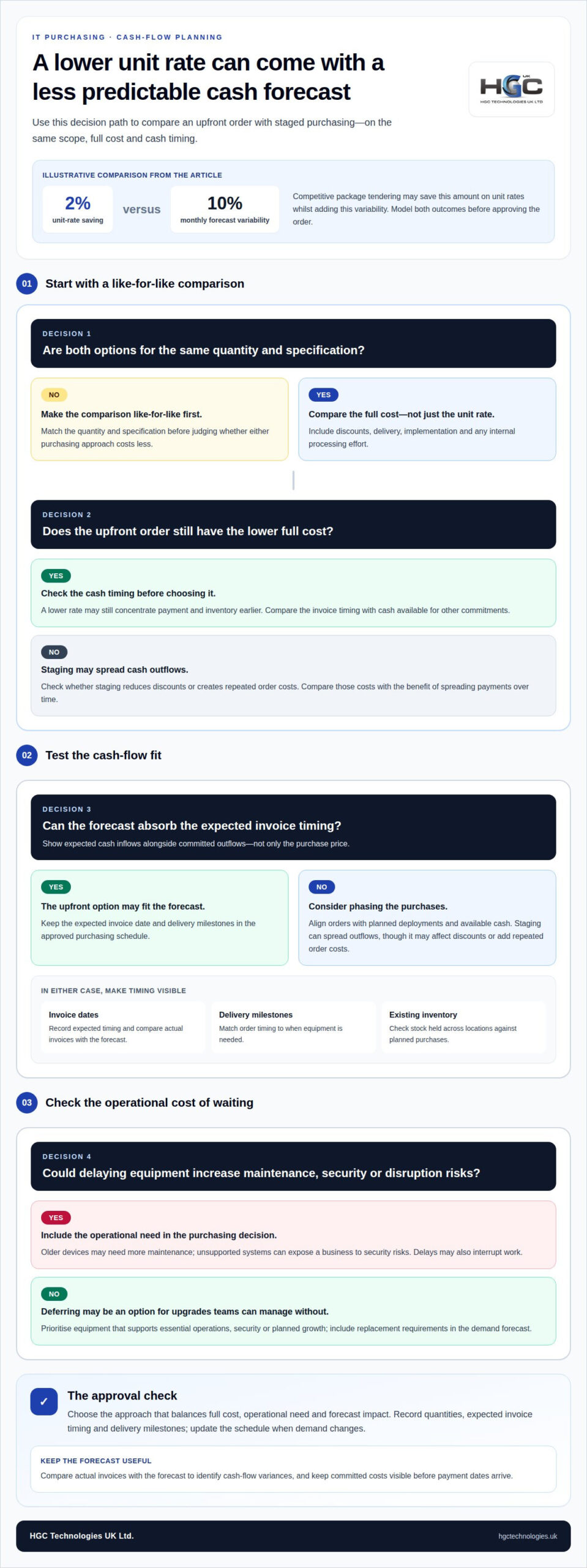
A lower unit rate can still create pressure if purchase timing becomes harder to predict. Competitive package tendering may save 2% on unit rates while adding 10% variability to the monthly cash forecast. Model both outcomes before approving an order: compare the saving with the effect of shifted invoice dates on cash available for other commitments. A forecast should show expected cash inflows alongside committed outflows, not just the purchase price.
Build demand forecasts from planned deployments, replacements and current inventory across locations. Predictive analytics can help track stock and forecast demand in real time, supporting suitable inventory levels. For a practical review, map each planned purchase against stock already held and the date the equipment is needed. This reduces the risk of tying up cash in surplus inventory or placing urgent orders that disrupt procurement.
Staggered purchases and a single upfront order don’t have a universally lower total cost. Compare the same quantity and specification, including unit rates, discounts, delivery and implementation costs, plus any internal processing effort. Staging can spread cash outflows, but may reduce volume discounts or create repeated order costs. An upfront order may secure a lower rate, yet concentrates payment and inventory earlier. The better choice depends on the full cost and its impact on your forecast.
Delaying equipment can also affect operations. Older devices may need more maintenance, and unsupported systems can expose a business to security risks. Include expected repairs, replacement requirements and security needs in the demand forecast. If a delay increases those costs or interrupts work, the apparent saving may not reduce total spending.
Keep an approved purchasing schedule that records quantities, expected invoice timing and delivery milestones. Update it when demand changes, then compare actual invoices with the forecast to identify cash flow variances. This gives finance a clearer view of committed costs before payment dates arrive. A structured IT purchasing plan can also help align order timing with operational demand.
3. Cash discounts and payment-term optimisation
Compare the value of a cash discount with the benefit of retaining funds for longer. Cash discounts commonly offer a 2-3% price reduction, so assess the saving against the effect of earlier payment on working capital. If cash is available and the discount exceeds the value of keeping funds accessible, early payment may be a useful strategy. Record the decision against the invoice and relevant payment term to support consistent procurement efficiency.
For public contracts, payment requirements are changing. According to the UK Government’s 2025 consultation on late payment practices, the Procurement Act 2023 is tightening payment-term requirements on public contracts, reducing the maximum payment window to 30 days in coming years. Include this timing in cash forecasts for public-sector work, and align purchase commitments with expected receipts and contractual payment obligations.
Automated Clearing House (ACH) payments are another payment method to consider, particularly for cross-border transactions. Before using ACH, establish the currency, any charges, settlement timing and how the payment will be reconciled against the supplier invoice. For UK cash planning, record the expected sterling outflow and its date rather than treating an initiated payment as settled.
Contract compliance helps protect agreed payment timing. Match each invoice to its approved purchase order, receipt and contract terms before payment, then route exceptions to the relevant approver. This helps prevent duplicate or off-contract payments from distorting forecasts. Finance should track payment commitments as soon as approval creates an obligation, not only when invoices reach accounts payable.
Payment flexibility matters on both sides of a transaction. A business may negotiate supplier terms that fit its cash position, while giving customers more time can support their cash flow. Balance that opportunity against the need to collect cash on time: forecast customer receipts alongside supplier payments, and make the impact of any changed payment term visible. Involving procurement and finance early keeps contracts, approvals and cash forecasts aligned.
4. Tracking upcoming spend commitments
Build a phased IT budget by listing each purchase, its business purpose, expected approval and planned payment date. Rank essential replacements ahead of optional upgrades, then map each phase against forecast cash inflows and other committed spending. This gives finance a timeline to revise when operational priorities or expected receipts change.
Record commitments at requisition, not only when invoices arrive. A requisition gives finance an earlier view of proposed spending, while an approved purchase order makes the commitment clearer. Include the expected amount, supplier, delivery milestone and payment timing in the purchasing record. When a purchase order is raised, include it in financial reporting so available capital is not overstated.
Use one shared view across procurement and accounts teams. For each order, track its status from request through approval, delivery, invoice and payment. For example, a requisition awaiting approval should appear differently from an approved order awaiting delivery. These stages help finance distinguish potential outflows from firm commitments and anticipate cash requirements before invoices fall due.
Automated purchasing workflows can connect requisitions, approvals and accounts payable records. Set approval limits and route requests to the appropriate budget owner, then match the approved order with its invoice and receipt. This reduces gaps between purchasing activity and cash forecasts. Regularly reviewing open orders can also catch changed quantities, delayed deliveries and duplicate requests before they disrupt plans or supplier relationships.
Compare forecast spending with actual payments during each finance review. Investigate differences, such as an invoice arriving earlier than planned or an order changing after approval. Update the timeline and cash forecast together so each revision reflects the latest commitment rather than an outdated estimate. This makes phased purchasing a working-capital planning tool, not simply a calendar of orders.
For a planned hardware purchase, discuss your IT procurement requirements as part of building a phased schedule that reflects operational needs.
HGC Technologies UK
HGC Technologies UK Ltd. supplies business technology for organisations planning purchases around operational needs and cash flow. Its range includes bulk refurbished Dell, Lenovo and HP laptops, as well as custom-built PCs and server solutions. These options can support phased equipment requirements without treating every purchase as a single order.
Turn to HGC Technologies UK Ltd. when planning a workplace refresh, equipping teams in stages or choosing devices for an upcoming purchasing phase. Share the equipment type and intended use to help align your purchase with the wider procurement schedule. Your business can then determine the order structure that fits its cash forecast.
To discuss your IT requirements, contact HGC Technologies UK Ltd.
Make your next procurement decision a deliberate one
Assign an owner to translate your technology roadmap into purchasing decisions. As business priorities shift, that person can bring operational and finance teams together to reassess which investments remain essential and when they fit the wider plan. This keeps staggering IT procurement to manage cash flow connected to real business needs, rather than turning it into a fixed schedule that no longer serves the organisation.
Use the next purchasing cycle to establish a clear decision point: define what must be in place, what can wait, and what would trigger a change in timing. This gives stakeholders a practical basis for adjusting plans when demand or available capital changes, without losing sight of the equipment teams need to work effectively.
For a discussion about business IT procurement, contact HGC Technologies UK Ltd. to discuss procurement. A considered conversation can help you take the next step with a clearer view of your requirements and priorities.
Frequently Asked Questions
How can UK businesses stagger IT procurement to improve cash flow?
Start by separating essential purchases from items that can wait, then connect each order to a business need and expected cash availability. For example, a company opening a new department could equip that team first and schedule non-urgent replacements for a later purchasing cycle. Assign an owner to each phase and review it when hiring plans, project requirements or cash forecasts change.
What are typical payment terms for UK business IT hardware and software?
There isn’t one standard payment term for every UK business purchase. Terms depend on the supplier agreement, the product and the buyer-supplier relationship. Suppliers may accept Net 45 or Net 60 in return for consistent order volume, but these are negotiated arrangements, not a universal rule. Hardware invoices and software subscriptions may also have different billing schedules, so record each due date separately.
How can UK businesses negotiate deposits, instalments and payment terms with IT suppliers?
Set out the proposed order, delivery stages and cash constraints before agreeing the contract. Ask whether a deposit, staged instalments or payments linked to delivery milestones can be included, then compare each due date with forecast cash. Make sure the contract clearly defines invoice triggers and payment deadlines. A documented schedule helps procurement and accounts teams apply the agreed terms consistently.

Lenovo vs HP: The 2026 Comparison for UK Business Procurement
The USD 6.26 billion UK laptop market might be obsessed with AI-powered silicon in 2026, but for the

The Reliability of Refurbished Business Laptops: A 2026 Procurement Guide
The brand-new consumer laptop on a retail shelf is often less durable than a three-year-old enterpri

Wholesale Computers UK: The 2026 Guide to Strategic IT Sourcing
Sales volumes for refurbished PCs in the UK doubled in a single year leading into 2026, yet many ent