
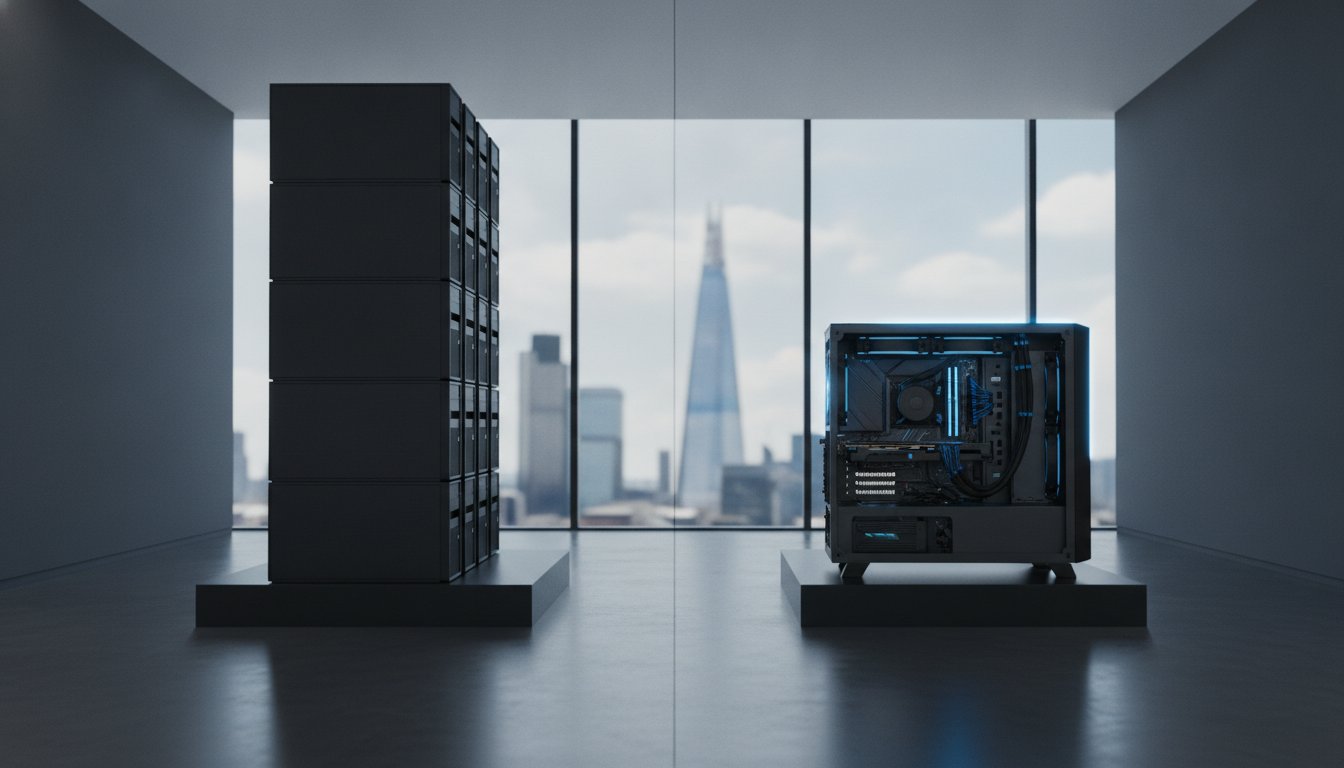
Custom Built PCs vs Pre-built for Business: The 2026 Procurement Guide
With enterprise PC prices projected to surge by up to 18% in 2026, the traditional cycle of frequent hardware replacement has become a significant fiscal liability for UK firms. The debate regarding custom built PCs vs pre-built for business is no longer merely a technical preference; it is a strategic decision concerning supply chain security and long-term hardware ROI. You likely recognise the mounting pressure of rising component costs and the persistent frustration of paying for pre-installed bloatware that actively hinders your team’s productivity.
This guide provides the clarity needed to choose between bespoke performance and off-the-shelf convenience in a volatile market. You will discover how to maximise your technology budget whilst ensuring your systems remain maintainable and relevant for years to come. We will examine the current global memory shortages, the impact of new Right to Repair legislation, and the methods for building a resilient infrastructure that outlasts the restricted lifecycles of standard retail units.
Key Takeaways
- Identify the core differences between mass-produced OEM units and bespoke systems to ensure your hardware investment aligns perfectly with your specific operational requirements.
- Assess the long-term ROI of custom built PCs vs pre-built for business by examining component-level reliability and the advantages of superior thermal management.
- Implement a modular “rolling refresh” strategy that allows for seamless memory and storage upgrades, effectively extending your hardware lifecycle whilst maintaining system integrity.
- Follow a structured five-step audit process to match your hardware procurement with actual software workloads, reducing wasted expenditure on unnecessary specifications.
- Discover how strategic workstation configuration eliminates performance-draining bloatware and provides a more stable environment for specialised enterprise tasks.
Defining the Choice: Custom Built PCs vs Pre-built for Business
The 2026 procurement landscape is defined by a necessary shift from convenience to precision. When evaluating custom built PCs vs pre-built for business, the decision hinges on whether your organisation values the immediate deployment of a mass-produced unit or the long-term ROI of a precision-engineered workstation. For decades, the default was a “one size fits all” approach. However, with hardware prices rising by up to 25% for high-performance workstations, buying excess capacity or settling for inefficient generic builds is a luxury few budgets can afford. Precision is now the primary driver of value.
What is a Pre-built Business PC?
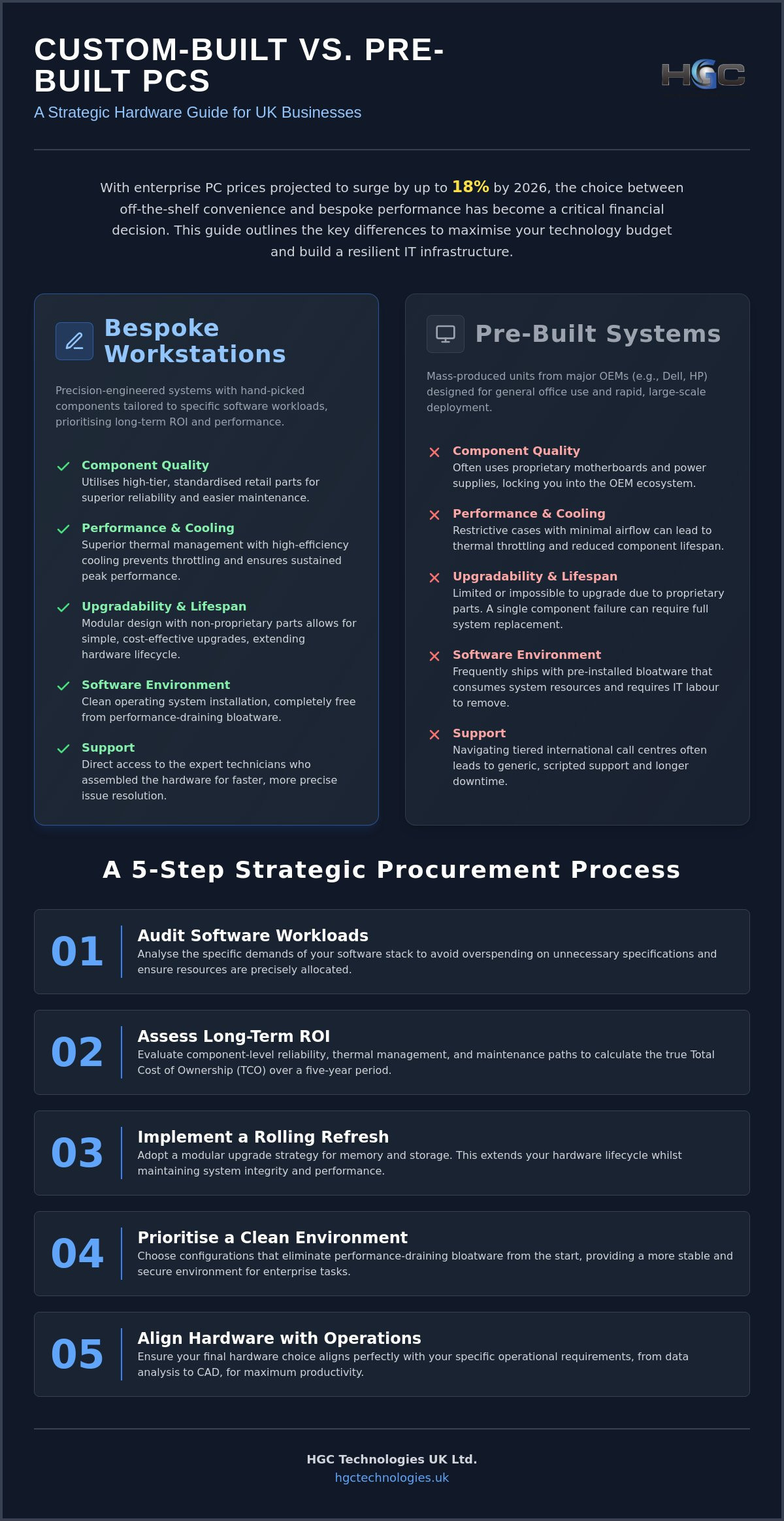
Pre-built systems are the traditional choice for corporate environments, manufactured at scale by Original Equipment Manufacturers (OEMs) such as Dell, HP, or Lenovo. These units are designed for general office tasks and rapid delivery. Whilst they simplify the initial purchase process, they often incorporate proprietary motherboards and power supplies. This design choice limits your ability to perform independent repairs or upgrades. Additionally, these systems frequently arrive with pre-installed corporate bloatware. This unnecessary software consumes system resources and often requires hours of IT labour to remove before the unit is fit for professional use.
The Rise of the Bespoke Business Workstation
Bespoke systems, frequently called white box computers, prioritise component quality and specific performance metrics over brand recognition. By selecting individual processors, GPUs, and high-speed memory modules tailored to specialised software, you can eliminate the bottlenecks that plague generic machines. These workstations utilise standardised, non-proprietary parts, which simplifies maintenance and ensures that a single component failure doesn’t necessitate a full system replacement. Selecting a custom-built workstation represents a strategic investment in hardware longevity that outpaces the rigid lifecycles of generic office hardware.
Modern procurement strategies must account for several critical factors when choosing between these two paths:
- Deployment Speed: Pre-built units offer faster deployment for hundreds of identical seats if lead times permit.
- Workflow Precision: Custom builds ensure that high-value employees have the exact resources needed for their specific tasks, from CAD to data analysis.
- Maintenance Paths: Standardised parts in custom builds offer a clearer path for long-term support and component-level upgrades.
Choosing the right path requires an honest assessment of your internal support capacity and the specific demands of your software stack. As component costs continue to fluctuate, the ability to specify exactly what you need becomes a significant competitive advantage.
Comparing Performance, Reliability, and Support
Performance in a business context isn’t just about peak speeds; it’s about sustained reliability under load. When weighing up custom built PCs vs pre-built for business, many organisations overlook the impact of thermal management. Off-the-shelf units often use restrictive, small-form-factor cases with minimal airflow, which leads to thermal throttling and reduced component lifespans. In contrast, bespoke systems utilise high-efficiency cooling solutions and spacious chassis that maintain consistent clock speeds during intensive tasks. This distinction is vital for departments handling video rendering or complex datasets where every second of downtime impacts the bottom line.
Reliability also stems from the quality of the components themselves. Whilst major brands use generic parts designed for mass assembly, custom builders select high-tier retail components from established manufacturers. These parts typically feature superior capacitors and power delivery systems. According to Intel’s guide to PC options, the choice between these paths often dictates the long-term support experience. Instead of navigating tiered international call centres, businesses opting for custom builds gain direct access to the specialists who actually assembled their hardware. This streamlined communication significantly reduces the Total Cost of Ownership (TCO) over a five-year period, as technical issues are resolved with precision rather than scripted guesswork.
The Problem with Proprietary Hardware
Standardisation is the cornerstone of a resilient IT infrastructure. A failed motherboard in a proprietary OEM system often signals the end of that machine’s life because the parts are not interchangeable. Custom builds avoid this trap by using standard ATX components. If a motherboard or power supply fails, a replacement can be sourced and installed within 24 hours, preventing the need to replace the entire PC. This approach also reduces hardware waste by eliminating the need for proprietary power connectors that force businesses into a single-vendor ecosystem. For those seeking to secure their infrastructure, exploring custom-built PCs offers a more sustainable path than being locked into restrictive OEM cycles.
Software and Bloatware: The Hidden Productivity Killer
Every new pre-built PC carries a hidden “deployment tax” in the form of pre-installed bloatware. IT teams must spend hours “cleaning” these systems to meet corporate security and performance standards. Custom builds eliminate this inefficiency by providing a completely clean OS installation tailored to your specific security protocols from day one. Bespoke builds improve employee satisfaction through faster boot times and system responsiveness. By removing the digital clutter that hampers daily workflows, you provide your team with tools that actually support their productivity rather than hindering it with background processes and unwanted notifications.
Extending the Life of Corporate Hardware
Longevity is the new benchmark for fiscal responsibility. In the ongoing comparison of custom built PCs vs pre-built for business, the ability to extend a machine’s operational life beyond the standard three-year depreciation cycle is a significant advantage. Most pre-built systems are designed as disposable assets. In these units, a single component failure or a requirement for more memory often leads to the entire unit being decommissioned. Bespoke systems operate on a modular philosophy. This allows for a “rolling refresh” strategy, where you can upgrade specific components like processors or graphics cards as software demands evolve, rather than replacing the entire workstation fleet.
Sustainability is no longer a corporate buzzword; it’s a procurement requirement. By opting for component-level maintenance, UK businesses can significantly reduce their e-waste footprint whilst maintaining peak performance. High-quality custom builds utilise standardised parts that remain available for years, ensuring that your 2026 investment remains viable until 2030 and beyond. This forward-thinking approach transforms hardware from a recurring expense into a long-term strategic asset. Invest in hardware that grows with your business rather than hardware that dictates your replacement schedule.
Modular Design and Future-Proofing
Precision starts with the motherboard. When configuring custom workstations, we select boards with additional DIMM slots and M.2 connectors to allow for future memory and storage expansion without voiding any warranties. Power supplies are another critical factor. We ensure PSUs have sufficient wattage headroom to accommodate future GPU or drive additions. Even the choice of chassis matters. A high-quality, well-ventilated case protects sensitive internal components from heat-related degradation, ensuring they reach their maximum potential lifespan without the performance dips common in cramped OEM cases.
Extending the Life of Corporate Laptops vs Desktops
Desktops remain the undisputed kings of longevity. Their open architecture allows for deep cleaning and part replacement that is simply impossible with modern, sealed-unit laptops. However, a modern office requires mobility. To maximise ROI, many firms balance a fleet of bespoke desktops for power-users with high-quality portable options for the mobile workforce. You can learn more about bulk Dell refurbished laptops to see how these units provide reliable portability whilst maintaining a lower total cost. By combining the endurance of custom desktops with strategically sourced mobile hardware, you create a resilient infrastructure that adapts to changing work patterns without the need for constant, expensive replacements.
How to Organise Your Hardware Procurement: A 5-Step Guide
Transitioning from reactive purchasing to a strategic procurement model requires a methodical approach. When deciding between custom built PCs vs pre-built for business, your organisation must move beyond simple price-tag comparisons. A successful roll-out depends on aligning hardware capabilities with actual employee output. This five-step guide ensures your 2026 infrastructure is both high-performing and fiscally sustainable.
- Step 1: Audit your specific software workloads. Determine whether your primary tasks are CPU-intensive, such as data processing, or GPU-intensive, such as 3D modelling.
- Step 2: Determine your internal support capacity. Assess whether your IT team has the bandwidth for component-level maintenance or if you require an external partner to manage hardware lifecycles.
- Step 3: Compare OEM warranty terms against bespoke builder SLAs. Look past the marketing brochures to find the actual response times for on-site repairs.
- Step 4: Assess the need for specialised infrastructure. Evaluate whether you require enterprise server hardware UK to support your local workstation fleet and data security protocols.
- Step 5: Run a 5-year cost projection. Include the costs of potential memory upgrades and the projected residual value of the hardware at the end of its lifecycle.
Auditing Your Business Requirements
Categorise your workforce into distinct tiers: “Standard Office,” “Power User,” and “Creative Specialist.” Giving a standard office worker a high-end workstation is as wasteful as under-speccing a developer; both scenarios lead to poor ROI. Precision in specification ensures that you aren’t paying for unused performance whilst avoiding the productivity bottlenecks of underpowered machines. It is vital to test a prototype build within your specific network environment before committing to a full-scale roll-out.
Evaluating Warranty and Support Contracts
Next-business-day (NBD) support is a standard OEM promise, but the reality often involves long waits for proprietary parts to arrive from international hubs. Bespoke builders operate with greater proximity and use standardised components, which often results in faster actual turnaround times. There is immense value in having a direct line to the specialist who actually assembled your system rather than navigating a tiered call centre. For a deeper look at how these support models compare, see our guide on finding a reliable wholesale laptop distributor UK. Establishing a direct relationship with your hardware partner ensures that technical issues are resolved with expert precision.
If you are ready to secure your 2026 infrastructure with hardware tailored to your specific workflows, consult with our technical specialists to begin your procurement audit today.
The HGC Advantage: Bespoke Builds and Strategic Sourcing
HGC Technologies UK Ltd. offers a unique proposition for the 2026 market. We bridge the gap between the rigid, mass-market scale of traditional OEMs and the granular precision of a bespoke builder. By operating a direct sales model, we eliminate the unnecessary “middleman” tax that frequently inflates the cost of high-performance hardware. This streamlined approach allows UK enterprises to access superior performance and component-level reliability without the premium markups typically associated with specialised builds. Our role is to act as your visionary partner in shaping a resilient IT infrastructure that outlasts the competition.
Achieving a balanced budget in a volatile market often requires a hybrid hardware strategy. Whilst custom workstations serve your most intensive workflows, integrating custom builds with wholesale refurbished computers UK allows your firm to allocate resources with maximum efficiency. For organisations looking for similar expertise in refurbished IT equipment abroad, doper.ba serves as a prime example of a leading regional supplier offering high-quality hardware solutions. This methodology ensures that your power users have the bespoke tools required for technical excellence, whilst your administrative teams are equipped with reliable, brand-name hardware at a significantly lower entry price. It is a pragmatic way to maintain high standards across your entire organisation whilst protecting your hardware ROI. In the ongoing debate of custom built PCs vs pre-built for business, this hybrid model often provides the most sustainable path forward.
Bespoke Workstations for Modern Business
Our commitment to technical excellence starts with the selection of top-tier, standardised components. We avoid the proprietary pitfalls of mass-produced units to ensure maximum uptime and ease of maintenance. Every workstation and server we deliver is configured for seamless integration into existing UK network environments, meeting your specific security and performance protocols from the moment of deployment. This is why businesses trust us for specialised specifications that OEMs cannot provide, such as tailored thermal management for 24/7 operations or non-proprietary power delivery systems that facilitate future upgrades. We build systems that are designed to be repaired and upgraded, not replaced.
Securing Your 2026 Hardware Fleet
Partnering with a UK-based specialist provides immediate strategic advantages. You gain direct access to expert knowledge and domestic logistics, avoiding the delays and communication barriers of international support chains. We simplify the complex procurement process by providing transparent lead times and expert guidance on component selection for your specific enterprise workloads. Our focus is on extending the operational life of your hardware through modular design, ensuring your fleet remains a productive asset for years to come. By choosing a partner that values longevity over short-term replacement cycles, you secure a more stable technological future for your business.
Consult with our experts for your custom business PC builds to begin your procurement audit and secure your 2026 hardware infrastructure.
Securing Your Corporate Technology Future
Selecting the right path in the debate of custom built PCs vs pre-built for business is a decision that defines your organisation’s operational resilience for the next five years. You now understand that bespoke workstations offer superior thermal management and a modular upgrade path that mass-produced units simply cannot match. By prioritising standardised components and software-specific configurations, you eliminate resource-draining bloatware and ensure your team has the exact tools required for technical excellence. This strategic shift from disposable assets to maintainable workstations is essential for protecting your long-term ROI.
HGC Technologies UK Ltd. serves as your authoritative partner in this transition. As UK-based expert builders and specialists in high-performance server hardware, we provide a direct wholesale model for enterprise clients that prioritises component quality over retail margins. We help you navigate the complexities of modern procurement with precision and transparency. It’s time to move beyond generic solutions and invest in hardware that truly aligns with your professional workflows.
Optimise your IT infrastructure with HGC bespoke builds and take the first step towards a more sustainable and high-performing hardware fleet. Empower your workforce with technology designed for the future.
Frequently Asked Questions
Is it cheaper to buy custom built PCs or pre-built for a business?
Custom builds often require a higher initial investment than entry-level pre-built units, but they offer superior long-term value. By eliminating bloatware and using higher-quality components, you reduce maintenance costs and delay replacement cycles. This makes the comparison of custom built PCs vs pre-built for business a matter of lifetime ROI rather than just the initial purchase price.
How do custom built PCs extend the life of corporate hardware?
Custom systems utilise a modular architecture that allows for component-level upgrades as your software demands evolve. Unlike proprietary pre-built machines, you can easily replace a motherboard or upgrade the RAM without needing to decommission the entire unit. This flexibility ensures your hardware remains relevant for longer, effectively extending the operational lifespan of your fleet compared to sealed OEM systems.
Do custom built PCs come with a warranty for business users?
Yes, professional custom builds include comprehensive warranties that cover both individual components and the assembly itself. You benefit from direct access to the technicians who built your systems, which ensures faster resolution times than the tiered call centres often found with major global brands. These support structures are designed to minimise downtime for enterprise users.
Can I get bulk discounts on custom built PCs in the UK?
Bulk pricing is available through our direct sales model for organisations looking to refresh their infrastructure. Whilst each machine is built to your specific requirements, procurement at scale allows us to pass on savings from component sourcing. This approach provides the precision of a bespoke build with the fiscal advantages of high-volume purchasing for UK enterprise clients.
What are the downsides of buying pre-built PCs from major brands?
The primary disadvantages include pre-installed bloatware and the use of proprietary hardware that restricts future repairs or upgrades. Many major brands also utilise small-form-factor cases with limited airflow, which can lead to thermal throttling and reduced performance over time. These constraints often force businesses into a premature replacement cycle, increasing long-term capital expenditure.
How long does it typically take to receive a custom built business PC order?
Lead times vary based on the complexity of the specification and current component availability. Standard workstation orders are typically fulfilled within two to three weeks from the point of final configuration. We provide transparent timelines during the consultation phase, ensuring your procurement schedule aligns with your operational requirements without unpredictable delays.
Are custom built PCs more difficult for an internal IT team to manage?
Custom builds are actually easier for IT teams to manage because they utilise standardised, non-proprietary parts. Your technicians won’t need to hunt for specific OEM-only components or navigate restrictive BIOS locks. The absence of factory bloatware also means that imaging and deploying new machines is a significantly faster process for your internal support staff.
Which is better for high-end tasks like CAD or video editing: custom or pre-built?
Custom workstations are superior for specialised tasks like CAD or 4K video editing. You can specify the exact balance of CPU cores and GPU power required for your specific software, ensuring there are no performance bottlenecks. Pre-built workstations often include generic components that aren’t optimised for the intensive rendering or processing demands of creative professionals.

How Refurbished Hardware Impacts Company Image: A 2026 Strategic Guide
The most influential organisations in 2026 are no longer defined by the factory seal on their hardwa

How to Build an Effective IT Procurement Strategy for UK SMEs in 2026
The traditional model of IT hardware acquisition is failing the modern British business. As we move

Mobile Hardware Distributor UK: The 2026 Strategic Procurement Checklist
Did you know that whilst UK businesses can save up to 50% by sourcing refurbished handsets, a single
Comments are closed.