
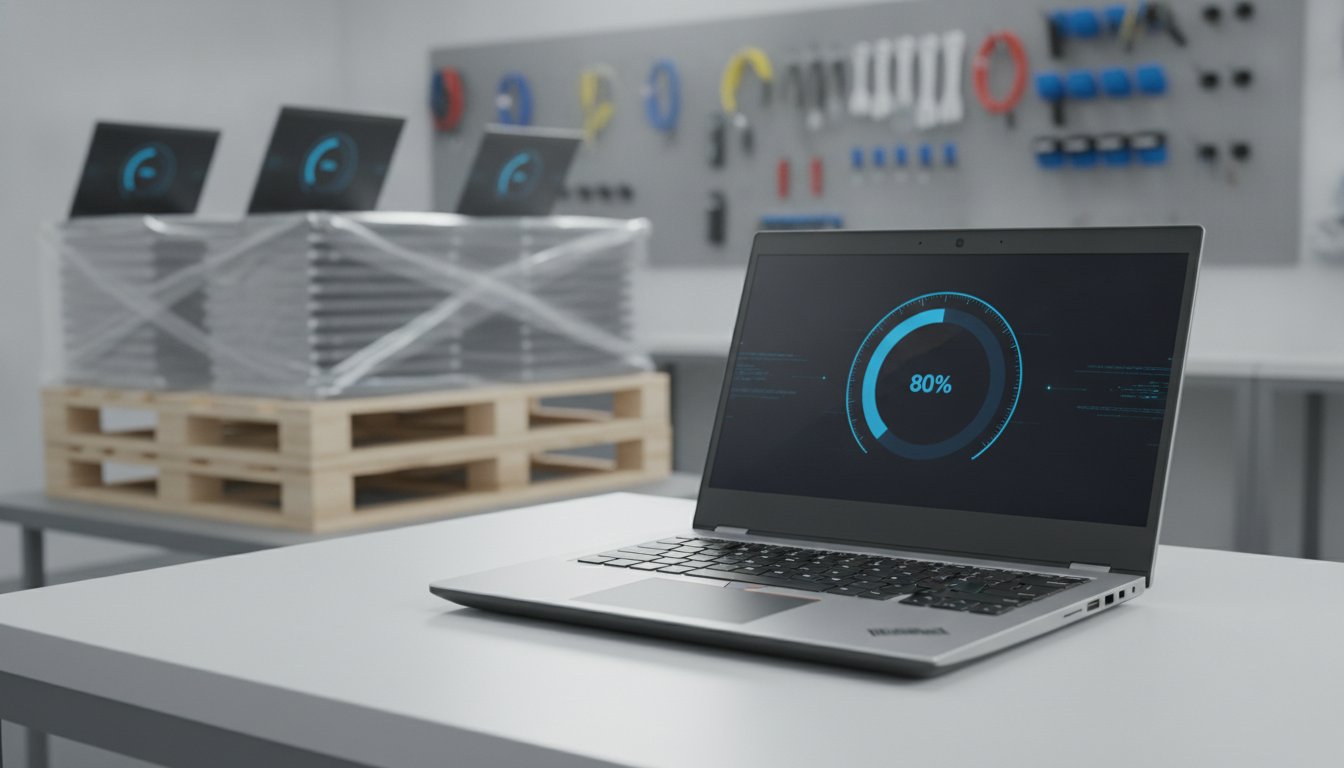
Refurbished Laptop Battery Life: 2026 Procurement Guide
A refurbished laptop with 80% battery health is not a compromise; it is the strategic sweet spot for 2026 corporate procurement. Whilst many IT directors fear the “bulk batch lottery,” where inconsistent performance leads to unexpected replacement costs, the reality is that professional grading has matured into a precise science. Understanding the realistic battery life expectations for refurbished laptops is now the primary differentiator between a high-ROI hardware refresh and a logistical headache. You likely recognise the frustration of explaining to end-users why a “renewed” device might not last a full eight-hour shift, or the sting of discovering hidden costs when batteries fail just months after purchase.
Planning a school laptop order? Battery-health percentage does not guarantee a full school day of runtime. Agree the minimum capacity, test workload and charging arrangements for your classroom or staff fleet before ordering. Our school and college refurbished laptop supply page explains how to request a batch quote with your battery, specification and delivery requirements.
This guide provides a definitive framework for evaluating battery health in bulk orders of Dell, HP, and Lenovo units. You will master the technical benchmarks that separate Grade A hardware from inferior alternatives, ensuring your organisation benefits from the latest 2026 EU Right to Repair standards. We will break down the crucial difference between health and runtime, provide a methodology for verifying capacity reports, and show you how to secure predictable hardware lifecycles that protect your bottom line and support your sustainability goals.
Key Takeaways
- Differentiate between battery health and battery life to manage end-user performance expectations effectively across your organisation.
- Identify why the 80% health benchmark remains the gold standard for Grade A units, ensuring your bulk orders meet professional corporate requirements.
- Master the “Powercfg” verification method to audit battery cycle counts and design capacity across large batches of Dell, HP, or Lenovo hardware.
- Evaluate the specific battery architectures of leading brands to select the most modular and maintainable systems for your hardware lifecycle.
- Secure predictable ROI and meet battery life expectations for refurbished laptops by aligning your procurement with professional grading standards.
Understanding Battery Health vs Battery Life in Refurbished Laptops
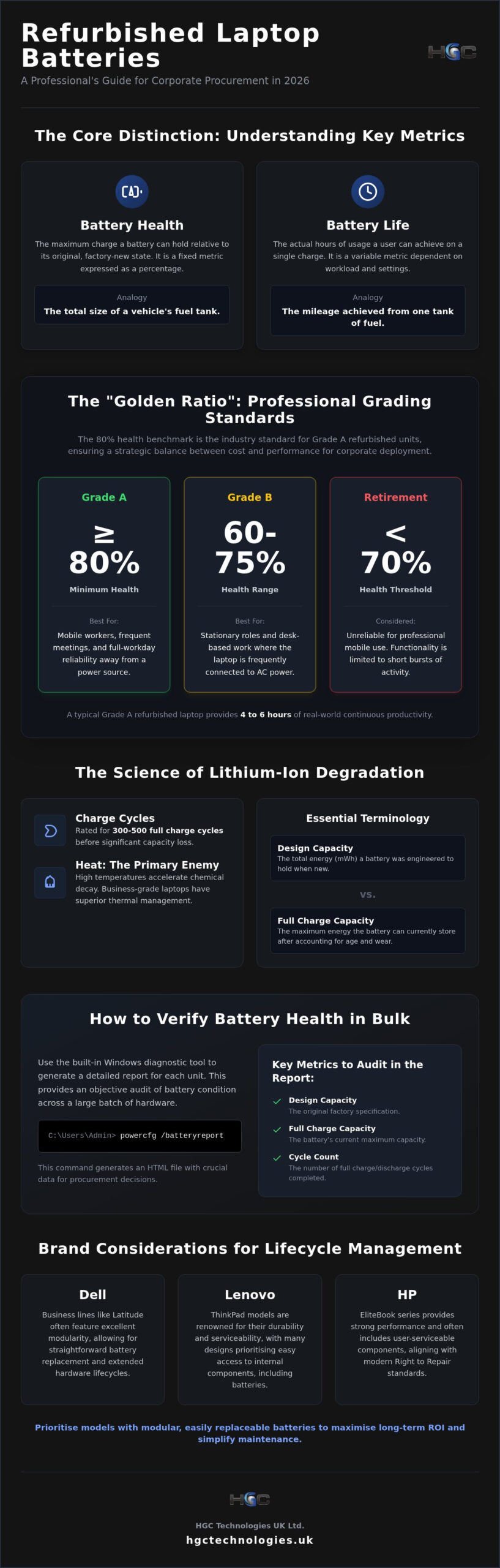
Procuring hardware at scale requires a clear distinction between technical capacity and real-world runtime. Battery health refers to the maximum charge a battery can currently hold relative to its original factory state, expressed as a percentage. In contrast, battery life represents the actual hours of usage an employee achieves on a single charge under specific conditions. Managing battery life expectations for refurbished laptops begins with understanding that whilst health is a fixed metric, life is variable and depends on software loads, screen brightness, and background processes.
IT departments must view the Lithium-ion battery as a consumable component within the hardware lifecycle. Much like vehicle tyres, these cells have a finite lifespan determined more by usage patterns than chronological age. A three-year-old Dell Latitude that spent its life docked in an office may have a healthier battery than a one-year-old consumer unit that underwent daily deep-discharge cycles.
The Science of Lithium-Ion Degradation
Chemical exhaustion is a predictable process. Most professional-grade batteries are rated for 300 to 500 full charge cycles before their capacity begins to drop significantly. A cycle is defined as a cumulative discharge equivalent to 100% of the battery’s capacity; it doesn’t necessarily happen in a single sitting. Business laptops often maintain better health because they include advanced thermal management systems. Heat is the primary enemy of lithium-ion stability; by keeping internal temperatures lower, corporate machines preserve their Design Capacity far better than thin-and-light consumer alternatives.
Why “Used” Does Not Mean “Useless”
Modern power management firmware has revolutionised battery longevity. Intelligent charging profiles now prevent cells from remaining at high voltage levels for extended periods, which effectively extends their professional utility to three or five years. A refurbished unit with 80% battery health still offers substantial runtime for the average office worker; it’s a far cry from a “spent” battery that requires constant AC power. Design Capacity represents the total energy a battery was engineered to hold at the factory, whereas Full Charge Capacity is the maximum amount of energy the battery can currently store after accounting for chemical wear. By focusing on these metrics during procurement, you ensure that your fleet remains mobile without the immediate cost of replacement parts.
What are the Realistic Battery Life Expectations in 2026?
In 2026, the industry standard for Grade A refurbished units has solidified at 80% battery health. This “Golden Ratio” ensures that devices remain functional for a standard workday whilst maintaining a cost-effective procurement price. Whilst the Best Battery Life Laptops on the new market might boast 15 or 20 hours of runtime, realistic battery life expectations for refurbished laptops in a corporate setting typically range between 4 and 6 hours of continuous productivity. This benchmark provides the necessary mobility for meetings and commuting without the premium price tag of a factory-fresh unit.
The 70% threshold is another critical marker for procurement officers to monitor. Once capacity dips below this level, the battery is nearing its professional retirement. It remains functional for short bursts or desk-based work, but it lacks the reliability required for truly mobile workers. Thankfully, Windows 11 and the emerging features of Windows 12 have introduced sophisticated power efficiency modes. These operating systems manage background processes more aggressively than their predecessors, which effectively stretches the runtime of older cells beyond their raw hardware capacity.
The Grade A Benchmark for Resellers
For those sourcing wholesale refurbished IT equipment UK wide, battery consistency is non-negotiable. Grade A units prioritise the 80% minimum health standard to protect reseller margins and reduce return rates. Grade B units often fall into the 60% to 75% health range. These are suitable for stationary desk work where the laptop is frequently plugged in, but they are risky for field teams. There is a strong correlation between aesthetic grading and internal health; well-maintained chassis often house batteries that haven’t been subjected to extreme heat or neglect.
Environmental Factors Affecting Daily Runtime
Screen brightness remains the primary drain on any portable system. Even a high-health battery will struggle if the display is constantly at 100% brightness or if the Wi-Fi is searching for a weak signal. Modern Standby in newer Dell and Lenovo models helps preserve charge whilst idle, but intensive tasks like video conferencing via Teams or Zoom will accelerate depletion. To ensure your fleet meets these battery life expectations for refurbished laptops, it’s vital to educate end-users on power-saving behaviours. If you require hardware that meets these rigorous standards, you can view current laptop configurations and stock to secure reliable stock.
Brand Comparison: Dell, Lenovo, and HP Battery Longevity
Selecting the right brand for your fleet involves more than just comparing processor speeds. The internal architecture of a laptop dictates how effectively it manages heat, which is the primary driver of cell degradation. Dell, Lenovo, and HP each approach battery management with different engineering philosophies. Understanding these nuances helps procurement officers set realistic battery life expectations for refurbished laptops across diverse hardware estates. Whilst all three brands adhere to high corporate standards, their specific battery technologies offer distinct advantages for long-term reliability and maintenance.
Dell Refurbished Laptops: Reliability and Sourcing
Dell has long been a staple of the British corporate landscape due to its modular design philosophy. This makes bulk Dell refurbished laptops a preferred choice for UK schools and offices that value repairability. The Latitude 7000 series, in particular, utilises high-density cells that support ExpressCharge technology, allowing batteries to reach 80% capacity in about an hour. From a management perspective, the Dell Command | Power Manager tool provides granular health oversight. It allows IT teams to cap charging at 80% or 90%, a strategy that significantly extends the lifespan of the hardware by reducing chemical stress on the lithium-ion cells.
Lenovo ThinkPad: The Reseller’s Favourite
Lenovo ThinkPads are legendary for their durability and technical sophistication. Resellers often prioritise bulk Lenovo refurbished laptops because they maintain their value amongst power users. Older T-series models featured the “Power Bridge” system, which combined an internal battery with a hot-swappable external one. Modern units like the X1 Carbon have moved to integrated designs, but they compensate with superior carbon fibre heat dissipation. If you are wondering How Long do They Last?, the answer often lies in the software. Lenovo Vantage allows users to recalibrate the battery gauge, which can fix “stuck” percentages and provide a more accurate reading of the remaining runtime.
HP EliteBooks offer a compelling middle ground with their “Long Life” battery cycles. HP engineers these batteries to last up to three years or 1,000 cycles, which is double the industry average for consumer-grade units. This longevity is supported by BIOS-level health monitoring that can alert users to impending failure before it impacts productivity. When managing battery life expectations for refurbished laptops, the EliteBook’s ability to maintain a consistent discharge curve makes it a reliable workhorse for mobile professionals who cannot always be near a UK power outlet. Each of these brands offers a pathway to sustainable, high-performance computing when sourced through a professional wholesale partner.
How to Verify Battery Health for Bulk Procurement
Verification is the final safeguard against inconsistent hardware performance. Whilst a supplier may claim Grade A status, professional procurement requires empirical evidence to guarantee that battery life expectations for refurbished laptops align with your operational needs. Relying on the visual appearance of a chassis is insufficient; you must audit the internal chemistry of the cells. For bulk orders, this involves a systematic approach to data extraction that moves beyond simple BIOS checks into detailed capacity reporting.
Wholesale distributors who specialise in high-volume supply chains utilise automated scripts to verify hundreds of units simultaneously. This process identifies “ghost charges,” where a battery appears full but lacks the chemical stability to sustain a load. By auditing these metrics before deployment, you eliminate the logistical burden of early-life failures and protect your organisation’s hardware ROI. If you are looking to secure a fleet that has already undergone this rigorous vetting, you can browse our current laptop inventory to find pre-tested Dell, HP, and Lenovo units.
Generating and Reading a Windows Battery Report
The most reliable method for individual unit verification is the native Windows “Powercfg” tool. To generate a report, open the Command Prompt and type powercfg /batteryreport. This command produces an HTML file that details the battery’s entire lifecycle. To calculate the health percentage, divide the Full Charge Capacity by the Design Capacity and multiply by 100. Analysing the “Battery Capacity History” section is particularly useful for spotting rapid degradation trends that might not be obvious from a single snapshot of the current charge level.
Third-Party Tools for Enterprise Management
For managed fleets, BIOS-level diagnostics provide a quick pre-boot health status, often categorising batteries as “Excellent,” “Fair,” or “Poor.” However, enterprise software solutions allow for ongoing monitoring across thousands of devices, alerting IT managers when a unit’s health drops below the 70% threshold. Cycle counts are often more important than the manufacture date because a five-year-old battery with 50 cycles will typically outperform a two-year-old unit with 600 cycles. By prioritising low cycle counts during your procurement audit, you ensure that your battery life expectations for refurbished laptops are based on actual usage rather than chronological age. This data-driven approach allows for more accurate hardware lifecycle planning and reduces the frequency of emergency battery replacements.
Maximising ROI with HGC Technologies UK Ltd. Wholesale Solutions
HGC Technologies UK Ltd. stands at the intersection of quality and scale. Sourcing from a professional wholesale laptop distributor UK partner is the most effective way to mitigate the risks associated with bulk hardware refreshes. Whilst the technical benchmarks discussed in previous sections provide a framework for evaluation, the actual reliability of your fleet depends on the integrity of the supply chain. HGC Technologies UK Ltd. eliminates the variability often found in the secondary market by treating battery health as a non-negotiable grading pillar. Every unit undergoes rigorous testing to ensure it meets corporate-ready standards, allowing you to deploy hardware with absolute confidence.
The commitment of HGC Technologies UK Ltd. to Grade A standards prioritises consistency across entire batches. By focusing on original components and verified capacity reports, we help organisations meet their battery life expectations for refurbished laptops without the overhead of post-purchase repairs. This approach doesn’t just protect your budget; it supports the circular economy by extending the functional life of premium Dell, HP, and Lenovo systems. High-performance computing shouldn’t come at the cost of sustainability, and the wholesale model at HGC Technologies UK Ltd. proves that these goals are mutually inclusive.
Predictable Quality for Resellers
Resellers face a unique challenge: protecting thin margins against the cost of returns. HGC Technologies UK Ltd. reduces “Dead on Arrival” (DOA) rates through comprehensive battery stress testing that simulates real-world usage before the stock ever leaves the facility. This rigorous vetting process ensures that the battery life expectations for refurbished laptops your clients hold are consistently met. Accessing premium ex-corporate stock from HGC Technologies UK Ltd. gives you a strategic advantage, providing hardware that is aesthetically superior and internally robust. The direct wholesale model ensures you receive high-quality original components, protecting your reputation as a reliable hardware provider.
Strategic Procurement for 2026
Planning a hardware refresh for the 2026 landscape requires a forward-thinking partner. As legislation like the EU Right to Repair shifts the market towards more maintainable devices, HGC Technologies UK Ltd. is already ahead of the curve by prioritising models with modular battery architectures. This allows you to plan your hardware lifecycle around proven battery endurance, ensuring a predictable ROI for years to come. Whether you need a standard Grade A batch or have specific requirements for minimum health percentages, the team at HGC Technologies UK Ltd. can customise orders to fit your technical needs. Secure your next batch of high-health hardware and contact HGC Technologies UK Ltd. today to discuss your requirements.
Strategic Procurement for a Mobile Workforce
Mastering the technical nuances of battery health transforms refurbished procurement from a gamble into a calculated strategic advantage. By distinguishing between raw capacity and real-world runtime, you can effectively manage battery life expectations for refurbished laptops across your entire organisation. The integration of rigorous verification methods and brand-specific knowledge ensures that your mobile workforce remains productive without the frequent interruptions caused by failing hardware or inconsistent power performance.
HGC Technologies UK Ltd. provides the authoritative expertise and high-standard inventory required to execute these 2026 procurement strategies at scale. As a UK-based Grade A specialist, we offer a direct wholesale model that prioritises original components and transparent health metrics for Dell, HP, and Lenovo systems, all without hidden financing fees. By choosing a partner dedicated to technical excellence and the circular economy, you secure predictable hardware lifecycles and a superior return on investment. View our bulk refurbished laptop inventory and secure your 2026 fleet. We are ready to help you build a more resilient and sustainable IT estate.
Frequently Asked Questions
What is a good battery health percentage for a refurbished laptop?
A health percentage of 80% or higher is considered excellent for a refurbished unit. This ensures the device meets the battery life expectations for refurbished laptops required for professional environments. Whilst a new battery holds 100% of its design capacity, an 80% threshold provides the necessary balance between cost and performance for corporate fleets. Units falling below 70% are typically relegated to desk-based roles where AC power is readily available.
How many hours should a refurbished Dell Latitude battery last?
You should expect a refurbished Dell Latitude to provide between 4 and 6 hours of runtime under standard office workloads. This benchmark applies specifically to the 7000 series ultrabooks equipped with high-density cells. Intensive tasks like video conferencing or high screen brightness will reduce this figure. Establishing these clear battery life expectations for refurbished laptops helps IT managers plan for mobile staff who require reliable performance during travel or meetings.
Can I replace the battery in a refurbished laptop if it fails?
Yes, replacing the battery in a refurbished business laptop is a straightforward process due to their modular design. Brands like Dell and HP prioritise repairability, which aligns with the 2026 EU Right to Repair legislation. Sourcing original replacement components through a professional distributor ensures that the laptop remains in service for several more years. This modularity is a key advantage of ex-corporate hardware over consumer-grade alternatives that often use glued-in cells.
Does a higher cycle count always mean a worse battery?
A higher cycle count is a strong indicator of wear, but it isn’t the only factor to consider. A battery with 400 cycles that was kept in a cool environment may outperform one with 200 cycles that was subjected to extreme heat. However, for bulk procurement, low cycle counts are generally preferred as they suggest less chemical exhaustion. Always check the cycle count alongside the full charge capacity to get a complete health profile.
Is battery health covered under a refurbished laptop warranty?
Warranty coverage for batteries varies by supplier, as they are technically consumable components. Reputable wholesale partners usually guarantee that a battery will hold a specific minimum charge, such as 80%, upon delivery. If a battery fails completely or drops significantly below the graded threshold within the warranty period, it’s typically replaced. Always verify the specific terms regarding consumables before finalising a bulk order to avoid unexpected maintenance costs.
How can I extend the battery life of my refurbished business laptop?
You can extend the lifespan of your battery by capping the maximum charge at 80% using tools like Dell Power Manager or Lenovo Vantage. Avoiding deep discharges below 10% and keeping the laptop away from heat sources also preserves chemical stability. Using the built-in Windows power efficiency modes reduces the strain on the cells during daily tasks. These simple habits help maintain the battery’s health and ensure consistent performance throughout its lifecycle.
Why does my refurbished laptop battery drain faster on Windows 11?
Windows 11 often consumes more power due to increased background telemetry and more demanding visual interface elements. Newer operating systems are designed for modern hardware that has higher base efficiency. If you find your refurbished unit draining quickly, you can mitigate this by enabling “Battery Saver” mode and disabling unnecessary startup applications. Adjusting the power mode to “Best Power Efficiency” in the settings menu will also help stretch the remaining runtime.
What is the difference between a “New” and “Refurbished” battery?
A new battery provides 100% of its original design capacity, whilst a refurbished battery is an original component that has undergone some usage. In a professional refurbishment context, the original high-quality battery is retained if it meets the 80% health benchmark. This is often preferable to using cheap, third-party “new” replacements that lack the safety circuitry and longevity of original Dell, HP, or Lenovo components.

Scalability of Custom-Built Server Solutions: A 2026 Enterprise Guide
What if the hardware designed to fuel your expansion is actually the primary bottleneck stifling you
Custom PC Builder UK: Myth-Busting the Move from OEM to Bespoke Business Hardware
Why are the UK’s most agile enterprises intentionally turning their backs on the global hardware g

How to Configure Server Hardware for UK Business: A 2026 Step-by-Step Guide
Strategic hardware procurement is no longer optional; it's a necessity for survival in a volatile ma