

How to Build a Lasting Relationship With a Hardware Provider
A small business can build a lasting partnership with a hardware provider through consistent communication, reliable commitments and fair collaboration. It doesn’t need to be the provider’s biggest customer. Building a long-term relationship with a hardware provider means sharing clear requirements, raising changes early and following through on agreed actions.
That takes more than placing repeat orders. Dependable supply and clear answers matter, especially when your plans rely on a provider’s decisions. Trust grows when both sides listen, share useful information and address problems directly instead of letting them linger.
This article explains how to choose communication channels, stay connected between orders, build trust through honest conversations and collaborate on growth. Find practical ways to make each interaction purposeful, set shared expectations and create a partnership that can adapt as your business needs change.
Key Takeaways
- Agree how and when to communicate, and share updates early when requirements or plans change.
- Use meaningful milestones to keep in touch between orders, making each message relevant to the relationship.
- Build trust by setting clear expectations, keeping commitments and addressing setbacks honestly.
- Share forecasts and workload plans to help identify opportunities for collaboration and future growth.
1. Choosing preferred communication channels
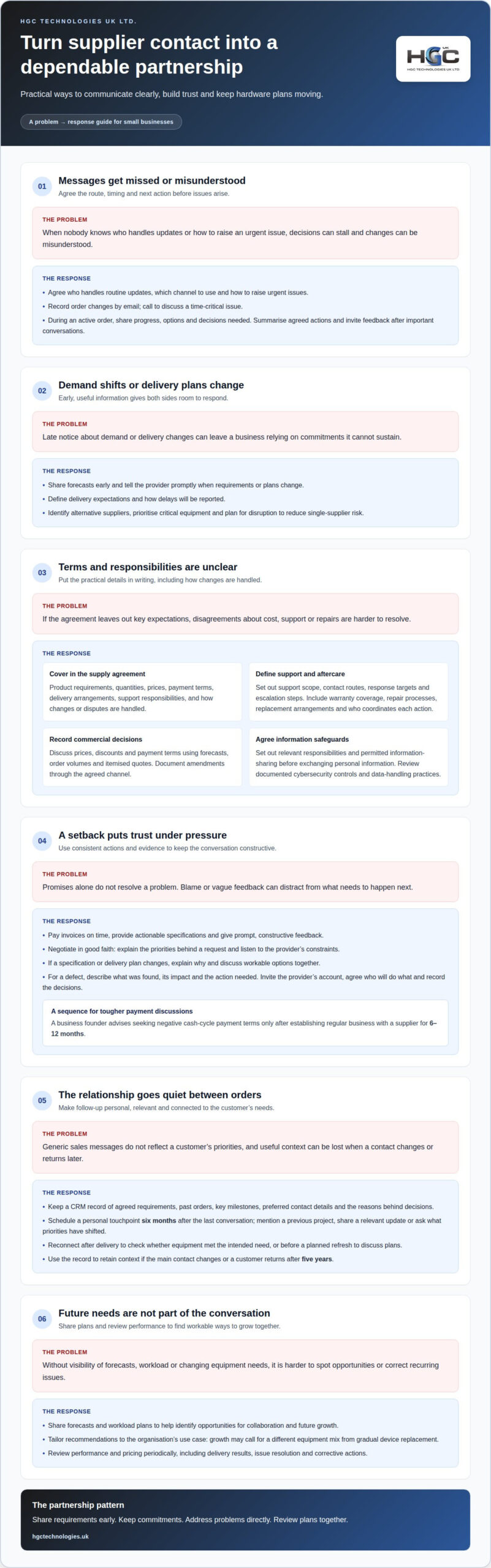
Building a long-term relationship with a hardware provider starts with agreed communication routes and clear expectations. UK businesses can assess a supplier by comparing product fit, delivery capability, support arrangements and communication. Ask who handles routine updates, which channel they prefer and how to raise urgent issues. For example, record order changes by email and call to discuss a time-critical issue.
Keep messages regular and relevant. During an active order, share timely updates about progress, options and decisions needed. If demand changes, tell the provider early rather than making commitments your business can’t sustain. Invite feedback after important conversations and summarise agreed actions so both sides can correct misunderstandings. Make every message useful to the next decision.
A UK hardware supply agreement should cover product requirements, quantities, prices, payment terms, delivery arrangements, support responsibilities and how changes or disputes are handled. Document amendments through the agreed channel. Procurement processes shape approvals, while data protection requirements affect how personal information is handled. Set out relevant responsibilities and permitted information-sharing before exchanging data.
Discuss prices, discounts and payment terms using forecasts, order volumes and itemised quotes, then record the agreed terms. For availability and reliable delivery, share forecasts early and communicate changes promptly. Define delivery expectations and how delays are reported. Specify support scope, contact routes, response targets and escalation steps in any service-level agreement.
Set out warranty coverage, repair processes and replacement arrangements, including who coordinates each action. Assess a provider’s financial stability through appropriate business and payment checks, and review its documented cybersecurity controls and data-handling practices. Reduce single-supplier risk by identifying alternatives, prioritising critical equipment and planning for disruption. Review performance and pricing periodically, discussing delivery results, issue resolution and corrective actions. Listen carefully, summarise concerns and invite specific feedback.
2. Using milestones and personal messages to stay in touch
Useful follow-up reflects the customer’s priorities, not just the last order. Consider different customer needs: a reseller may focus on dependable stock for resale, while an internal IT team may prioritise equipment for planned operations. Tailor each message accordingly. A note about an upcoming refresh is more valuable than a generic sales pitch when a customer is planning infrastructure changes.
Keep a customer relationship management (CRM) record of agreed requirements, past orders, key milestones and preferred contact details. This helps a colleague remember the context if the main contact changes, or if a customer returns after five years. Schedule a personal touchpoint six months after the last conversation, then make it relevant: mention a previous project, share an update connected to their needs or ask what priorities have shifted.
Use milestones as natural reasons to reconnect. After delivery, ask whether the equipment met the intended need; before a planned refresh, invite the customer to discuss their plans. A short, personal message shows that someone has considered the customer’s situation. Thank repeat customers and people who refer others with a thoughtful note or gesture, rather than treating every interaction as another sales opportunity.
Personalisation also means adapting the solution to the organisation’s use case. A business planning for growth might need a different equipment mix from one replacing devices gradually. Record the motivation behind each decision, then use it to shape future conversations and recommendations. That consistency demonstrates commitment over time. If a growth milestone calls for tailored workstation capacity, consider custom-built PCs as part of the next planning conversation.
Lasting relationships depend on understanding what each customer needs, then offering personalised solutions that fit those needs. A CRM tool can keep track of each client’s history and details, helping the business serve them better when they return after five years. The record gives the business a way to retain relevant details and history for that returning customer.
Make appreciation personal, too. Thank repeat clients and customers who refer friends and family with a special offer, a thoughtful gift or a handwritten note. These gestures recognise customers who return or recommend the business to others.
3. Building trust, honesty and respect
Trust grows through observable actions, not promises alone. A smaller buyer can earn a provider’s confidence through credible, consistent conduct, even without being its largest customer. Pay invoices on time, provide actionable specifications and give prompt, constructive feedback. These habits make strong working relationships part of everyday business, not just a claim made during contract discussions.
Negotiate in good faith by explaining the priorities behind a request and listening to the factory’s constraints. If a specification or delivery plan changes, share the reason and discuss workable options together. A business founder advises seeking negative cash-cycle payment terms only after establishing regular business with a supplier for 6-12 months. That sequence gives both parties time to build a record of reliable commitments before discussing more demanding terms.
Quality discussions need evidence and respect. If an inspection identifies a defect, describe what was found, its impact and the action needed. Independent inspection evidence can ground the conversation, but it doesn’t replace a direct discussion with the provider. Invite its account, agree who will do what and record the decisions. This keeps the focus on resolving the issue rather than assigning blame.
Some conversations will be difficult. The Mental Health Foundation advises giving both people time to prepare, then pausing and returning to a conversation if a comment causes upset. State the issue plainly, listen to the response and agree a practical next step. A setback handled openly can support a positive relationship in the coming months; delayed bad news or defensive exchanges can undermine confidence. Both partners control their own actions, so set clear boundaries and follow through on commitments. If repeated problems make the relationship feel wrong, reassess whether it remains workable.
The Mental Health Foundation says healthy relationships should be based on respect, communication, boundaries, honesty and trust, and describes them as something people build rather than find. It also says a healthy relationship requires commitment and willingness to accommodate each other’s needs.
Businesses can strengthen supplier relationships by treating suppliers as partners of choice. Negotiating in good faith, paying suppliers on time, communicating clearly, providing feedback and holding regular business reviews can all help sustain mutual confidence.
4. Collaboration on growth initiatives
Share growth plans early so a supplier can prepare for changing demand. A forecast should explain expected product types, workload and timing, not simply say that orders may increase. For example, a business planning a new team can discuss likely equipment requirements before procurement begins. Agree what the forecast means, how often it will be updated and who owns each change. Clear expectations help the supplier plan and give both parties a practical basis for discussing challenges.
Turn that information into shared planning. Compare forecast demand with current orders, upcoming projects and known constraints. If volumes may rise or fall, tell the supplier promptly and explain why. This gives them a chance to adjust their plans and respond with realistic options. A forecast isn’t a promise to buy; it’s a planning tool that helps partners make informed decisions. Keep updates consistent so the supplier can distinguish a revised estimate from a confirmed commitment.
Look beyond order volume for ways to improve how work gets done. Review the process together and identify avoidable costs, duplicated tasks or changes that could simplify fulfilment. If both sides agree on a saving, decide how to share the benefit and record the expected outcome. Partners can also map tier-two and tier-three suppliers together, identifying dependencies that could affect supply. This makes risk discussions specific and supports practical disruption plans.
Set a small group of relevant KPIs, such as order accuracy, delivery performance or issue resolution, then review results periodically. Quarterly business reviews provide a regular point to discuss progress, challenges and corrective actions. Give each action an owner and due date, then assess the response at the next review. This turns collaboration into a repeatable process that can help retain a valuable partnership as needs evolve. For a forward-looking hardware plan, discuss your next growth initiative.
HGC Technologies UK: Bulk Dell Refurbished Laptops
HGC Technologies UK Ltd. supplies bulk Dell refurbished laptops for businesses and technology resellers planning larger hardware requirements. It also offers bulk Lenovo and HP refurbished laptops for organisations considering these established brands. For projects with specific configuration needs, custom-built PCs are another option.
Make the conversation purposeful by outlining your organisation’s requirements, expected workload and purchasing priorities. This gives you a clear basis for discussing whether bulk refurbished laptops or custom-built PCs fit your plans as they evolve.
For your next business hardware requirement, contact HGC Technologies UK Ltd. to discuss the options.
Make your next supplier conversation count
Give your partnership a practical next step: turn what you’ve learned into a short working brief. Set out the business need, decisions still to make and outcomes that matter. Share it with the people involved in procurement and technical approval so future discussions begin with a common understanding rather than assumptions.
Building a long-term relationship with a hardware provider is an ongoing business choice, shaped by how both sides respond as requirements change. Use your next conversation to explore whether the working approach, communication and product needs align with your plans. A clear brief gives you a grounded starting point and keeps the discussion focused on what your organisation needs next.
For your next hardware requirement, contact HGC Technologies UK Ltd. to start a conversation. Take that first step with a clear view of your priorities and build towards a partnership that can develop alongside your business.
Frequently Asked Questions
What makes a good long-term hardware supplier relationship?
A good relationship makes responsibilities clear and helps both businesses handle change without confusion. For example, agree who can approve a specification change, how that decision is recorded and which contact owns the next action. Keep a shared record of product requirements and decisions so new team members can understand the arrangement and continue the work without relying on informal handovers.
What service-level agreements and support response times should hardware contracts specify?
Specify the support scope, contact routes, response targets and escalation steps in the service-level agreement.

The Hidden Costs of Cheap Refurbished Laptops: A 2026 Procurement Guide
The cheapest invoice in your procurement queue might actually be the most expensive mistake your IT

Sourcing Wholesale Refurbished Laptops in the UK: A Parts-to-Procurement Guide
A refurbished laptop is only as dependable as the checks behind it. When sourcing wholesale refurbis

Original Smartphones Wholesale UK: The 2026 Strategic Procurement Guide
Did you know that whilst the UK smartphone market revenue is hitting $18.1 million in 2026, nearly a