

The Hidden Costs of Cheap Refurbished Laptops: A 2026 Procurement Guide
The cheapest invoice in your procurement queue might actually be the most expensive mistake your IT department makes this year. Whilst a bargain-basement price tag on a bulk order feels like an immediate win for the quarterly budget, the hidden costs of cheap refurbished laptops often manifest as high failure rates and endless troubleshooting tickets. You likely recognise the frustration of deploying a fleet only to find batteries failing within months or hardware struggling to support modern enterprise software requirements. It’s a cycle that drains your technical resources and disrupts team productivity across the board.
We believe that technology procurement should be a strategic advantage rather than a recurring headache. This guide promises to reveal why the lowest initial price tag often leads to the highest long-term expense and how you can identify genuine value in the refurbished market. We’ll examine the critical metrics for achieving a lower total cost of ownership, from rigorous battery testing protocols to ensuring compatibility with 2026 software standards. By the end of this article, you’ll have a clear roadmap for sourcing reliable Dell, Lenovo, and HP hardware that performs for three years and beyond, ensuring your next deployment is both seamless and cost-effective.
Key Takeaways
- Recognise the false economy of low-end hardware, where a small upfront saving often results in significant repair costs and lost productivity.
- Uncover the hidden costs of cheap refurbished laptops by evaluating battery health and storage reliability to ensure long-term hardware performance.
- Reduce the operational burden on your IT department by choosing professionally vetted units that allow for seamless, immediate deployment.
- Master the nuances of hardware grading systems to distinguish between purely aesthetic refurbishments and genuine enterprise-grade quality.
- Secure your fleet’s future by prioritising reliable brands like Dell, HP, and Lenovo from specialist distributors who guarantee consistency across large orders.
Beyond the Sticker Price: Why ‘Cheap’ Can Be Expensive
Procurement decisions often hinge on a single figure: the unit price. Falling into the psychological trap of the lowest price tag is a common pitfall in high-volume IT purchasing. Whilst a low entry point looks excellent on a spreadsheet, the invoice is just the beginning. Understanding the hidden costs of cheap refurbished laptops requires looking beyond the initial transaction and into the long-term operational reality of your business.
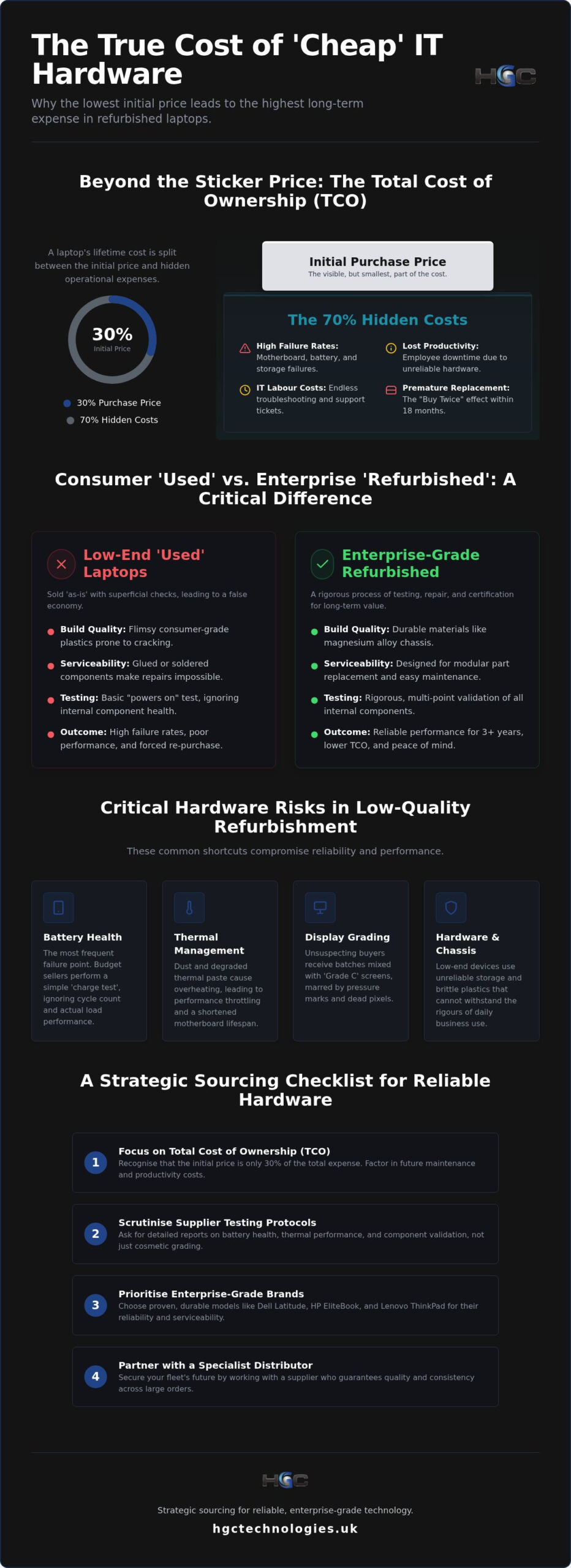
The ‘False Economy’ in IT occurs when a short-term saving creates a long-term liability. For instance, a £150 saving on the purchase price of a laptop can quickly transform into a £500 expense when you factor in replacement batteries, motherboard failures, and emergency onsite support. Industry data suggests that the initial purchase price typically accounts for a mere 30% of a laptop’s total lifetime cost. The remaining 70% is buried in maintenance, software licensing, and the inevitable hardware refreshes that come with low-quality sourcing.
Distinguishing between a ‘used’ device and one that is ‘professionally refurbished’ is critical for risk mitigation. A used laptop is typically sold ‘as-is’ with all its previous wear and tear intact, whereas understanding what ‘refurbished’ means involves a rigorous process of testing, repairing, and certifying hardware to meet specific standards. Professional refurbishment ensures that internal components are vetted for longevity, rather than just being wiped clean and resold.
Consumer vs. Enterprise-Grade Hardware
A refurbished Dell Latitude or Lenovo ThinkPad will consistently outperform a ‘cheap’ new consumer laptop in a professional setting. These enterprise-grade machines are built with magnesium alloy chassis and reinforced hinges, whilst budget consumer models rely on flimsy plastics that crack under the pressure of daily transit. Serviceability is another key differentiator; business brands are designed for modular part replacement, whereas consumer units are often glued or soldered together, making them impossible to repair. Invest in durability to avoid the hidden costs of cheap refurbished laptops that simply cannot withstand the rigours of a 40-hour work week.
The Illusion of Upfront Savings
The ‘Buy Twice’ phenomenon occurs when businesses purchase low-grade hardware that fails prematurely, forcing a second procurement cycle within 18 months. Low-quality components lead to hardware obsolescence long before the software life cycle ends, resulting in a fleet that is technically functional but practically useless for modern workloads. Total Cost of Ownership is the comprehensive calculation of all direct and indirect costs associated with an asset over its entire lifecycle, including acquisition, maintenance, and lost productivity.
Technical Deficiencies: The Hardware Risks of Low-End Refurbishment
Low-cost refurbishers frequently cut corners in areas that are invisible to the casual observer. These technical shortcuts represent the most immediate hidden costs of cheap refurbished laptops. Whilst a device might look pristine on your desk, its internal health determines whether it survives the first six months of a corporate deployment. A laptop that powers on today is not guaranteed to remain stable under the pressure of professional multitasking tomorrow.
Battery health is the most frequent failure point in the secondary market. Budget sellers often perform a simple “charge test” to see if the unit holds power for a few minutes. They ignore the total cycle count and the actual discharge rate under load. When you source enterprise-grade refurbished Dell, HP, and Lenovo laptops, you are investing in hardware that has undergone rigorous power-management validation rather than a superficial check. This prevents the logistical nightmare of replacing dozens of batteries just weeks after a bulk rollout.
Thermal management is another critical, yet often overlooked, hardware risk. Dust accumulation and degraded thermal paste can cause a processor to overheat, leading to aggressive thermal throttling. This kills performance and shortens the lifespan of the motherboard. Similarly, bulk buyers must stay vigilant regarding display grading. It is common to find “Grade C” screens, marred by pressure marks or dead pixels, being sold amongst “Grade A” batches to unsuspecting procurement officers. These defects are more than just aesthetic; they reduce employee comfort and increase eye strain during long shifts.
Battery Longevity and Component Wear
Professional wholesalers adhere to the “80% Capacity” rule, testing actual health cycles rather than just current charge levels. Beyond the battery, mechanical fatigue in keyboards and trackpads often signals a device nearing the end of its functional life. Pay close attention to port reliability; loose USB-C or HDMI ports are clear indicators of poor quality control and heavy previous usage. These small hardware failures eventually lead to significant downtime for your staff.
Software Licensing and Security Vulnerabilities
Security remains a paramount concern for any IT department. Cheap refurbished laptops often ship with “Grey Market” Windows keys that risk sudden deactivation by Microsoft. Outdated BIOS and firmware versions leave your network vulnerable to modern exploits that standard antivirus software cannot catch. Ensure all hardware meets TPM 2.0 requirements to maintain compatibility with Windows 11 and essential future security updates, protecting your company’s data integrity.
The Operational Burden: Hidden Labour and Productivity Costs
The true strain of a sub-standard procurement choice isn’t felt in the accounts office; it’s felt on the IT helpdesk. Whilst the purchase price might look lean, the hidden costs of cheap refurbished laptops manifest as hundreds of billable hours spent on ‘pre-deployment’ repairs. If your IT team is forced to replace components or troubleshoot driver conflicts before a laptop even reaches a staff member’s desk, you haven’t saved money. You’ve simply shifted the expense from the procurement budget to your operational payroll.
Managing inconsistent fleets represents a significant logistical nightmare. Sourcing mismatched units from various bargain suppliers means your IT department must maintain dozens of different driver sets and spare part inventories. This lack of standardisation turns a simple hardware update into a multi-day project. High failure rates also trigger a cycle of return logistics, where the administrative burden and postage fees for faulty units quickly erode any initial savings. Calculating the cost of a senior worker being offline for a full day often reveals that the hardware they were using was a false economy from the start.
IT Department Deployment and Support
Speed of deployment is a critical metric for any growing team. Choosing bulk Dell refurbished laptops allows your technical team to use standardised imaging, deploying software across hundreds of identical units in a fraction of the time. Conversely, cheap batches often contain varying internal components, leading to a massive ‘helpdesk spike’ after rollout. These units require manual configuration and bespoke driver troubleshooting, which prevents your IT staff from focusing on high-value strategic projects.
Employee Productivity and User Experience
Hardware performance is directly linked to staff retention and morale. The ‘Frustration Factor’ of working on slow, unreliable hardware creates a subtle but persistent drain on employee engagement. Frequent connectivity dropouts caused by low-end Wi-Fi cards in budget units can ruin a critical client presentation or internal meeting. Hardware reliability acts as the foundation of employee output; without stable tools, even the most skilled workforce is tethered to the speed of their failing equipment.
How to Evaluate a Refurbished Supplier for Quality
Vetting a supplier is the most effective way to eliminate the hidden costs of cheap refurbished laptops before they enter your supply chain. Many buyers assume that ‘Grade A’ is a universal industry standard; however, it is actually a subjective label that varies wildly amongst vendors. A true professional refurbisher focuses on functional longevity, whilst a low-end reseller might simply focus on cosmetic ‘skinning’ to hide external wear and tear. You must look for partners who prioritise technical integrity over surface-level aesthetics.
Warranty terms also require careful scrutiny during the procurement process. A ‘Return to Base’ (RTB) agreement sounds reassuring on paper, but for a business, it often means losing a device for two weeks whilst it is posted, repaired, and returned. This downtime represents a significant expense that isn’t reflected in the initial quote. High-quality suppliers offer more robust support frameworks that align with corporate operational needs, ensuring that hardware failures don’t lead to prolonged productivity gaps. Furthermore, quality refurbishment supports your ESG goals by extending the lifecycle of premium hardware, reducing e-waste without compromising on performance.
The Refurbishment Checklist
Ask direct questions about the technical process. A reputable partner should provide transparent answers regarding their internal protocols to ensure you aren’t inheriting someone else’s hardware problems. Verify the following before signing a contract:
- Does the supplier use certified data erasure software like Blancco to ensure compliance with NIST SP 800-88 standards?
- Are internal components like fans and heatsinks cleaned and inspected, or is the process purely external?
- What is the specific threshold for battery health? (e.g. a minimum of 80% of original design capacity).
- Is there a defined policy for dead pixels or screen pressure marks that would disqualify a unit from being ‘Grade A’?
Consistency in Bulk Procurement
For large-scale deployments, consistency is non-negotiable. Partnering with a dedicated wholesale laptop distributor UK ensures that your fleet remains uniform, which simplifies part swapping and technical support for your IT department. Auction sites and marketplace sellers often mix different sub-models or regional keyboard layouts within a single order, creating avoidable headaches during rollout. Specialist distributors also offer bespoke configurations, allowing you to upgrade RAM or SSDs to meet 2026 software demands whilst keeping the entire unit under a single, reliable warranty. To secure your business with hardware that meets these rigorous standards, view our latest wholesale inventory.
Strategic Sourcing: Why HGC Technologies Prioritises Reliability
Reliability is the only true currency in professional IT procurement. At HGC Technologies, we reject the industry tendency to prioritise volume over verification. We focus exclusively on enterprise-grade brands like Dell, HP, and Lenovo because these manufacturers design hardware for the rigours of a three to five-year corporate lifecycle. Our refurbishment standard is a technical discipline that goes far beyond the aesthetic ‘Grade A’ label. We ensure that every internal component meets our stringent performance benchmarks before a device ever enters our inventory.
HGC Technologies eliminates the hidden costs of cheap refurbished laptops by applying enterprise-grade standards to every unit we process. We understand that for UK resellers and corporate clients, consistency is the foundation of a successful rollout. Our direct sales model ensures total quality control, allowing us to provide high-volume inventory that matches your specific technical requirements without the variability found on auction sites or secondary marketplaces.
Professional Bulk Supply for UK Business
Success in large-scale deployment requires more than just functional hardware; it requires a partner who understands the operational stakes. We eliminate the friction of deployment through rigorous pre-sale testing and a commitment to Grade A standards. This allows our clients to integrate high-performance units into a wider wholesale refurbished computers UK strategy with absolute confidence. By removing the risk of early hardware failure, we protect your profit margins and your technical reputation amongst your end-users.
Beyond Laptops: Comprehensive IT Solutions
Strategic procurement extends across the entire technical infrastructure. We specialise in configuring enterprise server hardware UK for organisations that require scalable, high-performance data solutions. For mobile workforces, we facilitate the sourcing of original smartphones wholesale UK, ensuring every device meets our uncompromising standards for quality and longevity. We also offer custom-built PCs for specialised workloads, providing a bespoke alternative to off-the-shelf solutions. Establishing a long-term technology partnership with HGC Technologies ensures your business remains resilient, efficient, and free from the false economy of ‘cheap’ hardware buys.
Future-Proofing Your Fleet through Strategic Procurement
Procurement in 2026 requires a transition from reactive purchasing to a focus on long-term resilience. We’ve examined how the hidden costs of cheap refurbished laptops manifest as operational friction, technical vulnerabilities, and lost productivity across your organisation. Selecting enterprise-grade hardware from Dell, Lenovo, or HP isn’t just a preference; it’s a strategic decision to lower your total cost of ownership whilst maintaining peak performance for your workforce.
Choosing a partner that understands these technical nuances is essential for seamless deployment. As a specialist UK wholesaler, HGC Technologies delivers Grade A enterprise hardware through a direct sales model with no middlemen. This ensures you benefit from rigorous quality control and consistent, high-volume inventory across every order, allowing your IT department to focus on growth rather than troubleshooting.
Contact HGC Technologies for a Quote on Bulk Refurbished Laptops and discover the difference that professional refurbishment makes to your bottom line. Investing in quality now ensures your technical infrastructure remains a reliable engine for success for years to come.
Frequently Asked Questions
What are the most common hidden costs when buying cheap refurbished laptops?
The most common hidden costs of cheap refurbished laptops include premature battery failure, storage degradation, and the significant labour expense of IT troubleshooting. Whilst the initial price is low, businesses often face secondary costs from replacing worn components or managing high failure rates within the first year of deployment. These expenses quickly erode any upfront savings and increase the total cost of ownership.
How can I tell if a refurbished laptop is actually enterprise-grade?
Enterprise-grade laptops are identified by their specific model lines, such as Dell Latitude, Lenovo ThinkPad, and HP EliteBook. These machines feature durable chassis materials like magnesium alloy or carbon fibre, rather than the flimsy plastics found in consumer models. They also offer modular designs that allow for easy part replacement and long-term serviceability in a professional environment.
Is a 12-month warranty enough to protect my business from hardware failure?
A 12-month warranty provides a baseline of protection, but the specific terms are more critical for business continuity. You should verify if the warranty is “Return to Base,” which can lead to weeks of employee downtime whilst hardware is in transit. A robust warranty from a specialist wholesaler ensures that hardware issues are resolved without incurring high logistical expenses or prolonged productivity gaps.
Why is battery health such a major concern with refurbished hardware?
Battery health is a primary concern because lithium-ion batteries degrade over time regardless of the device’s cosmetic condition. Many low-end refurbishers only check if a unit holds a charge for a few minutes rather than testing the actual capacity and cycle count. This leads to the hidden costs of cheap refurbished laptops manifesting as a need for expensive replacements shortly after a bulk rollout.
What is the difference between Grade A and Grade B refurbished laptops?
Grade A refurbished laptops are in near-mint cosmetic condition with minimal signs of previous usage. Grade B units feature visible scuffs, scratches, or minor dents that don’t affect performance but are noticeable. For corporate environments where professional appearance is paramount, Grade A remains the standard, whilst Grade B is often utilised for back-office or high-wear industrial settings.
Can refurbished laptops handle modern operating systems like Windows 11?
Refurbished laptops can handle Windows 11 provided they meet specific hardware requirements, such as TPM 2.0 and compatible 8th Generation Intel processors or newer. Professional refurbishers vet their inventory to ensure compatibility with modern 2026 software standards. Sourcing from a specialist ensures your fleet won’t face immediate obsolescence due to operating system updates or security requirements.
How does buying refurbished laptops in bulk benefit my company’s sustainability goals?
Bulk procurement of refurbished hardware supports a circular economy by extending the functional lifecycle of high-quality electronics. This significantly reduces the carbon footprint associated with manufacturing new devices and diverts enterprise-grade technology from landfills. It allows companies to meet their ESG targets whilst equipping their teams with powerful tools that don’t compromise on reliability.
Why should businesses avoid buying refurbished laptops from consumer auction sites?
Consumer auction sites lack the consistency and rigorous testing protocols required for professional IT environments. You risk receiving mismatched models with varying keyboard layouts or internal components, which makes fleet management and imaging impossible. Additionally, these platforms rarely offer certified data erasure or the robust technical support that a dedicated wholesale partner provides for corporate clients.

Refurbished Laptops for NGOs UK: A Strategic 2026 Procurement Resource
With only 8% of UK charities reporting that their technology is well-integrated as of June 2026, the

Custom Built PCs for Business UK: The 2026 Procurement Guide
Settling for standard OEM specifications is a silent tax on your team's productivity. When procuring

How to Order Custom Specification PCs in Bulk: A 2026 Procurement Guide
In 2026, the era of treating bulk PC procurement as a simple commodity purchase is officially over.
Comments are closed.