

Logistics of a Large-Scale Laptop Rollout: A 2026 UK Strategic Guide
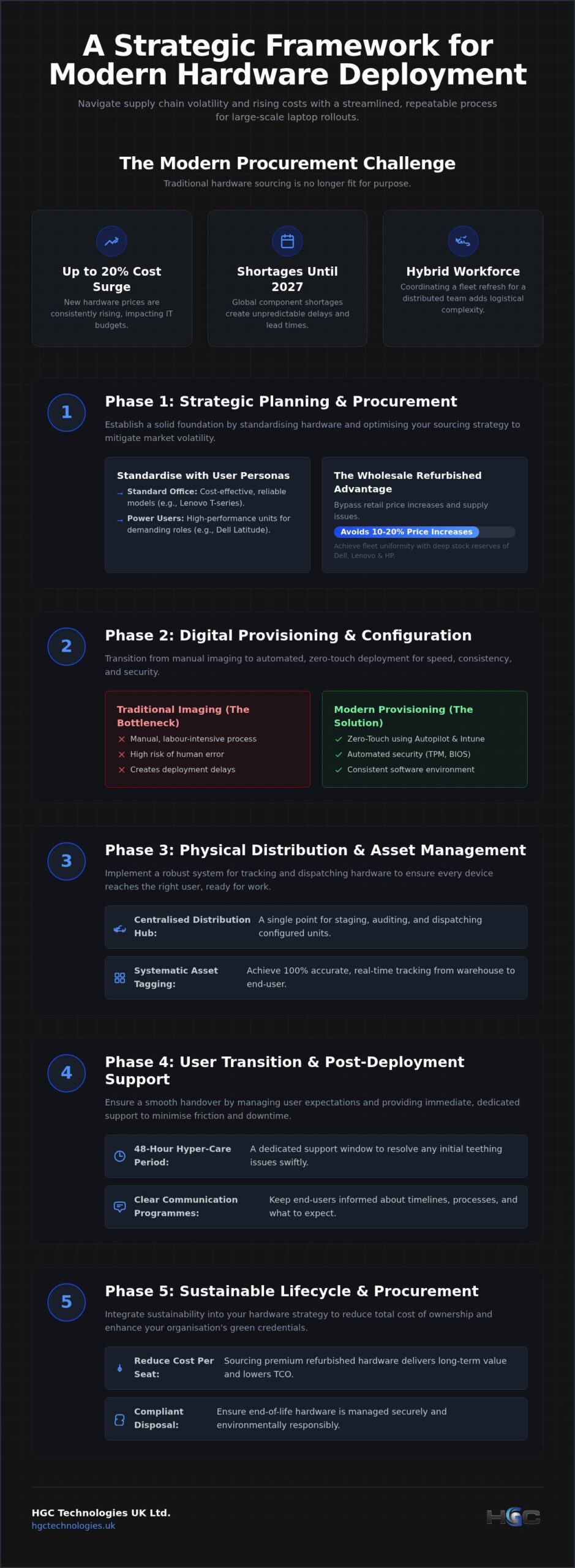
With hardware costs surging by up to 20 percent and global component shortages expected to persist into 2027, the traditional approach to hardware procurement is no longer fit for purpose. You likely recognise that orchestrating a fleet refresh across a hybrid workforce is a complex challenge that often results in spiralling costs, supply chain delays, and frustrated end-users. Managing the logistics of a large-scale laptop rollout requires more than just a purchase order; it demands a synchronised strategy that addresses procurement, digital provisioning, and physical distribution simultaneously.
This strategic guide provides a repeatable framework to master these complexities, helping you reduce your cost per seat whilst ensuring minimal downtime for your team. We will explore how to transition from manual imaging to automated provisioning and how to leverage wholesale partnerships to bypass market volatility. By the end of this article, you will understand how to maintain accurate asset tracking from the moment a device leaves the warehouse until its eventual compliant disposal. Prepare to transform your deployment process into a streamlined, professional operation that delivers long-term value to your organisation.
Key Takeaways
- Define hardware standards through user personas to simplify maintenance and ensure model consistency across your entire organisation.
- Optimise the logistics of a large-scale laptop rollout by adopting cloud-based, zero-touch provisioning tools like Microsoft Autopilot.
- Implement a centralised distribution and asset tagging system to achieve accurate tracking and streamline the physical dispatch of configured units.
- Establish a dedicated 48-hour hyper-care period and clear communication programmes to minimise end-user friction during the transition.
- Enhance your sustainability credentials and reduce cost per seat by sourcing premium refurbished hardware from leading brands like Dell and Lenovo.
Phase 1: Strategic Planning and Procurement Logistics
Standardisation is the bedrock of a successful deployment. Without it, your IT department faces a fragmented ecosystem of disparate drivers, proprietary chargers, and inconsistent performance levels. Defining hardware standards based on user personas ensures that every employee has the tools they need without overspending on unnecessary specifications. A “Standard Office” persona might thrive on a refurbished Lenovo T-series, whilst “Power Users” in data-heavy roles require the enhanced processing power of a Dell Latitude or HP EliteBook. This categorisation prevents the common pitfall of over-speccing the entire fleet to satisfy a minority of users.
Model consistency simplifies the entire logistics of a large-scale laptop rollout. It allows your technical team to maintain a single configuration profile, reducing the risk of driver conflicts and hardware failures. When assessing your budget, look beyond the initial procurement price to the Total Cost of Ownership (TCO). This calculation must include the long-term expenses of maintenance, energy consumption, and eventual disposal. Aligning your rollout with quieter business cycles, such as outside of financial year-end or peak holiday periods, ensures that your internal teams aren’t overwhelmed by simultaneous operational demands. History shows that even the most ambitious projects, such as the One Laptop per Child initiative, relied heavily on hardware uniformity to manage the complexities of maintenance and global distribution.
Sourcing at Scale: The Wholesale Advantage
Securing hundreds of identical units in a volatile market requires a strategic partner. Partnering with a specialist wholesale laptop distributor UK provides immediate access to deep stock reserves that retail channels simply cannot match. By opting for bulk refurbished Dell, Lenovo, or HP models, organisations can achieve fleet uniformity whilst avoiding the 10 to 20 percent price increases currently impacting new hardware. This wholesale approach ensures that your hardware partner can meet lead times and bulk delivery schedules, preventing the staggered arrivals that often derail rollout timelines.
Inventory Auditing and Quality Assurance
Rigorous quality control is non-negotiable for high-volume orders. Establishing a formal “Inward Goods” inspection process allows you to verify that every unit meets your technical specifications before it moves to the configuration phase. Understanding refurbished laptop grades explained is essential here; it ensures that your expectations for cosmetic and functional performance align with the hardware delivered. Secure temporary storage is also a vital component of the logistics of a large-scale laptop rollout. You must organise a dedicated, climate-controlled space where hardware can be safely staged, audited, and tagged prior to the digital provisioning phase.
Phase 2: Digital Provisioning and Configuration
Traditional imaging has become a liability for the modern enterprise. Whilst it once served as the industry standard, the manual application of a “Golden Image” creates a significant bottleneck in the logistics of a large-scale laptop rollout. Modern provisioning replaces this labour-intensive process with cloud-based tools like Microsoft Autopilot and Intune. These platforms allow for zero-touch deployment, where a device is shipped directly to the end-user and configures itself upon the first login. This shift reduces the burden on your internal IT team and eliminates the risk of human error during the imaging phase.
Security compliance must be baked into the configuration from the outset. Activating the Trusted Platform Module (TPM) and standardising BIOS settings are critical steps, particularly when deploying Windows 11 across a diverse fleet of Dell or Lenovo hardware. Automating the installation of core productivity suites and bespoke business software ensures that every user starts with a consistent, functional environment. A modern device deployment strategy replaces physical intervention with cloud-based intelligence, ensuring that security policies are applied the moment the machine connects to the internet. If you are preparing for a fleet refresh, sourcing bulk refurbished laptops from a reliable partner ensures your hardware is compatible with these advanced automated workflows from the moment of arrival.
The Modern Provisioning Workflow
Success in digital deployment depends on a methodical three-step approach. First, your hardware partner registers the unique hardware IDs with your management portal at the point of procurement. Second, you must assign configuration profiles based on specific department roles, ensuring that a graphic designer receives different software packages than a finance administrator. Finally, you must validate network requirements to ensure a seamless “Out-of-Box Experience” (OOBE). This preparation allows the device to pull down its settings automatically, regardless of the user’s physical location, bypassing the need for an on-site technician.
Security and Connectivity Logistics
Remote and hybrid work models demand robust connectivity from day one. Your provisioning profile should pre-configure VPN clients for secure access and mandate Multi-Factor Authentication (MFA) during the initial login phase to protect corporate data. It is also vital to pre-load the latest security patches and anti-virus definitions amongst the entire fleet. Current cybersecurity standards, such as the Cyber Essentials “Danzell” question set, require high-risk security patches to be applied within 14 days of release. Automating this update cycle ensures that your new assets remain compliant and protected against evolving threats without requiring manual intervention for each individual unit.
Phase 3: Physical Distribution and Asset Management
Precision in movement defines the success of your hardware refresh. Once devices are provisioned, the logistics of a large-scale laptop rollout shift toward secure physical transit and meticulous lifecycle visibility. Centralising your distribution centres allows for a streamlined dispatch process, ensuring that configured units are handled with professional care before they reach the end-user. For high-priority or executive staff, “White Glove” delivery services provide an additional layer of reassurance, offering on-site setup and immediate troubleshooting that minimises disruption at the leadership level.
Visibility remains paramount throughout this physical phase. Developing a robust asset tagging system is essential for both insurance compliance and long-term lifecycle tracking. These physical identifiers must be mirrored in a real-time asset register to prevent the emergence of “Dark IT,” where untracked devices become a security liability and a financial drain. By maintaining a single source of truth for every asset, you ensure that your investment is protected from the moment it leaves the warehouse until its eventual decommissioning.
Hybrid and Remote Distribution Strategies
Organising secure courier transport for a dispersed workforce requires a methodical approach to UK-wide delivery. Your logistics partner must manage the complexities of home-based distribution, including real-time tracking and “Failed Delivery” contingencies. Designing comprehensive “Welcome Packs” is a vital part of this process. These should include clear setup instructions, necessary peripheral accessories, and contact details for the hyper-care support team. This preparation empowers remote employees to become productive immediately, reducing the volume of support tickets during the critical first 48 hours.
Reverse Logistics: Legacy Device Retrieval
Efficiently managing the logistics of a large-scale laptop rollout must include a clear plan for legacy hardware. Coordinating the collection of old devices whilst delivering new units creates a seamless transition for the user and ensures that old assets don’t linger in home offices. Secure data destruction is a non-negotiable legal requirement; ensure all decommissioned hardware undergoes sanitisation according to ADISA standards. Once cleared, evaluate your legacy Dell, Lenovo, or HP gear for resale, recycling, or internal repurposing to maximise the residual value of your IT estate and support your organisation’s sustainability goals.
Phase 4: User Transition and Post-Deployment Support
The final handover of hardware marks the beginning of the most critical phase for user adoption. Establishing a dedicated “Hyper-care” period for the first 48 hours post-rollout ensures that any technical teething issues are resolved before they impact organisational productivity. This intensive support window allows your IT team to focus exclusively on the deployment, providing immediate assistance that builds user confidence in the new equipment. Managing user expectations through clear communication programmes is equally vital; employees should know exactly what to expect from their new device and where to turn if they encounter difficulties.
Empowering users through self-service portals can significantly reduce the burden on your primary helpdesk. These portals should offer guided troubleshooting for common setup issues, such as Wi-Fi configuration, printer mapping, and peripheral synchronisation. Gathering structured user feedback during this phase is essential for refining the logistics of a large-scale laptop rollout in future cycles. By understanding which aspects of the transition were seamless and which caused friction, you can continuously improve your deployment framework. If your organisation requires high-volume hardware to support such a transition, you can source bulk refurbished laptops that offer enterprise-grade reliability whilst maintaining your budget.
The “Day One” User Experience
Organising virtual or in-person “Drop-in” sessions provides a reassuring safety net for employees during their first hours with the new equipment. It is vital that helpdesk staff are fully briefed on the specific hardware being deployed, whether it is a Dell Pro or a Lenovo ThinkPad, to ensure they can provide accurate, hardware-specific advice. Creating short, accessible video tutorials for connecting to docking stations and external monitors can drastically reduce the volume of simple connectivity queries. These resources amongst your internal knowledge base ensure that users have the tools to help themselves from the moment they unbox their device.
Training and Adoption Logistics
Tailoring training sessions to different technical ability levels ensures that no employee feels overwhelmed by the technology shift. Highlighting specific hardware features, such as improved webcam quality for hybrid meetings or extended battery life for mobile working, encourages positive engagement with the new assets. By proactively addressing common “New Device” friction points, such as biometric login setup or keyboard layout variations, you can prevent the initial frustration that often leads to a spike in support tickets. A methodical approach to training ensures that the logistics of a large-scale laptop rollout result in a more capable and technologically confident workforce.
Phase 5: Sustainable Lifecycle and Procurement Strategy
Strategic IT leaders view the hardware lifecycle as a continuous loop rather than a linear path. Mastering the logistics of a large-scale laptop rollout requires a long-term vision that extends far beyond the initial deployment date. With the UK generating approximately 1.6 million tonnes of e-waste annually, integrating sustainability into your procurement roadmap is a commercial and ethical necessity. Planning for the next hardware refresh cycle, typically every three to five years, should begin the moment the current fleet is deployed. This foresight allows you to align future upgrades with evolving technical requirements and budget cycles whilst maintaining a high standard of operational readiness.
Transitioning from transactional purchasing to a strategic partnership with a hardware wholesaler provides the stability needed for ongoing growth. These relationships ensure a consistent supply for new hires and rapid replacements for hardware failures, preventing the productivity gaps caused by retail stock shortages. By leveraging wholesale partnerships, you gain access to a broader range of infrastructure support, including bespoke configurations and high-performance server solutions. This comprehensive approach to procurement ensures that your organisation remains agile, resilient, and prepared for the technological demands of 2026 and beyond.
Why Refurbished Laptops Win at Scale
Refurbished hardware has become the cornerstone of sustainable enterprise growth. Choosing bulk Dell refurbished laptops allows organisations to bypass the 10 to 20 percent price increases currently affecting new OEM equipment. These units help businesses meet rigorous corporate ESG (Environmental, Social, and Governance) targets by extending the life of premium components and reducing the carbon footprint associated with manufacturing new devices. Performance parity is guaranteed; enterprise-grade models from Lenovo and HP are engineered for longevity, ensuring that a professionally refurbished unit delivers the same reliability as a factory-new machine at a fraction of the cost.
Building a Long-term Wholesaler Relationship
Success in the logistics of a large-scale laptop rollout depends on the reliability of your supply chain. Moving toward a strategic hardware partnership allows you to secure priority access to identical models, which is essential for maintaining the fleet consistency discussed in Phase 1. A dedicated wholesaler doesn’t just provide units; they act as a knowledgeable guide through complex market trends and component shortages. This collaboration ensures that your IT estate remains standardised, making future maintenance and driver management significantly more efficient. Whether you’re scaling a remote team or upgrading a central office, a stable hardware partner is your most valuable asset in maintaining a high-performance digital environment.
Building a Resilient Digital Infrastructure for 2026 and Beyond
Success in the modern enterprise depends on a synchronised approach that bridges the gap between digital provisioning and physical supply chains. By adopting automated configuration tools and prioritising model consistency, you eliminate the traditional bottlenecks that often derail fleet refreshes. Integrating sustainability into your procurement roadmap doesn’t just reduce your environmental impact; it secures a cost-effective path to high-performance technology through premium refurbished assets.
Mastering the logistics of a large-scale laptop rollout is a complex undertaking that requires a reliable, expert partner. HGC Technologies UK Ltd. acts as your knowledgeable guide, providing the scale and stability needed to transform your IT estate without the volatility of the retail market. As wholesale specialists in Dell, Lenovo, and HP hardware, we offer national UK delivery and support backed by professional refurbishment to enterprise standards.
Secure your next large-scale rollout with HGC Technologies UK Ltd. and ensure your organisation is equipped to lead in an increasingly competitive landscape. Your journey toward a more efficient, sustainable, and high-performing workforce starts with a single strategic decision today.
Frequently Asked Questions
How long does a large-scale laptop rollout typically take?
A typical rollout takes between four and twelve weeks, depending on the total volume and technical complexity. The initial planning and procurement phase usually requires two to four weeks, whilst digital provisioning and physical distribution occur in subsequent stages. Large-scale projects require sufficient lead time to secure identical hardware models. This structured timeline ensures that every stage, from inward goods inspection to user handover, is executed with precision and minimal operational disruption.
What is the most cost-effective way to source 100+ laptops for a UK business?
Sourcing refurbished enterprise-grade hardware from a specialist wholesaler is the most cost-effective strategy for UK businesses. By opting for bulk Dell, Lenovo, or HP refurbished laptops, organisations can avoid the 10 to 20 percent price increases currently impacting new hardware markets. This approach delivers premium performance whilst significantly reducing the cost per seat. It allows businesses to allocate budget toward other critical areas of the logistics of a large-scale laptop rollout, such as advanced security configuration.
Should we use traditional imaging or modern Autopilot provisioning?
Modern Autopilot provisioning is significantly more efficient than traditional “Golden Imaging” for large deployments. It facilitates a zero-touch experience where devices configure themselves automatically upon the first user login. This method eliminates the manual labour associated with imaging each unit individually and reduces the risk of configuration errors. For businesses managing hybrid teams across the UK, cloud-based provisioning is the only scalable way to maintain security compliance and software consistency amongst a dispersed workforce.
What are the risks of using refurbished laptops for a corporate rollout?
The main risks involve functional reliability and aesthetic consistency if hardware is sourced from unverified retail channels. HGC Technologies UK Ltd. eliminates these concerns by adhering to professional refurbishment standards for all Dell and Lenovo assets. Every device undergoes rigorous testing to ensure it meets enterprise performance requirements. By choosing a partner that specialises in high-volume supply, you ensure that your fleet remains reliable and consistent, avoiding the pitfalls of fragmented hardware sourcing.
How do we manage the logistics of distributing laptops to remote workers?
Managing remote distribution requires a centralised dispatch centre and a secure UK-wide courier network. Devices should be provisioned centrally before being shipped directly to the employee’s home address with a comprehensive “Welcome Pack”. Real-time tracking is essential to maintain visibility throughout the logistics of a large-scale laptop rollout. This proactive approach prevents device loss and ensures that remote staff can become productive immediately without needing to visit a physical office for setup.
What happens to our old laptops after a large-scale hardware refresh?
Legacy hardware must undergo secure data destruction before being resold, repurposed, or recycled. Decommissioned assets are often collected during the delivery of new units to ensure a seamless transition for the user. It is vital to use a licensed carrier that follows ADISA standards for sanitisation to remain compliant with UK GDPR. Professional retrieval prevents old machines from becoming “Dark IT” liabilities whilst supporting corporate sustainability goals through responsible e-waste management.
Is it possible to get consistent hardware models when buying refurbished in bulk?
Achieving model consistency is entirely possible when partnering with a wholesaler that has the capacity for large-volume corporate orders. Specialist distributors maintain deep reserves of specific enterprise lines, such as the Dell Latitude or Lenovo ThinkPad T-series. This uniformity is critical for simplifying driver management and future technical support. By securing identical hardware in bulk, your IT team can maintain a single configuration profile, which drastically reduces the long-term maintenance burden for the entire organisation.

Refurbished IT for the UK Public Sector: 2026 Buying Guide
A refurbished laptop is only good value if it meets the need and stands up to scrutiny after deliver

Wholesale Refurbished Laptops for IT Resellers UK: The 2026 Strategic Procurement Guide
The UK refurbished electronics market reached a staggering £7.6 billion in 2025, proving that susta

Business Continuity with Refurbished Hardware: A 2026 Strategic Guide
Certified refurbished enterprise hardware offers cost savings of up to 70% compared to brand-new uni