

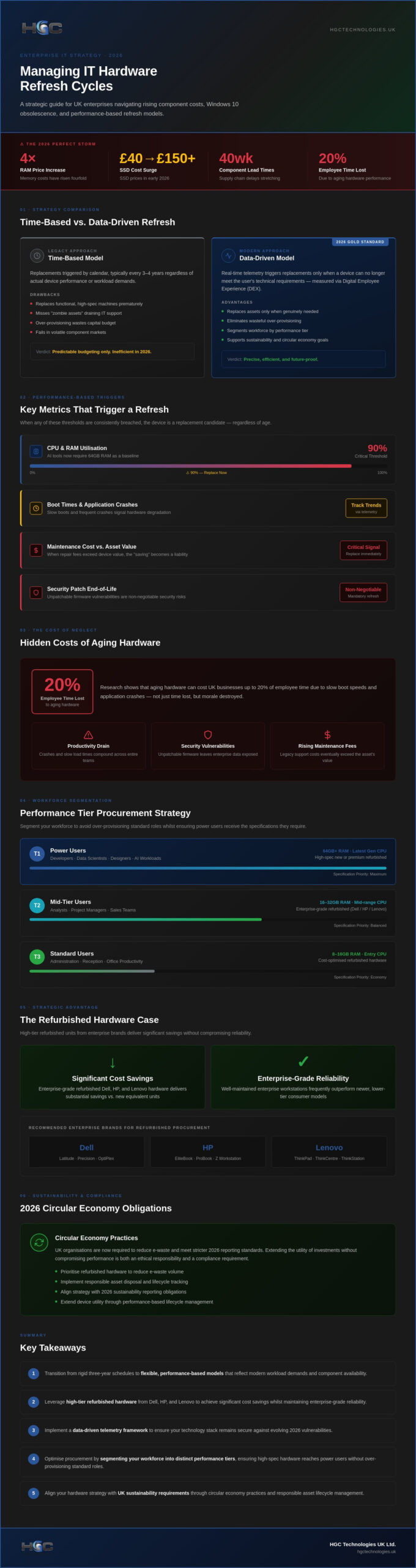
Managing IT Hardware Refresh Cycles: The 2026 UK Strategic Guide
With RAM prices rising fourfold and SSD costs climbing from £40 to over £150 in early 2026, the traditional “set and forget” replacement schedule has officially collapsed. UK IT leaders now face a perfect storm of Windows 10 obsolescence and component lead times stretching to 40 weeks; this leaves many departments trapped between sluggish performance and spiralling procurement costs. Effectively managing IT hardware refresh cycles is no longer a routine maintenance task. It is a high-stakes financial strategy required to safeguard your enterprise against security vulnerabilities and employee burnout.
You’re likely feeling the pressure to do more with less whilst maintaining the premium standards your workforce expects. This guide provides the roadmap to optimise your IT asset lifecycle to reduce costs, improve security, and enhance performance using data-driven refresh strategies. We will explore how to replace rigid timelines with performance-based triggers and high-tier refurbished hardware to ensure a predictable budget, seamless device transitions, and improved sustainability across your entire organisation.
Key Takeaways
- Transition from rigid three-year schedules to flexible, performance-based models that reflect modern workload demands and component availability.
- Leverage high-tier refurbished hardware from Dell, HP, and Lenovo to achieve significant cost savings whilst maintaining enterprise-grade reliability.
- Implement a data-driven framework for managing IT hardware refresh cycles to ensure your technology stack remains secure against evolving 2026 vulnerabilities.
- Optimise procurement by segmenting your workforce into distinct performance tiers, ensuring high-specification hardware reaches power users without over-provisioning for standard roles.
- Align your hardware strategy with UK sustainability requirements through circular economy practices and responsible asset lifecycle management.
The Evolution of IT Hardware Refresh Cycles in 2026
The era of the arbitrary three-year upgrade has officially ended. In 2026, the complexity of modern computing demands a more nuanced approach than the traditional, rigid replacement schedule. Successfully managing IT hardware refresh cycles today requires a data-driven outlook that prioritises actual performance over the date on a calendar. A hardware refresh cycle is the strategic, scheduled replacement of IT assets to maintain operational efficiency. It functions as a critical pillar within the systematic process of developing, operating, maintaining, upgrading, and disposing of assets. UK enterprises are moving away from fixed calendars. They are adopting flexible models that account for the explosive growth of AI-integrated software. These tools often require 64GB of RAM as a baseline, making old 8GB or 16GB machines obsolete almost overnight.
Sustainability has also taken centre stage. UK organisations are now prioritising the circular economy whilst looking for ways to extend the utility of their investments without compromising on speed. Effectively managing IT hardware refresh cycles in this environment requires balancing the need for cutting-edge performance with the ethical responsibility to reduce e-waste and meet stricter 2026 reporting standards.
Why Rigid Timelines Lead to Budget Wastage
Sticking to a strict calendar often results in massive capital leakage. Procurement teams frequently replace perfectly functional, high-specification workstations simply because they’ve reached a pre-set date. This ignores the reality that a well-maintained, enterprise-grade laptop can often outperform a newer, lower-tier consumer model. Conversely, rigid plans often miss “zombie assets.” These are aging devices that haven’t reached their refresh date yet but are already draining IT support resources. Over-provisioning at the start of a cycle to “future-proof” against unknown demands also leads to unnecessary expenditure that could be better allocated to critical server infrastructure.
The True Cost of Hardware Neglect
Ignoring the need for a refresh is equally dangerous. Sluggish devices aren’t just an annoyance; they’re a financial drain. Research indicates that aging hardware can cost UK businesses up to 20% in employee time due to slow boot speeds and application crashes. They don’t just lose time; they lose morale. Security risks represent an even greater threat. There is a direct correlation between aging hardware and unpatchable firmware vulnerabilities. When a device reaches a certain age, manufacturers often stop providing critical security updates. Eventually, the rising maintenance fees for these legacy systems will exceed the actual value of the asset. At that point, the perceived saving of not upgrading becomes a significant liability.
Data-Driven vs. Time-Based: Choosing Your Refresh Strategy
Procurement teams in 2026 are caught between two distinct philosophies. The traditional time-based model is favoured for its fiscal predictability. Many organisations still rely on a standard four-year refresh cycle to align with depreciation schedules and simplify bulk procurement. However, this one-size-fits-all approach often fails in the current climate. With memory costs rising fourfold and component lead times hitting 40 weeks, replacing a perfectly functional machine just because it reached its anniversary is an expensive luxury. Effectively managing IT hardware refresh cycles in a volatile market requires a move toward precision.
Modern enterprises are shifting toward a data-driven approach. This model uses real-time telemetry to trigger replacements only when a device can no longer meet the user’s technical requirements. Success is measured through the Digital Employee Experience (DEX), a metric that quantifies how hardware performance impacts daily productivity. Hybrid strategies are becoming the 2026 gold standard. These combine scheduled bulk buys for standard office staff with targeted, mid-cycle upgrades for high-demand roles. This ensures you aren’t over-spending on low-impact users whilst keeping your power users at peak efficiency.
Key Metrics for Performance-Based Refreshes
To move beyond guesswork, IT departments must track specific telemetry. Monitoring CPU and RAM utilisation trends is vital, especially as AI-driven applications now frequently demand 64GB of memory as a baseline. If a device consistently hits 90% memory usage, it’s a candidate for replacement regardless of its age. You should also track boot times and application crash rates to identify hardware fatigue before it results in a total failure. For mobile workforces, battery health analytics are the primary indicator of utility. Procurement teams often find that sourcing bulk Dell refurbished laptops allows them to replace failing mobile units with Grade A enterprise gear at a fraction of the cost of new consumer models.
Aligning Cycles with Business Objectives
Your hardware strategy must reflect your organisation’s growth trajectory. Scaling hardware to match headcount without over-extending the budget requires a tiered refresh policy. Prioritise high-impact departments like developers or designers for frequent 24-month cycles, whilst extending the lifespan of devices used for administrative tasks. Standardising your equipment across these tiers simplifies support and reduces the technical knowledge gap for your internal teams. If you are looking to refine your procurement process, you can view our latest wholesale inventory to find high-performance hardware that fits your strategic goals.
The Strategic Advantage of Refurbished Hardware in the Refresh Cycle
Procurement leaders are increasingly identifying Grade A refurbished laptops from Dell, HP, and Lenovo as the strategic “hidden gem” of the 2026 market. When managing IT hardware refresh cycles, the choice between brand-new consumer-grade devices and professionally refurbished enterprise workstations is clear. Consumer laptops are often built with planned obsolescence in mind; they use lighter, less durable materials that rarely survive a standard four-year corporate deployment. In contrast, enterprise-grade hardware is engineered for the rigours of constant travel and heavy workloads. Professional wholesalers employ rigorous testing protocols to ensure these machines meet or exceed original performance standards, effectively dismantling the outdated myth that refurbished means it’s unreliable.
Integrating wholesale refurbished IT equipment UK into your strategy also directly supports modern ESG (Environmental, Social, and Governance) targets. It allows firms to scale their infrastructure whilst adhering to circular economy principles. You’re not just saving money; you’re actively reducing the demand for new resource extraction and the energy-intensive manufacturing processes associated with fresh silicon.
Cost-Benefit Analysis: Refurbished vs. New
The financial logic is undeniable. New hardware notoriously loses 40% of its value within the first year of operation. By opting for refurbished units, UK businesses bypass this initial depreciation hit. This shift in spending power allows procurement teams to secure higher specifications, such as Intel Core i7 processors, for the same budget that would otherwise only cover new, mid-tier i5 models. When calculating the Total Cost of Ownership (TCO) over a 4-year period, the savings on capital expenditure can be redirected into critical areas like cybersecurity or custom server builds. It’s a pragmatic way to ensure your team has the best possible tools without over-extending the departmental budget.
Sustainability and the Circular Economy
Prioritising the circular economy is no longer optional for UK firms facing 2026 carbon neutral commitments. Extending the functional life of high-tier silicon is the most effective way to reduce e-waste and demonstrate corporate responsibility. Every device that stays in circulation longer represents a significant environmental victory. A professionally refurbished laptop reduces the total carbon footprint by approximately 80% compared to the production of a brand-new unit. By choosing a “smart refresh” approach, you ensure your organisation meets its performance goals whilst contributing to a more sustainable technology landscape.
Step-by-Step Guide to Implementing a Robust Refresh Policy
Establishing a resilient hardware policy is the only way to insulate your organisation from the supply chain volatility of 2026. Managing IT hardware refresh cycles effectively isn’t just about procurement; it’s about creating a repeatable, logical framework that balances user needs with fiscal reality. A structured approach ensures that you aren’t merely reacting to hardware failures but proactively driving productivity. Follow these five essential steps to build your policy:
- Step 1: Conduct a comprehensive IT asset audit to establish a baseline of every device currently in circulation.
- Step 2: Segment your users based on performance requirements, categorising them into Heavy (power users), Medium (standard office), and Light (task-based) tiers.
- Step 3: Define clear replacement triggers that move beyond simple age. Integrate the performance metrics and warranty status discussed in previous sections.
- Step 4: Partner with a reliable wholesale laptop distributor UK to ensure a consistent supply of enterprise-grade hardware.
- Step 5: Execute the rollout in phases. This approach prevents the IT department from being overwhelmed and ensures business continuity whilst new systems are bedded in.
By following this sequence, you transform a chaotic replacement schedule into a predictable, manageable business process. This discipline is particularly vital when managing IT hardware refresh cycles in larger organisations where “shadow IT”—unauthorised devices purchased outside official channels—can often lead to security gaps and budget leakage.
Conducting the IT Asset Audit
A successful refresh begins with total visibility. Your audit should identify hidden assets that have fallen off the official inventory list. Assess the physical and technical Grade of every unit to determine whether aging assets have resale value or should be earmarked for ethical recycling. High-grade equipment can often be repurposed for “Light” users, extending its lifecycle and improving your ROI. Using this granular data allows procurement teams to predict future budget requirements with high accuracy, avoiding the emergency buys that disrupt cash flow.
Standardising Your Hardware Fleet
Consistency is a force multiplier for IT efficiency. Sticking to a single reputable brand like Lenovo, Dell, or HP simplifies driver management and reduces the complexity of your software image. It also slashes your “spare part” inventory since many components are compatible across specific model ranges within the same brand. Standardisation speeds up the onboarding process for new employees who can move between workstations without a learning curve. If you’re ready to standardise your fleet with high-grade equipment, contact our wholesale procurement team to discuss bulk options for your next refresh phase.
Optimising UK Procurement with HGC Technologies UK
HGC Technologies UK serves as the definitive partner for organisations seeking to master the intricacies of managing IT hardware refresh cycles in a volatile market. We specialise in facilitating bulk refreshes by providing high-tier, Grade A refurbished stock that matches the performance of new units at a significantly reduced capital outlay. Our direct sales model is designed for total transparency. It eliminates the traditional layers of intermediation that often inflate procurement costs for UK resellers and corporate buyers. This direct relationship ensures that you receive the exact specifications required to maintain your competitive edge whilst adhering to the budgetary discipline discussed in previous sections.
We act as more than a supplier; we are a knowledgeable guide through the complex wholesale landscape. By aligning our inventory with your performance-based triggers, we ensure that your hardware transition is both seamless and strategically sound. Our commitment to excellence means that every laptop, PC, and server we provide has undergone rigorous testing to meet the high standards expected by modern UK enterprises.
Bulk Sourcing for Resellers and Large Enterprises
Maintaining consistency across a large-scale rollout is a common challenge for procurement teams. When you’re standardising your fleet to simplify IT support, our inventory of bulk Lenovo refurbished laptops ensures that every user in a specific tier receives identical hardware. This uniformity is vital for driver management and software stability across the organisation. Being a UK-based wholesaler, we offer a logistical advantage that international vendors simply can’t match. We bypass the 40-week component lead times that have plagued the industry in 2026, ensuring your staggered refresh model stays on schedule. Our warehouse operations are geared for rapid national distribution, providing the reliable stock availability needed for phased deployments.
Custom Solutions for Specialised Workloads
Modern enterprise demands often outpace the capabilities of off-the-shelf hardware. When managing IT hardware refresh cycles, it’s essential to consider the backend infrastructure that powers your operations. The strategic selection of enterprise server hardware UK is critical for supporting 2026 data processing and security standards. We provide bespoke server and PC builds, configuring each unit to meet the precise performance needs of specialised departments. Whether you require high-core-count CPUs for server-side processing or custom-built PCs for intensive graphical work, we bridge the gap between generic hardware and specialised utility. This holistic approach extends to mobile connectivity. We integrate original smartphones wholesale UK into your unified refresh plans, ensuring your mobile device management protocols are applied to a modern, secure fleet.
Future-Proofing Your IT Infrastructure for 2026 and Beyond
Mastering the art of managing IT hardware refresh cycles requires a decisive shift from rigid schedules to a more agile, data-driven methodology. By prioritising actual performance metrics over the arbitrary age of an asset, you can ensure that your workforce remains at peak productivity whilst simultaneously reducing unnecessary capital expenditure. This strategic pivot, combined with the integration of high-tier refurbished hardware, allows your organisation to meet its ESG targets without compromising on the reliability or speed your operations demand.
HGC Technologies UK stands ready to support your transition with premium technology solutions. As specialists in Grade A refurbished Dell, Lenovo, and HP hardware, we provide the scale and quality required for national UK distribution and bulk orders. Whether you require bespoke server and PC configurations or a consistent supply of enterprise workstations, our direct sales model ensures transparency and cost-efficiency at every stage of procurement. Optimise your next refresh cycle with HGC Technologies UK – View our bulk refurbished stock. Secure your competitive advantage today by building a technology stack that is as resilient as it is responsible.
Frequently Asked Questions
What is the ideal IT hardware refresh cycle for a UK business in 2026?
The ideal refresh cycle in 2026 is typically three to four years for standard office users, whilst power users and developers often require a shorter two-year cycle. This ensures that hardware keeps pace with the increasing RAM and processing demands of AI-integrated software. Businesses should move away from rigid calendars and use performance telemetry to trigger replacements when devices no longer meet user needs.
Is it better to buy new or refurbished laptops for a company-wide refresh?
Refurbished enterprise-grade laptops often provide superior value compared to new consumer-grade models during a company-wide refresh. High-tier devices from Dell, Lenovo, and HP are engineered for durability and carry a lower total cost of ownership. Choosing Grade A refurbished units allows you to secure higher specifications within your existing budget whilst supporting your organisation’s sustainability goals.
How do I calculate the ROI of a hardware refresh?
You calculate the ROI by subtracting the total cost of investment from the combined value of productivity gains, reduced maintenance fees, and the resale value of old assets. Managing IT hardware refresh cycles with a focus on ROI requires a granular look at how new equipment reduces helpdesk tickets and minimises downtime across the organisation. Improved employee retention and security risk mitigation should also be factored into the final calculation.
What are the security risks of delaying an IT hardware refresh?
Delaying a refresh exposes your organisation to significant security risks, including unpatchable firmware vulnerabilities and a lack of OS security updates for legacy systems. With the official end of support for Windows 10 having passed in late 2025, using older hardware in 2026 creates an expanded attack surface. Modern cyber threats can easily exploit these aging systems, potentially leading to costly data breaches.
Can I refresh my server hardware at the same time as my laptops?
You can certainly refresh your server hardware alongside your laptops to ensure your entire infrastructure is synchronised for peak performance. A holistic refresh prevents backend bottlenecks that might otherwise limit the benefits of high-spec end-user devices. HGC Technologies UK offers bespoke server solutions to help you align your data centre capabilities with your mobile workforce requirements during a unified refresh phase.
How does a hardware refresh impact employee productivity?
A hardware refresh has a direct impact on employee productivity by eliminating the “sluggish device” syndrome that costs UK firms significant time each week. Modern hardware ensures that applications launch instantly and multitasking remains fluid. This reduces employee frustration and allows your team to focus on high-value tasks rather than waiting for systems to respond or dealing with frequent crashes.
What happens to old IT hardware after a refresh cycle is complete?
Old IT hardware should be processed through a circular economy framework involving resale, repurposing for lower-demand roles, or ethical recycling. Many enterprise-grade units still hold significant value after their primary refresh cycle. Professional decommissioning ensures that all data is securely wiped before the hardware enters its second life or is responsibly broken down for materials; you can discover 億鑫鴻景電子 (Yixin Hongjing Electronics) for expert support with electronic component recovery and recycling.
Does HGC Technologies UK offer financing for bulk hardware purchases?
HGC Technologies UK does not offer financing or lease-to-own programmes for bulk hardware purchases. We operate a direct sales model to ensure the most transparent and competitive pricing for our clients. We recommend that businesses speak with their banking partners or independent financial providers to arrange suitable funding for their procurement needs if required.

Reducing Capital Expenditure on Business IT: A 2026 Strategic Guide
40% of firms have already delayed or cancelled vital capital expenditures in 2026 due to the volatil
Refurbished Laptop Battery Life: 2026 Procurement Guide
A refurbished laptop with 80% battery health is not a compromise; it is the strategic sweet spot for

Creating a Business IT Hardware Policy: The 2026 Procurement Checklist
With DRAM and SSD prices climbing by up to 130% in 2026, the era of casual tech spending is over. Yo
Comments are closed.