
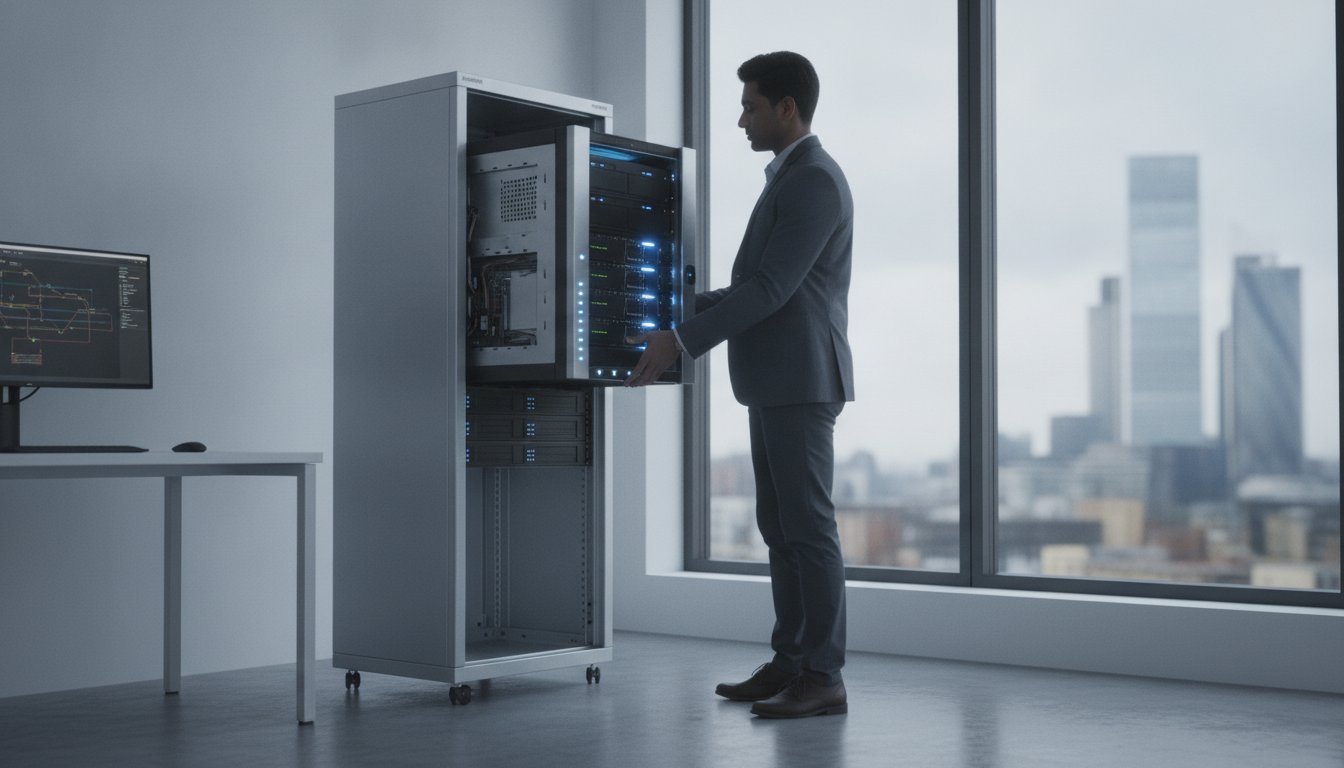
Refurbished Server Setup: 2026 Small Business Guide
The most reliable server for your company’s 2026 expansion isn’t sitting in a manufacturer’s warehouse; it has likely already been proven within a tier-one enterprise data centre. With DRAM contract prices surging by up to 95% in early 2026, the traditional path of buying new hardware has become a significant financial burden for many. You’re likely facing the dual pressure of soaring OEM prices and the fear that second-hand units might compromise your data integrity. It’s a frustrating position when you simply require a stable environment for file sharing and backups that can grow alongside your team.
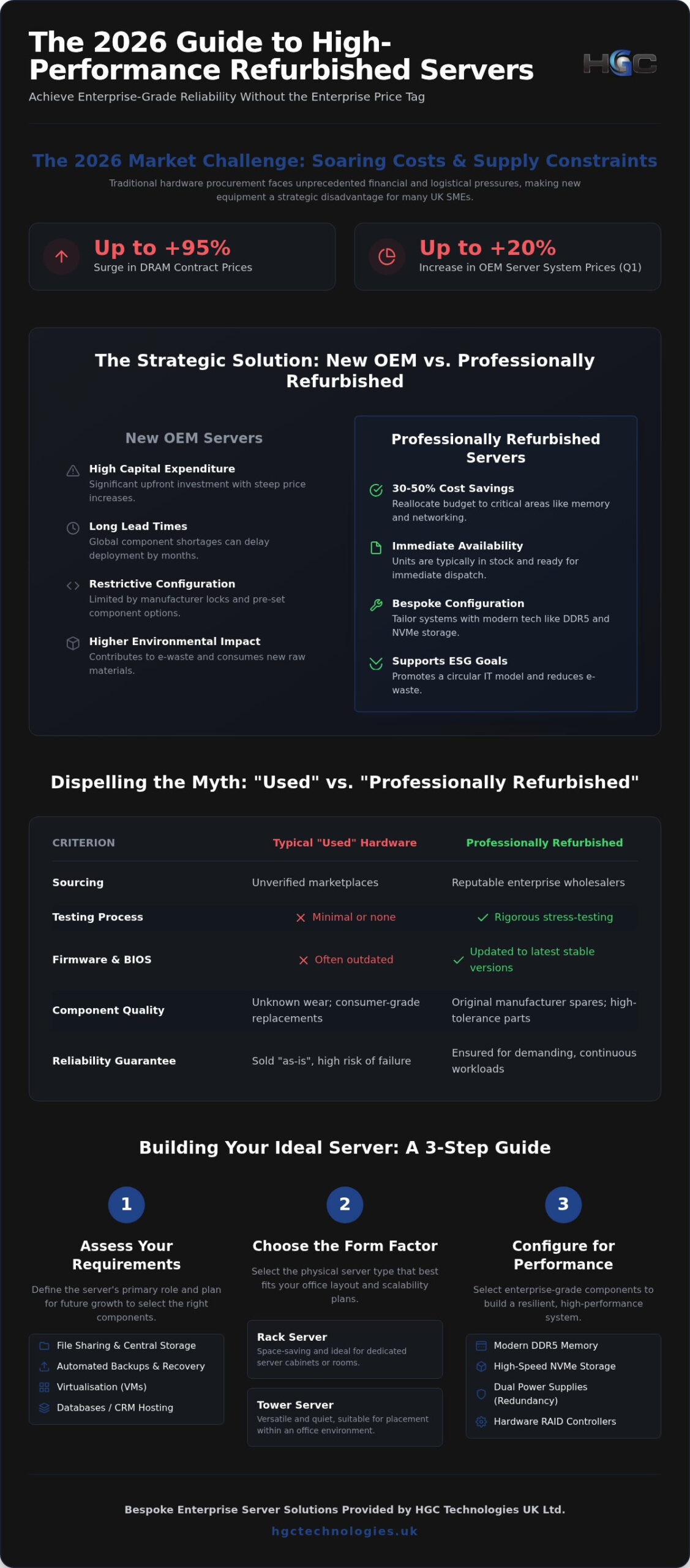
This guide clarifies how to implement a professional refurbished server setup for small business that bypasses these market constraints. We’ll demonstrate how to configure high-performance, bespoke systems using 2026 standards like NVMe storage and DDR5 memory. You’ll discover how to achieve cost savings of up to 50% whilst building a resilient, scalable infrastructure that avoids common procurement pitfalls. We will explore the essential hardware specifications and the strategic steps needed to secure enterprise-grade reliability without the enterprise-level price tag.
Key Takeaways
- Gain a strategic advantage by leveraging refurbished enterprise hardware to bypass 2026 OEM price hikes whilst maintaining high-performance standards.
- Master the refurbished server setup for small business by accurately identifying your requirements for file sharing, backups, and future storage scalability.
- Determine whether a space-saving rack server or a versatile tower unit is the most effective form factor for your specific office layout and growth plans.
- Implement a rigorous configuration process, including BIOS updates and component verification, to ensure your system is as reliable as a new unit.
- Access bespoke server solutions that provide tailored, high-performance specifications at a fraction of the cost of traditional retail hardware.
The Strategic Case for Refurbished Servers in 2026
The technology landscape of 2026 has forced a fundamental shift in how UK SMEs approach digital infrastructure. With OEM server system prices increasing by up to 20% in the first quarter of the year alone, the traditional reliance on brand-new hardware is no longer a fiscal necessity; it is often a strategic disadvantage. Many organisations now recognise that a refurbished server setup for small business provides a path to bypass restrictive manufacturer locks and artificial supply constraints. Before diving into procurement, it’s helpful to understand what is a server in the context of enterprise-grade reliability, as these machines are designed for continuous operation and redundancy that standard desktops cannot match.
Availability is another critical factor driving this shift. Whilst new enterprise hardware often comes with long lead times due to global component shortages, refurbished units are typically available for immediate dispatch. This allows your business to scale its operations in days rather than months. Additionally, adopting a circular IT model helps your company meet increasingly stringent Environmental, Social, and Governance (ESG) goals by extending the lifecycle of high-quality electronics and reducing e-waste.
Dispelling the “Second-Hand” Myth
High-performance hardware doesn’t lose its core capability just because it has been previously deployed in a data centre. There is a critical distinction between “used” equipment sold on unverified marketplaces and “professionally refurbished” units sourced from reputable wholesalers. Professional refurbishment involves a rigorous grading process where every component is stress-tested, firmware is updated, and any parts nearing end-of-life are replaced with original manufacturer spares. Enterprise-grade components are built with significantly higher tolerances and redundancy features than consumer-grade alternatives. This rigour ensures that your refurbished server setup for small business remains stable even under the most demanding workloads.
The ROI of Refurbished Infrastructure
Financial agility is the primary driver for the adoption of circular IT. When you compare the cost-per-core of a 2026 flagship server against a professionally refurbished model, the savings often range between 30% and 50%. Total Cost of Ownership (TCO) represents the comprehensive financial estimate encompassing the initial purchase price of server hardware plus all subsequent operational, maintenance, and energy costs incurred throughout its lifecycle. By reducing the upfront capital expenditure, you can reallocate your remaining budget into critical performance areas like DDR5 memory or high-speed 25GbE networking. This approach doesn’t just save money; it allows you to build a more powerful, resilient environment than your budget would otherwise permit under a “new-only” procurement policy.
Assessing Your Small Business Server Requirements
Identifying the specific role your hardware will play is the first step in a successful refurbished server setup for small business. A machine tasked with simple file sharing has vastly different requirements than one running Active Directory for a hundred users or hosting a high-traffic web application. You must also account for redundancy. Modern enterprise units often feature dual power supplies and hardware RAID controllers; these prevent a single component failure from halting your entire operation. A RAID 10 configuration, for example, offers a sophisticated balance of speed and data protection that is essential for business-critical applications.
Storage planning requires a forward-thinking approach. Don’t just calculate what you need today; project your data growth over the next three years to avoid premature upgrades. In 2026, virtualisation is the standard. Running multiple Virtual Machines (VMs) on a single physical server allows you to isolate different business functions, which improves security and simplifies backups. This flexibility is a primary reason SMEs choose enterprise-grade refurbished gear over basic desktop alternatives. It ensures that your infrastructure remains agile as your headcount increases.
Workload-Specific Hardware Selection
Your choice of components should mirror your primary tasks. A dedicated backup and disaster recovery server prioritises high-capacity SAS drives over raw processing power. Conversely, hosting internal databases or CRM software requires high-performance NVMe storage and CPUs with high clock speeds to ensure rapid query responses. You can explore a wider range of these specific configurations in our Enterprise Server Hardware UK: The 2026 Strategic Procurement Roundup. Selecting the right balance of cores and memory bandwidth is vital for maintaining consistent performance levels across your network.
Hybrid Cloud Integration
A common misconception is that you must choose between on-premise hardware and the cloud. A refurbished server often serves as a local buffer, providing fast, low-latency access to files whilst syncing critical data to the cloud for off-site redundancy. This hybrid approach balances the security of local control with the flexibility of remote access. It allows your team to work efficiently in the office without saturating your internet bandwidth. If you are unsure which balance is right for your team, consulting an expert on custom server solutions can provide the clarity needed to avoid the trap of over-provisioning.
Rack vs Tower: Choosing the Right Form Factor
The physical chassis you select for your refurbished server setup for small business dictates not only your initial footprint but also your long-term maintenance strategy. It’s a decision that must be made before you finalise your internal specifications, as the form factor influences cooling efficiency and noise levels. Tower servers offer a familiar, standalone design that integrates seamlessly into standard office environments. Conversely, rack-mounted units are the industry standard for businesses prioritising scalability and high-density computing within a structured environment.
Environmental factors are the primary differentiators. Rack servers utilise small, high-RPM fans that produce a distinctive, high-pitched whine, making them unsuitable for placement near employee desks. Tower units generally use larger fans that spin more slowly, resulting in a much quieter operation. You must also consider your electrical infrastructure. Enterprise hardware is designed for 24/7 reliability, and a dual-processor system with multiple drives can draw substantial current. It’s vital to ensure your office’s electrical circuit can support this load alongside your existing equipment without tripping breakers.
The Tower Server Advantage
Maintenance is straightforward with a tower unit. Their design allows for easy physical access to internal components without the need for sliding rails or complex cable management arms. This accessibility is particularly beneficial for non-technical staff who may need to perform basic visual checks or swap a hot-swappable drive. Because they don’t require a specialised cabinet, they are the preferred choice for retail units or small satellite offices where space for a dedicated server room is a luxury. They provide a “plug-and-play” experience whilst still offering the redundancy of enterprise-grade power and storage.
Building for the Future with Rack Solutions
Organisation is the primary benefit of the standard 19-inch rack system. It allows you to stack servers, network switches, and patch panels in a single, secure vertical column, which simplifies cable management and troubleshooting. A 2U rack server often provides the optimal equilibrium between expansion capacity for additional drives and larger heat sinks that facilitate more efficient, quieter cooling. This setup also promotes superior airflow management through the use of structured cabling and blanking panels. If your business plans to add more hardware within the next 24 months, starting with a small rack cabinet is a forward-thinking move that prevents a “sprawl” of disparate devices.
Step-by-Step Guide to Configuring Your Refurbished Server
Once your hardware arrives, the physical validation of your refurbished server setup for small business begins. Open the chassis to ensure that every component, from the memory modules to the drive caddies, is seated correctly and matches your bespoke specification. This initial audit prevents configuration errors before the machine even touches your network. Following physical verification, your first logical step is a comprehensive BIOS or UEFI update. Ensuring your system runs the latest firmware is a non-negotiable security requirement that patches known vulnerabilities and improves hardware compatibility. This methodical approach ensures your refurbished server setup for small business delivers the same uptime and resilience as a new unit.
Keeping firmware current is vital for maintaining a secure environment. You can learn more about how this impacts long-term reliability in our report on Wholesale Refurbished IT Equipment UK: 2026 Strategic Market Trends. After updates are complete, configure your RAID controller. This hardware-level organisation defines how your server handles data across multiple physical disks. For most SMEs in 2026, Windows Server 2025 or Ubuntu Server 24.04 LTS are the primary choices for an operating system. Each offers distinct advantages in terms of support and licensing costs, so align your choice with your internal technical expertise.
RAID Levels Explained for SMEs
Choosing the right RAID level is a balance of risk and performance. RAID 1 provides a simple mirror, which is perfect for boot drives where data safety is the priority. RAID 5 offers a balance of capacity and parity, whilst RAID 10 combines mirroring and striping for the ultimate performance and fault tolerance. Always prefer a dedicated hardware RAID controller over software-based solutions. Hardware controllers offload the processing burden from your CPU, ensuring your applications have maximum resources available.
Security and Remote Management
Enterprise servers feature dedicated remote management ports, such as Dell’s iDRAC or HP’s iLO. These tools allow you to monitor system health and perform troubleshooting from a remote location, even if the primary operating system is unresponsive. Secure these interfaces by changing default credentials immediately and placing them on an isolated management VLAN. You should also disable any unused physical ports and services to minimise your attack surface. If you require a system that is pre-configured to these high standards, explore our custom-built server solutions to save your team valuable setup time.
Sourcing Bespoke Server Solutions with HGC Technologies
HGC Technologies acts as a strategic bridge between high-end enterprise hardware and the specific operational needs of UK SMEs. Selecting a partner for your refurbished server setup for small business is about more than just finding the lowest price; it is about ensuring long-term reliability through rigorous technical standards. We specialise in high-performance configurations that provide “as-new” performance levels, backed by the expertise of a professional IT wholesaler. Our national UK coverage ensures that whether you are based in a central London hub or a satellite office, you receive the same premium quality and localised expertise. Every unit that leaves our facility undergoes a comprehensive multi-point inspection where we replace components showing signs of wear and update all system firmware to the latest stable versions.
By sourcing at scale, HGC Technologies provides SMEs with access to the same high-tier Dell and HP hardware used by global corporations. This wholesale advantage allows you to invest in superior components, such as NVMe storage or high-bandwidth networking, which are often cost-prohibitive when buying new retail units. Our commitment to quality transforms a second-hand unit into a reliable business asset that can serve your organisation for years to come. We handle the refurbishment rigour so your team can focus on growth, confident that your infrastructure is built on a foundation of stability and unmatched standards.
Tailored Configurations for UK Businesses
Standard retail servers often force businesses into “one-size-fits-all” configurations that lead to either under-performance or wasted capital. We move beyond these off-the-shelf limitations by offering bespoke builds with custom RAM, high-speed storage, and specific processor counts tailored to your unique workloads. Our direct sales model removes unnecessary layers from the procurement chain, ensuring you get enterprise specifications at wholesale prices. This breadth of infrastructure expertise extends beyond servers to our range of custom-built business PCs UK, allowing you to standardise your entire office environment through a single, reliable partner.
Starting Your Infrastructure Journey
Professional consultation is the cornerstone of a successful deployment. Our specialists work alongside your technical decision-makers to provide bespoke server quotes that align with your projected growth and specific application needs. A successful refurbished server setup for small business depends on more than just the hardware; it requires a partner who understands the lifecycle of technology and the importance of global connectivity. Preparing your business for a hardware transition requires precise planning, and our team provides the technical clarity needed to ensure a seamless integration into your existing network. To begin upgrading your infrastructure with high-performance, cost-effective hardware, view our current enterprise server hardware range today.
Future-Proofing Your Business Infrastructure
Building a resilient IT environment in 2026 requires a departure from the high-cost, low-availability cycles of new OEM procurement. You’ve seen how professional refurbishment transforms enterprise-grade hardware into a strategic asset, providing the scalability your business needs without the prohibitive capital expenditure. By accurately assessing your workload requirements and choosing the correct form factor, you ensure your infrastructure remains agile and efficient for years to come.
A successful refurbished server setup for small business rests on the foundation of technical rigour and bespoke configuration. HGC Technologies provides this stability as a Special UK Wholesaler, delivering Enterprise-Grade Refurbishment Standards that eliminate the uncertainties of the secondary market. Our commitment to Bespoke Hardware Configurations ensures that your system is built specifically for your operational goals rather than restricted by generic retail specifications.
Take the next step in securing your company’s digital future with a partner dedicated to your long-term success. Explore Bespoke Server Solutions for Your Business and build an infrastructure that grows alongside your ambitions.
Frequently Asked Questions
Is a refurbished server reliable enough for my small business?
Professionally refurbished enterprise hardware is engineered for 24/7 uptime and high-load environments. Unlike consumer gear, these machines feature redundant power supplies and advanced error-correcting memory. When you implement a refurbished server setup for small business, you’re investing in hardware that has already passed rigorous data centre stress tests. This inherent durability makes them exceptionally reliable for critical functions like file sharing and database hosting.
What is the difference between a refurbished server and a used server?
A used server is typically sold in its current state without any performance guarantees or technical validation. In contrast, professional refurbishment involves a systematic process of stress testing, interior cleaning, and firmware updates. Any components showing signs of degradation are replaced with original manufacturer parts. This rigour ensures the machine meets specific performance standards before it reaches your office, providing a level of security that “used” units cannot match.
Do refurbished servers come with a warranty?
Reputable IT wholesalers provide comprehensive warranties on their refurbished stock to instil long-term confidence. These agreements protect your investment against hardware defects and ensure that any unforeseen issues are resolved by technical experts. Whilst the specific duration varies, having a professional warranty in place is a key differentiator between a strategic procurement and a risky second-hand purchase. Always verify the coverage details with your supplier before finalising your order.
Can I run the latest version of Windows Server on refurbished hardware?
Most enterprise-grade servers from recent generations fully support the latest operating systems, including Windows Server 2025. You must ensure the hardware meets specific requirements, such as TPM 2.0 and compatible processor architectures. Professional wholesalers can often pre-configure your machine to meet these standards. This compatibility ensures that your refurbished server setup for small business remains secure and receives critical software updates throughout its operational life.
How much can a small business save by buying refurbished servers?
Small businesses can typically achieve cost savings of between 30% and 50% compared to the price of equivalent new hardware. These substantial reductions allow you to reallocate your IT budget towards higher-capacity storage or more robust networking equipment. By choosing a circular IT model, you bypass the inflated prices of 2026 OEM systems whilst still securing high-performance infrastructure that meets your specific technical requirements.
What happens if a component fails in a refurbished server?
Enterprise servers are designed with redundancy to prevent total system downtime in the event of a component failure. Features such as RAID arrays protect your data if a drive fails, whilst dual power supplies keep the system running if one unit loses power. Most parts are hot-swappable, meaning they can be replaced whilst the server is still operational. This modular design simplifies maintenance and ensures your business remains online.
Is it difficult to find spare parts for older server models?
Finding spare parts for major brands like Dell, HP, and Lenovo is straightforward due to the vast volume of these units in global circulation. Because enterprises refresh their hardware every three to five years, there is a consistent and plentiful supply of original components. This availability ensures that you can easily source replacement drives, memory modules, or power supplies, extending the useful life of your server far beyond its initial deployment.
Should I choose a rack server or a tower server for a small office?
Your choice depends entirely on your office environment and future growth plans. Tower servers are the superior choice for small offices without a dedicated server room because they operate quietly and require no specialised mounting. Rack servers are designed for high-density environments and offer better scalability if you plan to add multiple units. If noise levels are a primary concern, a tower unit provides the most unobtrusive solution.

Business Continuity with Refurbished Hardware: A 2026 Strategic Guide
Certified refurbished enterprise hardware offers cost savings of up to 70% compared to brand-new uni

Durable Refurbished Laptops for Field Engineers: The 2026 Strategic Buying Guide
Your 2026 engineering budget shouldn't be held hostage by the exorbitant price tags of brand-new ult

Wholesale Business Smartphones: 2026 Procurement Guide
Procuring a mobile fleet in 2026 is no longer a simple matter of finding the lowest unit price; it's