

Noise Levels of Refurbished Rack Servers: What to Expect
A refurbished rack server’s age may matter less to its noise than its configuration and operating environment. That’s why the noise levels of refurbished rack servers can be difficult to judge from a listing alone: fan speed, processor demand, storage and workload all influence what you’ll hear.
If you’re considering a server for a shared office, home lab or dedicated equipment room, it’s reasonable to ask whether it will be comfortable to work near. Published acoustic figures aren’t always directly comparable, particularly when the test setup and operating conditions aren’t clear.
This guide explains what drives server noise, what details to request from a supplier and how to compare measurements fairly. You’ll also learn how workload, cooling and placement affect sound in your intended space, so you can balance acoustic comfort with performance and thermal requirements.
With those factors in view, choosing a suitable configuration becomes a more considered procurement decision. HGC Technologies UK Ltd. supplies server solutions and configures server hardware for business requirements, helping organisations and technology resellers assess what may fit their needs.
Key Takeaways
- The noise levels of refurbished rack servers depend on configuration and operating conditions, so one figure may not predict how a server will sound in your space.
- Check how and where an acoustic reading was taken, including the server’s workload and operating state, before comparing figures.
- Use a like-for-like comparison table to assess shortlisted configurations without mixing idle readings with measurements taken under heavy load.
- Assess room use and airflow before choosing a location, then consider whether a practical trial is possible.
- Include noise requirements in your procurement brief and ask suppliers what configuration-specific evidence they can provide.
Noise levels of refurbished rack servers: why they vary
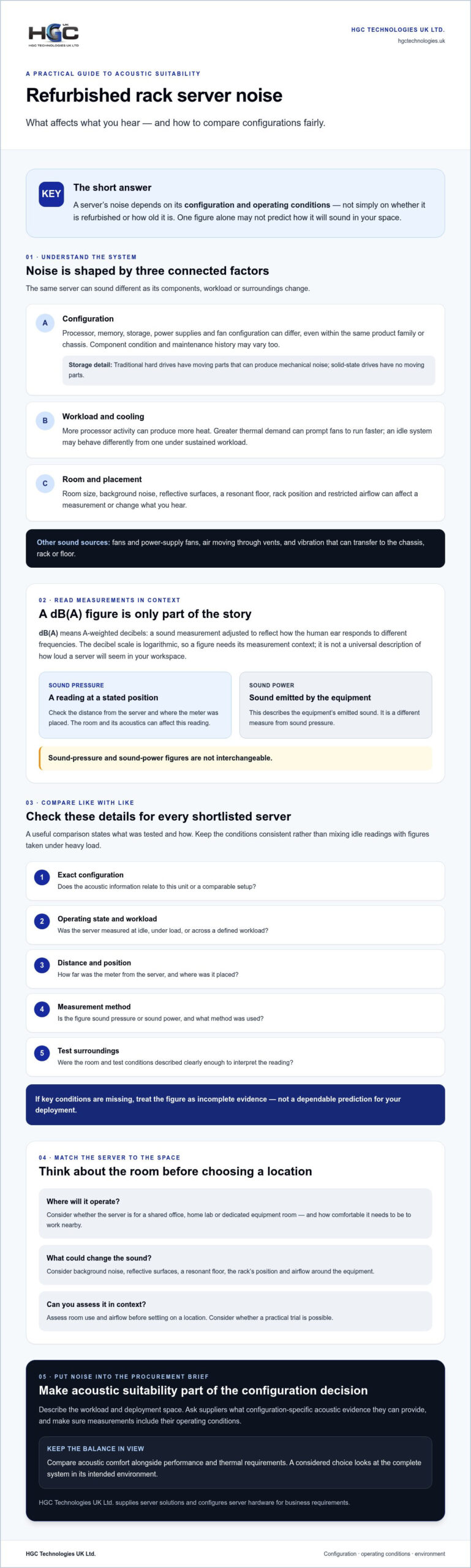
Server noise is the sound produced by a server and its cooling system during operation. It can include fan noise, air moving through the chassis, vibration and, where fitted, the mechanical sound of spinning drives. A single rating can mislead because it describes a particular configuration under particular conditions, not every server of the same type. The decibel (dB) scale is logarithmic, so a figure should be understood in its measurement context rather than treated as a simple, universal measure of loudness.
Generation, component choices, cooling demands and workload all influence how a rack server sounds. A processor working hard produces more heat, which can prompt fans to run faster; an idle system may behave differently. Room conditions matter too: reflective surfaces, a resonant floor or restricted airflow around the rack can change what you hear. Noise depends on the complete system and its operating conditions, not simply on whether the server is refurbished.
Which parts of a rack server generate noise?
Cooling fans are a key source. Their speed responds to thermal demand, which can rise with workload, processor activity or the temperature around the equipment. Power supplies may also contain fans and contribute to the overall sound. Storage matters too: traditional hard drives have moving parts that can produce mechanical noise, whereas solid-state drives have no moving parts. Air rushing through vents may create turbulence, while fans or drives can cause vibration that transfers into the chassis, rack or floor. Nearby surfaces may reflect or amplify sound, making the server seem louder in one room than another.
Why refurbished servers do not all sound alike
Refurbished units can differ in processor, memory, storage, power-supply and fan configuration, even when they share a product family or chassis. Component condition and maintenance history may also vary, so don’t assume age alone tells you how noisy a unit will be. Ask for details about the exact configuration and its condition, then check whether any acoustic information relates to that specific unit or a comparable setup.
Model-specific claims and numerical comparisons need reliable evidence. A measurement is useful only when you know what was tested and how; the next section explains which details to check before comparing figures. For procurement, treat acoustic suitability as part of the wider configuration decision. HGC Technologies UK Ltd. supplies server solutions and configures server hardware for business requirements, so you can raise your workload and deployment needs when considering a suitable system.
How to understand rack server noise measurements
A noise figure is useful only when you know what was measured and how. The noise levels of refurbished rack servers can’t be compared fairly by looking at two dB(A) numbers alone: one might describe a server at idle in a quiet test space, whilst another was recorded under load in a room with different acoustics.
dB(A), or A-weighted decibels, is a sound measurement adjusted to reflect how the human ear responds to different frequencies. However, a dB(A) value doesn’t tell you by itself how loud a server will seem in your workspace. Check whether a figure is a sound-pressure reading taken at a stated distance or a sound-power specification, which describes the sound emitted by the equipment. These are different measures and shouldn’t be treated as interchangeable.
Why operating state and setting matter
At idle, a server may generate less heat and its fans may run more slowly. Under a sustained workload, increased thermal demand can prompt faster fan operation and a different reading. Neither state is universally representative: the relevant figure depends on how you expect to use the server. Room size, background noise, reflective surfaces and the server’s position can also affect a sound-pressure measurement and your perception of it.
A meaningful comparison should state the server configuration, workload and operating state, measurement distance, measurement method and test surroundings. If any of these details are missing, treat the figure as incomplete evidence rather than a dependable prediction for your deployment.
What measurement details should buyers request?
Ask the supplier or source to clarify the conditions behind each reading. A practical checklist includes:
- Operating state: Was the server measured at idle, under load or across a defined workload?
- Distance and position: How far was the meter from the server, and where was it placed?
- Environment: Was the test carried out in a quiet room, an occupied workspace or another setting?
- Configuration and method: Which components were fitted, and is the value sound pressure or sound power?
Consider the source, too. Manufacturer specifications may use controlled test methods. Independent tests can offer useful comparisons if their conditions are clear, while informal user reports may reflect very different workloads, rooms or equipment setups. Give greatest weight to evidence that matches the configuration and use you’re assessing.
For procurement, use measurement evidence alongside your deployment requirements and any applicable UK workplace guidance. If you’re defining a server configuration for a business workload, you can discuss server requirements with HGC Technologies.
Compare refurbished rack servers fairly before choosing
A useful comparison puts each candidate under equivalent conditions. Don’t set an idle reading beside a high-load result and conclude that one server is quieter. Instead, record what was measured, how the system was configured and whether the test resembles the work and location you have in mind. This makes noise levels of refurbished rack servers a procurement criterion you can assess, rather than a vague impression.
How configuration and workload affect the comparison
Compare processors, storage, power supplies and other installed components only where the details are confirmed for each unit. A sustained workload can raise thermal demand and fan activity, so readings from different operating states aren’t directly comparable. Note the rack format and cooling requirements as points to investigate, too. Chassis size may affect airflow and fan design, but it doesn’t guarantee a particular noise level.
| Comparison factor | Candidate A | Candidate B |
|---|---|---|
| Configuration | Record confirmed processor, storage and installed components | Record confirmed processor, storage and installed components |
| Workload and operating state | State workload and whether measured at idle or under load | Match Candidate A’s workload and operating state |
| Acoustic evidence | Record figure, unit, source, distance and test surroundings | Record equivalent details, or mark as unknown |
| Format and cooling | Note rack format and stated cooling requirements | Note rack format and stated cooling requirements |
| Intended location | Describe the proposed room and its typical use | Use the same location criteria for comparison |
A practical comparison checklist for buyers
Before shortlisting, verify each configuration and identify whether acoustic claims come from a manufacturer specification, an independent test or an informal user report. Check that the workload, measurement distance and surroundings are relevant to your planned deployment. If a figure or condition isn’t available, mark it unknown and ask whether configuration-specific evidence can be supplied. Don’t fill gaps with assumptions based on age, chassis format or another unit’s result.
Use the table to separate confirmed facts from unanswered questions. If the evidence is incomplete, compare what you can verify and raise the missing information with the supplier before committing to a shortlist. This keeps the decision grounded in the actual configuration and the demands of your working environment.
Choose a suitable location and manage rack server noise
The same server can be acceptable in a dedicated equipment room yet disruptive beside desks or meeting areas. Assess the intended location before deciding whether a configuration is suitable. The noise levels of refurbished rack servers matter in context: room use, proximity and the time people spend there all shape whether operating noise is likely to be comfortable.
Is a rack server suitable for an occupied office?
Consider who uses the room, how close they’ll be to the rack and what activities take place nearby. Continuous equipment noise may be more intrusive where staff make calls, concentrate or share the space throughout the day. Check evidence for the exact configuration and a workload similar to yours before placing a server near regular work areas. If the room requires a quieter environment, consider a suitable equipment room or ask about an alternative configuration rather than assuming the server will be unobtrusive.
Work through this location assessment before deployment:
- Identify room use. Note whether it’s a dedicated equipment space, an occupied office or a shared area, and consider how close people will be to the server.
- Assess airflow. Check that the proposed position allows the server to draw in and exhaust air as intended. Avoid blocking vents or placing equipment where surrounding conditions could restrict cooling.
- Review noise evidence. Match the available measurement to the server configuration, operating state and workload, and consider whether the test conditions reflect the room.
- Trial where feasible. If practical, assess the server in or near its intended location under representative operating conditions before making a final placement decision.
Manage noise without compromising cooling
Keep ventilation paths clear and follow the manufacturer’s operating guidance for installation and airflow. A cabinet or acoustic treatment may affect ventilation, access or equipment operation, so don’t add an enclosure or sound-absorbing material unless the arrangement is compatible with the server’s requirements. Any treatment should address sound without trapping heat or obstructing maintenance access.
Rack position and vibration isolation may also be worth assessing where they’re compatible with the equipment and installation requirements. Check whether vibration transfers through the rack, floor or nearby surfaces, but avoid modifications that could compromise stability or operation. Fan changes or enclosure alterations aren’t a reliable route to silence and may affect cooling; verify any proposed change against the manufacturer’s guidance.
To balance acoustic comfort, workload and cooling, set out the room conditions and requirements before selecting hardware. Discuss your server configuration requirements with HGC Technologies as part of your procurement decision.
Specify refurbished rack servers with noise requirements in mind
Make acoustic suitability part of the procurement brief, alongside performance, capacity and deployment needs. Describe the intended workload, where the server will operate, whether it will usually be idle or under sustained load, and what noise evidence you need to assess it. This gives suppliers a clearer basis for discussing configuration options and helps you compare like with like. For wider planning considerations, see this enterprise server hardware guide.
Questions to ask a refurbished server supplier
Before adding a unit to your shortlist, ask for details about the offered configuration rather than a similar model or general product family. Useful questions include:
- What is the exact specification, including the processor, storage and other installed components?
- What condition information is available for the unit and its components?
- Is configuration-specific noise data available, and what measurement method, distance and surroundings does it describe?
- Does any reading represent idle, typical use or sustained workload operation?
- Does the proposed configuration suit the workload and room where it will be installed?
If acoustic data isn’t available, record that as unknown rather than treating another unit’s reading as a substitute. A figure without clear test conditions may offer limited guidance on the noise levels of refurbished rack servers in your own environment. Ask what evidence can be provided before committing to a shortlist, and weigh any gaps against how sensitive the intended location is to continuous equipment noise.
When to discuss a tailored server solution
A configuration discussion can be useful when the workload is demanding, the server must operate near staff, the room has airflow constraints or the available acoustic information doesn’t match your intended use. Bring a concise brief covering expected workload, installation location, operating state and the measurements or other evidence you need. This keeps the conversation focused on practical requirements without assuming a particular noise outcome.
HGC Technologies UK Ltd. supplies server solutions and configures server hardware for business requirements. If you’re weighing performance and deployment needs alongside acoustic evidence, discuss your server requirements with HGC.
Make your next server decision with confidence
The noise levels of refurbished rack servers depend on configuration, workload and operating conditions, so a listing figure is useful only when its measurement context is clear. Compare candidates using equivalent operating states, and check that the available evidence relates to the hardware you’re considering.
Then assess the intended location. A dedicated equipment space and an occupied office have different requirements, and cooling and airflow must remain priorities wherever the server is installed. Building workload, room use and evidence requirements into your procurement brief helps you make a balanced choice.
HGC Technologies UK Ltd. supplies professional server solutions and configures server hardware for specific enterprise needs. If you’re weighing acoustic considerations against performance and deployment requirements, discuss your server requirements with HGC Technologies. Set out your workload, deployment needs and acoustic questions to start a focused conversation about server configuration.
Frequently Asked Questions
Are refurbished rack servers noisy?
They can be, but noise varies by configuration and operating conditions, not simply by whether a server is refurbished. The noise levels of refurbished rack servers depend on factors such as cooling demand, workload, installed components and the room around the rack. A unit handling sustained processing may sound different from the same configuration at idle. Ask for evidence relating to the offered configuration and consider whether its likely sound is suitable for your intended location.
How loud is a rack server in dB(A)?
There isn’t one dB(A) figure that represents every rack server. A-weighted decibels describe sound using a scale adjusted to human hearing, but a reading is meaningful only alongside its test conditions. Check the exact configuration, operating state, workload, measurement distance and surroundings. Also confirm whether a figure is a sound-pressure reading or a sound-power value, as these describe different things and shouldn’t be compared as though they were equivalent.
Can I use a rack server in an office?
Possibly, but suitability depends on the server, the room and how people use that space. Consider how close staff sit, whether they make calls or need quiet for focused work, and how long the server will operate under load. Review configuration-specific noise evidence before placing equipment near regular work areas. A dedicated equipment room may be more appropriate where continuous equipment noise would disrupt everyday work.
Do refurbished rack servers make more noise than new servers?
Not necessarily. Refurbished status alone doesn’t establish how noisy a server will be; configuration, component condition, cooling demand and workload all matter. A new server with a demanding configuration may produce more fan noise than a refurbished unit under lighter use, but that isn’t a reliable comparison without evidence. Compare the exact hardware under equivalent operating conditions, and ask about the offered unit’s known condition rather than judging by age alone.
Why do rack server fans get louder under load?
Processing work generates heat, and the cooling system responds to keep components within their operating requirements. During a sustained workload, fans may increase speed to move more air through the chassis, which can make them more audible. Fan behaviour also depends on the configuration and surrounding conditions. This is why an idle reading may not reflect the sound you’ll hear during the work the server is intended to perform.
What should I ask before buying a refurbished rack server for a quiet room?
Request the exact specification, available condition information and any noise data for that configuration. Ask whether readings represent idle, typical use or sustained workload, and request the measurement method, distance and test surroundings. Explain where the server will be installed and what work it will perform. If relevant evidence isn’t available, treat the acoustic information as unknown rather than assuming another configuration’s result applies.
Can I make a rack server quieter by enclosing it?
An enclosure may reduce the sound reaching the room, but it can also restrict airflow and cause the server to run hotter or alter its cooling behaviour. Don’t place a server in a sealed or modified enclosure unless it’s compatible with the manufacturer’s operating guidance and ventilation requirements. Keep vents clear, preserve access and check the proposed setup carefully. Enclosures and other acoustic measures shouldn’t be assumed to make a server silent.

Laptops for Temp Staff & Contractors: 2026 UK Guide
Procuring brand-new hardware for short-term projects is no longer a sustainable strategy for the agi

How Laptop Grading Affects Performance: The 2026 B2B Buyer Guide
Surface scratches don't throttle processors. Even so, corporate procurement teams routinely overspen

Exploring Strategic Alternatives to Buying New Corporate Laptops in 2026
The manufacture date on your corporate hardware is no longer the most accurate measure of its perfor