
Scalability of Custom-Built Server Solutions: A 2026 Enterprise Guide
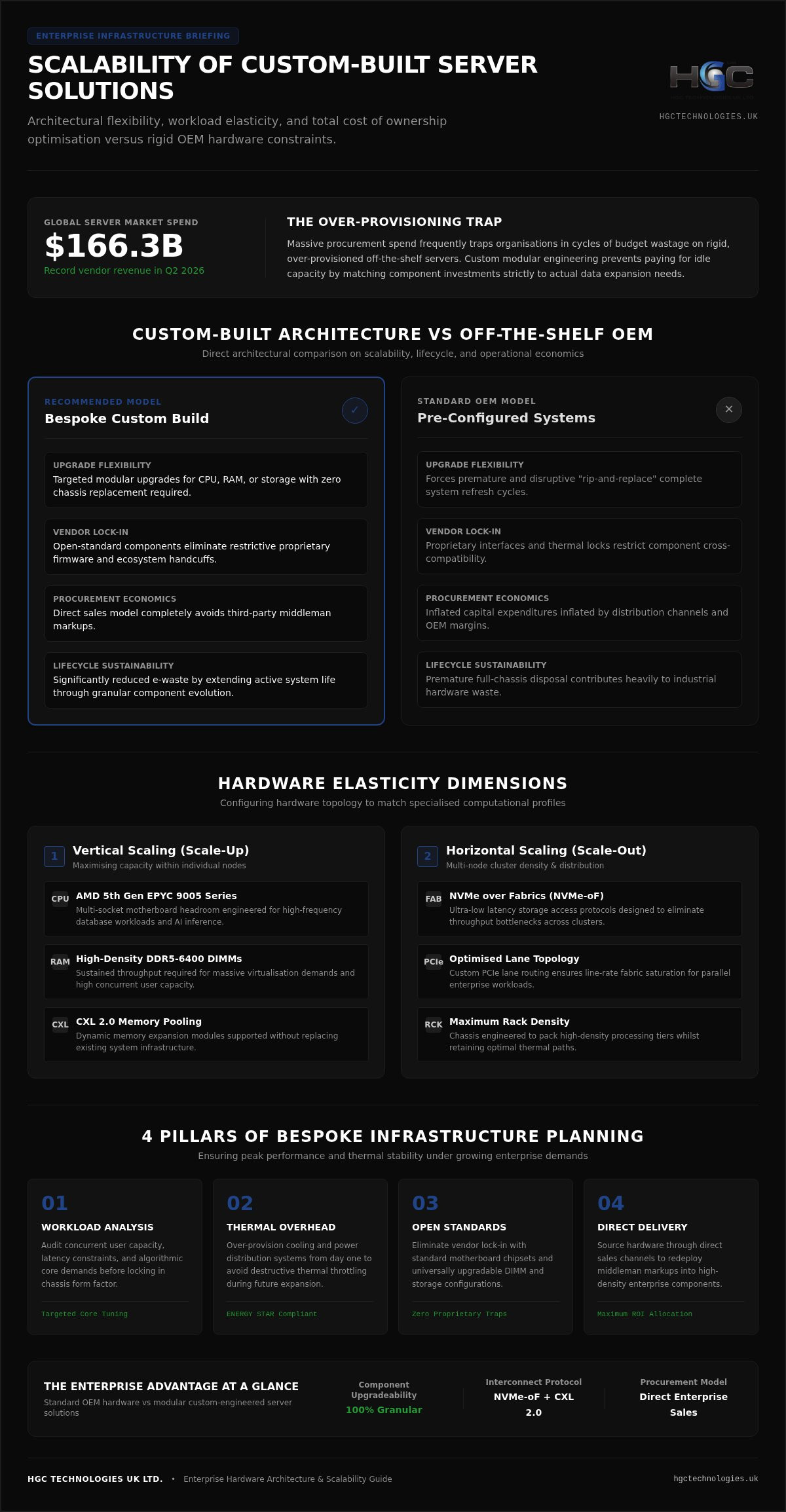
What if the hardware designed to fuel your expansion is actually the primary bottleneck stifling your progress? In a market where server vendor revenue reached a record $166.3 billion in Q2 2026, many organisations still find themselves trapped in a cycle of budget wastage on over-provisioned, off-the-shelf systems. The scalability of custom-built server solutions offers a decisive departure from this inefficiency. By prioritising modularity over rigid proprietary standards, you can ensure your infrastructure evolves alongside your workload requirements rather than becoming an expensive legacy burden.
You likely recognise the frustration of vendor lock-in or the inability to upgrade specific components as data demands surge. It is a common pain point that leads to unnecessary “rip-and-replace” cycles and inflated overheads. This guide promises to show you how bespoke server architecture provides the flexible foundation your business needs to scale without hardware constraints. We will explore how leveraging CXL 2.0 memory pooling and the latest high-density processing tiers allows you to achieve high-performance results tailored to your specific workloads whilst drastically reducing your total cost of ownership.
Key Takeaways
- Learn why the scalability of custom-built server solutions is the primary driver for long-term IT cost efficiency by eliminating proprietary hardware constraints.
- Master the distinction between vertical and horizontal scaling to design a hardware environment that achieves true elasticity as your data demands grow.
- Discover how open-standard components provide a superior return on investment compared to the restrictive vendor lock-in found in off-the-shelf OEM hardware.
- Identify the critical role of workload analysis and chassis selection in building a high-performance infrastructure that supports maximum rack density.
- Explore the advantages of a direct sales model that delivers bespoke enterprise-grade hardware without the burden of middleman markups.
Understanding Server Scalability in the Modern Enterprise Landscape
Server scalability isn’t just a technical specification; it’s a strategic business asset. At its core, it represents the system’s capacity to accommodate increasing workloads by seamlessly integrating additional resources. Unlike rigid, pre-configured models, the scalability of custom-built server solutions relies on a modular architecture that enables organisations to expand their compute, memory, or storage power without replacing the entire unit. This flexibility is the primary driver for long-term IT cost efficiency, as it prevents the frequent and expensive “rip-and-replace” cycles associated with traditional hardware procurement.
Off-the-shelf hardware often forces a compromise. You either buy more than you need today or risk running out of headroom tomorrow. Custom-built solutions bypass this by allowing for bespoke component selection. By choosing the right motherboard chipset, power supply overhead, and PCIe lane topology from the outset, you can future-proof your infrastructure. This approach ensures that when your data requirements spike, the physical chassis is ready to accept higher-density components without technical friction.
The Business Case for Scalable Infrastructure
Strategic procurement starts with avoiding the “over-provisioning” trap. Many enterprises waste significant portions of their budget on idle capacity, paying for high-spec hardware that sits under-utilised for years. Scalable servers support business agility, allowing your IT team to respond rapidly to market shifts by adding resources only when they are actually required. Beyond the financial benefits, this modularity is a responsible choice for the environment. By extending hardware lifecycles through targeted upgrades, companies significantly reduce long-term e-waste and align their technology lifecycle with sustainability goals.
Core Scalability Metrics for 2026
Understanding vertical and horizontal scalability is essential for modern performance tuning. In 2026, metrics focus heavily on throughput and latency as data sets continue to expand exponentially. You must consider concurrent user capacity, which dictates your initial CPU core count and RAM frequency requirements. The shift towards NVMe over Fabrics (NVMe-oF) has also transformed storage density expectations. Custom builds allow you to integrate these high-speed protocols directly into your rack architecture, ensuring that storage access never becomes a bottleneck as your network scales. This granular control over hardware metrics ensures that your infrastructure remains lean whilst delivering peak performance.
Vertical vs. Horizontal Scaling: Designing for Hardware Elasticity
Strategic infrastructure planning requires a deep understanding of how hardware accommodates growth. Whilst cloud providers often frame scalability as a software challenge, enterprise architects know that the physical chassis dictates the ultimate ceiling for expansion. The scalability of custom-built server solutions provides a distinct advantage here, offering a much higher vertical ceiling than standard OEM models that are often restricted by proprietary firmware or thermal limitations. Choosing the right path depends on your specific workload, whether you need to bolster a single node’s power or expand a distributed cluster.
Vertical Scaling: Maximising the Individual Node
Vertical scaling is the internal enhancement of an existing server node. It’s the most direct way to handle resource-heavy applications like high-frequency databases or AI inference models. By selecting multi-socket motherboards, such as those supporting the AMD 5th Gen EPYC 9005 series, you ensure a clear upgrade path for future CPU additions without replacing the entire system. High-density DIMM slots are equally vital, supporting DDR5-6400 modules to meet the massive RAM requirements of modern virtualisation.
Efficiency remains a priority during this expansion. Adhering to ENERGY STAR enterprise server specifications ensures that your scale-up strategy doesn’t lead to unmanageable power draw or thermal throttling. Custom builds allow you to over-provision cooling and power delivery from day one, providing the headroom needed for CXL 2.0 memory expansion modules that standard off-the-shelf units simply cannot accommodate.
Horizontal Scaling: Building the Cluster
Horizontal scaling, or scaling out, involves adding more server units to a cluster to distribute the workload. This is the preferred strategy for containerised microservices and web hosting where resilience is paramount. To prevent cluster bottlenecks, you must design for high-speed networking, utilising 100GbE or 400GbE RoCEv2 interfaces. Custom-built rack servers facilitate this by allowing for standardised internal components, ensuring uniformity across the cluster which simplifies management and deployment.
Achieving this level of hardware elasticity requires a partner who understands the nuances of bespoke configuration. You can explore how bespoke server solutions bridge the gap between high-performance needs and long-term scalability. By focusing on open standards and modular designs, you ensure your infrastructure remains agile enough to pivot as your business objectives evolve.
Custom-Built vs. Off-the-Shelf: Evaluating Long-Term Scalability and ROI
Choosing between a pre-configured OEM server and a custom-built alternative often determines your technical agility for the next five years. While major vendors offer the comfort of a known brand, they frequently impose a “vendor tax” that complicates the scalability of custom-built server solutions by comparison. By adhering to NIST architectural definitions of vertical and horizontal scaling, bespoke systems prioritise open standards that allow for granular hardware control. This architectural freedom ensures you aren’t forced into a specific upgrade path dictated by a manufacturer’s product roadmap.
Custom builds also offer superior flexibility at the firmware level. Unlike off-the-shelf units with locked BIOS settings, bespoke servers allow you to tune specific parameters to match your unique workloads. This might involve adjusting PCIe lane distribution for high-speed networking or optimising power states for sustained compute tasks. Such control ensures that your hardware isn’t just scalable in terms of physical parts, but also in its ability to adapt to shifting software requirements without requiring a total system refresh.
The “Hidden” Costs of OEM Scaling
Scaling an off-the-shelf system often reveals financial hurdles hidden behind the initial purchase price. Many Tier-1 OEMs utilise proprietary drive trays and power supplies that prevent you from using high-quality, market-rate third-party components. You might also encounter mandatory support contracts required to unlock specific hardware features or firmware updates. This environment of planned obsolescence pressures enterprise budgets, forcing a total refresh when a simple component upgrade would have sufficed. Such constraints turn what should be a simple expansion into a complex, high-cost procurement exercise that limits your long-term ROI.
ROI Advantages of Bespoke Solutions
Bespoke systems offer a more sustainable financial model by allowing you to invest only in the capacity you require today. When you need to expand, you can source market-rate RAM or NVMe drives, avoiding the significant markups associated with proprietary “certified” kits. For a detailed look at current market options, you can consult our enterprise server hardware UK procurement guide. Industry data suggests that opting for modular white-box builds can reduce the total cost of ownership by up to 40% over a five-year lifecycle compared to locked-in OEM solutions. This saving is achieved through lower initial acquisition costs and the freedom to perform mid-lifecycle upgrades without vendor interference. Customising your build ensures you pay for performance, not a logo.
Strategic Planning for High-Performance Scalable Infrastructure
Execution of the scalability of custom-built server solutions requires a transition from broad architectural goals to granular hardware specifications. In 2026, this planning phase must account for the latest interface standards, including PCIe 6.0 and DDR5 or high-frequency DDR6, to ensure your backplane doesn’t become a bottleneck within two years. A thorough workload analysis serves as the foundation for these choices. It prevents the common error of selecting a chassis that lacks the physical space or thermal headroom for future high-performance upgrades.
Choosing the right chassis is a balance between density and accessibility. Rack-mount servers remain the standard for versatile scaling, whilst blade servers offer superior density for virtualised environments by sharing power and cooling resources. However, you must plan for the thermal load of future upgrades from day one. As socket TDPs for high-end processors reach 500W, your cooling infrastructure must be capable of dissipating heat from a fully populated rack, not just the initial light deployment. This forward-thinking approach protects your investment and ensures sustained performance.
Step 1: Workload-Specific Component Selection
You must differentiate between compute-heavy tasks, such as AI and machine learning training, and storage-heavy requirements like enterprise Data Lakes. AI workloads demand massive PCIe lane counts to support multiple GPUs, whereas Data Lakes require high-density NVMe drive bays. The choice of motherboard chipset is critical here; it dictates the total number of available lanes and memory channels, effectively setting the hard ceiling for your growth. Ensure your power supply units (PSUs) have significant headroom. A 2000W unit might seem excessive for a single-processor build, but it’s a prerequisite for adding high-performance accelerators or additional storage controllers later.
Step 2: Designing for Redundancy and Maintenance
Scalability is only effective if it’s paired with high availability. Hot-swappable components, including drives, fans, and power modules, are prerequisites for maintaining uptime during hardware expansions or maintenance. Integrating remote management through IPMI (Intelligent Platform Management Interface) allows for national-scale infrastructure monitoring without physical site visits. You should also plan for N+1 redundancy in both power and cooling systems. This ensures that a single component failure doesn’t compromise the entire node’s performance whilst you’re in the process of scaling out. Establishing these standards early simplifies the management of complex, high-density clusters.
Build a future-ready foundation with bespoke server solutions designed to meet your specific enterprise performance and growth requirements.
Bespoke Enterprise Server Solutions: The HGC Technologies Approach
HGC Technologies UK Ltd. organises the design of high-performance server clusters with a singular focus on long-term agility. By operating a direct sales model, we eliminate middleman markups on enterprise hardware, ensuring your capital investment is directed towards performance rather than distribution overheads. The scalability of custom-built server solutions is significantly enhanced when the hardware is engineered specifically for your environment. We provide tailored specifications that go beyond the rigid limits of standard OEM brands, allowing for precise component selection that matches your operational reality.
Modern infrastructure requires a holistic view of the technology lifecycle. To build a truly cohesive ecosystem, many of our clients leverage custom built business PCs UK to complement their server infrastructure. This ensures that your high-performance workstations and backend clusters operate with the same level of architectural precision, creating a unified hardware environment that is easier to manage and scale.
Expert Configuration and National Supply
We maintain a steadfast commitment to high-performance workstation and server builds that meet the rigorous demands of the UK’s enterprise sector. Our methodical approach involves exhaustive testing and validation of bespoke hardware before deployment. We ensure reliability by using premium, industry-aligned components sourced from global leaders in silicon and storage fabrication. This dedication to quality ensures that your infrastructure remains stable whilst providing the necessary headroom for future vertical or horizontal expansion. We act as a knowledgeable guide, simplifying the complex wholesale process for our partners across the country.
Securing Your Scalable Future
HGC Technologies is the favourite partner for UK IT procurement because we offer more than just hardware; we provide a strategic advantage. We help you move beyond generic, off-the-shelf solutions toward a visionary infrastructure that anticipates growth. Our role is to simplify the procurement process whilst maintaining the highest standards of international capability and localized expertise. We understand that your business doesn’t stand still, and your hardware shouldn’t either. Contact our specialists for a bespoke server consultation to begin designing a hardware foundation that empowers your business to expand without limits.
Building an Elastic Foundation for Long-Term Growth
Establishing a robust hardware foundation requires moving beyond the rigid constraints of traditional OEM procurement. By prioritising the scalability of custom-built server solutions, you ensure that your data centre remains an agile asset rather than a legacy burden. This strategic approach allows you to transition from reactive purchasing to visionary infrastructure planning. Adopting open standards ensures your organisation can pivot rapidly as workloads evolve; you avoid the friction and hidden costs of proprietary vendor lock-in whilst maintaining peak performance.
HGC Technologies UK Ltd. acts as your specialist partner in this transition. We provide expert UK-based server configuration and high-performance hardware tailored to diverse business environments. Our direct wholesale model ensures maximum cost efficiency, allowing you to invest in premium components without middleman markups. Explore Bespoke Enterprise Server Solutions from HGC Technologies and take the first step towards a truly elastic infrastructure. You have the opportunity to secure a competitive advantage by building a system that grows alongside your business vision.
Frequently Asked Questions
What is the primary difference between scaling up and scaling out?
Scaling up, or vertical scaling, involves adding more power to a single server unit by upgrading its internal components like CPUs or memory modules. Conversely, scaling out, known as horizontal scaling, expands capacity by adding more server units to a distributed cluster. The scalability of custom-built server solutions excels in vertical scaling because bespoke motherboards often provide more expansion slots than pre-configured OEM models, allowing you to maximise the lifecycle of each node.
Are custom-built servers as reliable as brand-name OEM servers?
Custom-built servers are often more reliable than brand-name OEM alternatives because they utilise premium, industry-standard components without proprietary restrictions. Whilst OEMs might use locked-down firmware or non-standard parts, bespoke builds rely on open-standard hardware from leading global manufacturers. This transparency simplifies maintenance and ensures that every part is selected for its specific performance merits. HGC Technologies UK Ltd. follows a methodical testing process to validate every build, ensuring enterprise-grade stability for demanding environments.
How much can a business save by choosing custom server solutions?
Businesses typically achieve significant savings by avoiding the proprietary “vendor tax” associated with major OEM brands. These savings manifest through lower initial procurement costs and the ability to source market-rate components for future upgrades rather than expensive, branded kits. By only purchasing the capacity required at the time of deployment, you reduce over-provisioning wastage. This modular approach can lower the total cost of ownership by a substantial margin over a five-year hardware lifecycle.
Can I upgrade a custom-built server with any market-available component?
The open-standard architecture of custom-built servers allows you to utilise any market-available component that meets the system’s technical specifications. Unlike OEM servers that often use proprietary drive trays or BIOS whitelists to block third-party hardware, bespoke solutions offer total procurement freedom. This flexibility ensures you can integrate the latest NVMe drives or high-density RAM modules as they become available. It is a vital factor in the long-term scalability of custom-built server solutions for growing enterprises.
What are the cooling requirements for a scalable server rack in 2026?
In 2026, average data centre rack power densities have reached approximately 27 kW, requiring advanced thermal management strategies. Scalable racks must be designed to accommodate high-TDP processors that can reach up to 500W per socket. This necessitates a move towards direct-to-chip liquid cooling or high-velocity airflow chassis with N+1 fan redundancy. Planning for this thermal load during the initial build is essential to prevent performance throttling as you add more compute power to the rack.
Do custom-built servers support modern virtualisation platforms like VMware or Proxmox?
Custom-built servers fully support all major modern virtualisation platforms, including VMware, Proxmox, and Microsoft Hyper-V. Because these systems use standard x86 architectures and industry-aligned chipsets, they offer seamless compatibility with hypervisors. Bespoke configurations actually provide an advantage for virtualisation by allowing you to tailor the core-to-memory ratio specifically for your virtual machine density. This ensures that your underlying hardware is perfectly optimised for the specific demands of your containerised or virtualised workloads across the country.
What is the typical lead time for a bespoke enterprise server build in the UK?
Lead times for bespoke enterprise server builds vary based on component availability and the complexity of the configuration. HGC Technologies UK Ltd. operates a direct sales model that streamlines the procurement process for UK businesses. By maintaining strategic alliances with global component suppliers, we provide a responsive service that bypasses traditional OEM channels. Our national coverage ensures that once a build is tested and validated, it is delivered promptly to support your critical infrastructure requirements.
How does PCIe 6.0 impact the scalability of 2026 server solutions?
PCIe 6.0 significantly enhances scalability by doubling the bandwidth of the previous generation to 64 GT/s using PAM4 signalling. This leap in data transfer rates allows for much higher throughput between the CPU and high-speed accelerators or NVMe storage arrays. For enterprises scaling their AI or data-heavy workloads, PCIe 6.0 ensures that the system bus does not become a bottleneck. Integrating this standard into a custom build provides the necessary headroom for the next generation of expansion cards.

Enterprise Server Hardware Procurement Guide: The 2026 Strategic Framework for UK Businesses
Major OEM server prices surged by as much as 40% in the first quarter of 2026, leaving many UK busin

Refurbished Laptop Cosmetic Condition Guide: A 2026 Procurement Reference
In 2026, the difference between a high-performing IT fleet and a procurement disaster isn't found in

Finding Bulk Laptops with Specific Port Requirements: A 2026 Procurement Guide
The hidden cost of modern laptop procurement isn't found on the initial invoice. Instead, it's often