

Refurbished Laptop Failure Rates for Business: The 2026 Reliability Report
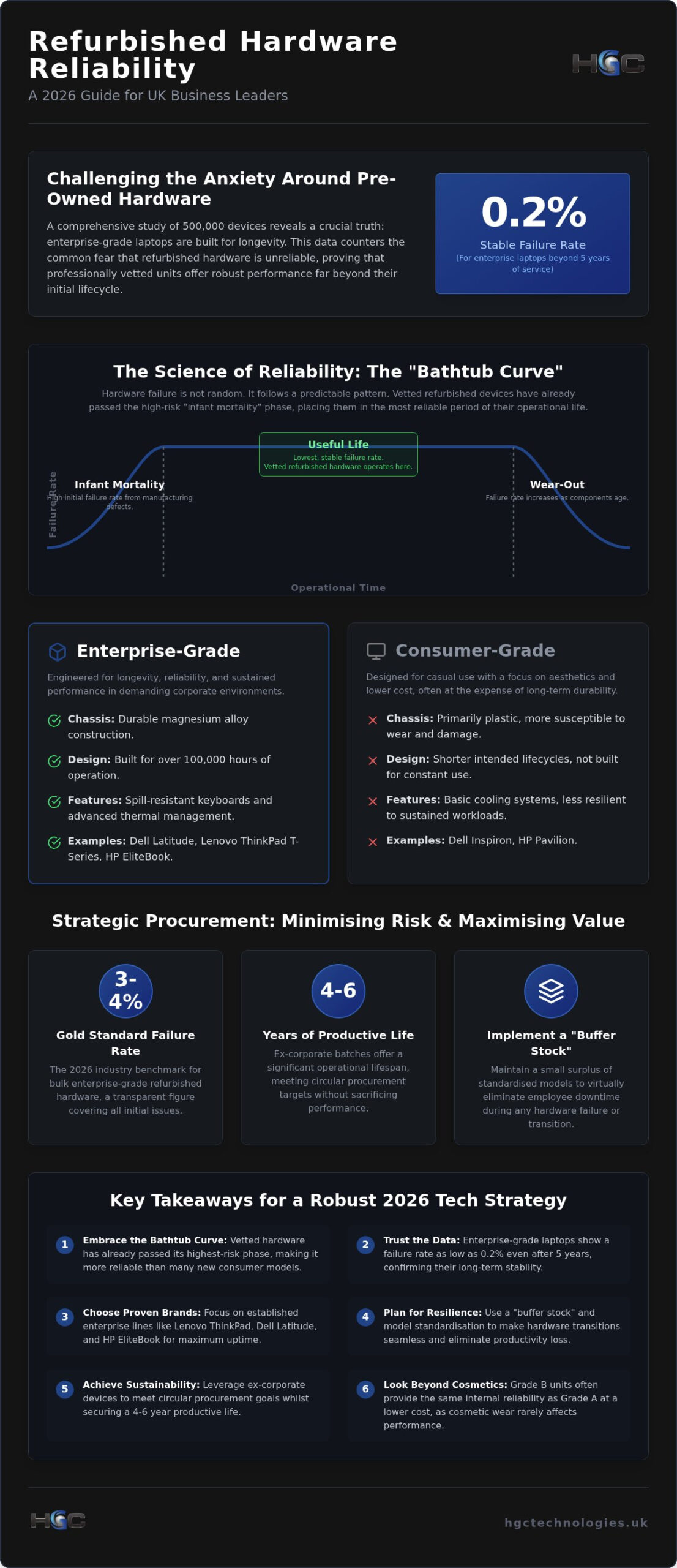
A comprehensive study of 500,000 devices recently revealed that enterprise-grade laptops maintain a remarkably stable failure rate of just 0.2 per cent, even when pushed beyond five years of service. This data directly challenges the persistent anxiety surrounding refurbished laptop failure rates business owners often cite when they are evaluating fleet procurement options. It’s a common fear that choosing pre-owned hardware is simply “buying someone else’s problem,” yet the reality of modern engineering and professional refurbishment suggests otherwise.
You want to reduce the high capital expenditure of new hardware without risking the productivity losses associated with hardware downtime. This report provides the empirical truth about refurbished hardware reliability and how to select units that have already survived the high-risk early failure phase. We will examine why vetted business-class units from brands like Dell, Lenovo, and HP remain the gold standard for corporate use. You will also learn the exact strategies needed to minimise failure risks across your entire organisation, ensuring your 2026 technology strategy is both sustainable and robust.
Key Takeaways
- Understand the “Bathtub Curve” and why vetted hardware often has lower failure rates than new consumer models by surviving the initial high-risk period.
- Review the 2026 data on refurbished laptop failure rates business leaders use to justify procurement, highlighting enterprise-grade stability as low as 0.2 per cent.
- Identify why specific enterprise lines, such as the Lenovo ThinkPad T series and Dell Latitude, remain the most reliable choices for high-uptime environments.
- Learn how to implement a “buffer stock” strategy and model standardisation to virtually eliminate employee downtime during hardware transitions.
- Discover how circular procurement targets can be met without sacrificing performance whilst leveraging ex-corporate batches that offer a 4-6 year productive life.
Understanding Refurbished Laptop Failure Rates in a Business Context
To accurately assess refurbished laptop failure rates business leaders must first distinguish between different types of hardware issues. Failure isn’t a single metric; it encompasses everything from Dead on Arrival (DOA) units to long-term component degradation, such as motherboard or battery exhaustion. Whilst some competitors claim failure rates under 3 per cent without providing a clear definition, the 2026 industry benchmark for enterprise-grade refurbished hardware sits at a transparent 3-4 per cent. This figure represents the gold standard for reliability in the secondary market, especially when dealing with bulk procurement for UK SMEs.
The disparity between business-grade hardware, such as the Dell Latitude or HP EliteBook, and consumer-grade models like the Inspiron or Pavilion is vast. Business machines are engineered for longevity, often designed to withstand over 100,000 hours of operation. They feature magnesium alloy chassis and spill-resistant keyboards that consumer models lack. For many organisations, the hidden cost of hardware failure isn’t just the replacement price. It’s the lost productivity and the IT labour required to reimage a machine and restore employee access that truly impacts the bottom line.
Refurbished vs New: The Reliability Paradox
New hardware often suffers from infant mortality, where manufacturing defects appear within the first 90 days of use. Professional Refurbishment (electronics) processes mitigate this by subjecting every unit to rigorous stress tests that new units rarely undergo after leaving the factory. When analysing refurbished laptop failure rates business teams should consider that a vetted, pre-owned ThinkPad often has a more predictable performance profile than a brand-new, budget-tier consumer laptop. These ex-corporate machines have already survived their initial lifecycle, meaning the highest risk period of their operational life has already passed.
Grading and its Impact on Failure Expectations
A common misconception is that cosmetic grading dictates functional reliability. Grade A units are often sought after for their pristine appearance, but Grade B units typically share the same internal component health. Understanding Refurbished Laptop Grades Explained is vital for procurement teams who want to balance aesthetic standards with strict budget requirements. Cosmetic wear on a laptop lid rarely correlates with the longevity of the internal SSD or RAM, provided the refurbishment partner has followed strict diagnostic protocols.
The Science of Reliability: Why Refurbished Hardware Often Outlasts New Consumer Models
Reliability in electronics follows a predictable trajectory known as the Bathtub Curve. This model illustrates that hardware is most likely to fail at two specific points: the very beginning of its life, due to manufacturing defects, and at the end of its natural lifespan, due to wear. When evaluating refurbished laptop failure rates business teams often find that pre-owned enterprise machines are statistically safer than brand-new budget models. This is because refurbished units have already survived the “infant mortality” phase, proving their structural and electrical integrity through real-world use.
Engineering excellence plays a decisive role in this longevity. Enterprise-grade laptops from Dell, Lenovo, and HP utilize superior silicon and high-tolerance capacitors that are designed to withstand constant thermal cycling. Cheap consumer models often suffer from “heat-death” because their cooling systems are inadequate for sustained workloads. Business-class hardware is built with sophisticated thermal management that prevents the internal degradation common in plastic-chassis alternatives. According to the Refurbished Computers & Laptops Market Forecasts, the market is set to reach USD 10.54 billion in 2026, driven largely by organisations recognising this superior price-to-performance ratio.
The Refurbishment “Burn-In” Process
Professional refurbishment involves more than a simple wipe-down. It includes a comprehensive “burn-in” process where CPUs and RAM are stress-tested to identify any latent defects that might cause system instability. At this stage, components like SSDs are scrutinised for health; if a drive shows signs of exhaustion, it is typically replaced with a new unit. Battery health is equally critical. Most professional graders enforce a strict threshold, replacing any battery that cannot hold a significant percentage of its original charge to ensure mobile productivity remains uncompromised.
Build Quality: Magnesium Alloy vs Plastic
Structural integrity is the silent guardian of internal electronics. Business laptops use magnesium alloy or carbon-fibre reinforced frames to prevent motherboard flex, which is a primary cause of microscopic solder fractures and eventual system failure. MIL-SPEC testing refers to a series of rigorous United States Department of Defense standards that ensure hardware can withstand extreme temperatures, vibrations, and physical shocks, guaranteeing long-term durability in demanding corporate environments. These standards are standard for the Dell Latitude and Lenovo ThinkPad lines. If you are looking to secure high-quality hardware for your fleet, you can view our latest bulk enterprise stock to find machines built to these exacting standards.
Comparing Failure Rates by Brand: Dell, Lenovo, and HP Refurbished Performance
Whilst the broader market average for 2026 stock remains below the 4 per cent benchmark, granular data reveals distinct reliability profiles amongst the three dominant manufacturers. Choosing the right brand is not merely about aesthetic preference; it is a strategic decision that directly influences refurbished laptop failure rates business teams must manage. Not all enterprise hardware is engineered identically, and the secondary market provides a unique perspective on which models truly survive the test of time and heavy corporate use.
Model continuity is a vital but often overlooked factor in reducing “software-induced” failures. When a fleet is standardised on a specific generation of Dell, Lenovo, or HP hardware, IT departments can maintain stable driver packages and BIOS configurations. This consistency eliminates the compatibility conflicts that frequently masquerade as hardware failures, significantly reducing the burden on internal support desks.
Brand-Specific Reliability Profiles
The Dell Latitude series, particularly the 7000 range, remains the workhorse of UK procurement due to its superior thermal design and modular construction. These units are built to dissipate heat efficiently, preventing the component fatigue that plagues thinner consumer models. Organisations looking for high-availability hardware often prioritise Bulk Dell Refurbished Laptops because they offer a proven balance of performance and long-term stability.
Lenovo ThinkPads, specifically the T and X series, consistently maintain the lowest long-term failure rates in the industry. Their legendary keyboard and hinge durability are matched by internal spill-protection mechanisms that safeguard the motherboard from common office accidents. Resellers and IT managers frequently select Bulk Lenovo Refurbished Laptops when uptime is the primary KPI. HP EliteBooks complement this landscape by balancing sleek, modern designs with consistent BIOS support and high-quality display panels, ensuring a premium user experience without the fragility of consumer-grade electronics.
Parts Availability: A Factor in Perceived Failure
A hardware failure only becomes a crisis if you cannot source a replacement part immediately. The global ecosystem surrounding Dell, Lenovo, and HP ensures that components like keyboards, fans, and internal cables are readily available. This is a primary reason why refurbished laptop failure rates business metrics are so much more favourable for these brands compared to niche or boutique manufacturers. HGC Technologies supports this ecosystem by ensuring a consistent stock of common replacement modules, allowing our partners to maintain enterprise-grade uptime with minimal disruption.
Strategic Procurement: Mitigating Failure Risks in Bulk Laptop Batches
Successful procurement is defined by how well an organisation manages risk, not just how much it saves on the initial purchase. Standardisation is the first pillar of this mitigation strategy. By deploying identical units across a department, your IT team can develop a single, stable software image. This approach eliminates the driver conflicts and BIOS inconsistencies that often lead to perceived hardware instability. When managing refurbished laptop failure rates business teams should prioritise model continuity to ensure that support remains predictable and efficient.
Reliability also depends on the rigour of the initial testing. You must verify that your supplier uses industry-leading diagnostic software, such as Blancco or Check-M8, to perform a full component audit. These tools go beyond simple boot tests; they stress-test the motherboard, verify battery health, and ensure that every sector of the SSD is functional. Aligning your warranty terms with your internal hardware refresh cycle further protects your investment, ensuring that any rare component failures are handled without additional capital expenditure.
The Spares-in-Closet Strategy
Total uptime is achievable through a simple “buffer stock” strategy. Instead of paying for expensive 24-hour on-site support contracts, many UK businesses now opt to keep a 3-5 per cent buffer of identical spare units on-site. The ROI is clear: buying five extra wholesale units is often significantly cheaper than a single year of premium on-site maintenance for a large fleet. If a device fails, the user simply swaps their SSD into a spare unit and is back to work in minutes. This method effectively reduces the impact of hardware downtime to nearly zero whilst keeping procurement costs low.
Evaluating Supplier Reliability
The source of your hardware is the single biggest predictor of long-term performance. There is a fundamental difference between “used” marketplace stock and “professionally refurbished” enterprise batches. Marketplaces often lack consistent grading standards and rigorous testing labs. Partnering with a dedicated Wholesale Laptop Distributor UK provides access to vetted, off-lease hardware that has been processed in a controlled environment. This ensures that the refurbished laptop failure rates business owners encounter remain within the 3-4 per cent industry benchmark. To secure vetted hardware for your next fleet refresh, you can view our current bulk enterprise stock and consult with our technical team.
Ensuring Enterprise-Grade Uptime with HGC Technologies’ Refurbished Solutions
HGC Technologies serves as a strategic anchor for the UK business community and IT resellers who demand consistent, enterprise-grade performance. Our procurement process is strictly focused on premium ex-corporate batches of Dell, Lenovo, and HP hardware. These brands are chosen specifically because they have already survived the high-risk infant mortality phase of the electronics lifecycle. By providing these vetted units in bulk, we ensure that the refurbished laptop failure rates business leaders experience are kept to an absolute minimum.
Fleet uniformity is a critical component of our value proposition. When you source 50 or 100 identical Dell Latitude or Lenovo ThinkPad units, you eliminate the driver conflicts and BIOS variations that plague mixed-model environments. This consistency allows your IT team to manage the fleet with surgical precision, reducing the time spent on troubleshooting and increasing overall employee productivity. Our commitment to excellence extends beyond portable devices; we also provide professional server solutions and custom-built PCs to help you scale your entire corporate infrastructure with the same level of reliability.
Wholesale Excellence and Quality Control
Our quality control protocol involves a multi-point inspection designed specifically for high-volume reliability. Unlike consumer-facing marketplaces, HGC Technologies provides direct access to large volumes of Grade A stock that has been audited for both functional and aesthetic integrity. We focus on the product lines that historically demonstrate the lowest return rates in the industry. This data-driven approach to inventory selection means that the refurbished laptop failure rates business clients encounter when working with us remain consistently below the 2026 industry benchmark of 4 per cent.
Next Steps for IT Procurement
Selecting the right hardware requires a careful balance of performance, longevity, and cost. Our experts are available to consult with your procurement team to identify the specific Dell, Lenovo, or HP models that align with your 2026 technology roadmap. We understand that IT managers need to verify hardware before committing to a bulk purchase. We encourage you to request a sample unit for your technical team to stress-test against your internal software stack. Enquire about our latest bulk inventory today to discover how HGC Technologies can strengthen your corporate fleet with reliable, cost-effective hardware.
Optimising Fleet Performance through Strategic Hardware Selection
The transition to a circular technology strategy is no longer just an environmental choice; it’s a calculated financial advantage. By prioritising high-tolerance enterprise hardware from Dell, Lenovo, and HP, your organisation can bypass the manufacturing defects often found in new consumer units. When evaluating refurbished laptop failure rates business leaders often discover that the empirical data supports a shift away from expensive, fragile consumer models toward vetted, professional-grade alternatives.
HGC Technologies supports this transition through a rigorous multi-point refurbishment testing protocol and reliable UK-wide wholesale distribution. We specialise in the hardware lines that IT managers trust most, ensuring that every batch meets the highest functional standards. Standardising your fleet with our premium stock allows you to simplify support and eliminate the variables that lead to downtime. Take the next step in optimising your technology budget and View Our Bulk Refurbished Laptop Inventory to find the perfect fit for your organisation. Investing in proven reliability is the smartest way to secure your company’s digital future.
Frequently Asked Questions
What is the average failure rate for refurbished business laptops?
The industry benchmark for professionally refurbished enterprise laptops in 2026 sits between 3 and 4 per cent. However, data from long-term studies shows that business-grade machines often maintain a stable failure rate of just 0.2 per cent after their initial year of service. This stability is a primary driver behind the growing refurbished laptop failure rates business metrics that procurement teams use to justify fleet transitions.
Are refurbished laptops more likely to fail than brand-new ones?
Refurbished units are often less likely to suffer from manufacturing defects than brand-new consumer models. New electronics face a period of “infant mortality” where assembly errors surface within the first 90 days. Professional refurbishment involves stress testing that identifies these latent issues, ensuring the hardware has already survived its highest-risk operational period before it reaches your office.
How does HGC Technologies test its refurbished hardware for reliability?
HGC Technologies employs a rigorous multi-point inspection process designed for high-volume corporate reliability. We use advanced diagnostic software to stress-test CPUs and RAM whilst auditing SSD health and battery cycles. Every unit is vetted for functional integrity to ensure that the bulk batches we distribute to UK resellers and corporate teams meet strict enterprise standards for performance and uptime.
Which laptop brand has the lowest failure rate when refurbished?
Lenovo ThinkPad models, specifically the T and X series, consistently report some of the lowest long-term failure rates in the secondary market. Dell Latitude’s 7000 series follows closely due to its superior thermal management and structural magnesium alloy frames. These brands are engineered for 100,000 hours of operation, which helps maintain the low refurbished laptop failure rates business owners expect from premium hardware.
What happens if a refurbished laptop fails shortly after purchase?
If a unit fails shortly after purchase, it is typically covered by a professional warranty aligned with your hardware refresh cycle. To eliminate downtime entirely, we recommend a “buffer stock” strategy where you keep a small percentage of identical spare units on-site. This allows your IT team to swap a user’s SSD into a working machine in minutes whilst the faulty unit is processed for repair.
Can refurbished laptops handle heavy enterprise software without crashing?
Yes, enterprise-grade refurbished hardware is specifically designed to handle sustained, heavy workloads without crashing. Unlike consumer laptops that throttle performance due to heat, business models from Dell, Lenovo, and HP feature superior thermal designs and high-quality silicon. These machines comfortably run modern ERP, CRM, and data-intensive applications whilst maintaining system stability over long working days.
How long do refurbished business laptops typically last?
A professionally refurbished business laptop typically provides a productive life of 4 to 6 years. Whilst many organisations refresh their fleet every 3 years to stay ahead of security risks, the actual hardware remains functional for much longer. The high-quality capacitors and structural materials used in enterprise lines ensure these machines remain reliable assets well beyond their initial corporate lease period.
Is it better to buy a new consumer laptop or a refurbished business laptop?
It is almost always better to choose a refurbished business laptop over a new consumer model for professional use. Consumer laptops rely on plastic chassis and integrated components that are difficult to repair and prone to motherboard flex. Refurbished business machines offer magnesium alloy frames, MIL-SPEC durability, and a global ecosystem of replacement parts that ensure your organisation avoids the high failure rates associated with budget retail hardware.
Rugged Refurbished Laptops: 2026 Procurement Guide
A standard laptop failing in the field isn't just a hardware issue; it's a total operational shutdow

Refurbished vs Open-Box Laptops: 2026 IT Procurement Guide
The cheapest laptop on an invoice often turns into your most expensive operational headache once dep

Avoiding Consumer Laptops for Business: 2026 UK Guide
The sleek retail notebook that looks like a procurement bargain on paper is often the single most ex
Comments are closed.