

Refurbished vs Open-Box Laptops: 2026 IT Procurement Guide
The cheapest laptop on an invoice often turns into your most expensive operational headache once deployed across an active workforce. When evaluating refurbished vs open-box laptops for business, procurement teams frequently assume that open-box units simply provide pristine, like-new machines at an effortless discount. You already know how sharply escalating OEM hardware costs are straining your annual IT expenditure, forcing you to balance strict financial targets against the daily computing demands of your staff.
However, securing lower acquisition costs doesn’t deliver long-term value if unvetted hardware triggers sudden component failures, chaotic driver management, and crippling employee downtime. This 2026 guide evaluates the critical differences between refurbished and open-box laptops to optimise business hardware budgets and fleet reliability across your organisation. We examine diagnostic testing baselines, commercial warranty coverage, and batch uniformity so you can establish predictable, multi-device IT rollouts that keep your teams fully productive.
Key Takeaways
- Understand the vital differences when evaluating refurbished vs open-box laptops for business, moving beyond surface cosmetics to assess true operational readiness.
- Discover how procuring matched hardware batches eliminates fragmented driver management and enables seamless, automated operating system deployments.
- Learn why component-level diagnostic stress testing and verified battery health thresholds offer far greater workforce stability than superficial retail checks.
- Calculate the complete total cost of ownership by balancing upfront acquisition discounts against enterprise warranty protection and long-term chassis parts availability.
- Apply a structured procurement framework to determine whether tactical open-box spot-buys or scalable refurbished rollouts best serve your organisation.
Refurbished vs Open-Box Laptops: Defining the Terms for Commercial IT
Corporate IT procurement demands a clear distinction between retail clearance terminology and enterprise hardware lifecycles. Consumer marketplaces often treat these terms interchangeably, leading buyers to conflate returned retail goods with thoroughly engineered enterprise hardware. Assessing refurbished vs open-box laptops for business requires looking past pristine packaging to examine diagnostic verification, supply origin, and long-term fleet compatibility. Understanding where a machine originates prevents expensive deployment blunders that leave internal IT teams scrambling to support mismatched hardware revisions.
What Constitutes an Open-Box Laptop in Commercial Settings?
An open-box laptop generally originates from a retail order cancellation, an immediate customer change-of-mind return, or a short-term store display model. These devices typically arrive in their original retail packaging with pristine exterior surfaces and negligible recorded runtime. They represent operational hardware that was unsealed, examined, and quickly sent back into the secondary sales loop.
While aesthetically flawless, open-box inventory presents severe structural hurdles for enterprise IT. Retail returns occur unpredictably, meaning stock appears as isolated single units rather than standardised batches. Attempting to build an operational workforce fleet around open-box channels leaves IT departments managing fragmented component revisions, varied display panels, and differing factory warranty end-dates across the same team.
The Corporate Reality of Professionally Refurbished Laptops
Professionally refurbished laptops originate from scheduled enterprise refresh cycles, corporate off-lease handbacks, and structured asset disposition programmes. Rather than relying on superficial cosmetic reviews, industrial refurbishers inspect, overhaul, and validate enterprise workhorses such as Dell Latitude, Lenovo ThinkPad, and HP EliteBook systems.
Every device undergoes systematic electrical diagnostics, thermal stress testing, cryptographic SSD sanitisation, and firmware updates according to strict electronics refurbishment and grading standards. Components that fail operational thresholds are replaced before engineers reimage the systems for commercial deployment. For organisations seeking scalable rollouts, consulting a dedicated strategic procurement guide reveals how matched enterprise refurbished batches provide the predictable uniformity required for rapid master imaging and dependable fleet-wide continuity.
Comparing Hardware Fleet Scalability, Uniformity, and Availability
Hardware scalability exposes the sharpest operational divide when evaluating refurbished vs open-box laptops for business. Commercial IT departments rarely deploy machines in isolation; they manage complex device ecosystems requiring identical BIOS configurations, driver stability, and predictable peripheral support. Piecemeal purchasing introduces administrative friction that rapidly cancels out any initial savings.
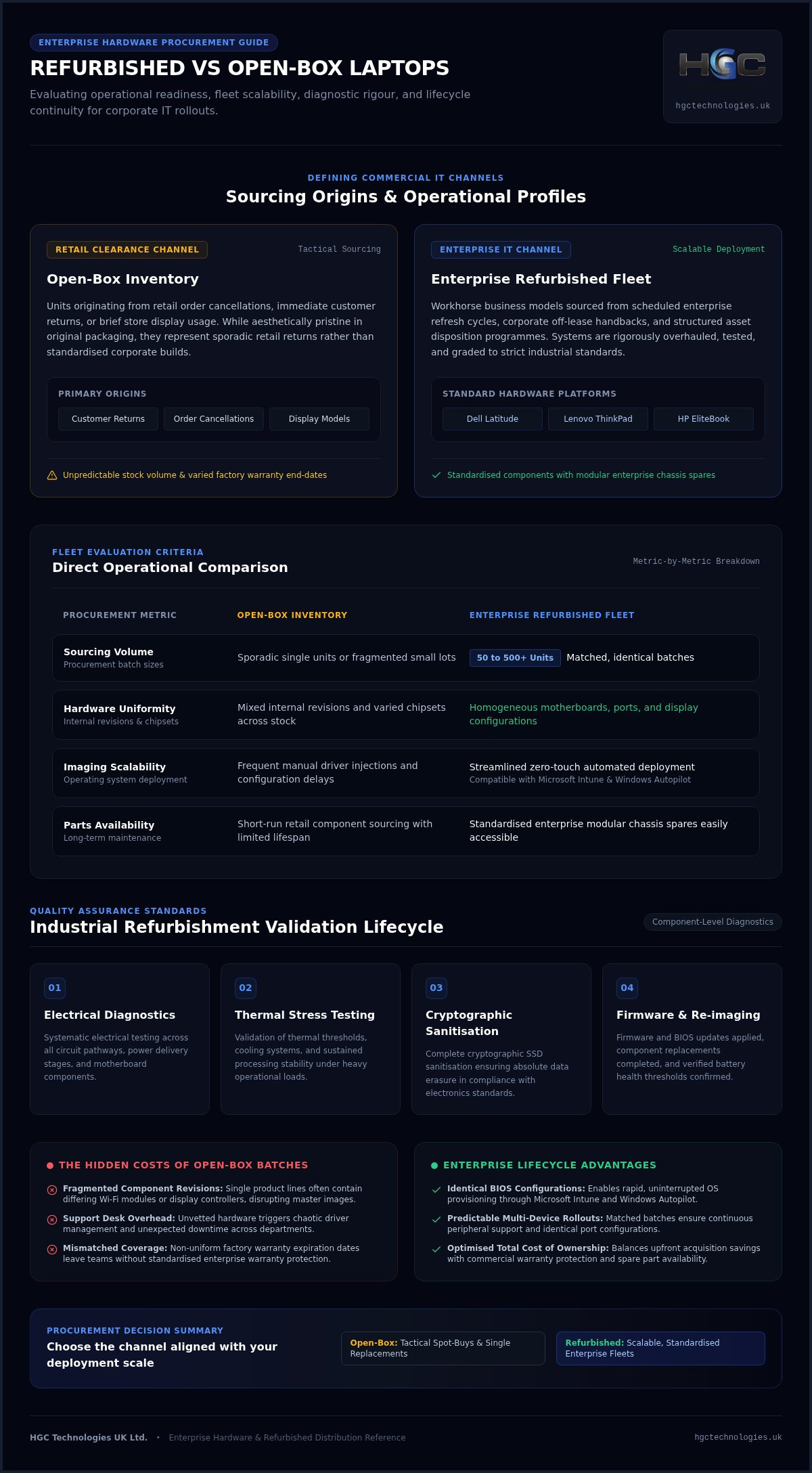
| Procurement Metric | Open-Box Inventory | Enterprise Refurbished Fleet |
|---|---|---|
| Sourcing Volume | Sporadic single units or fragmented small lots | Matched batches of 50 to 500+ identical units |
| Hardware Uniformity | Mixed internal revisions and varied chipsets | Homogeneous motherboards, ports, and displays |
| Imaging Scalability | Frequent manual driver injections required | Streamlined zero-touch automated deployment |
| Parts Availability | Short-run retail component sourcing | Standardised enterprise modular chassis spares |
Fleet Standardisation and Master OS Imaging Efficiency
Fleet uniformity directly dictates support desk workload. When systems share identical component architecture, automated provisioning tools such as Microsoft Intune and Windows Autopilot run without interruption. Procuring open-box hardware disrupts this workflow. A single retail product line might contain three distinct Wi-Fi modules or display controller revisions across different production weeks. These subtle differences derail master imaging routines, forcing technicians into time-consuming manual troubleshooting during routine staff rollouts.
Bulk Volume Sourcing for Growing Organisations and Resellers
Procurement bottlenecks emerge quickly when businesses rely on unpredictable consumer return pipelines. Open-box stock is inherently erratic, making multi-seat expansion an exercise in guesswork. In contrast, corporate refurbishment streams supply uniform, large-volume batches across proven product tiers. Organisations can deploy matched fleets of bulk Dell refurbished laptops alongside dependable Lenovo ThinkPad and HP EliteBook systems with complete configuration consistency.
Transparent documentation remains vital when securing commercial hardware. Just as global benchmark guidelines such as federal warranty law and disclosure standards demand clear terms for written coverage, commercial IT teams require unambiguous verification of component health before issuing devices. If your organisation is planning structured, department-wide rollouts, you can review available business configurations directly through HGC Technologies UK Ltd. to secure stable, uniform inventory.
Diagnostic Rigour, Component Testing, and Commercial Warranty Protection
Fear of unheralded hardware failure rightly haunts IT managers. When assessing refurbished vs open-box laptops for business, cosmetic appearance often masks critical operational risks. A device returned to a retailer might look immaculate, yet it could harbour subtle power-delivery faults or intermittent thermal issues that only surface under heavy corporate multitasking. Ensuring employee productivity demands verifiable component testing, not just pristine outer casing.
Enterprise Stress Testing vs Visual Cosmetic Inspection
Commercial refurbishers subject enterprise laptops to rigorous multi-point diagnostic workflows. Technicians stress-test processors under continuous heavy loads, verify power regulation circuits, inspect motherboard rails, and validate the read/write integrity of NVMe solid-state storage. Ports undergo complete physical and electrical loopback checks, while cooling fans and thermal paste receive thorough servicing.
Battery testing represents an equally vital distinction. Enterprise refurbishment facilities benchmark cell retention against strict operational baselines, typically enforcing a minimum 80% remaining capacity threshold. Batteries failing this hurdle are decommissioned and replaced. Conversely, retail open-box units generally receive only a superficial power-on self-test and a cursory wipe-down. Hidden battery wear or microscopic solder micro-fractures remain undetected, leaving your organisation vulnerable to sudden hardware dropouts.
Warranty Continuity and B2B Technical Aftercare Realities
Warranty coverage exposes another severe procurement trap. Open-box machines rely on the residual balance of the original manufacturer warranty. That clock starts ticking the moment the initial retail buyer makes the purchase. If a laptop sat on a distributor shelf for months after return, you might inherit a device with merely 30 to 90 days of factory protection remaining. Worse still, some consumer warranties are non-transferable, leaving business buyers with no manufacturer recourse if a display panel fails.
Commercial B2B refurbishment suppliers operate under an entirely different service model. They provide direct, contractual business warranties designed to protect enterprise cash flow and minimise operational disruption. When components falter, support teams process swift replacements without requiring your staff to navigate consumer retail return desks.
This disciplined approach aligns closely with wider sustainable electronics lifecycle management frameworks. By keeping thoroughly tested, dependable tier-one machines in circulation, organisations prevent premature hardware obsolescence whilst securing reliable technical backing that keeps daily business workflows uninterrupted.
Total Cost of Ownership and Lifecycle Value for Modern Enterprises
Calculating genuine return on investment requires evaluating total cost of ownership rather than chasing superficial retail ticket discounts. When weighing refurbished vs open-box laptops for business, procurement teams must balance component durability, modular replacement access, and depreciation curves against ongoing operational demands. Hardware that appears marginally cheaper upfront can quickly drain budgets if replacement chassis parts prove impossible to source twelve months later.
Capital Expenditure Savings and Enterprise Asset Depreciation
Brand-new laptops suffer their steepest depreciation within the opening twelve months of deployment. Open-box units capture only a fraction of that depreciation relief, carrying an unnecessary retail price premium without offering corresponding fleet scalability. In contrast, enterprise refurbished laptops bypass that initial steep decline entirely. Because commercial lines like Dell Latitude and HP EliteBook maintain standardised modular chassis designs across multi-year cycles, replacement keyboards, screens, and internal batteries remain widely accessible and affordable throughout the equipment’s operational lifespan.
Sustainability Mandates and Corporate ESG Alignment
Hardware manufacturing generates 75% to 85% of a business laptop’s lifetime carbon footprint, producing between 218 kg and 350 kg CO₂e before the system is ever booted. Sourcing certified enterprise refurbished units circumvents new mineral extraction and manufacturing emissions, preventing roughly 200 kg to 316 kg CO₂e per machine. Aligning your procurement strategy with evolving sustainable IT equipment trends satisfies auditable corporate Scope 3 emission targets whilst conserving essential capital reserves.
Mapping Hardware Sourcing to Business User Demographics
Deploying equipment effectively requires matching user roles to the proper sourcing model:
- Executive Leadership: Tactical open-box acquisitions can occasionally satisfy single-seat C-suite requirements where an executive demands a specific, high-end consumer chassis style on short notice.
- Operational & General Workforce: Administrative staff, customer support desks, and hybrid teams achieve far greater continuity using matched batches of bulk Lenovo refurbished laptops or Dell Latitude systems, ensuring identical docking station support and streamlined hot-swap replacements.
Ready to modernise your workforce hardware without inflating your capital expenditure? Explore enterprise fleet solutions to secure dependable, fully tested refurbished inventory configured for your operational requirements.
Strategic Procurement Framework: Selecting the Optimal Sourcing Channel
Deciding between refurbished vs open-box laptops for business comes down to operational scale and fleet strategy. Procurement leaders shouldn’t treat these two sourcing models as interchangeable alternatives competing for the same corporate requisition; they solve fundamentally different operational problems. Making the correct procurement choice requires auditing three core criteria before allocating capital:
- Batch Consistency: Do you need five, twenty, or hundreds of identical units running an identical OS image, or are you acquiring an isolated single workstation?
- Warranty Integrity: Does your operational model require unambiguous commercial B2B warranty support, or can your team absorb the risk of residual consumer warranty clocks?
- Lifecycle Horizon: Are you equipping a department for multi-year stability, or merely plugging a temporary operational gap?
When to Consider Open-Box Hardware for Business Needs
Open-box channels provide genuine tactical utility in narrow, isolated scenarios. If an executive requires a specific premium chassis on short notice, or an emergency spot-replacement is needed to keep an employee working whilst primary hardware undergoes bench repair, sourcing an individual open-box unit makes commercial sense. The challenge arises when organisations attempt to scale this approach. Sourcing open-box stock across multiple desks inevitably fragments your IT ecosystem, burdening technical staff with mismatched drivers and disparate peripheral docks.
Why Enterprise Refurbished Fleets Secure Operational Continuity
Enterprise refurbished systems represent the definitive standard for departmental deployments, regional branch rollouts, and growing business operations. By supplying matched lots of tier-one business machines with verified component integrity, professional refurbishers deliver the architectural consistency that modern IT departments require. System images apply effortlessly, spare parts remain universally interchangeable, and user downtime drops significantly.
Partnering with an established national wholesale distributor removes the volatility of retail clearance channels. IT decision-makers secure predictable inventory pipelines, dependable commercial grade testing, and tier-one chassis designed specifically for rigorous corporate use. To standardise your workplace infrastructure and protect your annual IT budget, enquire about wholesale corporate hardware to access verified enterprise laptop fleets configured directly for your business requirements.
Future-Proof Your Workforce Fleet with Enterprise Reliability
Evaluating refurbished vs open-box laptops for business ultimately clarifies a strategic choice: tactical, one-off spot buys versus resilient, enterprise-wide standardisation. While open-box devices can address urgent single-seat needs, corporate continuity relies on matched batches, verified component stress testing, and clear commercial warranty backing. Choosing enterprise-grade refurbished hardware protects your capital expenditure, slashes Scope 3 emissions, and eliminates driver maintenance friction across your workforce.
As a specialised nationwide wholesale distributor, HGC Technologies supplies large-volume corporate stock profiles across tier-one brands including Dell, HP, and Lenovo. Every system undergoes rigorous diagnostic benchmarking and disciplined grading protocols engineered specifically for commercial operations, ensuring seamless multi-seat rollouts without operational compromise. Equip your organisation with dependable, cost-effective computing power that keeps your employees focused and productive. Consult HGC Technologies for wholesale enterprise laptop procurement to build a uniform, high-performance IT fleet today.
Frequently Asked Questions
Is an open-box laptop considered brand new under commercial terms?
No, commercial IT procurement does not classify open-box laptops as brand new. The moment retail packaging is unsealed, the equipment enters secondary supply channels. While the device may exhibit pristine cosmetic condition and negligible operating hours, it no longer carries pristine factory-sealed status. Furthermore, the manufacturer warranty period may have already begun counting down from the original retail transaction date.
What is the primary difference between refurbished and open-box laptops for business?
The core difference centres on diagnostic testing, volume availability, and hardware origin. When comparing refurbished vs open-box laptops for business, open-box models represent individual retail customer returns inspected primarily for visual cleanliness. Enterprise refurbished systems originate from corporate refresh cycles, undergoing multi-point component stress testing, cryptographic data sanitisation, hardware upgrades, and grading to ensure dependable, fleet-wide deployment across active business departments.
How do warranty terms differ between commercial refurbished and open-box laptops?
Open-box units typically rely on the remaining balance of the original retail warranty, whereas enterprise refurbished machines include dedicated B2B warranty coverage. A returned open-box device might offer as little as 30 to 90 days of factory protection if it lingered in distribution. Reputable corporate refurbishers provide clear commercial warranty structures that guarantee swift repair or hardware replacement directly through your wholesale partner.
Can our business obtain multiple identical units when purchasing open-box laptops?
Procuring matched, multi-seat laptop deployments through open-box channels is rarely achievable. Open-box inventories rely on unpredictable retail returns, generating single units or fragmented micro-lots with varied internal components. In contrast, corporate refurbishment pipelines supply matched batches containing dozens or hundreds of identical business systems, allowing IT teams to standardise accessories, power supplies, and docking stations across entire offices.
Why do IT departments prefer ex-corporate refurbished laptops over retail open-box models?
Corporate IT departments favour ex-enterprise refurbished laptops because uniform hardware architecture simplifies driver management and automated operating system deployment. Systems sharing an identical motherboard and chipset revision roll out seamlessly using Microsoft Intune or Autopilot. Open-box units from consumer lines introduce varied internal revisions, forcing IT engineers into repetitive manual troubleshooting, driver patching, and bespoke image building.
How does purchasing refurbished corporate hardware support enterprise ESG targets?
Procuring circular enterprise hardware curtails capital goods emissions by avoiding new factory production. Because roughly 75% to 85% of an enterprise laptop’s lifetime carbon footprint stems from manufacturing and mineral extraction, deploying a certified refurbished system prevents between 200 kg and 316 kg of CO₂e per machine. These verifiable savings provide auditable data to satisfy corporate sustainability disclosures and carbon reduction mandates.
Are replacement components readily available for older refurbished enterprise laptops?
Yes, replacement components for enterprise refurbished machines remain readily accessible and budget-friendly for years. Tier-one corporate lines such as Dell Latitude, Lenovo ThinkPad, and HP EliteBook utilise standardised, modular chassis architectures engineered for enterprise serviceability. Internal cooling fans, replacement batteries, display assemblies, and keyboards remain widely stocked across wholesale distribution channels, ensuring rapid repairs and prolonged fleet usability.
Custom Built PCs for Business UK: The 2026 Procurement Guide
Settling for standard OEM specifications is a silent tax on your team's productivity. When procuring
Ex-Corporate Laptops Bulk UK: The 2026 Professional Procurement Guide
Manufacturing a single new laptop generates an estimated 300-400kg of CO2 equivalent, a statistic th

The Strategic Business Case for Refurbished Hardware in 2026
Sales of refurbished PCs in the UK almost doubled between the final quarter of 2024 and the end of 2