

Avoiding Consumer Laptops for Business: 2026 UK Guide
The sleek retail notebook that looks like a procurement bargain on paper is often the single most expensive mistake an IT department can make. When processors and memory configurations appear identical on a specification sheet, it’s completely understandable to assume retail machines deliver equal performance for a lower initial checkout price. Yet, avoiding consumer-grade laptops for business use is vital if you want to sidestep unexpected operating system licensing fees, persistent hardware breakdowns, and the logistical friction of managing disk images across an inconsistent fleet.
Building a resilient technical infrastructure requires a strategic balance between chassis durability, rigorous data security, and long-term procurement discipline. In this guide, discover why consumer laptops undermine day-to-day business operations and how enterprise-grade hardware protects both your cybersecurity posture and your bottom line. We’ll examine the hidden mechanical compromises of retail devices, unpack essential domain management standards, and demonstrate how to establish a cost-efficient, scalable hardware strategy that eliminates recurring helpdesk tickets.
Key Takeaways
- Understand why avoiding consumer-grade laptops for business use is essential to prevent premature component fatigue and thermal throttling under intensive daily workloads.
- Explore the architectural divide between consumer retail notebooks and enterprise machines built with silicon-level firmware defences and native domain management support.
- Uncover the reality of Total Cost of Ownership, revealing how retail shelf-price savings are swiftly eroded by elevated repair rates and disruptive staff downtime.
- Establish practical procurement criteria, from MIL-STD 810 build certifications to modular serviceability, to streamline fleet standardisation and IT deployment.
- Learn how sourcing bulk refurbished Dell, Lenovo, and HP laptops across the UK delivers commercial-grade performance whilst securing outright capital asset ownership.
The Hidden Risks of Deploying Consumer-Grade Laptops in Business Environments
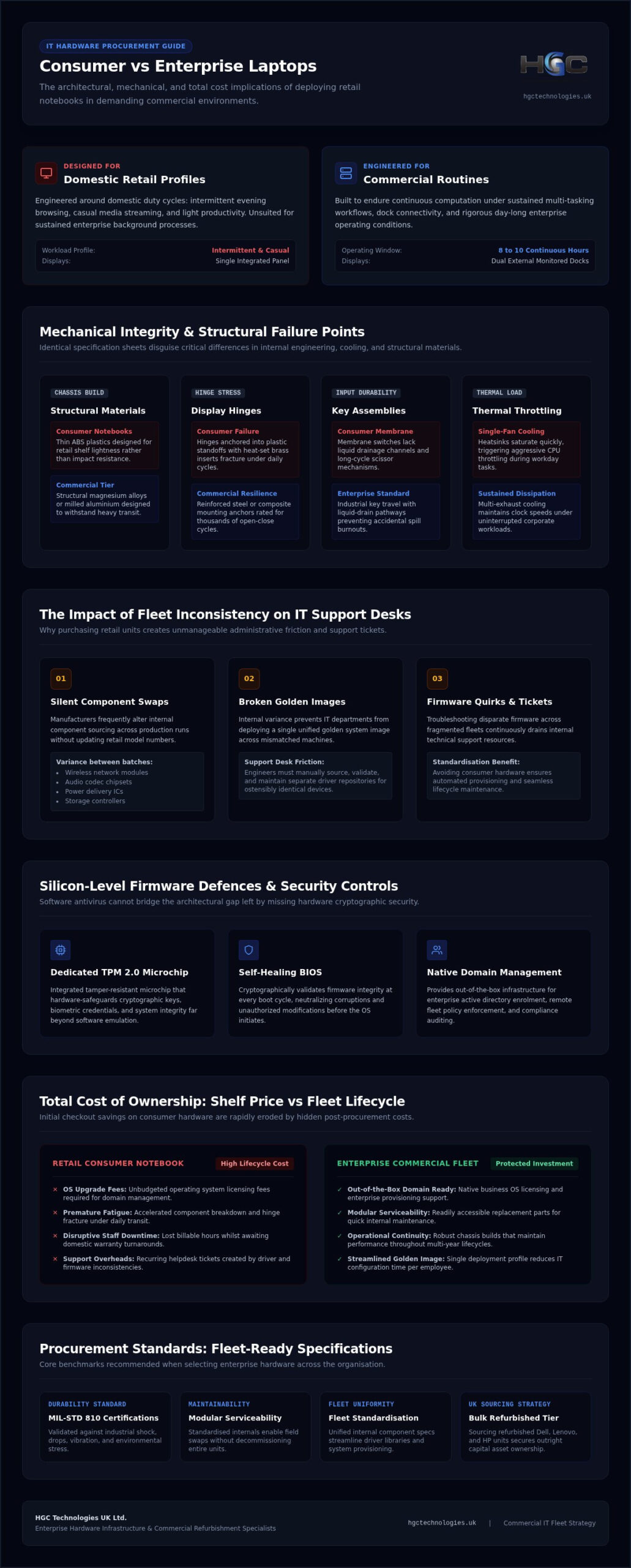
Retail laptops are engineered around domestic usage patterns: intermittent evening browsing, casual media streaming, and light productivity. Subjecting these machines to a commercial routine; eight to ten hours of continuous computation, dual external displays, and heavy multitasking; exposes severe structural limitations. Corporate workflows generate sustained thermal loads that domestic cooling systems simply cannot dissipate over extended operating windows. In assessing the true Total Cost of Ownership across an organisation, early hardware exhaustion quickly erodes any initial margin saved at retail checkout. Understanding these engineering constraints shows why avoiding consumer-grade laptops for business use is vital for safeguarding operational continuity.
The Reality of Consumer Build Quality and Component Longevity
Consumer notebooks prioritise retail shelf appeal, slender profiles, and minimal manufacturing expense. Chassis construction routinely relies on thin acrylonitrile butadiene styrene (ABS) plastics rather than structural magnesium alloys or milled aluminium. This structural compromise introduces tangible points of failure:
- Fragile Display Hinges: Domestic hinges are typically secured into plastic standoffs using heat-set brass inserts, which repeatedly fracture under daily opening and transport cycles.
- Membrane Keyboard Degradation: Key assemblies lack liquid-drain channels, industrial key travel, and long-cycle scissor switches, leading to premature key chatter or switch failure.
- Thermal Throttling: Compact, single-fan domestic cooling designs trigger aggressive processor throttling under enterprise background tasks, degrading workday productivity.
Physical failure rates on domestic platforms dramatically outpace commercial tiers, directly translating into unplanned downtime and lost billable hours.
The Impact of Fleet Inconsistency on IT Support Desks
Procuring domestic machines introduces severe administrative friction for technical support teams. Retail device manufacturers alter internal component sourcing across production runs without changing the retail model number. A batch of laptops purchased three months apart may contain entirely different wireless modules, audio codecs, power ICs, and storage controllers.
This internal variance dismantles fleet standardisation. IT departments cannot deploy a unified golden system image across mismatched machines. Instead, system engineers must source, test, and maintain disparate driver repositories for ostensibly identical devices. Troubleshooting unique firmware quirks across a fragmented fleet drains internal resources. Maintaining strict operational consistency requires avoiding consumer-grade laptops for business use, ensuring support desks can automate provisioning and streamline lifecycle maintenance effectively.
Architectural and Security Differences: Enterprise Hardware Versus Retail Consumer Devices
Consumer devices frequently match enterprise laptops on top-line retail spec sheets. Both might feature similar clock speeds or solid-state capacities, yet their physical architectures serve radically different objectives. True enterprise equipment is engineered from the silicon up to protect commercial networks and withstand continuous operation. In contrast, domestic laptops sacrifice cryptographic security and modular servicing to minimise production costs. Deciding on avoiding consumer-grade laptops for business use is fundamentally a decision to secure your perimeter and protect corporate intellectual property.
Hardware-Level Cyber Security and Cryptographic Controls
Software antivirus cannot compensate for missing hardware security controls. Enterprise laptops integrate dedicated, tamper-resistant Trusted Platform Module (TPM 2.0) microchips that safeguard encryption keys, biometric credentials, and system integrity far beyond software-based emulation. Business motherboards feature self-healing BIOS architectures that cryptographically verify firmware integrity at every boot cycle, neutralising malicious rootkits before the operating system initialises. Aligning internal controls with official NCSC device security guidance requires these hardware-anchored defences, ensuring remote endpoints remain resilient against sophisticated credential harvesting.
Operating System Compatibility and Enterprise Management
Domestic retail units invariably ship with Windows Home editions, creating immediate deployment hurdles for technical teams:
- No Active Directory Integration: Windows Home cannot natively join local Active Directory domains or enrol seamlessly into Microsoft Entra ID.
- Missing Management Features: Group Policy Editor, BitLocker drive encryption, and remote desktop services are absent by default.
- Unbudgeted Upgrade Costs: Upgrading retail machines to professional operating system editions introduces immediate, unplanned licensing expenditure.
Enterprise platforms running Windows Pro support out-of-band management and silent administrative patching. Sourcing uniform, enterprise-ready systems via an experienced wholesale laptop distributor UK partner ensures every deployed unit immediately respects your corporate access policies without manual operating system overhauls.
Internal Architecture, Thermal Management, and Repairability
Component longevity hinges on internal layout. Enterprise platforms utilise dual composite heat pipes and high-static-pressure fans, allowing processors to maintain peak boost clocks without dangerous thermal spikes. Crucially, commercial engineering favours field-serviceable modularity. Dual SO-DIMM memory slots, modular wireless cards, and easily accessible battery brackets permit swift repairs.
Consumer motherboards systematically solder dynamic RAM and wireless chips directly to the mainboard to compress physical chassis thickness. A single failing memory module on a soldered consumer board renders the entire computer unusable. Avoiding consumer-grade laptops for business use guarantees access to commercial device tiers where components can be individually replaced in minutes, keeping employee endpoints operational.
The Total Cost of Ownership: Why Cheap Consumer Hardware Costs More Over Time
Procurement teams focused solely on upfront unit pricing frequently overlook post-purchase operational liabilities. A device bought at retail may seem like an immediate financial win, yet the purchase receipt covers merely twenty to thirty per cent of total lifecycle expenditure. Unscheduled hardware failures, elevated support tickets, and disrupted employee workflows rapidly inflate ongoing maintenance costs. As the Rutgers University IT department explains, commercial-grade systems deliver vastly superior operational longevity through standardized engineering, lower cumulative fault rates, and comprehensive manageability. Rigorously avoiding consumer-grade laptops for business use is the most effective safeguard against these hidden, compounding operational deficits.
Unplanned Downtime and Lost Staff Productivity
Device failure paralyses employee output. When a domestic laptop malfunctions, resolving the issue involves significant logistical friction that diverts internal resources:
- Onerous Return Channels: Consumer warranties generally demand off-site return-to-base postage, often stranding end users without working systems for several weeks.
- Unavailable Replacement Modules: Retail original equipment manufacturers phase out internal spare components quickly, creating lengthy supply-chain delays for basic repairs.
- Ballooning Idle Payroll: The cumulative cost of several unbillable working days quickly outstrips any initial capital saved on consumer hardware.
Commercial tiers mitigate this friction entirely. Standardised components and rapid-access chassis designs ensure corporate workforces experience minimal operational disruption when maintenance is required.
Depreciation Curves and Residual Asset Value
Capital asset value behaves starkly differently between retail and commercial device tiers. Consumer machines experience steep, irreversible physical depreciation. Thin plastics flex under daily transit, displaying unsightly casing stress, keyboard shine, and hinge fatigue after mere months of deployment. Secondary remarketing channels heavily discount or outright reject degraded retail hardware at decommissioning, wiping out residual asset values.
Commercial platforms maintain strong secondary market desirability. Engineered around resilient aluminium unibodies and magnesium roll cages, these machines retain robust structural integrity throughout extended deployment cycles. Forward-thinking organisations circumvent the premium costs of brand-new business machines by procuring bulk professionally refurbished commercial inventory directly. This strategy provides enterprise-tier reliability and superior residual stability while avoiding consumer-grade laptops for business use and keeping capital expenditures tightly controlled.
Establishing a Robust IT Procurement Strategy: How to Select Fleet-Ready Laptops
A structured procurement framework eliminates chaotic, reactionary buying habits. Allowing departments to acquire retail notebooks during periods of rapid recruitment inevitably fractures your hardware fleet. Avoiding consumer-grade laptops for business use requires establishing strict, non-negotiable operational criteria before signing off on purchase orders. Prioritise equipment validated under MIL-STD 810 environmental testing standards. These rigorous military-grade durability benchmarks verify that chassis components, display hinges, and internal solder joints will survive drops, heavy vibration, and thermal shocks encountered in everyday commercial use.
Establishing Standard Fleet Hardware Profiles
Segmenting your organisation into distinct operational personas simplifies rollout schedules whilst preventing specification creep. Audit departmental workflows to create three distinct hardware configurations:
- Core Administration: Multi-core processors, a baseline of 16GB dual-channel memory, and high-speed NVMe solid-state storage to handle intensive cloud collaboration suites.
- Hybrid Field Professionals: Resilient 13-inch to 14-inch form factors built with lightweight structural alloys and anti-glare panels for consistent off-site visibility.
- Advanced Computational Users: High-performance configurations featuring dedicated graphics processing and expandable memory banks for sustained data processing.
Consolidating your fleet around proven corporate lines; including Lenovo ThinkPad, HP EliteBook, and Dell Latitude; eliminates device fragmentation. Procuring bulk Dell refurbished laptops allows technical managers to supply identical, high-tier hardware across hundreds of seats, establishing total administrative uniformity.
Connectivity, Docking, and Peripheral Standardisation
Consumer devices routinely eliminate physical interface ports to pursue ultra-thin aesthetics, forcing workers to rely on an assortment of unstable third-party USB hubs. These cheap adapters generate network latency, trigger display dropouts, and introduce unnecessary hardware failure points into your office.
Enterprise platforms preserve dedicated connectivity, incorporating fully featured Thunderbolt or USB-C interfaces alongside native gigabit Ethernet. Standardising on universal single-cable docks guarantees that remote employees hot-desking between meeting rooms and workstations experience zero connectivity friction. Avoiding consumer-grade laptops for business use protects your physical workspace from peripheral chaos, ensuring immediate docking compatibility across every shared desk. To build a robust, scalable device fleet for your organisation, explore fleet hardware solutions from HGC Technologies UK today.
Maximising Procurement Value: Sourcing Bulk Enterprise Refurbished Laptops Across the UK
Transitioning to commercial hardware does not require exhausting your annual capital budget on brand-new units. Bulk refurbished enterprise workstations bridge the financial divide, pairing top-tier structural resilience with fiscal discipline. Adopting this sourcing channel allows organisations to meet stringent durability benchmarks whilst completely avoiding consumer-grade laptops for business use. Beyond raw financial economy, extending the operational lifecycle of commercial hardware delivers tangible sustainability benefits, actively curbing corporate electronic waste across the UK.
The Strategic Financial Case for Bulk Refurbished Workstations
Direct capital procurement eliminates ongoing contractual encumbrances. Rather than binding your organisation to recurring subscription fees or restrictive third-party contracts, outright asset acquisition provides total operational autonomy. You retain permanent ownership of your hardware assets, dictating refresh schedules and internal device redeployment on your own schedule.
Acquiring enterprise-grade hardware in bulk delivers uniform chassis configurations across entire operating teams. Standardised batches simplify operating system deployment, preserve golden image integrity, and eliminate driver conflicts. Deploying battle-tested platforms like bulk Lenovo refurbished laptops allows growing enterprises to roll out identical, magnesium-reinforced workstations without compromising procurement standards.
Partnering with HGC Technologies UK for National Hardware Supply
Securing uniform volume requires a dedicated B2B wholesale partner. HGC Technologies UK Ltd. supplies rigorously tested, enterprise-grade Dell, HP, and Lenovo laptops to businesses, educational institutions, and IT resellers nationwide. Each machine undergoes stringent hardware diagnostics to verify component integrity, display clarity, and thermal performance before commercial dispatch.
Accessing extensive wholesale inventories ensures your technical team can deploy matched hardware tiers across multiple departments simultaneously. Avoiding consumer-grade laptops for business use becomes straightforward when supported by dependable commercial volume. Partnering directly with an established UK specialist guarantees your workforce secures robust, fleet-ready computing power built for demanding operational duty cycles, all backed by straightforward capital asset ownership.
Securing Operational Resilience Through Smarter Hardware Procurement
Balancing daily team productivity against ongoing operational expenditure requires looking past initial retail price tags. Domestic notebooks introduce fragile chassis designs, unbudgeted operating system licensing headaches, and fragmented fleet management that drains technical resources. Prioritising long-term reliability and strictly avoiding consumer-grade laptops for business use ensures your IT ecosystem rests on structural durability, modular serviceability, and silicon-level cryptographic security.
Upgrading your device fleet doesn’t require prohibitive upfront expense or restrictive third-party contracts. As a specialist national wholesaler, HGC Technologies UK Ltd. supplies bulk professionally refurbished Dell, Lenovo, and HP enterprise systems via a straightforward direct sales model that delivers transparent, permanent asset ownership. Every device undergoes comprehensive technical grading to guarantee exceptional corporate reliability for UK organisations, educational establishments, and trade resellers. Ready to eliminate endpoint downtime and streamline administrative overhead? Explore wholesale enterprise laptops with HGC Technologies and equip your workforce with dependable, fleet-ready hardware that scales alongside your organisation.
Frequently Asked Questions
Why do consumer laptops break more frequently than commercial laptops in business environments?
Consumer laptops fail more frequently because their physical construction relies on lightweight plastics, fragile single-fan cooling loops, and plastic-mounted display hinges designed for sporadic domestic use. When exposed to continuous eight-hour business workloads, these materials warp under thermal strain. Structural flexing damages internal solder joints, causing early component exhaustion. Avoiding consumer-grade laptops for business use prevents these structural vulnerabilities from disrupting daily commercial operations.
Can our business simply upgrade Windows Home to Windows Pro on consumer laptops?
Yes, an organisation can purchase standalone Windows Pro upgrade licenses, but this approach introduces significant unbudgeted expense and logistical friction. Each retail unit requires manual activation, operating system reconfiguration, and administrative auditing before joining your network. Even after software upgrades, the underlying hardware still lacks enterprise thermal dissipation, physical modularity, and corporate docking support. It remains far more economical to procure fleet-ready commercial systems with native enterprise OS licensing already integrated.
What specific hardware security features are missing from retail consumer laptops?
Retail consumer laptops regularly omit hardware-anchored security controls like self-healing cryptographic BIOS architectures, smart card readers, and out-of-band management tools. While many domestic units include basic firmware-level TPM emulation, they rarely feature tamper-resistant dedicated physical microchips or silicon-level memory encryption. Without these hardware foundations, endpoints remain vulnerable to advanced rootkits and physical attacks that bypass conventional software antivirus and operating system login credentials.
How does deploying consumer laptops increase the workload for internal IT support teams?
Deploying consumer notebooks forces internal technical teams to manage an inconsistent patchwork of internal components and driver revisions. Because retail manufacturers switch internal chips between production runs, IT engineers can’t maintain standard system images. Support staff spend disproportionate hours troubleshooting obscure hardware conflicts, managing bespoke driver sets, and navigating complex return-to-base consumer warranties that delay essential employee repairs.
Are refurbished business laptops more reliable than brand-new retail consumer laptops?
Professionally refurbished commercial laptops consistently demonstrate superior long-term reliability compared to new retail devices. Commercial platforms like Dell Latitude, Lenovo ThinkPad, and HP EliteBook are constructed with magnesium alloys, spill-resistant input devices, and modular cooling layouts designed for multi-year corporate service. Backed by rigorous wholesale diagnostics and component testing, these enterprise systems endure heavy daily usage far better than fragile, budget-tier consumer alternatives.
What makes military-standard (MIL-STD 810) testing important for commercial portable computers?
MIL-STD 810 certification verifies that portable hardware can withstand harsh operational stresses, including mechanical drops, continuous transit vibration, humidity, and extreme thermal cycling. Consumer notebooks skip these stringent tests to lower retail prices. Commercial devices certified to these benchmarks ensure mobile employees, field engineers, and hybrid staff can travel and work off-site without suffering structural casing cracks or catastrophic internal board failures.
Why is hardware lifecycle stability vital when purchasing laptops for growing corporate fleets?
Lifecycle stability ensures that identical hardware models, internal motherboard layouts, and component drivers remain available for eighteen to thirty-six months. This consistency is vital for maintaining golden system images and streamlining internal spare inventories. Avoiding consumer-grade laptops for business use guarantees fleet continuity, allowing growing UK businesses to onboard new employees with identical, predictable hardware profiles without complicating IT administration.

The Strategic Business Case for Refurbished Hardware in 2026
Sales of refurbished PCs in the UK almost doubled between the final quarter of 2024 and the end of 2
How to Vet a Refurbished Laptop Supplier: A 2026 UK Procurement Guide
Refurbished PC sales in the UK nearly doubled between the end of 2024 and late 2025, marking a defin

Refurbished Laptops for Field Engineers: 2026 Guide
The hidden cost of field engineering hardware isn't the initial purchase price; it's the inevitable