

Sustainable IT for CSR: A UK Business Guide for 2026
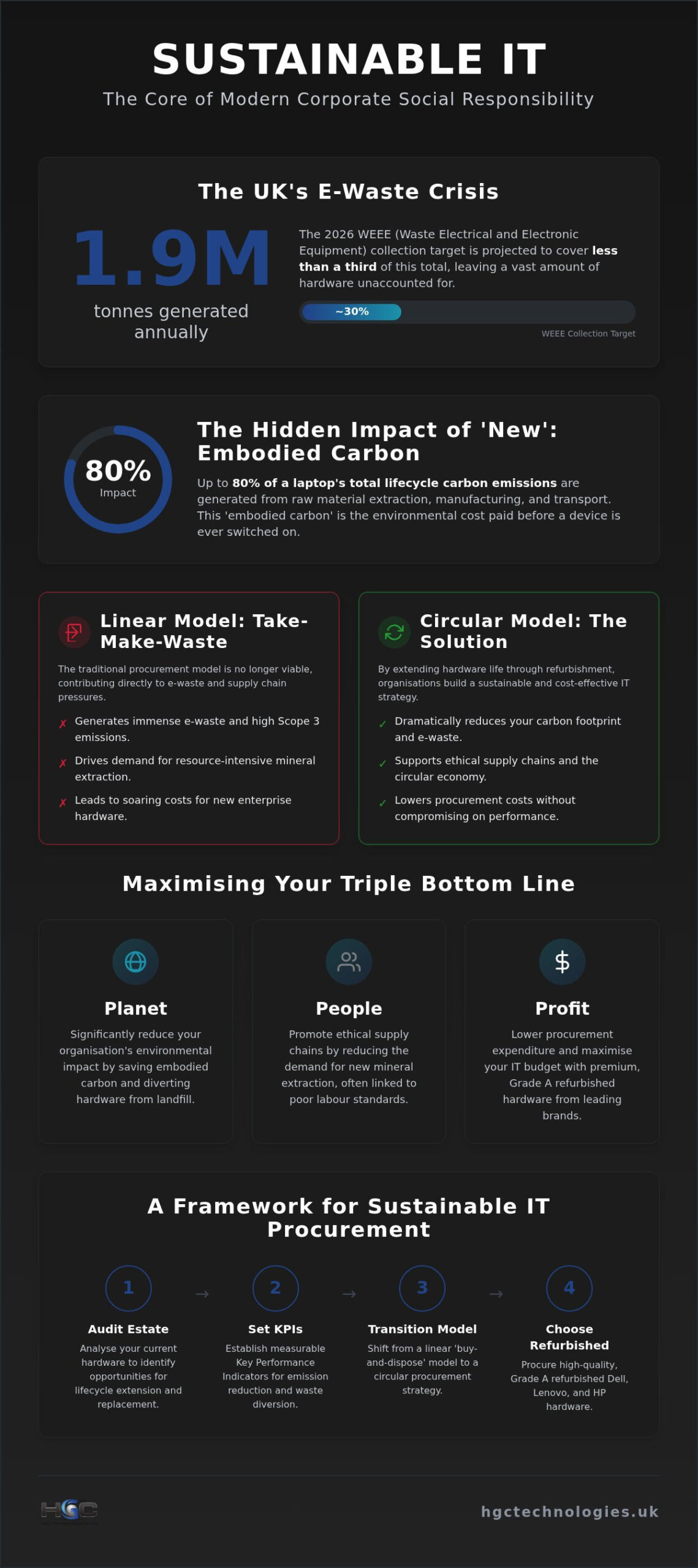
The UK generates approximately 1.9 million tonnes of e-waste annually, yet the 2026 WEEE collection target covers less than a third of this total. Most UK business leaders recognise that the traditional “take-make-waste” procurement model is no longer viable. You’re likely facing intense pressure to report on Scope 3 emissions whilst grappling with the soaring costs of new enterprise hardware. It’s becoming evident that sustainable IT for corporate social responsibility is no longer a peripheral initiative but a core strategic pillar for any forward-thinking organisation.
You deserve a procurement strategy that satisfies both your financial targets and your environmental commitments. This guide promises to show you how integrating professional hardware lifecycle management into your CSR strategy can drastically reduce your carbon footprint and drive measurable impact. We will outline a clear framework for sustainable IT procurement that delivers premium quality Dell, Lenovo, and HP hardware without the environmental guilt, ensuring your business remains a trailblazer in the circular economy.
Key Takeaways
- Understand the critical role of technology in enhancing ESG scores and why hardware lifecycle management is now a vital component of modern CSR reporting.
- Identify the environmental cost of “embodied carbon” in new devices and how choosing refurbished hardware helps your organisation combat the UK’s e-waste challenge.
- Learn how to implement sustainable IT for corporate social responsibility by transitioning to a circular procurement model that doesn’t compromise on performance or reliability.
- Discover the financial advantages of bulk procurement for Grade A refurbished laptops from leading brands like Dell, Lenovo, and HP to maximise your IT budget.
- Gain a clear framework for auditing your current estate and setting measurable KPIs to track the environmental impact of your technology choices.
The Intersection of Sustainable IT and Corporate Social Responsibility (CSR)
Corporate responsibility has undergone a fundamental transformation. In 2026, it’s no longer a peripheral activity restricted to annual charity drives or community grants. It’s a core operational requirement. For UK enterprises, the most significant opportunity for improvement lies within the digital infrastructure. Integrating sustainable IT for corporate social responsibility allows organisations to address their environmental impact at the source rather than attempting to offset it later. This approach directly influences the ‘Triple Bottom Line’ by reducing waste (Planet), supporting ethical supply chains (People), and lowering procurement costs (Profit).
What is Sustainable IT in 2026?
Sustainable IT is the strategic practice of managing hardware lifecycles to minimise environmental harm whilst maximising resource efficiency. This discipline, widely known as Green Computing, has moved beyond simple energy-saving settings on monitors. It now demands a total transition from linear ‘buy-use-dispose’ models to circular frameworks. This shift involves prioritising energy-efficient server solutions and embracing professional refurbishment for end-user devices. By extending the life of a laptop or server, businesses significantly reduce the demand for raw mineral extraction and the energy-intensive manufacturing processes that define the technology industry.
Why CSR Managers are Prioritising Technology
Technology is often the ‘hidden’ factor in ESG scores. Whilst many firms focus on office heating or travel, their IT estate frequently represents a massive portion of their Scope 3 emissions. These are the indirect emissions that occur in an organisation’s value chain, including the production and disposal of hardware. CSR managers now prioritise sustainable IT for corporate social responsibility to align with the United Nations Sustainable Development Goals (SDGs), particularly Goal 12 regarding responsible consumption and production. Adopting a circular approach to hardware doesn’t just satisfy auditors; it resonates with eco-conscious UK consumers who expect the brands they support to demonstrate genuine environmental leadership. Choosing bulk refurbished hardware from established brands like Dell, Lenovo, and HP provides a transparent, data-backed method to prove this commitment.
The Environmental and Social Impact of Hardware Procurement
Hardware procurement is the single largest contributor to an organisation’s digital carbon footprint. Whilst energy efficiency during use is vital, the vast majority of a device’s environmental impact occurs before it ever reaches your desk. This “embodied carbon” represents the total greenhouse gas emissions generated during raw material extraction, manufacturing, and transport. For a typical enterprise laptop, manufacturing can account for up to 80% of its total lifecycle carbon emissions. It’s a staggering figure that many CSR reports overlook.
Social responsibility in the supply chain is equally critical. The mining of minerals like cobalt and tantalum often involves high-risk regions where labour standards are poorly enforced. By extending the life of existing assets, businesses reduce the pressure on these fragile supply chains. This ethical approach is a cornerstone of any robust CSR framework, ensuring that your technology choices don’t come at a human cost. It’s a proactive way to manage your brand’s global impact.
Understanding Embodied Carbon in IT
Manufacturing new technology requires an immense amount of energy and water. It also relies on the extraction of rare earth minerals, a process that frequently causes significant ecological damage. When you choose refurbished hardware, you bypass this initial carbon-heavy phase. This decision effectively “saves” the carbon that would have been emitted to produce a new unit. UK government departments are already refining their sustainable technology procurement processes to tackle these very issues. By opting for professionally refurbished Dell, Lenovo, or HP devices, your business can significantly lower its Scope 3 emissions whilst maintaining high performance standards.
Combating the UK’s E-waste Challenge
The UK generates approximately 1.9 million tonnes of e-waste annually, making it one of the largest producers per capita in the world. For 2026, the national household WEEE collection target has been set at 532,882 tonnes, which is only a fraction of what’s discarded. Much of this waste contains hazardous materials like lead and mercury that can leach into the environment if not managed correctly. Adopting sustainable IT for corporate social responsibility keeps these valuable materials in the circular economy for longer. Extending the lifespan of corporate hardware through professional refurbishment doesn’t just prevent landfill; it democratises access to premium technology for a wider range of organisations. If you’re looking to reduce your environmental footprint, consider how bulk refurbished laptops can transform your procurement strategy into a driver for positive change.
Refurbished vs New: Navigating the Circular Economy in IT
Choosing between new and refurbished hardware is no longer a simple matter of budget. It’s a strategic decision that defines an organisation’s commitment to the circular economy. For UK businesses, implementing sustainable IT for corporate social responsibility requires moving past the outdated belief that refurbished equipment is a compromise. In reality, the transition to professionally refurbished hardware represents a sophisticated approach to asset management that balances high-end performance with aggressive environmental targets.
Performance Myths and Reality
The most persistent myth in procurement is that refurbished devices are less reliable than their factory-new counterparts. This overlooks the fundamental build quality of enterprise-grade hardware. Machines such as the Dell Latitude, Lenovo ThinkPad, and HP EliteBook are engineered for longevity and resilience, unlike consumer-grade alternatives. When these units undergo professional refurbishment, they’re subjected to rigorous component-level testing and diagnostic checks that often exceed standard factory sampling.
Adhering to the Government Buying Standards ensures that your organisation meets high benchmarks for technical specifications whilst prioritising resource efficiency. In the 2026 business landscape, Grade A refurbished units are fully compatible with modern security protocols and the latest enterprise software. They provide a seamless user experience that is indistinguishable from new equipment, ensuring that your workforce remains productive and secure.
The Cost-Sustainability Synergy
Sustainable procurement shouldn’t be a financial burden. One of the most compelling advantages of the circular model is the ability to acquire higher-specification machines within a restricted budget. By opting for bulk Dell refurbished laptops, a business can often secure premium i7 processors and expanded memory capacities for the same cost as entry-level new devices. This allows your IT department to deliver better tools to your staff whilst significantly reducing the organisation’s “embodied carbon” footprint.
The financial savings generated through this model create a virtuous cycle. Capital that was previously tied up in the high margins of new hardware can be reallocated to other CSR initiatives, such as carbon capture projects or community digital literacy programmes. Understanding these Wholesale refurbished IT equipment UK: 2026 strategic market trends is essential for any technical decision-maker. It transforms the IT department from a cost centre into a primary driver of the company’s sustainability agenda. Every refurbished unit deployed is a measurable victory for your ESG reporting, representing a direct reduction in raw material demand and industrial water consumption.
Building a Sustainable IT Procurement Strategy for Your Organisation
Transforming your IT department into a sustainability leader requires a structured, actionable framework. It’s about moving from ad-hoc purchases to a “refurbished-first” policy that integrates with your wider environmental goals. By formalising these processes, you ensure that sustainable IT for corporate social responsibility becomes a repeatable success rather than a one-off project. This transition requires a shift in mindset, viewing every hardware acquisition as a chance to reduce your carbon footprint whilst maintaining operational excellence.
Step 1: The IT Lifecycle Audit
Start by evaluating the remaining lifespan of every device in your current estate. You don’t need to replace everything at once; in fact, doing so often leads to unnecessary waste. Instead, identify “low-impact” roles, such as administrative or standard office positions, where refurbished hardware is the optimal choice. Mapping out a phased replacement schedule helps avoid mass disposal and allows for a more controlled transition to circular procurement. This audit should also establish responsible end-of-life protocols, ensuring that old equipment is recycled or repurposed in accordance with the latest WEEE regulations.
Step 2: Sourcing and Partnership
The success of your strategy depends on your choice of a wholesale laptop distributor UK. You must select a partner that offers transparent grading systems, specifically focusing on Grade A units for corporate environments to ensure cosmetic and functional excellence. Verify their professional refurbishment processes and ensure they provide robust warranty support for your bulk Dell, Lenovo, or HP acquisitions. A reliable partner acts as an extension of your IT team, simplifying the complexities of bulk procurement. If you’re ready to upgrade your fleet, you can view our professional refurbished hardware options to find solutions that match your enterprise standards.
Step 3: Measuring and Reporting Impact
Data is the lifeblood of modern CSR reporting. You must calculate the CO2e savings achieved by opting for refurbished units over new ones to provide concrete evidence for your ESG scores. Tracking the total cost of ownership (TCO) across the hardware lifecycle will also reveal significant financial efficiencies that can be reinvested into other green initiatives. It’s vital to share these sustainability successes with stakeholders and employees. When staff understand that their sustainable IT for corporate social responsibility efforts have saved tonnes of carbon and thousands of litres of water, it fosters a culture of environmental pride throughout the organisation.
Scaling CSR Impact with Bulk Refurbished IT Solutions from HGC Technologies
HGC Technologies UK Ltd. acts as a strategic bridge for organisations ready to move beyond pilot programmes into full-scale circular operations. We provide the infrastructure necessary to make sustainable IT for corporate social responsibility a scalable reality for UK enterprises. Our focus on professional refurbishment ensures that high-volume procurement doesn’t result in a drop in quality or reliability. By partnering with a specialist wholesaler, your business can execute a rapid transition to sustainable hardware whilst maintaining the rigorous standards required by modern technical decision-makers.
Tailored Hardware for UK Enterprises
Many UK offices find that bulk Dell refurbished laptops provide the perfect balance of rugged durability and high-end performance. We also maintain extensive stock of Lenovo and HP systems to ensure consistency across your entire fleet, which is essential for seamless software deployment and IT support. For organisations with more specific technical requirements, we offer custom-built PC and server solutions designed for sustainable data management. These bespoke configurations allow you to meet your exact operational needs whilst adhering to strict environmental standards. We deliver these solutions nationally, providing the logistical expertise required for large-scale deployments across multiple UK sites without compromising on professional standards.
Your Partner in Circular IT
Reliability is the foundation of our business model. Every unit we supply undergoes a rigorous quality assurance process to meet professional standards, ensuring that each device is ready for immediate enterprise use. We don’t just sell hardware; we provide a verified path to lower your Scope 3 emissions through the circular economy. Our direct sales model removes unnecessary layers from the supply chain, ensuring that your transition to sustainable IT for corporate social responsibility is as cost-effective as it is impactful. This approach allows you to maximise your CSR budget whilst securing premium technology for your workforce. We act as a knowledgeable guide, simplifying the complexities of wholesale procurement so you can focus on your core business objectives and long-term sustainability targets.
Ready to transform your procurement strategy? Contact HGC Technologies for a bulk sustainable hardware quote to begin your organisation’s transition to a more responsible and cost-effective technology lifecycle.
Leading the Transition to a Circular Digital Economy
Sustainable IT is no longer an optional extra; it’s a fundamental requirement for any UK business aiming to lead in 2026. By addressing the embodied carbon in your hardware and embracing a circular procurement model, you can turn your IT department into a primary driver of environmental impact. This shift allows you to reduce Scope 3 emissions whilst securing high-performance Grade A equipment that meets the most demanding enterprise standards. It’s a strategy that perfectly aligns your operational needs with your ethical commitments.
Adopting sustainable IT for corporate social responsibility ensures your organisation remains resilient, ethical, and financially efficient. As an authoritative UK wholesale partner, HGC Technologies UK Ltd. specialises in providing bulk refurbished Dell, HP, and Lenovo systems, alongside bespoke custom PC and server configurations tailored for your specific needs. It’s time to move beyond traditional procurement and embrace a model that values long-term stability over short-term gains. Maximise your CSR impact with bulk refurbished laptops from HGC Technologies and lead your industry towards a more responsible digital future. Your journey towards a circular IT estate starts with a single strategic choice.
Frequently Asked Questions
What are the main benefits of sustainable IT for CSR reporting?
Adopting sustainable IT for corporate social responsibility provides concrete, quantifiable data for your annual reports. It allows you to track significant reductions in Scope 3 emissions, which cover the indirect impact of your supply chain. By choosing circular hardware, you demonstrate a commitment to United Nations Sustainable Development Goals, specifically Goal 12. This transparency builds trust with stakeholders and investors who increasingly scrutinise the environmental impact of digital infrastructure and hardware lifecycles.
Is refurbished IT hardware reliable enough for enterprise-level use?
Grade A refurbished enterprise hardware is specifically engineered for professional durability. Unlike consumer models, business-grade machines from Dell, Lenovo, and HP feature robust internal components and modular designs. Every unit undergoes rigorous diagnostic testing and component-level inspection to ensure it meets original factory performance standards. This professional refurbishment process ensures that your workforce receives reliable, high-spec equipment that is fully compatible with modern corporate security protocols and software environments.
How do I calculate the CO2 savings from buying refurbished laptops?
Calculating savings involves comparing the “embodied carbon” of a new device against the footprint of a refurbished unit. Manufacturing a new laptop generates the vast majority of its lifecycle emissions, often up to 80%. By extending the life of an existing machine, you effectively “save” that manufacturing cost. You should consult manufacturer-specific sustainability reports or lifecycle assessment tools to find the exact CO2e values for common enterprise models like the Dell Latitude or HP EliteBook.
Can sustainable IT procurement actually save my business money?
Sustainable IT procurement significantly reduces capital expenditure whilst maintaining high performance. Choosing refurbished hardware allows your organisation to acquire premium, high-specification machines for a fraction of the cost of new units. These savings can be reallocated to other strategic initiatives or used to upgrade your entire fleet more frequently. Because enterprise-grade hardware retains its value and reliability, the total cost of ownership is often much lower than buying entry-level new equipment.
What is the difference between CSR and ESG in the context of IT?
CSR represents the overarching framework and values that drive your organisation’s commitment to social and environmental responsibility. ESG provides the specific, measurable criteria that investors use to evaluate those efforts. In the context of sustainable IT for corporate social responsibility, your CSR policy might dictate a move toward circularity, whilst your ESG reporting provides the precise data on e-waste reduction and carbon savings that proves the policy’s effectiveness to stakeholders.
How does the circular economy apply to corporate server hardware?
The circular economy applies to servers through professional refurbishment and component-level upgrades. Rather than decommissioning entire server racks, businesses can opt for refurbished server solutions that provide the same processing power and reliability as new installations. This approach keeps high-value materials like rare earth minerals in use for longer. Custom-built server solutions can also be configured using professionally tested components, allowing for scalable data management that aligns with your organisation’s broader environmental objectives.
What should I look for in a sustainable IT hardware wholesaler?
You should prioritise wholesalers that offer transparent, component-level grading systems and a proven track record in bulk corporate supply. Ensure they specialise in enterprise brands like Dell, Lenovo, and HP, as these machines are built for longevity. A reliable partner should provide comprehensive quality assurance reports and robust technical support. It’s also vital to verify their national delivery capabilities and their ability to provide custom configurations that meet your specific technical and environmental requirements.
Does HGC Technologies provide warranties on bulk refurbished laptops?
HGC Technologies provides comprehensive warranty support on all bulk refurbished laptops to ensure long-term reliability for our corporate clients. We stand by our professional refurbishment process, which includes rigorous testing of all hardware components. This commitment to quality assurance provides technical decision-makers with the peace of mind that their sustainable procurement choice is backed by expert support. Our warranties are designed to match the high standards expected in the B2B technology sector and enterprise environments.

Case Study: Refurbished Laptops in UK Education in 2026
A refurbished laptop project is only as strong as the evidence behind it. The question behind “cas

Durable Refurbished Laptops for Field Engineers: The 2026 Strategic Buying Guide
Your 2026 engineering budget shouldn't be held hostage by the exorbitant price tags of brand-new ult

How to Configure Server Hardware for UK Business: A 2026 Step-by-Step Guide
Strategic hardware procurement is no longer optional; it's a necessity for survival in a volatile ma