

The Long-Term Reliability of Refurbished Servers: A 2026 Procurement Guide
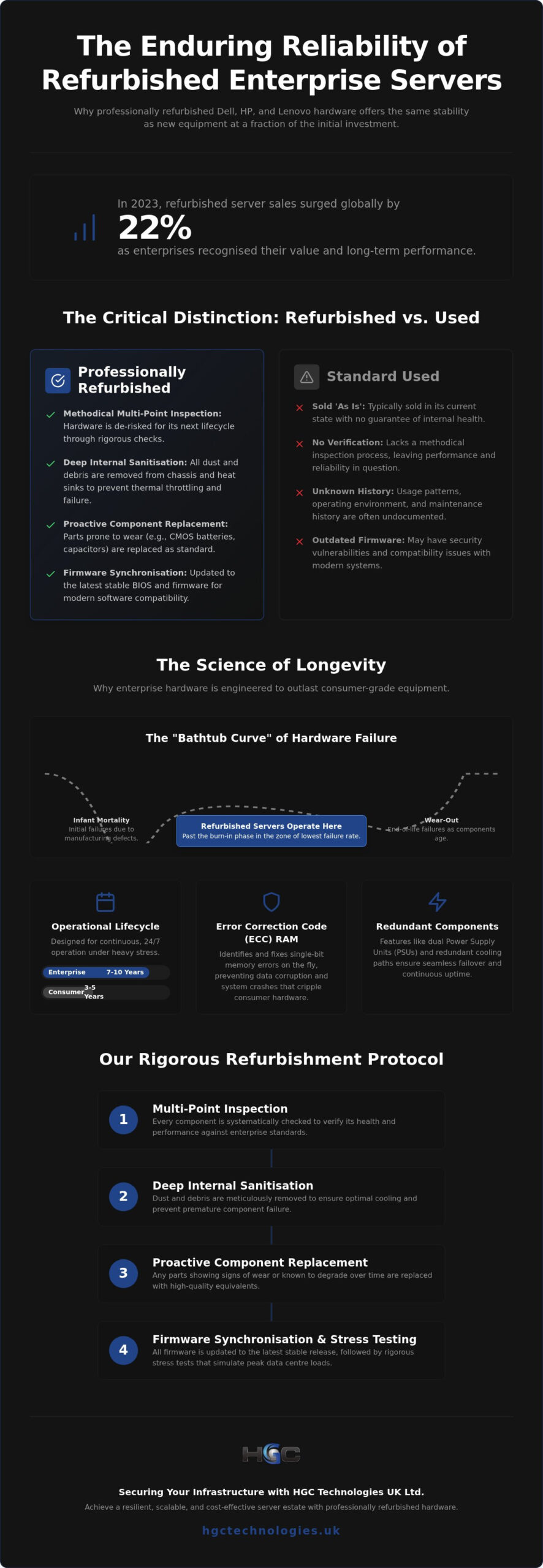
In 2023, refurbished server sales surged by 22% globally as enterprise leaders realised that “new” doesn’t always mean “superior” for the bottom line. You’ve likely felt the mounting pressure of scaling your digital infrastructure whilst facing rising component costs and increasingly rigid budget constraints. It’s natural to harbour concerns that moving away from factory-fresh hardware might invite hardware failure or compromise your operational uptime. However, the long-term reliability of refurbished servers has evolved into a cornerstone of sustainable, high-performance procurement in the UK market.
This 2026 guide demonstrates why professionally refurbished Dell, HP, and Lenovo hardware offers the same stability as new equipment at a fraction of the initial investment. We’ll provide the clarity you need to distinguish between refurbishment grades and understand the rigorous testing standards that ensure enterprise-grade durability. By the end of this article, you’ll have a data-driven framework to present to your stakeholders, proving that you can achieve a resilient, scalable server estate without sacrificing performance or peace of mind. Let’s explore how to optimise your infrastructure for the years ahead.
Key Takeaways
- Learn how to distinguish between standard used hardware and professionally refurbished systems to ensure consistent uptime for mission-critical workloads.
- Understand the technical factors, such as ECC RAM and solid-state durability, that underpin the long-term reliability of refurbished servers in high-demand environments.
- Discover the rigorous stress-testing and firmware update protocols required to de-risk your infrastructure and simulate peak data centre loads.
- Compare the total cost of ownership between new and refurbished hardware to maximise your lifecycle ROI whilst maintaining enterprise-grade standards.
- Recognise the strategic advantage of sourcing bespoke, custom-built server solutions from a specialist UK wholesaler to achieve a scalable and resilient estate.
Defining Reliability in the Refurbished Server Market
Reliability represents a system’s capacity to maintain consistent uptime whilst navigating the rigours of enterprise workloads. For technical decision-makers in 2026, this metric is no longer tied exclusively to the age of the hardware. Instead, it’s defined by the quality of the refurbishment process and the inherent durability of the underlying architecture. As UK businesses increasingly adopt a circular economy model to meet sustainability targets, the long-term reliability of refurbished servers has become a primary consideration for scalable procurement. True reliability is often measured through Mean Time Between Failures (MTBF) data, which indicates that enterprise-grade hardware often exceeds its initial three-year service window by a significant margin. HGC Technologies UK Ltd. facilitates this shift by ensuring every system in our inventory is restored to peak operational standards, providing a stable foundation for your mission-critical applications.
Refurbished vs Used: The Critical Distinction
It’s vital to distinguish between “used” hardware and “professionally refurbished” server systems. A used server is frequently sold in its current state with no verification of its internal health or usage history. In contrast, professional refurbishment involves a methodical multi-point inspection that de-risks the hardware for its next lifecycle. This rigorous approach is what guarantees the long-term reliability of refurbished servers in a high-demand data centre environment. HGC Technologies UK Ltd. oversees every stage of this process to ensure that “pre-owned” never implies “compromised”.
- Deep Internal Sanitisation: Technicians remove all dust and debris from the chassis and heat sinks. This prevents the thermal throttling that can lead to performance degradation or premature component failure.
- Proactive Component Replacement: Parts that are prone to age-related wear, such as CMOS batteries and high-stress capacitors, are replaced as standard.
- Firmware Synchronisation: Every logic board and controller is flashed with the latest stable BIOS and firmware to ensure compatibility with modern software stacks.
The Role of Enterprise-Grade Engineering
The durability of a server is rooted in its engineering. Unlike consumer-grade gear, enterprise servers are built for 24/7 operation under heavy thermal and computational stress. Manufacturers design these systems with redundant cooling paths and over-engineered power delivery to ensure they can withstand years of continuous use. Whilst a standard desktop might reach the end of its life in three to five years, enterprise components are typically designed for a 7-10 year operational lifecycle. This inherent resilience allows refurbished units to perform with the same stability as new hardware. By sourcing these high-spec builds, UK organisations can scale their estates with confidence, knowing the architecture was designed from the ground up for longevity and resilience.
The Science of Longevity: Why Enterprise Hardware Outlasts Consumer Gear
Understanding the long-term reliability of refurbished servers requires a look at the “Bathtub Curve” of hardware failure. This statistical model shows that electronic components are most likely to fail either in the first few months of use, known as infant mortality, or at the very end of their intended lifespan. Professionally refurbished systems sit comfortably in the middle “stable” zone. They’ve already survived the initial burn-in period that claims faulty units, making them statistically more predictable than brand-new hardware that hasn’t yet been stress-tested in a live environment.
Enterprise systems distinguish themselves through redundancy and error correction. Unlike consumer hardware, server-grade equipment utilises Error Correction Code (ECC) RAM. This technology identifies and fixes single-bit memory errors on the fly, preventing system crashes that would otherwise occur over years of continuous operation. Combined with redundant power supply units (PSUs) that allow for seamless failover, the architecture is designed to prioritise uptime above all else. Industry experts often discuss the reliability of refurbished servers as a viable alternative for mission-critical tasks because these core safety features don’t degrade with age.
Component-Level Durability
Server CPUs, such as Intel Xeon or AMD EPYC, are built for extreme durability. These processors rarely fail because they lack moving parts and are manufactured with higher-grade silicon than their desktop counterparts. The motherboards supporting them are equally resilient, featuring high-quality solid capacitors that resist the leaking issues common in older consumer electronics. These boards are engineered to filter out electrical noise, ensuring the long-term reliability of refurbished servers even when running at high utilisation for extended periods. If you’re looking to scale your infrastructure, choosing bespoke server solutions built on this enterprise-grade foundation is a prudent strategic move.
Thermal Management and System Health
Heat is the primary enemy of hardware longevity. Enterprise rack servers employ sophisticated airflow designs, using high-static pressure fans and dedicated shrouds to direct cool air exactly where it’s needed. During the refurbishment process, technicians re-apply high-performance thermal compounds to the CPUs. This ensures optimal heat transfer and prevents the thermal throttling that can plague neglected systems. Modern monitoring tools, such as Dell’s iDRAC or HP’s iLO, provide real-time telemetry on system health. These controllers allow administrators to predict potential fan or drive failures before they impact the business, maintaining a level of stability that consumer gear simply cannot match.
De-risking Your Infrastructure: Testing Protocols and Grading Standards
Rigorous validation is the only way to guarantee the long-term reliability of refurbished servers in a production environment. Whilst the previous sections established the engineering foundations of these systems, the actual verification process is what eliminates hardware uncertainty. By 2026, the industry has moved towards a program-level approach to data security, adhering to the NIST SP 800-88 Rev. 2 standard. This ensures that every storage medium is sanitised using documented, holistic processes before the hardware is reconfigured. HGC Technologies UK Ltd. follows these industrial testing protocols and grading standards to ensure that every system meets the same operational specifications as it did when it first left the factory.
Software-level integrity is just as critical as mechanical health. A professional refurbishment cycle includes flashing all components, from the BIOS to the RAID controllers, to the latest stable firmware versions. This proactive step prevents security vulnerabilities and ensures the hardware remains compatible with modern virtualisation layers and operating systems. By addressing these software foundations, HGC Technologies UK Ltd. ensures that the system is ready for years of stable service without the risk of legacy code causing unexpected downtime.
The Professional Testing Checklist
Technical decision-makers require evidence of exhaustive stress-testing before integrating refurbished units into their estate. Every system undergoes a multi-stage diagnostic suite to simulate the most demanding data centre conditions.
- CPU Stress Testing: Technicians run computational workloads at 100% utilisation for extended periods. This identifies any thermal instabilities or instruction set errors that might only appear under heavy load.
- Memory Diagnostics: Every DIMM slot is tested for bit-level accuracy. This identifies and replaces faulty modules that could otherwise cause intermittent system crashes or data corruption.
- Storage Health Checks: We analyse SMART data to evaluate drive longevity. Only media with healthy endurance ratings and no sector errors remains in the system to ensure the long-term reliability of refurbished servers.
Understanding Grading for Server Chassis
Grading systems provide the transparency needed to align procurement with specific deployment environments. Whilst the internal performance is verified across all units, the external condition is categorised to help organisations balance aesthetics with budget requirements.
- Grade A: These units are in near-mint condition. They’re the ideal choice for front-facing racks or clients who require a “like-new” appearance for their infrastructure.
- Grade B: You might find minor cosmetic marks or light scratches on the chassis. These are purely aesthetic and don’t affect the cooling efficiency or the operational performance of the server.
- Grade C: Visible wear is present, but the hardware remains fully functional. These units offer the highest cost savings and are perfect for internal testing labs or back-office environments where appearance is secondary to performance.
Calculating the Total Cost of Ownership (TCO) and Lifecycle ROI
Procurement is a balancing act between performance and expenditure. In 2026, the performance-per-pound ratio for 14th and 15th generation enterprise units remains remarkably high. These systems handle modern virtualisation and AI-adjacent workloads whilst requiring significantly lower capital expenditure (CAPEX) than brand-new equivalents. When you factor in the long-term reliability of refurbished servers, the lifecycle ROI becomes undeniable. You aren’t just saving on the initial buy; you’re bypassing the steep depreciation curve that hits new hardware the moment it leaves the factory.
Maintenance costs also play a pivotal role in the TCO calculation. OEM support contracts for new equipment often carry premium price tags that don’t necessarily reflect superior service levels. Transitioning to Third-Party Maintenance (TPM) for refurbished estates provides equivalent service-level agreements for a fraction of the cost. This financial agility allows UK businesses to scale infrastructure at pace. Instead of waiting for a single new node to clear budget hurdles, that same investment can often secure a redundant, high-availability cluster of refurbished units.
Hidden Savings Beyond the Purchase Price
Lead times are a critical factor in 2026. New OEM hardware orders often face delays due to global supply chain volatility. Refurbished equipment is generally available for immediate dispatch, allowing you to deploy critical infrastructure without waiting months for a delivery. Additionally, purchasing through sustainable channels can provide tax benefits under UK green procurement frameworks, which lowers the effective cost of ownership even further. Lower depreciation rates also mean that if you choose to decommission the hardware in the future, you’ll recover a higher percentage of your initial investment compared to new gear.
Environmental Impact as a Business Value
ESG (Environmental, Social, and Governance) targets are now a core component of UK corporate strategy. Extending a server’s operational life by five years dramatically reduces the carbon footprint associated with manufacturing and global shipping. Aligning your procurement with the UK’s 2026 sustainability standards proves to stakeholders that your growth is responsible. This ethical stance doesn’t just lower costs; it positions your organisation as a forward-thinking leader in the circular economy. By choosing refurbished, you’re actively participating in a system that values durability over disposability.
To start building a more cost-effective data centre, view our current server solutions today.
Securing Your Infrastructure with HGC Technologies UK Ltd.
Choosing a procurement partner is as critical as selecting the hardware itself. HGC Technologies UK Ltd. acts as a strategic guide for businesses seeking to scale their digital infrastructure whilst maintaining operational excellence. We focus on providing high-performance, professionally refurbished systems from leading brands like Dell, HP, and Lenovo. Our direct sales model is designed for transparency and speed. It serves organisations that prefer straightforward procurement over the complications of complex financing models or lease-to-own programmes. By focusing on the enterprise server hardware UK market, we offer a national reach that supports corporate estates from the edge to the core.
The long-term reliability of refurbished servers depends on the expertise behind the refurbishment. HGC Technologies UK Ltd. applies industrial standards to every unit in our inventory. We ensure that your hardware arrives ready for immediate deployment in mission-critical environments. This dedication to quality allows you to build a resilient server estate that rivals the stability of new equipment at a significantly lower cost. We help you navigate the transition to a more sustainable, high-performance IT model without compromising on durability or support.
Bespoke Configurations for High Performance
Standard off-the-shelf solutions often fail to meet the specific demands of niche enterprise applications. We organise bespoke server builds that allow you to customise RAM capacity, storage tiers, and processor speeds to match your precise workload requirements. This flexibility ensures that your hardware is never under-utilised or over-provisioned. We also verify that every configuration maintains full compatibility with your existing rack infrastructure and power delivery systems. Bespoke builds represent the intersection of cost-efficiency and tailored performance. This tailored approach maximises your hardware investment whilst ensuring the long-term reliability of refurbished servers across your entire network.
Partnering for Long-Term Stability
Sustainable IT procurement is no longer a niche choice; it’s a strategic advantage in the 2026 business landscape. HGC Technologies UK Ltd. remains committed to professional server solutions that align with the UK’s evolving environmental standards. We provide the technical expertise and logistical support needed to transition your legacy estate to a modern, circular model. Our national UK coverage ensures that your procurement needs are met with precision and reliability. We act as a trailblazer in the market, shaping high standards for the refurbished sector through our rigorous testing and strategic alliances. Contact HGC Technologies UK Ltd. to discuss your next enterprise server hardware UK project and secure the future of your infrastructure.
Future-Proofing Your Data Centre with Confidence
The evolution of the UK IT market has proven that high performance doesn’t require the premium price tag of factory-new hardware. By prioritising the long-term reliability of refurbished servers, your organisation can scale its digital infrastructure whilst meeting stringent ESG targets. You’ve seen how rigorous stress-testing and enterprise-grade engineering bridge the gap between cost and stability. This strategic shift allows for a more agile, resilient estate that’s ready for the demands of 2026 and beyond.
HGC Technologies UK Ltd. stands ready as your strategic partner in this transition. Founded in 2020, we’re a specialist UK wholesaler dedicated to providing high-performance infrastructure through a direct national supply model. Our expertise in bespoke, custom-built server solutions ensures that your hardware is precisely tailored to your operational needs. We invite you to explore our range of high-performance enterprise server solutions to discover how we can support your next growth phase. It’s time to build a more sustainable, cost-effective future for your enterprise.
Frequently Asked Questions
Are refurbished servers as reliable as new ones for 24/7 operation?
Yes, provided they undergo professional refurbishment. Enterprise hardware from brands like Dell, HP, and Lenovo is engineered specifically for 24/7 workloads. Professional refurbishment includes rigorous stress testing and component validation that often exceeds standard factory checks. This meticulous process ensures the long-term reliability of refurbished servers remains comparable to new units when deployed in demanding production environments.
What is the typical lifespan of a professionally refurbished server?
You can expect a professionally refurbished enterprise server to provide five to seven years of stable service. Since these systems utilise high-grade silicon and solid-state components designed for a ten-year lifecycle, a unit that is three years old at the point of refurbishment still has significant operational life remaining. Regular maintenance and controlled thermal environments in your data centre will further extend this longevity.
Do refurbished servers come with a warranty or support?
Yes, reputable specialist wholesalers provide their own warranties and support packages to protect your investment. Whilst the original manufacturer’s warranty may have expired, professional third-party maintenance offers equivalent protection levels. HGC Technologies ensures that all server solutions are backed by professional support, giving you the same peace of mind you would expect with new hardware throughout its next lifecycle.
How much can a UK business realistically save by choosing refurbished hardware?
UK businesses often achieve capital expenditure savings of 50% to 80% compared to purchasing brand-new OEM hardware. These substantial savings allow for faster infrastructure scaling or the deployment of redundant, high-availability clusters that might otherwise be unaffordable. By bypassing the initial depreciation hit, your organisation retains more capital for other critical digital transformation projects whilst maintaining enterprise-grade standards.
Can I upgrade the components in a refurbished server later?
Absolutely. One of the primary advantages of enterprise platforms is their modularity and ease of expansion. You can scale RAM, upgrade processors, or add high-capacity storage drives as your business requirements grow. HGC Technologies specialises in bespoke configurations, meaning we can help you customise your system at the point of purchase and provide compatible parts for any future hardware expansions.
What happens if a component fails in a refurbished server?
Component failures are managed through your support contract or warranty provider. Because enterprise servers feature redundant power supplies and hot-swappable drives, many individual part failures don’t cause system downtime. You simply swap the faulty part for a replacement module. This modular design is a key factor in the long-term reliability of refurbished servers, allowing for rapid repairs without the need to replace the entire unit.
Is it difficult to find spare parts for older refurbished server models?
No, the market for spare parts for major brands is vast and highly accessible across the UK. Because these models are produced in such high volumes, components like fans, power supplies, and logic boards remain available for many years after the product is decommissioned by the OEM. Specialist wholesalers maintain extensive inventories to ensure your systems remain operational and supported for their entire service life.
How does refurbished server hardware impact my company’s carbon footprint?
Choosing refurbished hardware significantly reduces your carbon footprint by extending the lifecycle of existing electronics. It avoids the energy-intensive manufacturing process and the carbon emissions associated with shipping new units globally. By 2026, aligning IT procurement with these circular economy principles is essential for meeting UK corporate ESG targets and reducing the environmental impact of electronic waste.

Post-Purchase Support for Wholesale Laptops: A 2026 Strategic Guide for UK Resellers
In the competitive UK IT hardware market, a low unit price is often a Trojan horse for hidden operat

Mobile Hardware Distributor UK: The 2026 Strategic Procurement Checklist
Did you know that whilst UK businesses can save up to 50% by sourcing refurbished handsets, a single

BYOD Policy vs Corporate-Owned Refurbished Laptops: The 2026 Strategic Comparison
The long-held belief that letting employees use their own devices saves your budget is a costly misc