

7 Strategic IT Budget Optimisation Strategies for UK Businesses in 2026
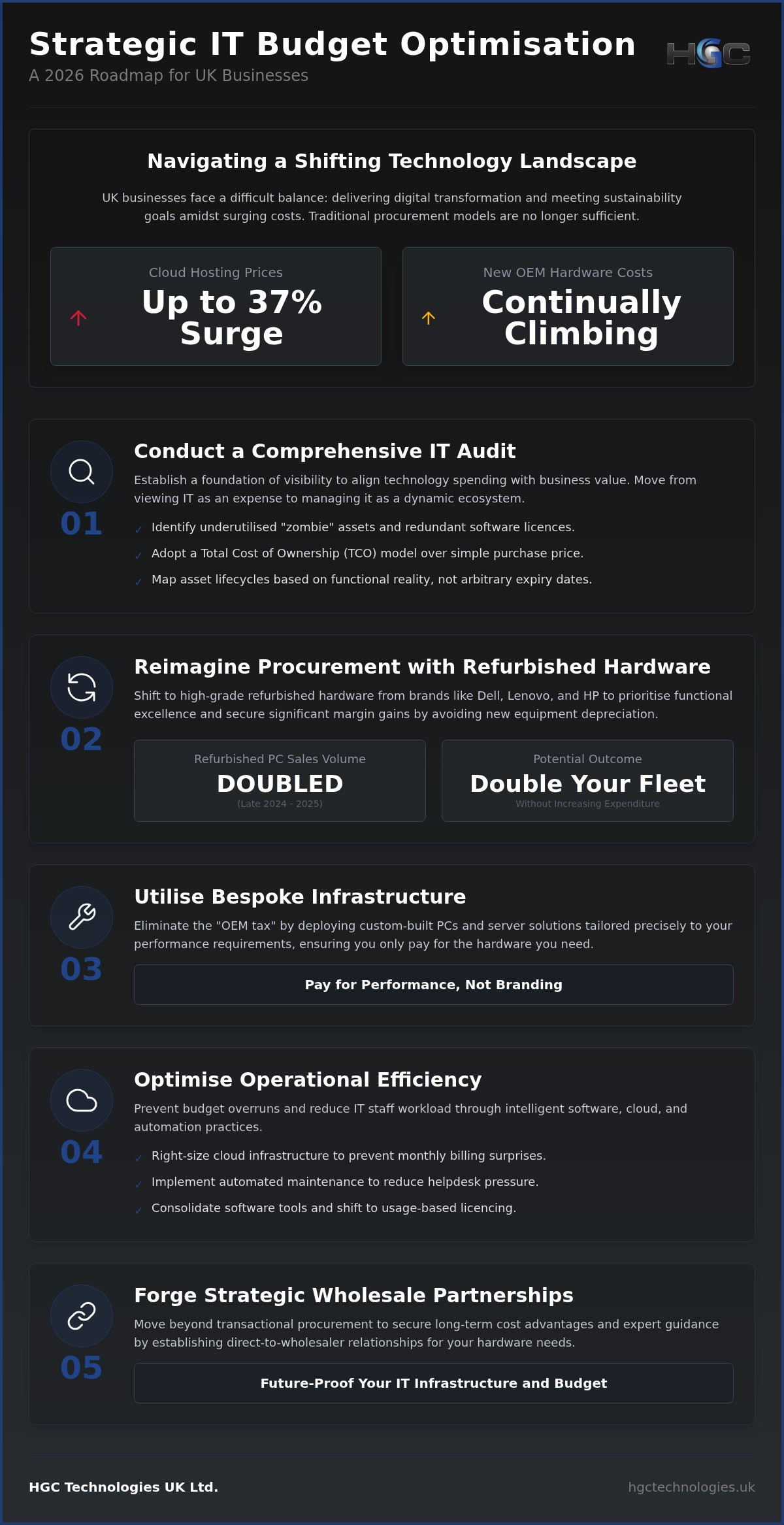
The volume of refurbished PCs sold through UK distributors doubled between late 2024 and 2025, signalling a massive shift in how enterprise technology is acquired. This isn’t just a trend; it’s a necessary response to a market where cloud hosting prices have surged by up to 37% and OEM hardware costs continue to climb. You likely feel the pressure to deliver cutting-edge digital transformation whilst meeting increasingly strict corporate sustainability goals on a tightening budget. It’s a difficult balance to maintain when traditional procurement models no longer serve your bottom line.
This article outlines seven strategic IT budget optimisation strategies UK businesses can deploy in 2026 to reduce technology overheads and maximise ROI. You’ll discover how professional procurement and circular lifecycle management provide a pathway to lower Total Cost of Ownership without compromising on performance. We will explore how high-grade refurbished units and bespoke server configurations allow you to bypass the premium of buying new, ensuring your infrastructure remains resilient, scalable, and environmentally responsible. By the end of this guide, you’ll have a clear roadmap for partnering with reliable specialists to secure high-performance hardware that fits your financial constraints.
Key Takeaways
- Conduct a comprehensive IT audit to align technology expenditure with actual business value whilst identifying underutilised hardware and cloud assets.
- Implement high-impact IT budget optimisation strategies UK by transitioning to Grade A bulk refurbished laptops from leading brands like Dell, Lenovo, and HP.
- Eliminate the “OEM tax” by utilising custom-built PCs and server solutions tailored to your specific performance requirements rather than paying for unnecessary branding.
- Optimise operational efficiency through right-sized cloud infrastructure and automated maintenance to prevent monthly billing surprises and reduce helpdesk pressure.
- Forge strategic wholesale partnerships to move beyond transactional procurement and secure long-term cost advantages through direct-to-wholesaler relationships.
Establishing the Foundation: The Comprehensive IT Audit
Strategic alignment is the cornerstone of any successful technology roadmap. Effective IT budget optimisation strategies UK begin not with a spreadsheet of costs, but with a deep understanding of how every pound spent contributes to business value. You must treat your IT infrastructure as a dynamic ecosystem rather than a static expense. This requires a granular inventory of every hardware component, software subscription, and cloud instance currently in operation across your organisation. Without this baseline, you’re essentially managing your assets in the dark.
Visibility is the primary barrier to efficiency. Adopting IT cost transparency principles allows your leadership team to see the direct link between technology spending and service delivery. This shift enables you to identify “zombie” assets; those underutilised servers or forgotten software licences that continue to drain resources without providing a return. Transitioning to a Total Cost of Ownership (TCO) model is one of the most effective IT budget optimisation strategies UK firms can adopt. It forces a move away from simple purchase price metrics toward a more accurate calculation that accounts for maintenance, energy consumption, and support requirements over the asset’s entire life.
Mapping Asset Lifecycles
Prioritise your hardware replacements based on functional reality rather than arbitrary expiry dates. Identify equipment reaching the end of its functional life by evaluating the performance gap between existing units and modern workload requirements. Whilst a five-year-old server might still run, its increased failure risk and power inefficiency often exceed the cost of a modern, professionally refurbished alternative. Focus your budget on mission-critical infrastructure first, ensuring that high-performance hardware is allocated where it generates the most impact. It’s often more strategic to redeploy older units to low-demand tasks whilst investing in bespoke builds for your core operations.
Identifying Redundant Licencing
Software bloat is a silent budget killer in the modern enterprise. Analyse usage patterns amongst different departments to uncover duplicate tools that perform identical functions. It’s common for marketing and sales teams to use separate project management platforms that could be consolidated into a single enterprise licence. Where possible, transition from rigid seat-based contracts to usage-based models. This ensures you only pay for the value your team actually extracts from the software, preventing the accumulation of “shelfware” that plagues many UK businesses. Consolidation doesn’t just save money; it simplifies your security posture and reduces the management burden on your IT staff.
Reimagining Procurement: The Role of Bulk Refurbished Hardware
Procurement remains one of the largest capital outlays for any organisation. Whilst the allure of unboxing factory-new hardware is strong, the “new is always better” myth is a luxury most modern businesses can no longer afford. For those seeking effective IT budget optimisation strategies UK, shifting toward high-grade refurbished hardware is a game-changer. It’s about prioritising functional excellence over aesthetic novelty. When you source enterprise-grade equipment that has undergone professional refurbishment, you aren’t just saving money; you’re securing hardware built for a much longer lifecycle than standard consumer models. This approach allows you to secure significant margin gains by avoiding the steep depreciation that hits new equipment the moment it leaves the warehouse.
The Economic Case for Refurbished Dell and Lenovo
The economic case for refurbished Dell and Lenovo units is undeniable. These business-class machines are designed with modularity and durability in mind, making them ideal candidates for a second life. UK schools and NGOs, in particular, have found that bulk Dell refurbished laptops offer a price-to-performance ratio that new units simply cannot match. By opting for these models, organisations can often double the size of their fleet without increasing their total expenditure. This isn’t a compromise on performance. It’s a strategic decision to invest in proven technology that has already demonstrated its reliability in the field. If you are looking to refresh your office hardware, you can browse our bulk refurbished inventory to find the right fit for your team.
Quality Assurance and Grading Standards
Quality assurance is what separates a professional wholesaler from a standard reseller. Sourcing from a reputable wholesale laptop distributor UK ensures that every unit meets strict grading standards. Grade A units, for instance, are virtually indistinguishable from new machines, exhibiting minimal signs of previous use. The refurbishment process involves rigorous stress testing, data sanitisation, and the installation of authentic components. This methodical approach guarantees that the hardware you receive is ready for immediate deployment. By understanding the nuances between Grade A, B, and C classifications, procurement officers can make informed decisions that align with specific departmental needs and budget constraints. This level of clarity is essential for any modern IT budget optimisation strategies UK, ensuring that performance never takes a backseat to cost savings.
Bespoke Infrastructure: Custom PC Builds vs. OEM Constraints
Proprietary hardware often locks organisations into a cycle of unnecessary spending. Whilst major manufacturers offer convenience, they frequently bundle features and branding that provide zero functional value to your specific operations. This “OEM tax” is a hidden drain on corporate resources, forcing businesses to pay for aesthetic designs or software bloatware they’ll never use. Effective IT budget optimisation strategies UK firms are now adopting focus on stripping away these superfluous costs in favour of bespoke infrastructure. By moving toward custom-built systems, you regain control over your hardware specifications and ensure that every pound spent is directly tied to a performance requirement.
Precise resource allocation is the hallmark of a bespoke build. Instead of accepting the rigid configurations offered by off-the-shelf models, custom systems allow you to prioritise the components that matter most to your team. For example, a data-heavy department might require expanded RAM and NVMe storage but have no need for a high-end dedicated GPU. Custom builds enable this level of granular control, preventing the “over-speccing” that often occurs with standard procurement. Additionally, the modularity of bespoke systems offers a significant long-term maintenance advantage. By selecting standardised internal components that adhere to open standards, you ensure that future repairs don’t require expensive, brand-specific parts that are often subject to supply chain delays.
Tailoring Hardware to Professional Roles
Designing workstations for specific professional roles is a powerful way to eliminate “feature creep” in your desktop deployments. A standard office user does not require the same power as a video editor, yet many firms buy identical, mid-range OEM machines for both, leaving one user frustrated and the other with wasted capacity. Utilising custom built business PCs UK allows you to optimise technical workflows by matching the hardware to the task. This strategic approach ensures that high-performance tasks receive the necessary resources whilst standard office deployments remain lean and cost-effective. It’s a method that prioritises functional longevity over brand prestige.
Scalable Server Solutions
Configuring server hardware for specific enterprise workloads is essential for maintaining a lean data centre. Bespoke server builds offer a level of scalability that proprietary, locked-in systems simply cannot match. When your infrastructure is built on open standards, you can upgrade storage or processing power as your business grows without being forced into a total hardware refresh by an OEM’s end-of-life policy. This flexibility is a core component of modern IT budget optimisation strategies UK. Furthermore, custom builds allow for better control over energy efficiency. By selecting high-efficiency power supplies and cooling configurations tailored to your specific environment, you can significantly reduce the long-term operational costs of your server room.
Operational Efficiency: Software, Cloud, and Automation
Efficiency isn’t solely defined by your procurement choices; it’s equally dependent on how you manage your existing digital ecosystem. Many organisations fell into the “Cloud-First” trap, assuming that off-site hosting would naturally lead to lower costs. However, with major providers like Hetzner increasing cloud server prices by up to 37% in early 2026, the narrative has shifted toward a “Cloud-Smart” approach. This strategy involves a rigorous evaluation of which workloads truly benefit from the cloud and which are more cost-effectively managed on-premise. For many, maintaining core infrastructure on bespoke server hardware provides greater financial predictability and avoids the volatile pricing driven by global DRAM shortages.
Automation serves as a force multiplier for your technical team. By implementing automated scripts for routine maintenance, security patching, and basic helpdesk triage, you reduce the human overhead associated with infrastructure management. This allows your high-value staff to focus on strategic initiatives rather than repetitive administrative tasks. Simultaneously, investing in staff training for existing tools often yields a higher ROI than purchasing new software. Most teams only utilise a fraction of their current software capabilities. Unlocking these features can eliminate the perceived need for additional, expensive subscriptions.
Controlling Cloud Sprawl
Cloud sprawl is a silent budget killer. A 2026 report indicated that approximately 29% of IaaS and PaaS spending is entirely wasted on idle or forgotten environments. Effective IT budget optimisation strategies UK must include monthly audits to identify and shut down these unused instances. For predictable, long-term workloads, you should utilise reserved instances to secure lower rates compared to on-demand pricing. Implementing strict provisioning policies ensures that new environments aren’t created without a clear business case and an associated sunset date. If you’re looking to rebalance your infrastructure, explore our server solutions to see how on-premise hardware can stabilise your operational costs.
Open-Source and Alternative Licencing
Evaluate open-source alternatives for non-critical business applications to significantly reduce your annual recurring costs. Whilst mission-critical systems may require enterprise support, many internal tools for project management or development environments have robust open-source counterparts. When negotiating enterprise agreements, focus on actual headcount usage rather than vague “per-device” models that lead to overpayment. Licence optimisation is the continuous process of aligning software entitlements with actual usage patterns to ensure compliance with the Data (Use and Access) Act 2025 whilst eliminating redundant expenditure. This methodical approach ensures your software stack remains lean and fully compliant with the latest UK standards.
Future-Proofing via Strategic Wholesale Partnerships
Transactional buying is a reactive habit that leaves your organisation vulnerable to market volatility. To truly master IT budget optimisation strategies UK, you must move beyond ad-hoc purchasing and establish strategic procurement partnerships. A direct relationship with a specialist wholesaler provides a level of financial and operational stability that standard retail channels can’t match. By skipping the middlemen, you secure better margins and gain a knowledgeable guide who understands your long-term infrastructure goals. These alliances aren’t just about lower unit costs; they’re about ensuring your business remains resilient in the face of global supply chain fluctuations.
Reliability is the currency of a successful partnership. When you work directly with a UK-based wholesaler, you benefit from localised expertise and a physical inventory that’s ready for immediate dispatch. This proximity is vital when you need to scale operations quickly or replace mission-critical hardware without waiting weeks for international shipping. A dedicated partner acts as an extension of your procurement team, helping you navigate the complexities of hardware lifecycles whilst ensuring that your technology stack remains consistent across every department. This consistency simplifies maintenance and reduces the training burden on your staff, contributing to a lower Total Cost of Ownership over time.
The Circular Economy Advantage
Aligning your IT procurement with the circular economy is no longer just a corporate social responsibility (CSR) exercise; it’s a financial imperative. By integrating wholesale refurbished computers UK into your fleet, you significantly reduce e-waste whilst simultaneously lowering your technology overheads. This sustainable approach provides substantial marketing value, allowing you to demonstrate a tangible commitment to ESG targets. Investors and clients increasingly favour organisations that prioritise environmental stewardship, making refurbished hardware a strategic asset for your brand’s reputation and your bottom line. It’s a rare scenario where doing the right thing for the planet is also the most profitable choice for the business.
Inventory Planning and Direct Supply
Forecasting your hardware needs in collaboration with a wholesaler allows for more precise budget allocation. Instead of reacting to sudden shortages, you can organise your rollouts based on verified inventory levels. This proactive planning ensures consistent specifications for large-scale team deployments, preventing the “mix-and-match” hardware environments that complicate IT support. Sourcing from a UK-based inventory means you can bypass the unpredictability of customs delays and fluctuating import duties. It’s a methodical approach to supply chain management that ensures your team always has the tools they need to perform, regardless of wider market disruptions. By securing a reliable pipeline of high-performance equipment, you protect your digital transformation projects from the delays that often derail ambitious business goals.
Securing Your Digital Future through Strategic Value
True IT resilience in 2026 demands a departure from outdated procurement habits. You’ve seen how a comprehensive audit exposes hidden waste and how bespoke builds outperform rigid proprietary models. By embracing the circular economy and right-sizing your cloud spend, you transform IT from a mounting expense into a lean, strategic asset. These IT budget optimisation strategies UK businesses are now adopting provide the foundation for sustainable growth and technical excellence whilst maintaining a competitive edge.
Reliability shouldn’t come with a premium price tag. You can optimise your IT budget with Grade A refurbished hardware from HGC Technologies. As specialists in Dell, Lenovo, and HP refurbishment, we maintain a comprehensive UK-based wholesale inventory to ensure your team remains equipped without delay. Whether you require bespoke server and PC configurations or large-scale fleet rollouts, our direct wholesale model offers a distinct cost advantage. The path to a more efficient infrastructure is clear; it’s time to lead your organisation into a new era of technical and financial performance.
Frequently Asked Questions
What are the best IT budget optimisation strategies for UK businesses in 2026?
The most effective approach involves a combination of circular procurement, right-sizing cloud infrastructure, and adopting bespoke hardware builds. These IT budget optimisation strategies UK firms are prioritising ensure that capital expenditure aligns with actual performance needs rather than brand prestige. By combining professional refurbishment with automated operational maintenance, businesses can significantly reduce their total cost of ownership whilst maintaining high technical standards.
Is refurbished IT hardware reliable enough for enterprise environments?
Professionally refurbished enterprise-grade hardware often meets or exceeds the reliability of new consumer-grade equipment. Units from leading brands like Dell, Lenovo, and HP are designed for modularity and durability, allowing them to undergo rigorous stress testing and data sanitisation. When sourced through a specialist wholesaler, these machines provide a stable and high-performance foundation for mission-critical corporate tasks.
How much can a business save by switching to refurbished laptops?
Organisations typically realise substantial capital expenditure savings, often allowing them to double their fleet size for the same budget as new equipment. Whilst exact figures vary based on specifications, the price-to-performance ratio of Grade A refurbished units is significantly higher than factory-new alternatives. This financial flexibility enables businesses to redirect funds toward other digital transformation projects or critical security upgrades.
What is the difference between Grade A and Grade B refurbished laptops?
Grade A units are in near-mint condition with minimal, if any, visible signs of previous use. In contrast, Grade B laptops may show light cosmetic wear, such as minor scratches or scuffs, but remain fully functional and undergo the same internal testing. For client-facing roles, Grade A is the standard choice, whilst Grade B offers even deeper savings for internal back-office functions.
Why should a UK business consider custom-built PCs over brand-name OEMs?
Custom-built PCs eliminate the “OEM tax” by ensuring you only pay for the specific components your team requires. Brand-name manufacturers often bundle unnecessary features or proprietary parts that are difficult to repair. Bespoke builds allow for precise resource allocation, such as prioritising high-speed storage or specific RAM configurations, which results in a more efficient and easily maintainable hardware environment.
How does the circular economy impact IT procurement costs?
The circular economy reduces procurement costs by extending the functional life of high-quality hardware and minimising the need for constant new purchases. By integrating refurbished tech, businesses lower their e-waste and meet ESG targets whilst benefiting from the lower price points of secondary-market equipment. This approach transforms IT from a linear “buy-and-discard” cycle into a sustainable, cost-effective resource management strategy.
Can custom servers be as secure as proprietary enterprise solutions?
Custom servers are equally secure because they utilise the same industry-standard security protocols and hardware-level protections as proprietary models. By using open-standard components, IT teams have greater visibility over the hardware stack and can implement bespoke security configurations tailored to their specific network environment. This transparency often makes it easier to patch vulnerabilities and maintain compliance with UK data protection standards.
What role does an IT audit play in budget optimisation?
An IT audit provides the essential data baseline needed to identify “zombie” assets and redundant software licences. It allows you to map asset lifecycles and prioritise hardware refreshes based on actual performance gaps rather than arbitrary timelines. This foundational step ensures that any IT budget optimisation strategies UK organisations implement are based on accurate usage data and clear business objectives.

Refurbished Laptops Reseller Supplier: The 2026 Resource Guide for UK IT Partners
Did you know that the UK has officially overtaken Germany as the largest market for refurbished PCs

How to Configure Server Hardware for UK Business: A 2026 Step-by-Step Guide
Strategic hardware procurement is no longer optional; it's a necessity for survival in a volatile ma

Refurbished Hardware for Disaster Recovery: Practical Guide
Could refurbished hardware strengthen your recovery plan, or create another point of failure? The an