

Bulk Smartphone Supply for UK Corporate Clients
A bulk smartphone order should start with a clear fleet requirement, not a guessed handset count. In the UK, specialist suppliers commonly treat orders of 10 or more devices as business bulk purchases. To place an order, set out the models, quantities, condition and delivery destination, then establish stock, minimum order quantities and supply terms. These details give bulk smartphones for corporate clients in the UK a clear route from initial brief to purchase order.
Before committing to bulk smartphones for corporate clients in the UK, get the practical details straight, particularly when several teams or resale customers depend on the same supply. This guide explains how to define an order, assess stock and quantities, and consider delivery, returns and after-sales support. It also shows how bulk smartphone supply can meet the needs of UK organisations equipping staff and resellers sourcing devices for customers.
Key Takeaways
- Build a clear purchase order around handset models, quantities, condition and delivery requirements to make the ordering process more straightforward.
- Minimum quantities vary by model, so understand how stock levels and order thresholds affect your chosen devices.
- Review device grading, accessory details and compatibility when planning a smartphone or tablet fleet.
- Compare delivery, returns and after-sales terms as part of your procurement decision, then consider how HGC Technologies UK’s original smartphones fit your requirements.
Delivery, returns and after-sales support
When comparing suppliers, look beyond the handset price. Check the full quote alongside delivery arrangements, warranty coverage, returns terms and support. Costs depend on the models, condition and quantity selected. Delivery arrangements depend on stock and destination, while warranty terms and support procedures vary by supplier.
For UK delivery, confirm when an order must be placed to dispatch and how tracking details are shared. Ask how split shipments are managed if models are fulfilled separately. A multi-model order, for example, may arrive in separate consignments, so clear packing information helps receiving teams reconcile each delivery.
Provide the complete delivery address, postcode and any separate site addresses with the order. For a distributed organisation, list each location and the handset quantities assigned to it. This gives the supplier a clear delivery plan and helps receiving teams match devices to the right site.
Before payment, read the written terms for damaged, faulty or incorrectly supplied devices. Confirm how to report an issue, any applicable time limits, and whether exchanges or refunds are available. Keep the purchase order and delivery records together so discrepancies can be checked against the original shipment.
After-sales support should explain how to report a fault, what information to provide and how warranty claims are handled. Record each handset model and delivery date against the relevant team or site. For bulk orders, this makes it easier to identify the devices involved when a support request arises.
Before placing an order, confirm the destination addresses, delivery arrangements, returns terms, warranty coverage and support process. Comparing these details alongside the models and quantities makes supplier terms easier to assess before a fleet purchase.
Bulk smartphone stock and minimum order quantities
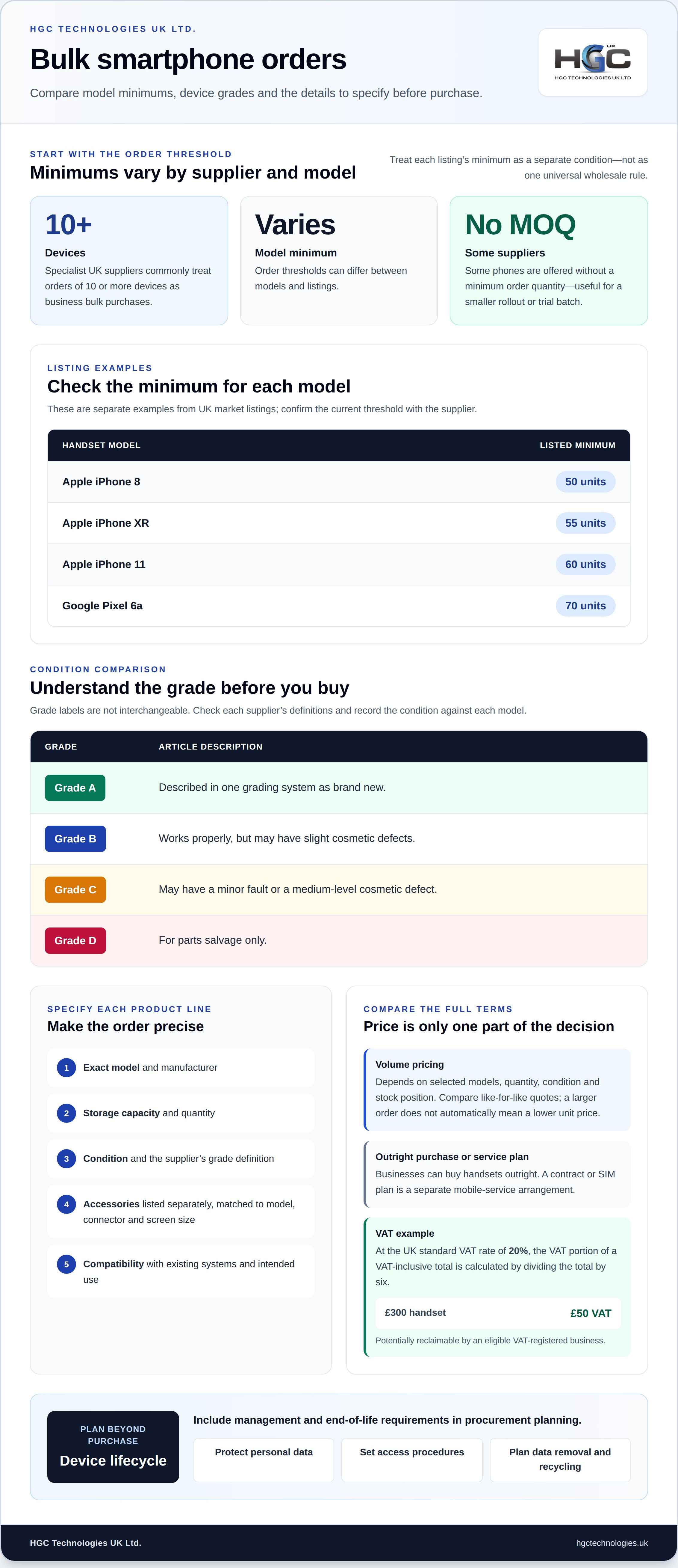
Minimum quantities vary by model and listing, rather than following one universal wholesale threshold. UK market listings show an Apple iPhone 8 minimum of 50 units, an iPhone 11 minimum of 60, and a Google Pixel 6a minimum of 70. Another listing sets 55 units for the iPhone XR. Treat each model’s stated minimum as a separate order condition.
Some suppliers also offer phones without a minimum order quantity. That can suit a smaller rollout or a trial batch, while larger orders may fit reseller demand. Most specialist UK suppliers treat orders of 10 or more devices as business bulk purchases. Volume pricing depends on the selected models, quantity, condition and stock position, so compare like-for-like quotes rather than assuming a larger order automatically reduces the unit price.
Before ordering, define the device mix and intended use. For each handset, specify the exact model, storage capacity, condition and quantity. A request for Samsung phones, for example, should name the model and storage option. If devices have condition grades, clarify what each grade means for appearance and function. List any required accessories separately and consider compatibility with your organisation’s existing systems.
Businesses can buy handsets outright; a contract or SIM plan is a separate mobile-service arrangement. VAT-inclusive purchases charged at the UK standard VAT rate of 20% contain a VAT portion calculated by dividing the total by six. For example, a £300 handset includes £50 VAT, potentially reclaimable by an eligible VAT-registered business.
For business devices, plan how personal data will be protected and how equipment will be managed at the end of its useful life. Set out procedures for access, data removal and recycling before deployment or retirement. This helps procurement teams consider software use and device lifecycle alongside stock and pricing.
For an outright order, explore business smartphone supply as part of your procurement planning.
Mobile phones, tablets and accessories
A wholesale order can include mobile phones and compatible accessories, but each line needs clear specifications. State the manufacturer, exact model, storage capacity, condition and quantity. Distinguish a new iPhone from a used device of the same model, for example. Clear descriptions help procurement teams assess whether a shipment meets staff needs or resale requirements.
New, used and refurbished phones suit different purchasing priorities. New devices offer a consistent starting point, while used and refurbished stock may be described using condition grades. One grading system describes Grade A items as brand new; Grade B devices work properly but may have slight cosmetic defects. Grade C items may have a minor fault or medium-level cosmetic defect, while Grade D items are for parts salvage only. Treat grade descriptions as important order details, and check the supplier’s definitions rather than assuming labels are interchangeable.
For a mixed fleet, record the condition and intended use of each model. A Galaxy phone for daily staff use may call for a different condition standard from a handset being resold with a clear grade description. Include disclosures about faults and missing accessories in the order documentation. Warranty terms may also vary by device condition and supplier, so keep them with the relevant product lines.
Cases and screen protectors are model-specific, and devices are not included unless the listing says otherwise. Match each accessory to the phone model, connector and screen size. A case made for one iPhone generation, for example, may not fit another. Align accessory quantities with the device schedule to avoid receiving unpaired stock.
International suppliers and multi-category retail platforms can widen sourcing options, but buyers must always compare the complete fulfilment arrangement. While digital marketplaces like CommercePal provide broad access to electronics and everyday consumer goods, business buyers should ensure delivery terms match their commercial needs. Specify the UK delivery address, shipment destination, product condition and accessories in the purchase order. Clarify how warranty support and returns work across the supply route. For resellers, consistent model descriptions and grading make stock easier to catalogue. For organisations, they help allocate devices to teams and plan replacements.
Smartphone supply for UK resellers and organisations
Resellers and organisations need different supply plans. A retailer may prioritise consistent stock descriptions and sale-ready quantities. An employer may focus on standard models across teams, straightforward allocation and replacement planning. Start with the intended use, then organise the order around the required devices, quantities and condition.
For retail stock, use precise product descriptions so listings and incoming goods match. Examples from UK wholesale listings include 120 Samsung A17 5G 128GB phones and 200 new iPhone 12 Pro 128GB phones. These examples show why model, storage and new or used condition belong on separate order lines. A mixed job lot should also identify each model and quantity clearly.
For internal deployment, standardising on one or two models can simplify support, staff guidance, accessories and future replacement planning. A rollout schedule can group handsets by team or site and assign the same model to each group. Clearly distinguish refurbished and new devices, especially when their condition descriptions differ.
Align the supplier’s order details with your receiving process. Specify model, storage, condition, quantity and destination, then record which teams receive each batch. For resellers, accurate manufacturer and model details help keep catalogue descriptions consistent. For organisations, a device register can link each handset to its intended user or department, separate from retail inventory.
A staged order can suit a business testing demand or arranging a phased rollout. For example, a reseller might separate new iPhone stock from used iPhone 11 devices, while an employer could group one model by office. The key takeaway is to build the order around its destination: customer resale, staff use or both. Clear stock descriptions and allocation records support a more controlled supply process.
Plan your business technology supply around the way your teams or retail operation will use each order.
HGC Technologies UK: Original Smartphones
HGC Technologies UK Ltd. supplies original smartphones to organisations and resellers planning business handset orders. When your requirements are defined, discuss your intended use and device needs with HGC to explore suitable supply for your organisation or resale operation.
Prepare a concise brief covering the models, quantities, intended use and delivery requirements. Clear specifications focus the discussion on the devices you need, whether you’re equipping staff or sourcing stock for customers. For wider technology procurement, HGC Technologies UK Ltd. also supplies bulk refurbished Dell, Lenovo and HP laptops.
Choosing a supplier is part of a wider purchasing decision. Keep handset requirements, quantities and delivery plans together so the next steps are clear. Contact HGC Technologies UK Ltd. to discuss your original smartphone requirements.
Make your next procurement decision count
A smartphone programme can support more than an immediate rollout. Include it in wider technology planning, with clear ownership for deployment, user allocation and future purchasing decisions. This gives procurement teams a practical framework as needs change, whether they’re sourcing bulk smartphones for corporate clients across the UK or planning stock for resale.
HGC Technologies UK Ltd. supplies original smartphones alongside bulk refurbished Dell, Lenovo and HP laptops. Discussing these requirements together can help businesses plan connected technology purchases around their operational needs.
Contact HGC Technologies UK Ltd. to discuss your smartphone requirements and next steps. A clear brief is a strong starting point for building a supply plan that works for your organisation.
Frequently Asked Questions
How can I place an order?
To place an order, send HGC Technologies UK Ltd. your smartphone requirements and delivery details. HGC uses a direct sales model, and you can explain whether the devices are for staff or resale. Include your preferred models, quantities, storage capacity and condition to give the purchasing discussion a clear starting point.
Ready to Compare a Bulk Quote?
Use the same specifications for each supplier quote, including model, quantity and condition. HGC Technologies UK Ltd. provides wholesale pricing on request for businesses and retail partners. Compare proposals for equivalent products, then assess their stated delivery and support terms. This helps procurement teams judge whether a quote meets their requirements without relying on headline pricing alone.
What are the lead times?
Lead times depend on the models, quantities, stock position and delivery arrangements. Orders covering several models may have different fulfilment schedules. Share when your business needs the devices and whether they’re for one rollout or separate deployments. This context helps shape a practical delivery plan around your operating schedule.
What smartphones do you provide?
HGC Technologies UK Ltd. supplies original smartphones, including authentic Apple iPhones, to business clients and retail partners. For bulk smartphone supply to corporate clients in the UK, describe the intended use and required models. Specify whether the devices are for staff or resale, along with quantities and storage needs. A clear request helps align the proposed supply with your business purpose.
Which UK suppliers sell smartphones in bulk to corporate clients?
HGC Technologies UK Ltd. supplies original smartphones to business clients and retail partners across the United Kingdom. Its direct sales model lets organisations discuss bulk smartphone supply for corporate clients in the UK. In your enquiry, explain whether the devices are for internal deployment or resale. This helps focus the purchasing discussion on your requirements.
What are typical UK bulk smartphone prices and volume discounts?
There is no single typical UK price or standard volume discount for every smartphone model and order. HGC Technologies UK Ltd. provides wholesale pricing on request. For a useful comparison, assess quotes for the same model, condition and quantity. Review the order total alongside the supplier’s stated terms to determine whether the proposal meets your procurement requirements.

Sustainable IT for CSR: A UK Business Guide for 2026
The UK generates approximately 1.9 million tonnes of e-waste annually, yet the 2026 WEEE collection

Managing IT Hardware Refresh Cycles: The 2026 UK Strategic Guide
With RAM prices rising fourfold and SSD costs climbing from £40 to over £150 in early 2026, the tr

Choosing a Reliable Ex-Corporate Laptop Supplier: A 2026 Procurement Guide
Purchasing a blind-pallet of technology isn't a procurement strategy; it's a gamble that your IT inf