

Managing Warranties for a Fleet of Refurbished Laptops: The 2026 Procurement Guide
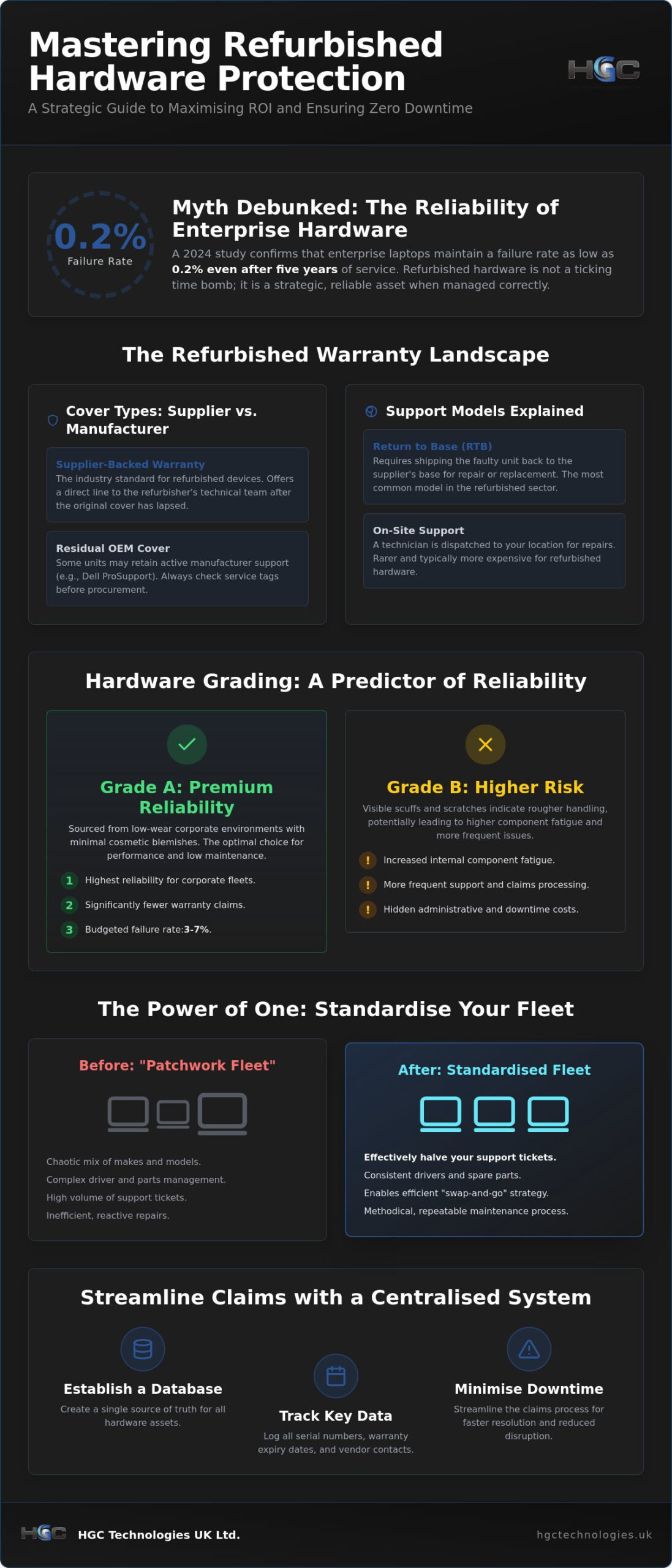
A 2024 study of 500,000 devices confirmed that enterprise laptop failure rates stay as low as 0.2 per cent even after five years of service, debunking the myth that older hardware is a ticking time bomb. Despite this data, the administrative burden of managing warranties for a fleet of refurbished laptops remains a significant barrier for many procurement leaders. You’ve likely experienced the frustration of juggling fragmented expiry dates or worrying about how a sudden hardware failure might disrupt your team’s productivity whilst driving up unexpected costs.
It’s time to move past the chaos of spreadsheets and reactive repairs. This 2026 guide provides the strategic framework you need to master refurbished hardware protection, ensuring zero downtime and maximum ROI for your organisation. We’ll examine how to establish a centralised tracking system and standardise your fleet with premium Grade A units from manufacturers like Dell, Lenovo, and HP to create a predictable, high-performance IT ecosystem. By aligning your procurement strategy with robust protection protocols, you can transform hardware maintenance from a logistical headache into a competitive advantage.
Key Takeaways
- Understand the critical transition from manufacturer to supplier-backed cover and the operational differences between Return to Base and on-site support models.
- Learn how fleet standardisation on a single model can significantly reduce support tickets and enable a more efficient “swap-and-go” replacement strategy.
- Master the art of managing warranties for a fleet of refurbished laptops by using hardware grading to forecast failure rates and secure predictable maintenance budgets.
- Establish a centralised database for serial numbers and vendor contacts to streamline the claims process and minimise downtime for your end-users.
- Discover how sourcing professional Grade A hardware ensures batch consistency, providing the foundation for a reliable and low-maintenance corporate fleet.
The Refurbished Warranty Landscape: Supplier vs. Manufacturer
Warranty coverage is the primary differentiator between a risky purchase and a strategic investment. When you procure new hardware, you’re paying a premium for the Original Equipment Manufacturer (OEM) safety net. However, the industry definition of refurbished electronics dictates that these devices undergo professional testing and restoration after their initial corporate lifecycle. By the time these units reach the secondary market, the original 3-year manufacturer cover has often lapsed. This is where supplier-backed protection becomes the cornerstone of managing warranties for a fleet of refurbished laptops.
In the UK, B2B transactions don’t enjoy the same automatic protections as consumer purchases under the Consumer Rights Act. Instead, your protection is defined by the specific terms of your commercial contract. Understanding the difference between “Return to Base” (RTB) and on-site support is vital. RTB requires you to ship the faulty unit back to the supplier for repair; whilst on-site support, though rarer in the refurbished sector, provides a technician at your location. Establishing clear expectations at the point of sale ensures that your internal IT team isn’t left to handle complex hardware failures without external support.
Understanding Tiered Protection Levels
Supplier-backed warranties are the industry standard for bulk procurement, offering a direct line to the refurbisher’s technical team. Procurement teams can also find residual OEM cover. When sourcing bulk Dell refurbished laptops, you should always check the service tag. Some units may still have active ProSupport or basic hardware coverage that can be transferred to your organisation. For high-risk environments, third-party extended warranties or specialised laptop insurance can provide an additional layer of security against accidental damage and theft.
The Role of Hardware Grading in Warranty Risk
Hardware grading is more than an aesthetic choice; it’s a predictor of reliability. Grade A units are typically sourced from executive environments where they’ve seen minimal physical stress. These premium units see significantly fewer warranty claims than lower-grade counterparts. Choosing “cheap” lower-grade hardware often results in hidden administrative costs because you’ll spend more time processing returns than you saved on the initial purchase.
- Grade A Focus: These units are typically sourced from low-wear environments, showing minimal cosmetic damage and offering the highest reliability for corporate fleets.
- Grade B Risk: Visible scuffs often indicate a device that has been handled more roughly, potentially leading to higher internal component fatigue and more frequent claims.
Procurement teams typically apply a failure rate multiplier of 3-7 per cent for refurbished Grade A units when budgeting for maintenance. Standardising on specific models like the Dell Latitude or Lenovo ThinkPad series also ensures that spare parts are readily available. This simplifies the repair cycle and reduces the logistical weight of managing warranties for a fleet of refurbished laptops.
How to Standardise Your Fleet to Simplify Support
Standardisation is the ultimate force multiplier for IT efficiency. Many UK offices currently suffer from “patchwork fleet” syndrome, which is a chaotic mix of various makes and models acquired hastily during the remote work shifts of previous years. This fragmentation creates a logistical bottleneck. Every unique model requires its own driver sets, specific replacement parts, and distinct warranty claim paths. By adopting the “Power of One” strategy and sticking to a single model, such as the Dell Latitude 7420, you can effectively halve your support tickets and streamline the process of managing warranties for a fleet of refurbished laptops.
Consistency is the foundation of reliability. Aligning your procurement with a trusted wholesale laptop distributor UK allows you to secure identical batches. This batch consistency ensures that if a component fails on one unit, the replacement part is guaranteed to fit every other machine in your estate. It transforms your maintenance from a reactive scramble into a methodical, repeatable process, allowing your team to focus on high-value tasks rather than troubleshooting obscure hardware conflicts.
Choosing the Right “Anchor” Model
Selecting an “anchor” model requires a focus on chassis durability and long-term parts availability. The Dell Latitude and Lenovo ThinkPad series are the gold standard for refurbished fleets because they are built for the rigours of corporate use and offer exceptional modularity. Avoid consumer-grade refurbished units at all costs. These machines often lack the driver stability and rugged construction needed for business environments, making them a liability for long-term fleet management. If you’re ready to build a more resilient estate, you can explore our current wholesale inventory to find the right anchor model for your organisation.
The Buffer Stock Strategy
The most effective way to ensure zero downtime is the “Swap-and-Go” strategy. Maintain a 3-5 per cent buffer stock pool of identical machines. When a user reports a hardware fault, your IT team simply swaps their drive or migrates their profile into a buffer unit, allowing the employee to return to work in minutes. The faulty device is then processed for repair under warranty whilst the user remains productive. This approach is often more cost-effective than paying for premium on-site warranties, as it eliminates the wait for an external technician to arrive and provides an immediate solution for the end-user. Organising an internal “Tech Bar” stocked with these ready-to-go replacements ensures that managing warranties for a fleet of refurbished laptops becomes a background process rather than a source of user frustration.
Forecasting Failure Rates and Budgeting for Maintenance
Precision in financial planning is what separates a successful hardware strategy from a costly logistical burden. When managing warranties for a fleet of refurbished laptops, your budget must account for both predictable protection costs and the statistical probability of hardware attrition. Start by conducting a rigorous audit of your current estate using IT Asset Management (ITAM) tools. This data allows you to map out the age, hardware grade, and remaining warranty duration for every unit, providing a clear baseline for your maintenance requirements.
Once your audit is complete, apply a standard failure rate multiplier to your projections. For high-quality Grade A hardware, industry data suggests a failure rate between 3 and 7 per cent. This figure is essential for calculating your Total Cost of Ownership (TCO). Your TCO model should include the initial purchase price, the cost of any extended protection plans, and a dedicated contingency fund for out-of-warranty repairs such as accidental screen damage or liquid ingress. Establishing a 36-month lifecycle replacement schedule for your refurbished gear ensures that you refresh your technology before the “wear-out” phase leads to a spike in maintenance costs.
Predicting the “Bathtub Curve” in Refurbished Hardware
The “Bathtub Curve” is a well-known reliability model that describes high failure rates at the very beginning and end of a product’s life. One of the primary advantages of sourcing from a reputable wholesale refurbished computers UK supplier is that “Early Infant Mortality” failures are virtually non-existent. These units have already survived their initial deployment and undergone rigorous stress testing during the refurbishment process. Instead, your focus should be on the wear-out phase, particularly regarding batteries and SSDs. Monitoring battery health cycles through your ITAM software allows you to proactively replace components before they fail, maintaining high levels of end-user satisfaction.
The Hidden ROI of Refurbished Warranties
Presenting the business case for refurbished hardware to a CFO requires a focus on value over pure cost-savings. When you compare the price of a brand-new laptop with 3-year OEM support against a refurbished unit paired with a 5 per cent buffer stock, the refurbished model often delivers a significantly higher return on investment. This strategy provides immediate hardware availability whilst keeping capital expenditure low. MTBF represents the statistical probability of hardware reliability within a specific timeframe, serving as a critical benchmark for evaluating the long-term stability of enterprise-grade mobile workstations. By leveraging these metrics, you can demonstrate that managing warranties for a fleet of refurbished laptops is a mathematically sound approach to modern IT procurement.
Streamlining the Claims Process and Logistics
Operational efficiency in managing warranties for a fleet of refurbished laptops depends entirely on the speed and clarity of your claims process. A fragmented approach to documentation creates unnecessary delays whilst your IT team hunts for purchase dates and vendor contacts. Centralising your warranty database is the first step toward professional-grade logistics. Every unit should be logged with its serial number, hardware grade, and supplier contact details at the point of ingestion. This ensures that when a failure occurs, the response is immediate and methodical rather than reactive.
Data security must remain a priority throughout the repair cycle. Before shipping any unit for Return to Base (RTB) repairs, your IT department must sanitise drives to meet internal compliance and GDPR standards. Packaging also plays a critical role in preventing further damage during transit. Use double-walled boxes and anti-static padding to ensure the device reaches the technician in its original condition. Additionally, establish clear “Dead on Arrival” (DOA) protocols with your wholesaler. Most reputable partners provide a specific window, typically 14 days, to report transit damage or immediate component failure for an instant replacement.
Implementing a Warranty Management Portal
Static spreadsheets are rarely sufficient for a growing corporate estate. Transitioning to dedicated IT Asset Management (ITAM) software allows you to automate notifications for units approaching their warranty expiry. Integrating this data directly into your existing helpdesk, such as Jira or ServiceNow, empowers your technicians to see a device’s coverage status the moment a user raises a support ticket. This visibility prevents out-of-pocket repair costs on units that are still covered by supplier protection.
Logistics for the Hybrid Workforce
Supporting a hybrid workforce across the UK requires a more agile logistics model than traditional office-based support. The “Courier Swap” model is particularly effective for remote employees. In this scenario, a courier delivers a ready-to-use replacement unit and collects the faulty device in a single visit. This approach minimises user downtime and ensures that your hardware remains within the protective loop of your warranty agreement. Setting clear internal Service Level Agreements (SLAs) for these swaps helps manage user expectations and maintains high productivity levels across the organisation. If you’re looking to upgrade your current estate with reliable, professionally graded hardware, you can view our latest inventory of enterprise laptops to secure a consistent fleet for your team.
Partnering with HGC Technologies UK Ltd. for Fleet Reliability
Reliability in a corporate environment is built upon the quality of your supply chain. Whilst previous sections of this guide have outlined the logistical and financial frameworks for managing warranties for a fleet of refurbished laptops, the physical hardware remains the most critical variable. HGC Technologies UK Ltd. operates as a specialist wholesale partner, bridging the gap between raw hardware availability and the precise needs of UK corporate procurement teams and resellers. We prioritise batch consistency, ensuring that when you order fifty units, you receive fifty identical machines that fit perfectly into your standardised support model.
Our professional grading standards are the cornerstone of a low-maintenance fleet. By focusing on Grade A units, we significantly reduce the statistical probability of hardware failure, which in turn lowers the administrative burden on your IT helpdesk. For organisations looking to refresh their mobile workstations, sourcing bulk Lenovo refurbished laptops through HGC Technologies UK Ltd. provides the peace of mind that comes with transparent warranty terms and verified hardware integrity. We understand that for resellers, managing warranties for your own clients requires a supplier who provides clear, enforceable protection levels without the hidden caveats often found in the secondary market.
A Strategic Partnership, Not Just a Transaction
Volume procurement requires more than a simple checkout process; it demands a collaborative relationship. HGC Technologies UK Ltd. provides your team with direct access to our technical specialists for volume troubleshooting, allowing you to resolve batch-level queries before they impact your end-users. This partnership approach helps you future-proof your estate by providing consistent access to popular enterprise models, ensuring that your buffer stock remains compatible for years to come. Simultaneously, our model supports the UK circular economy, allowing your organisation to meet sustainability targets whilst maintaining the high performance standards your employees expect.
Next Steps for Your 2026 Fleet Strategy
Executing a successful refurbished strategy begins with verification. We invite procurement leads and resellers to request a sample unit to personally inspect our grading standards and build quality. This hands-on approach ensures that our Grade A hardware meets your specific corporate requirements before you commit to a full-scale rollout. Beyond mobile computing, our team is available to consult on custom server builds designed to support your expanding laptop infrastructure. Contact HGC Technologies UK Ltd. today for a bespoke wholesale quote and take the first step toward a more resilient, cost-effective IT estate. Our experts are ready to help you master the complexities of managing warranties for a fleet of refurbished laptops whilst maximising your long-term return on investment.
Securing the Future of Your Corporate IT Estate
Fleet standardisation and professional grading are the twin pillars of a low-maintenance hardware strategy. By moving from a reactive patchwork model to a proactive, data-driven approach, you eliminate the logistical friction that often accompanies older hardware. This transition allows your IT team to shift their focus from troubleshooting hardware conflicts to driving innovation across the business. It’s about more than just saving on initial costs; it’s about ensuring that every end-user has the tools they need to succeed without the threat of unexpected downtime.
Effective managing warranties for a fleet of refurbished laptops isn’t just about protection; it’s about building a resilient, circular ecosystem that supports your team without inflating your overheads. As a trusted UK partner for corporate IT procurement and a specialist in Dell, HP, and Lenovo wholesale, we are here to support your long-term growth. Our commitment to Grade A professional refurbishment standards ensures that your estate remains as reliable as it is cost-effective.
View our latest bulk refurbished laptop inventory for your fleet and discover how a strategic partnership can transform your technology lifecycle. You’ve now got the framework to lead your organisation into a more sustainable and efficient 2026. We look forward to helping you build a fleet that performs without compromise.
Frequently Asked Questions
Do refurbished laptops come with warranties in the UK?
Yes, professionally refurbished laptops sold in the UK market typically include a supplier-backed warranty. Whilst consumer law provides certain protections for individuals, B2B transactions are governed by the specific terms of your commercial contract. Reputable wholesalers ensure that every unit undergoes rigorous testing to guarantee performance, providing a safety net that mirrors the reliability of new hardware.
What is a typical warranty period for a fleet of refurbished business laptops?
A standard warranty period for enterprise-grade refurbished hardware is typically 12 months. Some suppliers offer shorter 6-month terms for budget-conscious batches, whilst others provide extended options up to 3 years. When managing warranties for a fleet of refurbished laptops, it’s essential to confirm whether the term covers both parts and labour to avoid unexpected repair costs during the device lifecycle.
How do I handle a warranty claim for a laptop used by a remote worker?
The most efficient method for remote staff is the “Courier Swap” model. A courier delivers a replacement unit to the employee’s home and collects the faulty device simultaneously. This approach minimises user downtime and ensures that your internal IT team can process the warranty claim with the supplier whilst the employee remains productive with a secondary machine.
Is it better to buy an extended warranty or keep buffer stock?
Buffer stock is generally superior for maintaining operational continuity in a corporate environment. Whilst an extended warranty provides financial protection, it doesn’t solve the immediate problem of a productive employee without a machine. Maintaining a 3-5 per cent pool of identical units allows for instant swaps, which is often more cost-effective than premium on-site support contracts.
Can I still get manufacturer support for a refurbished Dell or HP laptop?
Manufacturer support is available only if the original OEM warranty has not yet expired. You can check this status by entering the service tag on the manufacturer’s website. If the original cover has lapsed, your primary point of contact for repairs will be your refurbishment partner, who provides the replacement parts and technical expertise for that specific model.
What does “Return to Base” (RTB) warranty actually mean for my business?
An RTB warranty means that the buyer is responsible for shipping the faulty hardware back to the supplier’s service centre for repair. The supplier covers the cost of parts and labour to fix the unit, and they typically pay for the return shipping back to your office. It’s the most common warranty type for refurbished hardware due to its balance of cost and protection.
How do I track warranties for a fleet of 100+ refurbished units?
Tracking a large estate requires a centralised IT Asset Management (ITAM) system or a dedicated database. You should log every unit’s serial number, purchase date, and warranty expiry at the point of delivery. This allows your team to automate expiry notifications and ensures that managing warranties for a fleet of refurbished laptops remains a streamlined, proactive process rather than a manual administrative burden.
Does the battery have the same warranty as the laptop hardware?
Batteries are often treated as consumable items and may have a shorter warranty period than the main chassis, typically 90 days to 6 months. Because batteries naturally degrade over time, suppliers guarantee they will hold a specific charge percentage at the time of delivery. It’s vital to check the specific battery terms in your contract to ensure they align with your fleet’s performance requirements.

Wholesale Business Smartphones: 2026 Procurement Guide
Procuring a mobile fleet in 2026 is no longer a simple matter of finding the lowest unit price; it's

Data-Intensive Server Hardware: 2026 Procurement Guide
With server DRAM contract prices surging by up to 95 per cent in early 2026 and major OEMs hiking li

Lenovo vs HP: The 2026 Comparison for UK Business Procurement
The USD 6.26 billion UK laptop market might be obsessed with AI-powered silicon in 2026, but for the
Comments are closed.