
Refurbished IT Hardware Warranty: What Buyers Should Expect
A refurbished laptop can last 3-5 years or more, depending on its model, specifications and use. Warranties vary by seller, device age and refurbishment process, so a lower price alone won’t tell you how well protected you are. This refurbished IT hardware warranty guide for UK buyers explains what cover to expect and how to weigh it against a laptop’s likely lifespan.
It’s sensible to look beyond the word “refurbished”: battery wear, product grading and warranty exclusions all affect a device’s value. UK consumer rights matter too, because a seller’s warranty does not replace your statutory protections. This guide explains how to assess warranty terms, what they may cover and how to read grades without confusing cosmetic condition with performance. It also explains how battery condition fits into the decision, so you can judge refurbished hardware more clearly.
Key Takeaways
- Battery wear can affect a refurbished laptop’s practical lifespan. Understand how battery condition is treated in the warranty before deciding whether the cover meets your needs.
- For electrical-goods extended warranties lasting at least 12 months, GOV.UK says the 45-day refund condition applies. Read the cancellation terms as carefully as the coverage.
- The Consumer Rights Act 2015 requires goods sold by a commercial trader to be of satisfactory quality, fit for purpose and as described, according to the UK legislation register. A commercial warranty doesn’t replace your statutory rights.
- Product grades describe appearance, not necessarily performance, and refurbished laptop warranties vary. Look at the description, exclusions and length of cover together to judge the offer.
1. Battery wear and battery guarantees
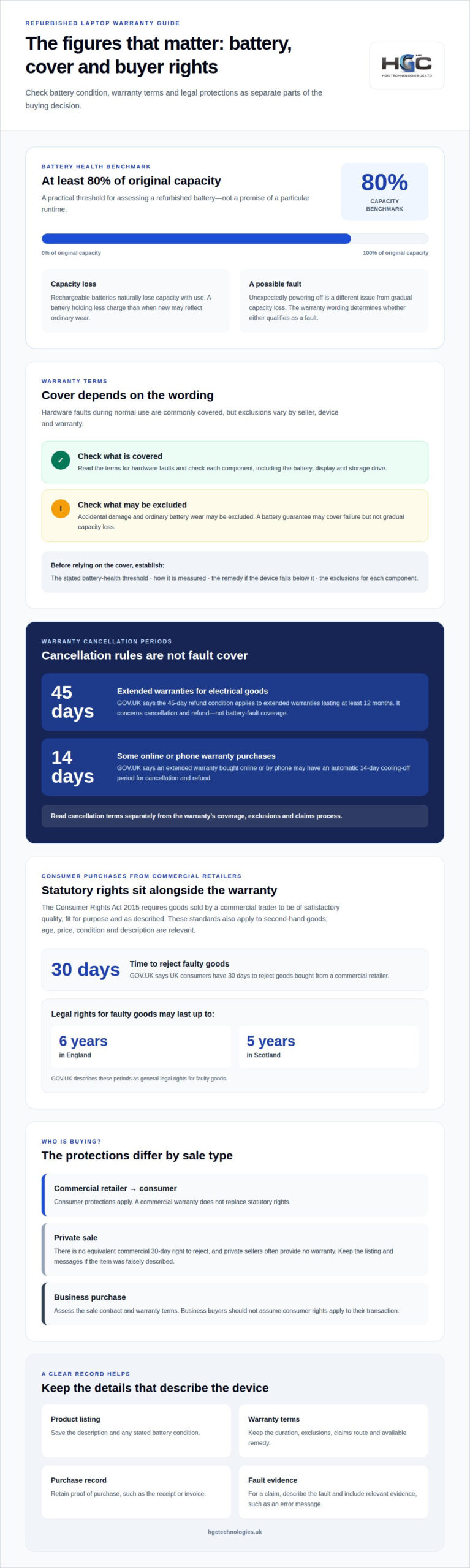
Battery condition affects how long a refurbished laptop lasts between charges. Rechargeable batteries naturally lose capacity with use, so distinguish ordinary wear from a battery fault. A useful buying benchmark is at least 80% of the battery’s original charging capacity. Treat that as a practical threshold, not a promise of a particular runtime.
Do refurbished IT warranties cover batteries, screens, hard drives and other consumable parts? Coverage depends on the terms. Hardware faults during normal use are commonly covered, while accidental damage and ordinary battery wear may be excluded. Read the exclusions for each component, including the battery, display and storage drive, before relying on the cover.
Ask what “battery guarantee” means in practice. It may cover a battery that fails but exclude gradual capacity loss through normal use. For example, a laptop that powers off unexpectedly has a different problem from one that simply holds less charge than when new. The warranty wording determines whether either issue qualifies as a fault.
Check the stated battery-health threshold, how it is measured and what remedy applies if the device falls below it. Keep the listing, battery-health details and purchase record together. If the description gives a specific condition, save it with the warranty terms. This gives you a clear record if the laptop delivered differs from its description.
GOV.UK says the 45-day refund condition applies to electrical-goods extended warranties lasting at least 12 months. The condition concerns cancellation and a refund, not battery-fault coverage. Read the cancellation terms separately from the exclusions. For private sales, the UK legislation register cites the Misrepresentation Act 1967 as a basis for rescinding a contract when a seller falsely describes an item. That is distinct from a commercial warranty claim.
For business purchases, assess battery health against the intended workload. A laptop used away from a desk depends more on its battery than one that stays docked. Set a minimum acceptable condition for your use case, then compare the warranty’s remedy and exclusions with that requirement.
2. Consumer Rights Act protections for refurbished hardware
According to the UK legislation register, the Consumer Rights Act 2015 requires goods sold by a commercial trader to be of satisfactory quality, fit for purpose and as described. These standards apply to second-hand goods too, with age, price, condition and description relevant. A refurbished phone described as fully working should match that description.
GOV.UK says consumers generally have legal rights for faulty goods for up to 6 years in England, or 5 years in Scotland. GOV.UK also says UK consumers have 30 days to reject goods bought from a commercial retailer. These protections concern consumer purchases; business buyers should consider the sale contract and warranty terms. A company purchasing equipment shouldn’t assume consumer rights apply to its transaction.
Private-sale protections differ. A UK private sale doesn’t carry the commercial 30-day right to reject, and private sellers often provide no warranty. For example, a device bought from an individual isn’t covered by the same commercial-trader rules. Keep the listing and messages: if a private seller falsely describes an item, the UK legislation register cites the Misrepresentation Act 1967 as a basis for rescinding the contract.
To make a warranty claim, follow the stated process and contact the seller or warranty provider. Provide proof of purchase, describe the fault and include relevant evidence, such as an error message. For business purchases, keep the invoice and correspondence in the organisation’s records. The terms specify who can claim and whether a third-party user is covered.
Before purchase, read the warranty’s duration, exclusions, claims route and remedy. Check whether a repair, replacement or refund is available, and who handles the return. GOV.UK says an extended warranty bought online or by phone may have an automatic 14-day cooling-off period for cancellation and refund. That period concerns cancelling the warranty, not rejecting faulty hardware.
For organisations sourcing refurbished devices in quantity, compare the written warranty with the equipment description and intended use. Explore bulk refurbished laptops as part of your procurement planning.
3. Honest grading and product descriptions
Phone grades usually describe cosmetic condition, not performance. Grade A phones look almost new, Grade B phones show light wear, and Grade C phones have more visible marks and scuffs. These labels help compare appearance, but do not establish how well a device works. A Grade A phone may still need a separate battery assessment.
Grading scales can vary between retailers, so read the written description alongside the letter. Look for specific examples, such as scratches on the casing, marks around the screen or keyboard wear. Clear descriptions help business buyers decide whether the visible condition suits staff-facing equipment or a back-office deployment.
Assess cosmetic grade separately from functional condition. The description should say whether essential features work and identify any faults or limitations. For a laptop, consider the screen, keyboard, ports and battery; for a phone, consider the display, cameras and charging function. A grade alone answers none of these questions.
Confirm what comes with the device. Listings may state whether accessories, such as a charger, are included and whether the packaging is original or replacement. These details matter for deployment planning, especially when ordering multiple units. Don’t assume that every refurbished item includes the accessories listed in the manufacturer’s original specification.
Finally, compare the product description with the warranty terms. A disclosed mark is different from an undisclosed fault. Keep the listing and order record, then compare any concern with the description and cover. For example, a scratched casing may match a Grade C description, while a fault affecting normal operation raises a separate question about the device’s stated condition and warranty.
4. Whether refurbished laptops usually include warranties
Refurbished laptops are commonly sold with warranty cover, but there is no single standard for every device. The length and scope depend on the seller, the laptop’s age and the refurbishment process. Use the written terms, not the word “refurbished”, to understand your protection. A refurbished IT hardware warranty guide for UK businesses should begin with that distinction.
Warranty terms for manufacturer-refurbished hardware can vary. Commercial retailer refurbished hardware may carry a manufacturer warranty lasting 12 to 24 Months. These are different warranty arrangements: identify who handles a claim, what the cover includes and whether the original manufacturer warranty applies to that particular device.
For refurbished laptops, a practical benchmark is 6 to 12 months of warranty cover. Coverage usually concerns faults arising during normal use, not accidental damage. A short warranty lasting only a few weeks gives less time to discover problems through routine business use. Read the exclusions as carefully as the headline duration.
Warranty periods for desktops, servers and networking equipment depend on the seller, device age and refurbishment process. Don’t assume a laptop’s warranty applies to every hardware category. For each item, establish the coverage period, claims process and available remedy, such as repair or replacement.
Testing before resale can help identify faults, but it does not make the warranty terms irrelevant. Check that the product description identifies the device and its condition, then read what happens if a fault develops. For example, a screen fault during normal use may be treated differently from impact damage. The written exclusions determine the distinction.
For business buying, record warranty duration and claim responsibilities alongside each device’s asset information. This makes it easier to manage support across a mixed fleet and distinguish warranty cover from statutory rights. Use this refurbished IT hardware warranty guide for UK procurement planning, then review the bulk refurbished laptop options for your business purchase.
HGC Technologies UK
HGC Technologies UK Ltd. supplies businesses with refurbished laptops and custom-built PCs for their technology requirements. When planning a business purchase, assess the warranty terms alongside the devices’ intended use, condition and deployment needs. This helps your procurement team weigh cover against operational requirements, whether replacing existing equipment or equipping a workforce. HGC Technologies UK Ltd. offers bulk refurbished Dell, Lenovo and HP laptops, as well as custom-built PCs, for different business needs. Share the type of equipment your organisation requires and how it will be used to focus your purchasing decision on suitable hardware and its terms. Contact HGC Technologies UK Ltd. to discuss your business hardware requirements.
Make your next hardware decision with confidence
Turn warranty considerations into a practical procurement standard for your organisation. A refurbished IT hardware warranty guide for UK businesses should support decisions about device users, deployment and the disruption your team can accommodate if equipment needs attention. Set out how warranty records will be stored and who will coordinate claims, so responsibilities remain clear as your hardware estate changes.
Use a refurbished IT hardware warranty guide that UK procurement teams can apply consistently across purchases. This helps your team assess each device as part of a longer-term technology plan, rather than treating it as an isolated decision. If you’re preparing a business order, discuss your requirements with HGC Technologies UK and agree on a suitable next step.
Contact HGC Technologies UK to discuss your business hardware needs. Build your next procurement decision around what your organisation needs to do.
Frequently Asked Questions
Do manufacturer warranties transfer to second-hand owners in the UK?
Not automatically; transferability depends on the manufacturer’s warranty terms. A second-hand buyer should establish whether cover stays with the device or applies only to its original purchaser. For example, a laptop could still be within its stated warranty period, while the terms set conditions for a new owner to make a claim. Keep the original purchase record and device details together.
What is usually not covered?
Refurbished hardware warranties commonly exclude accidental or liquid damage, misuse and faults caused by unauthorised repairs. Gradual battery wear may also count as normal use rather than a fault. For example, a device damaged by a spill differs from one that develops a fault during ordinary operation. Check the exclusions to understand how these situations are handled, and consider them alongside the headline cover.
What warranty length is legally required for refurbished IT hardware in the UK?
There is no standard warranty duration for refurbished IT hardware in the UK; the commercial warranty period varies by seller, device and refurbishment process. A warranty is separate from statutory rights, which may apply to goods bought from a trader. For procurement, record the seller’s stated start and end dates and distinguish the written warranty from rights attached to the purchase.
What is the difference between a refurbished hardware warranty and UK consumer rights?
A warranty is additional cover offered under its own terms, whilst consumer rights come from law and apply to eligible purchases from traders. According to the UK legislation register, the Consumer Rights Act 2015 sets requirements for goods sold by commercial traders. The distinction matters if warranty cover expires or excludes a problem: statutory rights are separate, although business purchases may not qualify for consumer protections.
What exclusions and limitations are common in refurbished IT hardware warranties?
Common exclusions include accidental or liquid damage, misuse, unauthorised repairs and ordinary battery deterioration. Terms may also distinguish faults arising during normal use from damage caused after delivery. For instance, a laptop fault during routine work differs from a cracked screen after an impact. Note which situation applies, what evidence the claims process requires and whether the stated remedy is repair, replacement or another option.
Can a refurbished IT hardware warranty be transferred or extended in the UK?
Transfer and extension are not automatic; the terms determine whether a new owner can use existing cover or buy additional protection. Check whether the warranty is linked to the device, purchaser or original sale, and whether an extension changes the expiry date or exclusions. For example, transferred cover might continue only for the remaining period rather than restart when ownership changes.

Scalability of Custom-Built Server Solutions: A 2026 Enterprise Guide
What if the hardware designed to fuel your expansion is actually the primary bottleneck stifling you
Energy Efficiency of Refurbished Laptops: A Practical Guide
A refurbished laptop isn’t automatically less energy-efficient than a new one. The energy efficien

Negotiating a Bulk Purchase of Refurbished Laptops: A Practical Guide
A lower unit price can hide a costly mismatch. When negotiating a bulk purchase of refurbished lapto