

Enterprise Laptop Deployment Strategy: The 2026 Guide to Bulk Rollouts
What if your next hardware rollout didn’t involve a single IT staff member touching a device? For many UK organisations, the traditional enterprise laptop deployment strategy has become a logistical burden defined by rising hardware costs and the constant threat of security breaches during transit. You likely feel the pressure of managing a hybrid workforce whilst trying to maintain rigid security standards and keeping procurement budgets under control. It’s a common frustration to see high-value talent bogged down by manual imaging and the logistical nightmare of remote distribution.
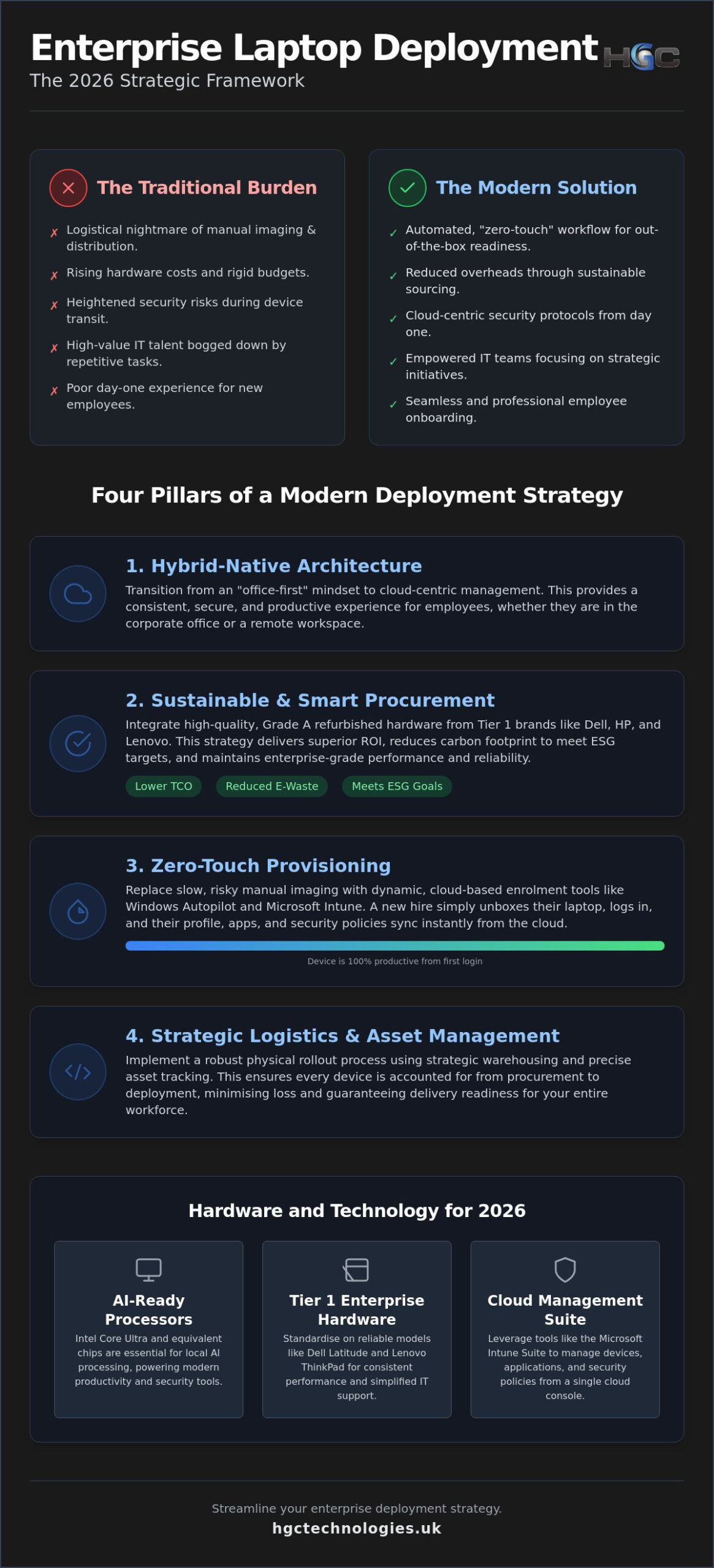
Success in 2026 requires a shift toward automated, lifecycle-oriented procurement. This guide empowers you to master these complexities by leveraging a strategic framework designed for the modern enterprise. You’ll learn to implement a seamless, zero-touch workflow that reduces overheads through sustainable sourcing whilst maintaining elite performance levels. We’ll explore how to integrate advanced tools like the updated Microsoft Intune Suite to ensure your team is productive from day one. From sourcing high-quality refurbished Dell and Lenovo units to automating your security protocols, this is your roadmap to a more resilient and cost-effective IT infrastructure.
Key Takeaways
- Learn how to transition from traditional office-centric setups to a hybrid-native architecture that supports remote teams seamlessly.
- Discover why sourcing bulk refurbished hardware from brands like Dell, HP, and Lenovo offers superior ROI whilst meeting modern sustainability targets.
- Master a modern enterprise laptop deployment strategy by replacing manual imaging with dynamic provisioning and cloud-based enrolment tools like Windows Autopilot.
- Optimise your physical rollout through strategic warehousing and precise asset tracking to ensure every device is accounted for from day one.
- Understand how a specialist wholesale partner can simplify complex procurement and logistics to deliver a high-satisfaction employee experience.
The Evolution of Enterprise Laptop Deployment in 2026
Deployment is no longer a static event. It’s a comprehensive System Deployment Lifecycle that begins long before a device reaches an employee’s hands. In 2026, a successful enterprise laptop deployment strategy must be built on a “hybrid-native” architecture. This means moving away from the “office-first” mindset where devices are tethered to local servers for updates and configuration. Instead, modern strategies prioritise cloud-centric management that provides a consistent experience whether a user is in a corporate office or a remote home workspace. This holistic approach ensures that security and productivity are maintained from procurement through to eventual end-of-life recycling.
Hardware specifications have also undergone a radical shift this year. The integration of AI-ready components, such as the Intel Core Ultra processors found in the latest Dell Latitude and Lenovo ThinkPad models, is now a requirement rather than a luxury. These chips enable the local AI processing that powers 2026’s productivity tools and advanced security analytics. For UK enterprises, this means your procurement strategy must balance cutting-edge performance with the practicalities of bulk distribution across diverse geographical locations. You can’t rely on old specifications if you want to leverage the AIOps and conversational assistants that now drive corporate efficiency.
The “Zero-Touch” Expectation
Manual imaging has become a significant liability. For a national UK workforce, shipping a device to a central hub for manual configuration creates unnecessary delays and heightened security risks during transit. The 2026 standard is out-of-the-box readiness. When a new hire receives their laptop, they should be able to log in and see their profile, applications, and security policies sync instantly via the cloud. This level of simplicity isn’t just a convenience; it’s a critical factor in employee retention. If a staff member’s first day involves a three-hour struggle with the helpdesk, you’ve already lost the engagement battle. Zero-touch workflows ensure speed, security, and a professional first impression.
Sustainability as a Strategic Pillar
UK IT departments now face rigorous ESG reporting requirements that didn’t exist a few years ago. The Circular Economy is no longer a niche concept; it’s a procurement mandate. Integrating bulk refurbished Dell, Lenovo, and HP hardware into your rollout is a powerful way to reduce your carbon footprint whilst maintaining enterprise-grade standards. By choosing high-quality refurbished units, you’re diverting electronic waste and significantly lowering the embodied carbon of your hardware refresh. It’s a responsible approach that aligns fiscal efficiency with environmental stewardship. Reducing the carbon impact of your 2026 refresh doesn’t mean sacrificing quality; it means choosing hardware with a proven lifecycle and reliable performance.
Hardware Infrastructure: Bulk Procurement and Sourcing Strategies
Procurement is the foundation upon which any resilient enterprise laptop deployment strategy is built. Whilst many IT leaders focus exclusively on software provisioning, the physical hardware choice determines your long-term support overheads and total cost of ownership. In 2026, the financial argument for new OEM hardware is increasingly difficult to justify for standard office roles. High-quality, Grade A refurbished units from Tier 1 manufacturers provide the same enterprise-grade durability at a significantly lower entry point. This allows organisations to allocate budget more effectively, perhaps by investing in higher specifications for power users or upgrading peripheral ecosystems.
Standardising your fleet is essential for operational efficiency. When you deploy a uniform range of Dell Latitude or Lenovo ThinkPad models, your IT team manages a single set of drivers and a predictable set of hardware behaviours. This consistency reduces the time spent troubleshooting unique hardware quirks and simplifies the management of spare parts. Reliability matters most in a hybrid environment where a hardware failure could mean days of downtime whilst a replacement is couriered to a remote worker. Choosing brand-name reliability ensures that the chassis, keyboards, and internal components are designed for the rigours of daily professional use, not just the occasional home session.
Addressing user personas is the final piece of the procurement puzzle. A standard admin role might thrive on a lightweight, efficient ultrabook, but your development and creative teams require substantial processing power and memory. Segmenting your procurement into defined tiers ensures that no one is over-provisioned with expensive tech they don’t need, nor under-provisioned with hardware that stifles their productivity. If you are looking to refine your hardware selection, you can explore our range of business-grade units to find the right fit for your team.
The Case for Bulk Refurbished Dell and Lenovo Laptops
The durability of enterprise-grade chassis, such as those found in the Dell Latitude and Lenovo ThinkPad lines, makes them ideal candidates for refurbishment. These machines are engineered with magnesium alloys and carbon fibre, ensuring they withstand years of travel and intensive use. For detailed insights on sourcing these units at scale, consult our guide to bulk Dell refurbished laptops. Grade A refurbished hardware ensures that executives and office staff receive devices that look and perform like new, maintaining high employee satisfaction levels from day one.
Custom Builds for Specialised Enterprise Roles
Sometimes, off-the-shelf laptops cannot meet the demands of high-performance workstation roles or unique edge-computing tasks. In these scenarios, integrating custom PC builds into your wider deployment strategy provides the necessary power for data-intensive applications. This approach often requires a robust backend, so it’s worth reviewing the latest trends in enterprise server hardware UK to ensure your infrastructure can scale alongside your specialised workstations. Balancing mobile flexibility with high-performance fixed assets creates a versatile environment for every department.
Imaging and Provisioning: Modern Methodology
The software layer is where operational efficiency meets user experience. Whilst the previous sections addressed the physical procurement of high-quality hardware, the provisioning phase determines how quickly that hardware becomes productive. In 2026, the contrast between traditional imaging and modern dynamic provisioning is stark. Traditional imaging, which involves creating a monolithic “golden” image and cloning it across hundreds of drives, is increasingly seen as a legacy bottleneck. It’s slow, bandwidth-intensive, and requires significant manual intervention. A modern enterprise laptop deployment strategy treats the operating system as a modular platform where policies and applications are layered dynamically via the cloud.
This shift allows for far greater flexibility. Instead of maintaining dozens of different images for various departments, IT managers can maintain a single, clean OS baseline. Applications are then delivered based on the user’s identity and role. For organisations still grappling with legacy software that won’t run natively on modern architectures, 2026 offers sophisticated virtualisation and containerisation solutions. These tools ensure that critical older applications remain accessible without compromising the security or speed of the new deployment. Developing a refined enterprise laptop deployment strategy means moving away from the “burn and ship” model of the past decade in favour of these agile, cloud-native workflows.
The Windows Autopilot Workflow
Zero-touch deployment is the gold standard for 2026 rollouts. The process begins with registering hardware IDs at the point of wholesale purchase, ensuring that every Dell or Lenovo unit is pre-assigned to your organisation’s tenant. When the employee unboxes the device, the custom-designed Out-of-Box Experience (OOBE) guides them through a branded login process. This reduces IT touchpoints to near-zero, as the device automatically enrols in management and begins downloading the necessary profile settings. It’s a seamless transition that eliminates the need for staging areas or local IT labs.
Security Protocols and Encryption
Security is not an afterthought in a bulk rollout; it’s a foundational requirement. Standardising BitLocker encryption and TPM 2.0 across the entire fleet is a non-negotiable baseline for 2026. Beyond the OS, managing BIOS-level security ensures that the hardware remains protected even before the boot process begins. This includes enforcing secure boot protocols and setting hardware passwords at scale. Adhering to these standards ensures full compliance with UK data protection regulations, providing peace of mind whilst devices are in transit to remote staff or being used in public spaces.
Logistics, Asset Management, and User Enablement
Logistics represents the physical heartbeat of your enterprise laptop deployment strategy. Once your devices are provisioned and secured, the focus shifts to the complex movement of hardware across the UK. Managing a large-scale rollout involves more than just shipping boxes; it requires a coordinated approach to warehousing, kitting, and national distribution. Every device must be tracked within a centralised hardware registry from the moment it leaves the distribution centre. This ensures that your asset management records remain accurate from day one, preventing the “ghost assets” that often plague organisations during a major hardware refresh cycle.
The “Day One” experience is the ultimate test of your enablement strategy. Providing clear, printed instructions alongside digital guides ensures that employees feel supported regardless of their technical proficiency. A successful rollout doesn’t end with delivery; it includes a robust post-deployment framework. Establishing a clear hardware swap-out process for faulty units or upgrades is essential for maintaining long-term productivity. When a remote worker experiences a hardware failure, having a pre-arranged courier swap service ensures they are back online within 24 hours, protecting both your operational output and your internal reputation.
National Distribution Logistics
Securing devices during transit across the UK is a primary concern for any security-conscious organisation. Using tracked, high-security courier services ensures that sensitive hardware doesn’t go missing between the warehouse and the remote worker’s doorstep. Coordinating delivery windows for hybrid staff requires precision to ensure equipment is received safely. For senior leadership, a “White Glove” experience, where the device is delivered and briefly oriented by a specialist, can significantly enhance the perceived value of the IT department’s services.
Training and Support Frameworks
Reducing the initial surge of helpdesk tickets is possible through proactive hardware orientation. Providing self-service portals and “Quick Start” digital guides allows users to troubleshoot minor setup questions independently. By establishing a feedback loop after the first week of deployment, you can identify common pain points and adjust your strategy for future phases. This iterative approach ensures that your enterprise laptop deployment strategy remains agile and responsive to the needs of your workforce. If you need a partner to handle your bulk hardware needs, source your enterprise laptops from HGC Technologies today.
Streamlining Your Strategy with HGC Technologies
Executing a sophisticated enterprise laptop deployment strategy requires more than just a software checklist. It demands a hardware partner capable of delivering consistent, high-quality assets at a scale that matches your organisational growth. HGC Technologies serves as a strategic wholesale laptop distributor UK, bridging the gap between high-level procurement needs and the practical realities of national distribution. By specialising in bulk refurbished Dell, Lenovo, and HP hardware, we provide the stability and performance required for modern hybrid workforces whilst ensuring your IT budget is utilised with maximum efficiency.
Where standard configurations fall short, our custom-built computing and server solutions provide the necessary power for high-demand environments. Whether your data science team requires bespoke workstations or your infrastructure needs a custom server build to handle increased cloud traffic, we offer the technical expertise to tailor hardware to your specific operational requirements. This ability to mix and match enterprise-grade laptops with high-performance custom builds ensures that every department within your organisation is equipped for peak productivity. Our expertise in UK-wide enterprise hardware procurement allows us to navigate the complexities of the 2026 market with precision and authority.
Why Wholesale Refurbished is the Future of Enterprise IT
Budget optimisation is a primary driver for 2026 procurement, but the benefits of wholesale refurbished hardware extend beyond cost. Accessing large batches of identical specifications is critical for the zero-touch provisioning workflows discussed earlier. When every device in a rollout shares the same hardware profile, registering them for Windows Autopilot and enforcing security policies becomes a streamlined, repeatable process. This uniformity ensures long-term hardware availability, allowing you to add identical units to your fleet as your team grows without introducing configuration drift. It’s a sustainable approach that balances elite performance with responsible lifecycle management.
Partnering for Scalable Success
Our direct procurement model eliminates the complexities often associated with technology refreshes. We support both corporate buyers and resellers with authentic, professionally vetted hardware that meets the highest industry standards. By removing the layers of traditional retail, we offer a more transparent and responsive path to hardware acquisition. As you look toward your 2026 deployment planning, partnering with an expert who understands the nuances of the UK enterprise landscape is essential for a successful enterprise laptop deployment strategy. Contact HGC Technologies to discuss how we can support your next hardware rollout with reliability and strategic foresight.
Building a Resilient Digital Infrastructure
Success in the modern workplace depends on a seamless enterprise laptop deployment strategy that prioritises speed, security, and sustainability. By moving toward zero-touch provisioning and cloud-native management, you can eliminate traditional logistical hurdles and ensure your team is productive from day one. You’ve seen how high-quality, refurbished hardware from Tier 1 brands offers a strategic advantage, balancing elite performance with responsible budget management. This unified approach to procurement and distribution is what separates agile organisations from those burdened by legacy processes.
HGC Technologies provides the expertise and hardware scale required to execute these complex rollouts with confidence. We are specialists in bulk refurbished Dell, Lenovo, and HP laptops, offering custom server and workstation solutions delivered through our professional UK-wide wholesale distribution network. Explore our bulk refurbished laptop inventory for your 2026 deployment to find the right fit for your organisation. We are ready to support your growth and help you achieve a more efficient digital future.
Frequently Asked Questions
What is the most efficient laptop deployment method for 2026?
Zero-touch provisioning is the most efficient method for a modern enterprise laptop deployment strategy. By leveraging cloud-based enrolment tools like Microsoft Intune, devices are shipped directly from the distributor to the employee’s home. The configuration happens automatically the moment the user logs in, which removes the need for centralised IT staging labs and significantly reduces the time from procurement to productivity.
How does refurbished hardware impact enterprise security?
Professionally refurbished enterprise-grade hardware maintains the same security standards as new units. Devices such as the Dell Latitude or Lenovo ThinkPad lines include TPM 2.0 chips and support secure boot protocols as standard. Provided the hardware is sourced from a reputable wholesale partner, it’s fully compatible with modern encryption and identity-centric security models, ensuring your data remains protected during and after the rollout.
Can I use Windows Autopilot with refurbished Dell or Lenovo laptops?
Yes, you can fully integrate refurbished Dell and Lenovo laptops with Windows Autopilot. This process requires registering the hardware IDs with your organisation’s tenant, which can be handled at the point of wholesale purchase. Once registered, these devices behave identically to new hardware, allowing for seamless, cloud-based enrolment and automated policy enforcement without any manual imaging required from your IT staff.
What are the cost benefits of bulk refurbished laptops for UK enterprises?
Bulk refurbished laptops offer a significantly lower total cost of ownership compared to new OEM hardware. UK enterprises can often secure higher-specification machines for a fraction of the cost of new entry-level units. This budget optimisation allows for more frequent refresh cycles or investment in specialised custom-built PCs for technical roles. Purchasing refurbished units also supports circular economy goals, reducing the environmental impact of your procurement.
How do I manage laptop deployment for a fully remote workforce?
Managing a remote rollout requires a combination of direct-to-employee shipping and cloud-native management tools. Your enterprise laptop deployment strategy should focus on a “hybrid-native” architecture where devices are configured via the internet rather than a local corporate network. Using tracked courier services and providing digital “Quick Start” guides ensures remote workers are supported throughout the setup process without needing to visit a physical office.
What hardware specifications should I prioritise for a 2026 fleet refresh?
You should prioritise AI-ready processors, such as the Intel Core Ultra series, to support the latest productivity and security tools. A minimum of 16GB RAM is now the standard for multitasking in professional environments, whilst NVMe SSDs are essential for fast boot times. Ensure all devices have TPM 2.0 for security compliance. For specialised roles, consider custom-built workstations that handle more intensive data processing beyond standard office requirements.
How does sustainable IT procurement affect UK tax or ESG reporting?
Sustainable IT procurement directly supports UK ESG reporting mandates by reducing electronic waste and lowering the embodied carbon of your fleet. Choosing refurbished hardware demonstrates a clear commitment to the circular economy, which is increasingly a requirement for corporate tenders and investor relations. The reduction in capital expenditure and alignment with national sustainability goals provide a distinct strategic advantage for modern UK enterprises.
What is the difference between traditional imaging and modern provisioning?
Traditional imaging involves cloning a monolithic “golden” OS image onto every drive, a process that is slow and difficult to maintain. Modern provisioning uses a clean OS baseline and layers applications and settings dynamically via the cloud. This approach is far more agile, as it allows IT teams to update policies or software without re-imaging the entire device. It’s the foundation of a zero-touch workflow and essential for managing dispersed teams.

Cost-Effective UK Start-up Server Guide 2026
The era of cheap, predictable cloud computing has officially ended, leaving many founders trapped be

Choosing the Best Custom PC for Video Editing in the UK: 2026 Buying Guide
Your professional workstation is only as fast as its most restrictive bottleneck. Selecting a custom

Dell Latitude 7420: The 2026 Business Procurement & Specification Guide
The most expensive laptop in the 2026 catalogue isn't necessarily the most efficient choice for your
Comments are closed.